
BDSM subspace is the floaty, altered headspace a submissive can slip into during intense play: a chemical and psychological shift where pain, pressure, and command stop registering as ordinary sensation and start feeling like something closer to weightlessness. The body floods with endorphins. The inner monologue goes quiet. Time goes soft at the edges.
In erotica, subspace is the moment a scene stops being choreography and becomes emotional architecture. It is also one of the most misused terms in the genre, thrown at any scene where a character kneels and sighs.
This guide covers what subspace actually is, where the trope came from in published kink fiction, how skilled authors write it on the page, and why the drop afterward matters as much as the peak. If you have ever read a scene where the submissive "goes somewhere else" and wondered what that place is, this is the answer.
What Subspace Actually Means
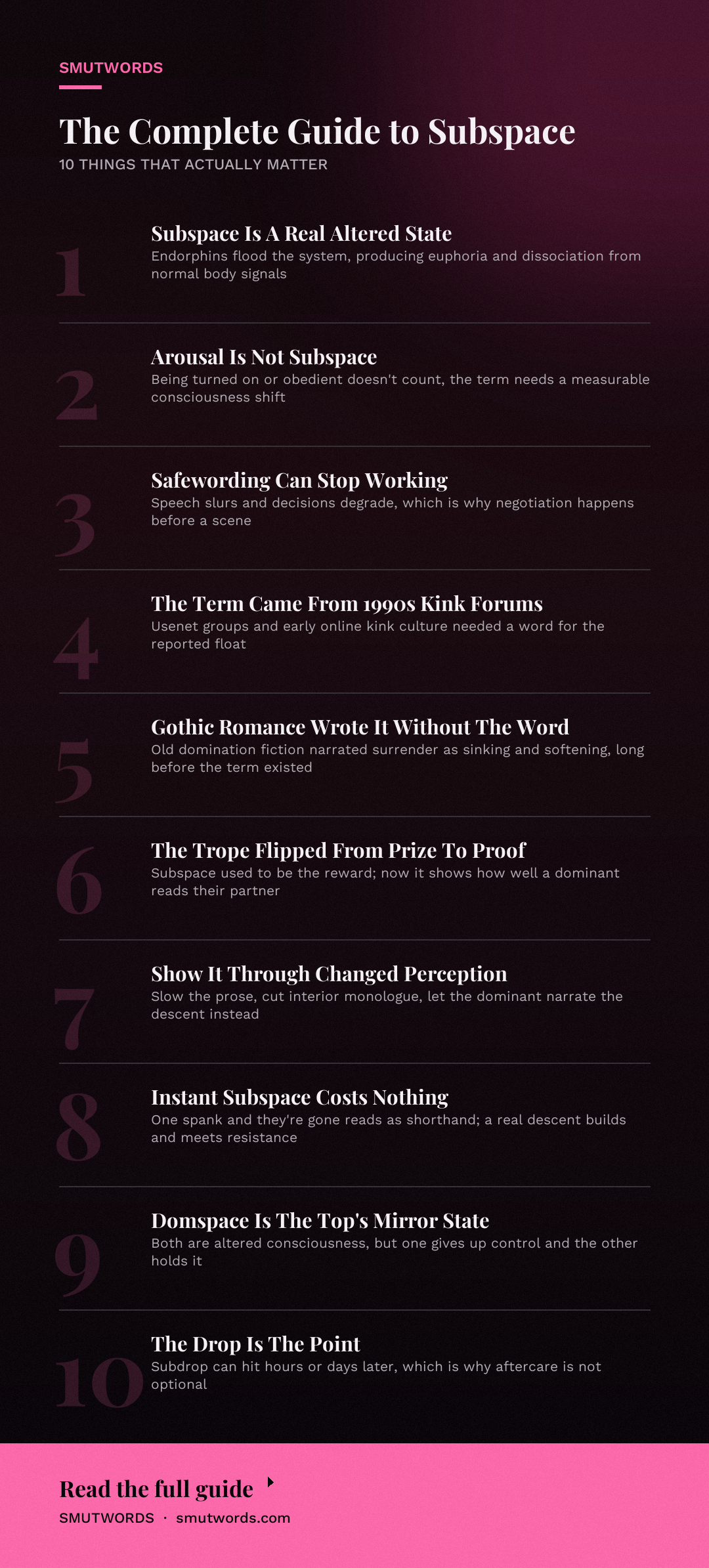
Subspace is a genuine altered state of consciousness reported by people who bottom in intense BDSM scenes. It is not a metaphor for "feeling submissive." It is closer to a runner's high crossed with deep meditation: endorphins and other neurochemicals flood the system in response to sustained pain, pressure, or intense sensation, and the result is euphoria, dissociation from the body's usual signals, reduced verbal capacity, and a profound sense of safety and focus.
People describe it as floating, sinking, going underwater, or being wrapped in warm weight. Some go quiet. Some go giggly. Some cry without distress.
Speech can slur, coordination drops, and the ability to make decisions or safeword normally can degrade. That is exactly why negotiation happens before a scene, not during one.
What counts as subspace and what does not is worth drawing clearly, because the term gets stretched until it means nothing:
- It counts when there is a measurable shift in consciousness: altered speech, time distortion, emotional flooding, or a floating sensation tied to the scene itself.
- It counts when the state is reached through sustained sensation or submission, whether that is impact play, restraint, humiliation, or prolonged obedience.
- It does not count as subspace when a character is simply aroused, obedient, or turned on. Arousal is not the same state, though the two travel together.
- It does not count when it is used as a tidy plot device to skip a character's interiority. Floating away is not characterization.
The most common misconception is that subspace is passive bliss. It actually involves surrender the submissive is actively choosing, and it can turn frightening if the dominant does not notice a drop or a distress signal. The scene's success depends on the top reading the bottom's state accurately, which is why the practice pairs so tightly with risk-aware frameworks like RACK.
Where Subspace Comes From
The word "subspace" as a fandom and community term emerged from the real-world BDSM scene and its overlapping online cultures in the 1990s, when Usenet groups and early kink forums started swapping accounts of what submission did to the mind. Practitioners needed a word for the reported float, and the community gave them one. Headspace followed as the umbrella term, with variants like pet space, little space, and trance branching off depending on the role and flavor of the dynamic.
Its migration into published erotica is more interesting than a simple timeline. Historically, the sensation of submission in romance was narrated emotionally rather than neurologically. Gothic romance and the older domination fiction traditions wrote surrender as feeling and metaphor: the heroine sinking, softening, losing herself to a commanding figure.
Those scenes were describing subspace before anyone had the term, and the vocabulary was romantic rather than clinical. If you want the deep roots of that earlier tradition, the history in our piece on Gothic romance shows how far back the "sinking into someone else's will" imagery goes.
Later erotica and fan fiction culture made subspace explicit. Fandom, especially in the 2000s and 2010s, developed an elaborate shared vocabulary for kink headspaces, complete with trigger warnings and aftercare tags. That vocabulary leaked back into original fiction, and now readers expect a scene to actually name what is happening to the submissive's consciousness.
The biggest shift in how subspace is portrayed: it used to be an endpoint, a reward the scene built toward. Now it is often a diagnostic tool. Contemporary authors use it to reveal how well (or badly) a dominant reads their partner, and a submissive who never drops into subspace during a scene becomes a signal that something is off in the dynamic. The trope has flipped from prize to proof.
How It Shows Up in Erotica
On the page, subspace is a craft problem before it is a kink. A writer has to translate a nonverbal state into language without turning the character into a puddle of adjectives. The strongest scenes handle it through altered perception and altered detail, not through the phrase "she drifted into subspace."
Skillful authors tend to do a few things well. They slow the prose down. They remove interior monologue. They make sensory detail strange and selective, so the sub sees one thing in sharp relief and the rest blurs.
Dialogue breaks down into one-word answers or nothing at all. The dominant narrates the descent instead, which is also how the top tracks the bottom's state.
Common variations authors reach for:
- The verbal descent: the sub's speech degrades from sentences to single words to a nod, and the dominant catches it in real time.
- The physical marker: limbs growing heavy, the body going limp in the ropes, tears without sadness. This is where accurate rope safety awareness matters, since a sub who has gone non-verbal may not report numbness or tingling.
- The time skip: the character realizes the scene had no clock, that an hour disappeared into a stretch that felt like minutes.
- The abrupt surfacing: the dominant's voice pulls them up, and the return is disorienting, the room too bright and too close.
- The counterpart at the top: a mirroring state in the dominant, which is its own distinct thing (domspace), and pairing both on the page lets a writer show two altered minds in one room.
- The drop: what happens after. A scene that hits subspace but skips the come-down is leaving its best material on the floor.
The most common flat version of subspace is the instant one: a single spank, a single command, and the character is gone. That reads as fantasy shorthand and it strips the scene of tension, because if the state arrives free, it costs nothing.
Enjoyed this? Get a free book.
Join the list and we will send a complete free story straight to your inbox, plus new releases every week after that. No credit card, no catch.
A strong version builds. The writer shows the sub fighting the drop into it, or resisting a little, so that surrendering has a price.
Strong subspace scenes are also specific to the character. A controlled character whose thoughts go quiet is one kind of writing. A chatterbox going silent is another.
A character whose usual defenses are a sharp tongue, losing that tongue entirely, is a third. The state reveals something about who they are. Weak scenes use subspace to erase the character; good ones use it to expose them.
The erotic charge lives in the trust transaction. Subspace means the sub has handed their monitoring of their own body and safety to another person. That is the hot part, and it is also where the writing has to stay honest about risk. A scene where a top ignores a distress signal is not a fantasy of devotion; it is a fantasy of danger, and it should be written as one.
For variations on how a scene itself is structured around this state, including the negotiation and the shape of play, see Scene Play. Subspace is usually the peak of that arc, or the aftermath of it. For a close look at how a scene gets stretched out before that peak arrives, our breakdown of edging covers the mechanics.
Subspace vs Domspace
These two get used interchangeably and they are genuinely different states, so it is worth separating them the way a reader would search for it.
Subspace is a bottoming state reached through surrender, pressure, and sensory overload. Domspace is the top's version: a flow state, a heightened focus and near-euphoria that comes from command, control, and responsibility. Both involve altered consciousness. Both come with drop afterward.
But subspace is characterized by giving up control and domspace by holding it, and the emotional flavor differs, which is why authors write them differently. A submissive in subspace is often quiet and receptive. A dominant in domspace is often almost predatory in their focus, watching everything.
Writing them together is one of the most effective tools in a kink scene, because you get two people operating in altered states in the same room, each one monitoring and being monitored by the other. The tension of a scene lives right there. For the top's side in more depth, see Domspace.
Frequently Asked Questions
What does subspace feel like?
People describe it as floating or sinking, weightlessness, warmth, and a quieting of the everyday thought stream. Speech can slow or stop, time can distort, and pain or pressure can stop reading as pain and start reading as intense sensation. It is euphoric for most people, but can tip into disorientation or distress if a scene runs long.
Is subspace dangerous?
The state itself is not dangerous when a scene is properly negotiated and supervised, but it carries real risk because the sub may not communicate or safeword normally once they are deep in it. The dominant has to watch for physical distress and have a plan, and anyone playing this way in real life should research risk-aware frameworks like RACK before a scene, not after.
What is subdrop and how long does it last?
Subdrop is the low that follows subspace, caused by hormonal levels crashing back down, and it can hit hours or even a day or two after a scene ends. Symptoms include tearfulness, exhaustion, anxiety, and a hollow feeling. It is normal, it is real, and it is the reason aftercare is not optional in this dynamic.
Can you enter subspace without pain?
Yes. Impact and pain are common routes, but restraint, obedience, humiliation, sensory play, and even long stretches of service can produce a subspace state. Anything that combines trust, sustained focus, and surrender can get a submissive there, which is why so many different kinks end in the same float.
How does a dominant know their submissive is in subspace?
Watch for speech changes, slack or heavy limbs, a glassy gaze, slowed responses, and a shift from active participation to passive receptivity. A good top checks in verbally and watches for physical warning signs like numbness, breathing changes, or distress. The dominant should also expect and plan for the drop after.
Is subspace only a kink thing, or does it happen in vanilla sex?
Deep altered states during sex can happen outside formal BDSM, especially with intense trust and prolonged arousal, but subspace as communities use the term is specifically tied to kink dynamics and the structure of negotiated scenes. In a mixed relationship with one kink partner and one vanilla partner, this is one of the areas where expectations genuinely differ, and it is covered in our guide to the vanilla/kink mix relationship.
Final Thoughts
Subspace is where a kink scene earns its emotional weight: the point where surrender becomes something the body feels, not just something the character agrees to. Write it slowly. Let it cost something. Honor the come-down, and the reader will feel the drop in their own chest.
If you want to watch it done right, find a book that treats aftercare as the emotional climax rather than the epilogue, and study how a long, careful descent lands on the page.








Loading comments…