
BDSM is the umbrella term for consensual power exchange, bondage, discipline, dominance, submission, sadism, and masochism, shaping both the physical acts and the psychological roles inside a scene or a relationship. In erotica, it's the genre's most reliable pressure cooker: two people agree on who holds the power, and everything that follows runs on that agreement.
When readers search for bdsm marking, they're usually chasing one specific payoff inside that umbrella. The visible evidence of what happened. This guide covers the whole structure around it.
What BDSM Actually Means
The letters compress three older pairings: bondage and discipline (B/D), dominance and submission (D/s), and sadism and masochism (S/M). Some writers use "BDSM" as shorthand for the whole culture around those practices; others use it strictly as a label for the activities themselves. Both readings are common and neither is wrong.
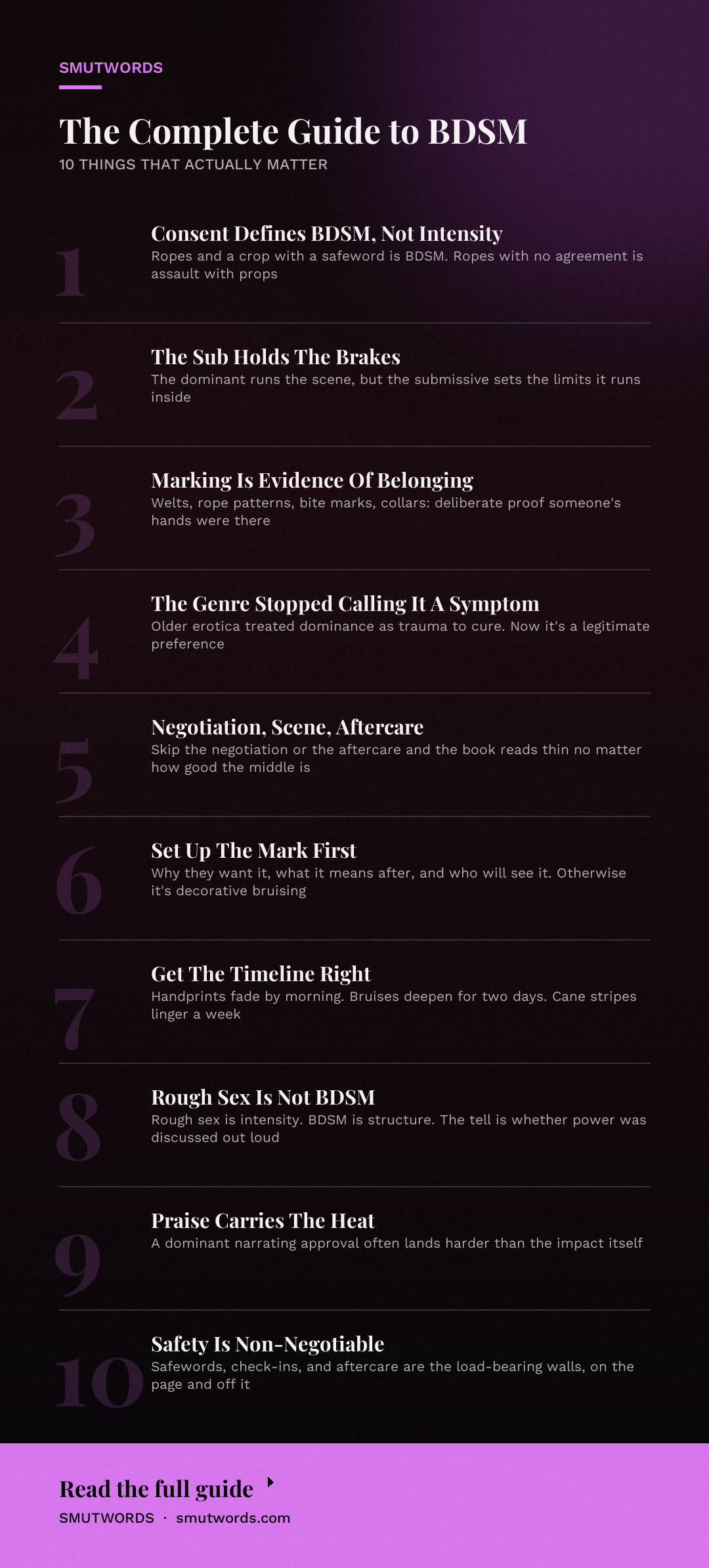
What does not count is the important part. BDSM in fiction and in real life is defined by consent, not by intensity. A scene with ropes, a riding crop, and a safeword is BDSM. A scene with ropes and no agreement is assault with props.
The distinction is not a technicality. In the best-written erotica it's the engine of the whole story.
Two common misconceptions are worth clearing up. First, that BDSM is always about pain. Plenty of dynamics involve no pain at all: service, protocol, restraint, denial, and psychological control carry entire books on their own.
Second, that the dominant is the one in charge. The dominant runs the scene; the submissive sets the limits the scene runs inside. Most experienced writers know the sub holds the brakes, and the tension of that arrangement is where the good stuff lives.
"Marking" deserves its own note here, since it's the phrase that brings a lot of readers to this page. In BDSM contexts, marking means the deliberate leaving of visible or felt evidence: welts, rope patterns, bite marks, bruises, collars, cuffs, or a red handprint that fades by morning. It can be physical or symbolic, temporary or semi-permanent, and it is almost always erotic evidence of belonging, of an event that happened, of someone's hands having been there.
Where BDSM Comes From
The practices are ancient; the acronym is not. "Sadism" and "masochism" entered medical vocabulary in the late nineteenth century, named for the Marquis de Sade and Leopold von Sacher-Masoch, whose writing made flagellation, submission, and cruelty into literary subjects. Krafft-Ebing and later Freud filed it all under pathology. That framing shaped a century of fiction in which BDSM appeared mainly as something a character needed curing of.
The acronym itself, and the culture around it, took shape in the mid-to-late twentieth century as organized communities formed in major cities and began publishing their own magazines, guides, and etiquette. The 1950s gave readers "Story of O," a French novel by Pauline Réage that remains the clearest early blueprint for erotic submission written from the inside rather than the clinic.
The 1970s and 80s brought leather community publications, the first broad safe-sex and negotiation literature, and a slow shift toward BDSM as a chosen practice rather than a diagnosis.
Romance publishing arrived late. For decades, kink appeared in genre fiction as a villain's hobby or a dark secret, and the "BDSM romance" shelf barely existed. The 2000s and 2010s changed that almost completely: a wave of mainstream bestsellers put contractual D/s dynamics in grocery-store paperback racks, fan fiction moved kink from subtext to text, and indie publishing proved there was a large paying audience for explicit, negotiated power exchange with a happy ending.
The biggest shift in the last fifteen years isn't volume, it's framing. Older erotica often treated dominance as a symptom of trauma that love would fix. Current BDSM fiction treats the dynamic as a legitimate preference, with safewords on the page, negotiation as foreplay, and aftercare as part of the arc. The genre got better at writing the administration of kink, and readers noticed.
How It Shows Up in Erotica
On the page, BDSM is a pacing machine. Negotiation gives you talking and tension. The scene delivers the physical payoff. Aftercare slows everything down and produces the emotional landing.
A book that skips the negotiation or the aftercare usually reads thin, no matter how good the middle is.
Here are the variations you see most often, and what each one is actually doing:
- D/s without pain. Protocol, orders, kneeling, waiting. The erotic charge is obedience and attention rather than sensation.
- Bondage-forward. Rope, cuffs, spreader bars, suspension. Shibari in particular has become a genre staple because the marks it leaves are visual and temporary, and the tying itself takes time on the page. See Shibari.
- S/M with heavy sensory play. Floggers, canes, clamps. Pain is reframed as intensity, and the sub's tolerance becomes a measure of devotion.
- Marking as the central kink. Bites, bruises, fingerprints, collars, a claim that outlasts the scene. The mark is the point of the scene, not a side effect.
- 24/7 and TPE. Total Power Exchange extends the dynamic past the bedroom into daily life. Harder to write well, because a permanent dynamic needs daily-life logistics.
- Feral or instinct-driven play. Less protocol, more growl, often paired with shifter and monster romance. See Feral Play.
- Vanilla/kink mix. One partner experienced, one brand new. The teaching arc doubles as the romance arc. See What Is Vanilla/Kink Mix Relationship? for how that dynamic plays out across a full book.
Marking scenes deserve special attention because they're where craft shows most clearly. A strong marking scene establishes three things before anyone touches anybody: why this character wants to be marked, what the mark will mean afterward, and who gets to see it. The bite on the shoulder is never just a bite when a rival, a spouse, or a mirror will encounter it later. Writers who skip that setup end up with decorative bruising.
The mechanics matter too. Good marking scenes specify sensation: the sting that dulls into heat, the itch of a welt under clothing the next day, the tenderness that flares when a collar presses on it. Specificity is what separates a scene a reader remembers from one they skim.
Contrast that with size-driven scenes, where the erotic charge is built from visual exaggeration instead. Both work, but they run on different fuel. See Monster Cock Kink and the size queen breakdown if that's the flavor you want.
Praise does a lot of heavy lifting inside D/s scenes. A dominant who narrates approval ("good girl," "you took that beautifully") converts obedience into reward, and the sub's reaction to that praise often carries more heat than the impact itself. It's one of the cheapest, most effective tools in the genre. See Praise Kink.
Enjoyed this? Get a free book.
Join the list and we will send a complete free story straight to your inbox, plus new releases every week after that. No credit card, no catch.
Physical realism is where a lot of published BDSM goes soft. Rope leaves marks that last hours, not days. Bruises deepen for two days and fade over a week. A handprint on an ass is gone by morning; a cane stripe lingers visibly for a week or more.
Writers who get the timeline right earn a reader's trust, and trust is the currency of this entire genre. The higher the stakes a book claims, the more it needs the physical details to hold up.
Emotional realism is the other coin. The best BDSM fiction never lets the sub's vulnerability sit unaddressed. There is a moment after the scene, sometimes a single line, where someone checks in.
That check-in is not filler. It's the thing that lets a reader sink into the fantasy of being taken apart, knowing the story will put them back together.
If you want to see how much territory the genre covers, notice how often BDSM appears as a layer inside a non-BDSM premise. Gothic romance uses dominance and restraint as atmosphere. Pheromone-bond books use instinct as a stand-in for negotiated surrender.
Revenge and breakup stories use rough control as emotional shorthand. The kink travels, and it changes shape depending on the subgenre carrying it. See Gothic Romance and the revenge sex vs breakup sex comparison for two very different examples.
Group dynamics are their own subgenre: scenes where a sub is passed between partners, usually with an explicit pre-negotiated agreement about positions, order, and marks. These scenes live or die on choreography. When the negotiation is on the page, the heat is higher because the reader knows the rules. See Orgy and Swinging for where those overlap.
Real-world safety is non-negotiable and worth stating plainly, even in a fantasy-first article. Safewords, check-ins, and aftercare are the load-bearing walls of every real dynamic. Fiction can dramatize what happens when they're ignored, but a story that treats them as unnecessary is teaching readers the wrong lesson, and it usually reads as lazy besides.
BDSM vs Rough Sex
These two get confused constantly, and the difference changes how a scene reads. Rough sex is about intensity: fast, hard, physical, often spontaneous. BDSM is about structure: negotiated roles, agreed limits, and a dynamic that exists before, during, and after the fucking.
You can have rough sex with no BDSM at all, and you can have an extremely formal BDSM scene with almost no roughness in it. The tell is whether power was discussed. Two characters who fall into bed and get wild are in rough-sex territory; see Rough Sex. Two characters who agreed, in words, on the page, who would hold the power this time, are in BDSM.
In practice, the two overlap plenty, and the best BDSM erotica borrows rough sex's physicality while keeping the structure. The mistake is calling a scene BDSM because it's intense, or calling it rough sex because it happened fast. The label matters less than whether the book knows which one it's writing.
Frequently Asked Questions
What is marking in BDSM?
Marking is the deliberate leaving of physical or symbolic evidence on a partner: bites, bruises, welts, rope impressions, collars, or cuffs. It signals ownership, belonging, or the memory of a specific scene. In erotica it's often the emotional center of a scene rather than a side detail.
Are BDSM and rough sex the same thing?
No. Rough sex is about physical intensity; BDSM is about negotiated power roles and limits. A scene can be one without the other. The clearest difference on the page is whether the characters discuss who's in charge before anything happens.
What is a safeword and do I need one in a story?
A safeword is a pre-agreed signal that stops a scene immediately. In fiction, its presence tells the reader the dynamic is consensual and safe, which lets them relax into the fantasy. Many authors also use a "slow down" signal alongside the hard stop.
Why do readers like BDSM erotica so much?
Because it makes control and trust explicit. The stakes are high (someone is surrendering power), the negotiation is intimate, and the payoff is a structured release you don't get in real life. Readers get the thrill of danger with the guarantee of safety.
What does TPE mean in BDSM romance?
Total Power Exchange, sometimes written 24/7, means the dynamic extends outside the bedroom into everyday life. It's harder to write well because it requires daily-life logistics, not just scene mechanics. When done right, it produces some of the genre's most intense long-arc books.
What is aftercare and why does it matter in erotica?
Aftercare is what happens after a scene: checking in, physical comfort, food, water, reassurance. In fiction it's the emotional landing that lets a reader process the intensity. A book that skips aftercare often feels incomplete, even when the scene itself was strong.
Final Thoughts
BDSM erotica works when the negotiation is as hot as the act, and the marks, whether they're rope lines or bite bruises or a collar, are never just decoration. They're the receipt of a promise someone kept. Find a book that takes that seriously, and notice how much harder the scene hits when you know exactly what rules are being followed, and exactly who agreed to them.







Loading comments…