
A single dad romance is a love story built around a hero who is already raising children on his own when the heroine arrives. He's widowed, divorced, never married, or otherwise solo parenting, and the kids are not background set dressing. They shape the schedule, the stakes, and the emotional weather of the whole book.
The romance turns on how this man, who has already organized his life around caretaking, makes room for a woman in it. And how she finds her place in a family that was functioning fine before she showed up.
That's the plain version. The rest of this guide is for readers who want the machinery: where the trope came from, how it works on the page, what separates a great single dad romance from a forgettable one, and the questions people actually ask when they search for it at eleven at night.
What Single Dad Romance Actually Means
The label describes a hero's parental status, but the trope is really about a specific emotional structure. The man is competent. He has a system: the school run, the custody calendar, the babysitter he trusts, the meal he can make one-handed while holding a toddler.
Then the heroine disrupts the system, and the book watches him decide whether the disruption is worth it.
What counts: any romance where the hero is raising at least one child primarily on his own and that child materially affects the plot. The child can be a baby, a teenager, or a grown adult still living at home. The hero can be a billionaire, a rancher, a small-town mechanic, or a hockey player. The heroine can be the nanny, the neighbor, his employee, his ex's sister, or a stranger who rear-ends his car in the school parking lot.
What doesn't count, or counts only loosely: a hero who has a child he sees every other weekend and the kid never appears on the page. A hero whose ex-wife does all the parenting. A book where the child exists only to deliver one cute line in chapter three and then vanishes.
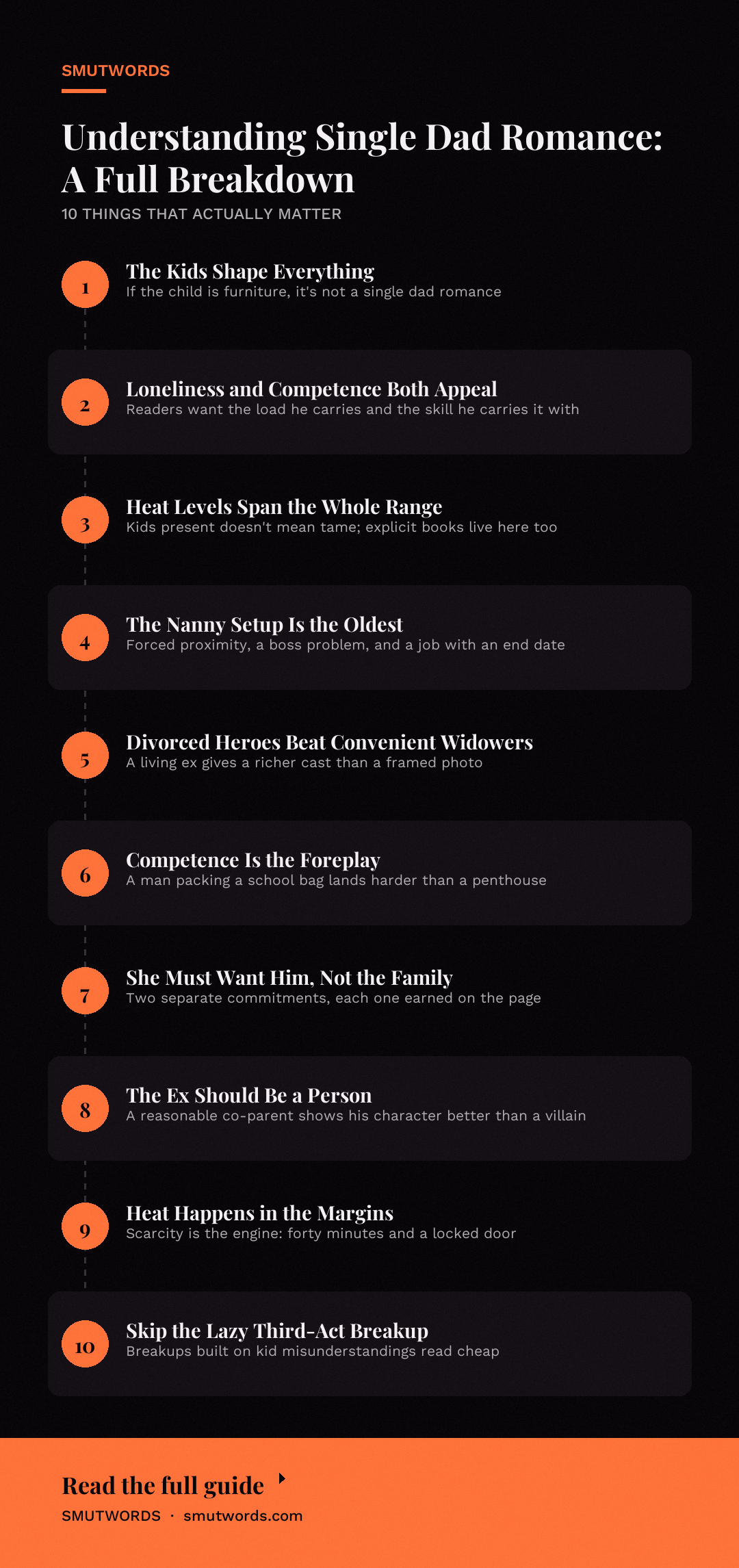
Readers of this trope are ruthless about this distinction. If the kids are furniture, it's a romance with a father in it, not a single dad romance.
The word "single" does work here that people sometimes miss. It signals that the hero is carrying the load alone, or close to it. A divorced dad with 50/50 custody still qualifies, because half the time he is the only adult in the house and the whole apparatus of his life bends around that.
The loneliness of the single parent is part of the appeal. So is the competence.
Common misconceptions, since we're being thorough:
- It's a sweet/clean subgenre. No. Single dad romance spans heat levels from closed-door to explicit. The kids being present doesn't make the book tame. Plenty of these books have the hero putting the kids to bed and then doing something considerably less wholesome on the kitchen counter.
- The heroine is always a surrogate mother. Sometimes she is, and the book is honest about that. Just as often she's a woman with her own life who refuses to be absorbed into his, and the tension is about whether he can meet her halfway instead of expecting her to slot into the family he already built.
- The dead wife is a villain or a saint. The good ones refuse both. A late wife who was complicated, or a divorce that was mutual and sad, gives the hero a past worth having. A cartoon villain ex makes him a victim instead of an adult.
- It's the same as single mom romance. The mirror trope exists and sells well, but the emotional beats differ because the cultural scripts differ. A single mother hero is often written as guarded and overextended. A single father hero is often written as unexpectedly tender. Both are fantasies. Just different ones.
Where Single Dad Romance Comes From
The single father has been a sentimental figure in popular fiction for a long time. Mid-century Hollywood loved him: the widower raising children who needs a woman to soften the household, a plot that ran through everything from Westerns to sitcoms. The widower-with-children setup was a reliable way to give a male lead vulnerability without making him weak, and a reliable way to give a female lead a job.
Category romance picked that up early. The 1980s and 1990s line romances used the widowed father constantly, often paired with a younger heroine hired to care for his kids. The nanny setup is genuinely old.
It gave authors a built-in reason for the two leads to be in the same house, a built-in source of conflict (he's her boss, she's too young, the kids are getting attached), and a built-in ticking clock, since the job ends when the kids are old enough or the summer is over.
The bigger shift came with the rise of indie publishing and the modern contemporary romance market in the 2010s. Two things changed at once. First, heat levels opened up, and the single dad stopped being a figure of gentle domesticity and started being a full romantic lead with an adult sex life happening around nap schedules.
Second, the divorce rate and blended families became normal enough that readers wanted heroes who were divorced rather than conveniently widowed. A divorced dad has an ex-wife who is alive, possibly difficult, possibly a friend, and that's a much richer cast than a dead wife and a framed photo.
The trope also migrated into small-town romance, sports romance, and romantic suspense, where it picked up different textures. The small-town version leans on community and the heroine being absorbed into a world. The sports version uses travel schedules and a public life the kids have to navigate. The suspense version uses the children as stakes in the most literal way.
Through all of it, the nanny variant has stayed the most durable. Search volume for single dad nanny books is enormous, and it's easy to see why: the job creates forced proximity, an unequal power dynamic that authors love to complicate, and a natural arc where the heroine goes from employee to family.
If you want to trace how a specific power imbalance gets handled across a whole genre, that's a useful thing to compare against other structured setups, the way a ghostwriter romance uses a professional secret to create the same kind of pressure.
How It Shows Up in Erotica
Here's where an editor's eye matters. The single dad romance is a structure, and like any structure it can be built well or badly. The good news is that the mechanics are visible once you know what to look for.
The child is a character, not a prop. The strongest versions give the kid a personality, a want, and a problem the adults have to solve. The child's routine is the book's clock. School pickup at 3:15 means the heroine's date has to fit around 3:15.
A sick kid means the hotel weekend gets canceled. The plot should be visibly constrained by parenting, because that constraint is what makes the eventual romance feel like a real choice rather than a convenient one.
The hero's competence is the foreplay. Readers of this trope respond to a man who can braid hair, pack a lunch, and remember which kid is allergic to strawberries. The erotic charge is often in watching him be good at caretaking, then watching that same focus turn on the heroine. A scene where he packs a school bag and then backs her against the fridge carries more weight than a scene where he simply backs her against the fridge.
Enjoyed this? Get a free book.
Join the list and we will send a complete free story straight to your inbox, plus new releases every week after that. No credit card, no catch.
The heroine has to want the man, not just the family. This is the failure mode that sinks otherwise decent books. If the heroine's real longing is for a ready-made family and the hero is a convenient vessel for it, the romance reads as a transaction.
The good versions make her ambivalent about the kids at first, or make her explicitly not a kid person. When she falls for the child, that's a choice. When she falls for the father, that's a different choice. Two separate commitments, both earned.
The ex is handled with adult realism. A living, reasonable ex-wife who co-parents well and wants her children happy is more interesting than a villain, and it forces the hero to show his character through cooperation rather than resentment.
The redemption arc of a hero who was a bad husband and is trying to be a good father is one of the richest versions of this trope. It shares DNA with the mechanics of a redemption arc romance, where the reader has to believe the change before they'll accept the happy ending.
Heat is often domestic. Single dad romance tends toward sex that happens in the margins of a parent's life: late at night in a quiet house, in the shower before the kids wake up, in the laundry room while a cartoon plays in the next room. The scarcity is the erotic engine. A man who has maybe forty minutes and a locked door is a different kind of lover than a billionaire with a penthouse and no curfew.
The variants authors actually use, in rough order of how often they show up:
- Single dad nanny. The heroine is hired to care for the kids. Forced proximity, employer-employee tension, the classic "we can't, I work for you" barrier.
- Single dad boss. The heroine works for him in a non-childcare capacity. The kids show up at the office, in the parking lot, on the company retreat, and the professional and personal keep colliding.
- Small-town single dad. The heroine is new in town, or returning, and the community and his family are inseparable. Slow burn, high domesticity, usually a town full of characters who comment on everything.
- Single dad sports star. A public hero, a private fatherhood. Media attention on the kids raises the stakes of any new relationship.
- Widower romance. The hero has lost his wife and is grieving. This version trades the ex-wife drama for survivor's guilt and often a slow thawing that readers find devastating in the best way.
- Accidental pregnancy with a single dad. The heroine becomes pregnant by a man who's already a father, or the pregnancy is what propels them together. It echoes the mechanics of secret baby plots, though the emotional questions are different since the fatherhood is already established.
- Guardian romance. He's not a father by biology but by obligation, raising a niece, a nephew, or a child of a fallen friend. The guardianship is recent or contested, which adds legal or family stakes.
- Single dad plus age gap, plus forbidden elements. His best friend's daughter, his late wife's much younger sister, the student's mother. These lean on taboo and social discomfort to raise the temperature.
What makes a flat version, since we're being honest: a hero who is described as a devoted father but whose children only appear to say something cute. A heroine who is immediately perfect with kids and is rewarded with a family. A third-act breakup that involves the child being endangered by the heroine's presence, which is lazy.
And the dreaded epilogue of "and she never wanted children of her own but now she has three," as though the only possible happy ending is to replace the missing mother entirely.
What makes a strong version. A hero with a life that's already full and a choice that costs him something. A heroine with her own stakes. Children who are specific and sometimes difficult. An ex who is a person. An ending that feels like an expansion, not a substitution.
If you like watching the domestic and the explicit interlock, the same skill applies in other tropes. The craft of writing a hero whose hands can't stay off the heroine even as he insists he's staying away is what the Angry Sex vs Makeup Sex breakdown covers.
There's also a lot to learn from how the neighbor romance guide treats proximity as the engine of a slow burn, which is exactly what a single dad next door can do.
Single Dad Romance vs Prince Romance
The comparison comes up because both tropes depend on the heroine being recruited into an existing structure that already has obligations, staff, and people who think they have a say in the hero's life. In a prince romance, that structure is the palace, the succession, and a family that's openly hostile or strategically friendly. In a single dad romance, it's the school district, the babysitter, the ex-wife, and a child who will absolutely tell you everything.
In a prince romance, the heroine is potentially upgrading her entire life by joining his. In a single dad romance, the heroine is often being asked to give up something: her freedom, her career, the fantasy of being the only person who matters to someone.
The palace demands she adapt. The single dad's house demands she adapt and then bake cupcakes. Both are worth reading. They press different buttons.
Frequently Asked Questions
Is single dad romance always about the nanny?
No. The nanny setup is one variant and by far the most common, but the heroine can also be a neighbor, a coworker, his employee, a family friend, a physical therapist, or the doctor who treats his child. The trope only requires that the hero is a single father and the children shape the story.
Are the kids usually in the spicy scenes?
No, and it would be a serious problem if they were. The children are always off-page or asleep during explicit content, and the good books make a point of showing that the adults have protected the kids from their relationship. The heat happens in the parts of the hero's life his children don't occupy.
What's the difference between a widower romance and a single dad romance?
A widower romance is a specific flavor of single dad romance where the hero's partner has died. It tends to center grief, survivor's guilt, and a slow emotional thaw. A single dad romance can also feature a divorced or never-married hero, which brings different complications like an involved ex or unresolved trust.
Do single dad romances always include a third-act breakup?
Many do, and it's the trope's weakest move when handled lazily. The best versions avoid the breakup or ground it in a real conflict about the children, like a custody threat or the heroine deciding she can't accept the limitations of his life. Breakups that hinge on a misunderstanding involving the kids tend to feel cheap.
Is there a single mom romance equivalent?
Yes, and it's a big genre. Single mom romance follows the same structure with a heroine who is raising children on her own, often with a guarded, overextended characterization. The audience overlap is large. Many readers choose based on whether they want the caretaker fantasy aimed at a man or a woman.
Why do readers love this trope so much?
Because a man being patient and competent with children reads as proof of character. Readers see the capacity for love, loyalty, and unglamorous daily work that a partner could trust. The eventual surrender to the heroine feels earned because he's already shown he can commit to something bigger than himself.
Final Thoughts
The single dad romance works because it makes love visible in ordinary labor. The hero isn't charming a woman at a gala. He's packing lunches and watching the clock and choosing, eventually, to make room for someone in a life he already built.
If you want one that gets all of that right, look for the books where the kids are specific, the heroine has her own spine, and the heat has a curfew. Start with a single dad nanny book from a writer who understands that a man putting a toddler to bed and then locking the bedroom door is a whole scene by itself.




Loading comments…