
Sports romance is a romance novel in which one or both leads work inside the machinery of competitive athletics: a player, a coach, an agent, a team doctor, a sports journalist. The sport shapes the plot, the schedule, the stakes, and the sex.
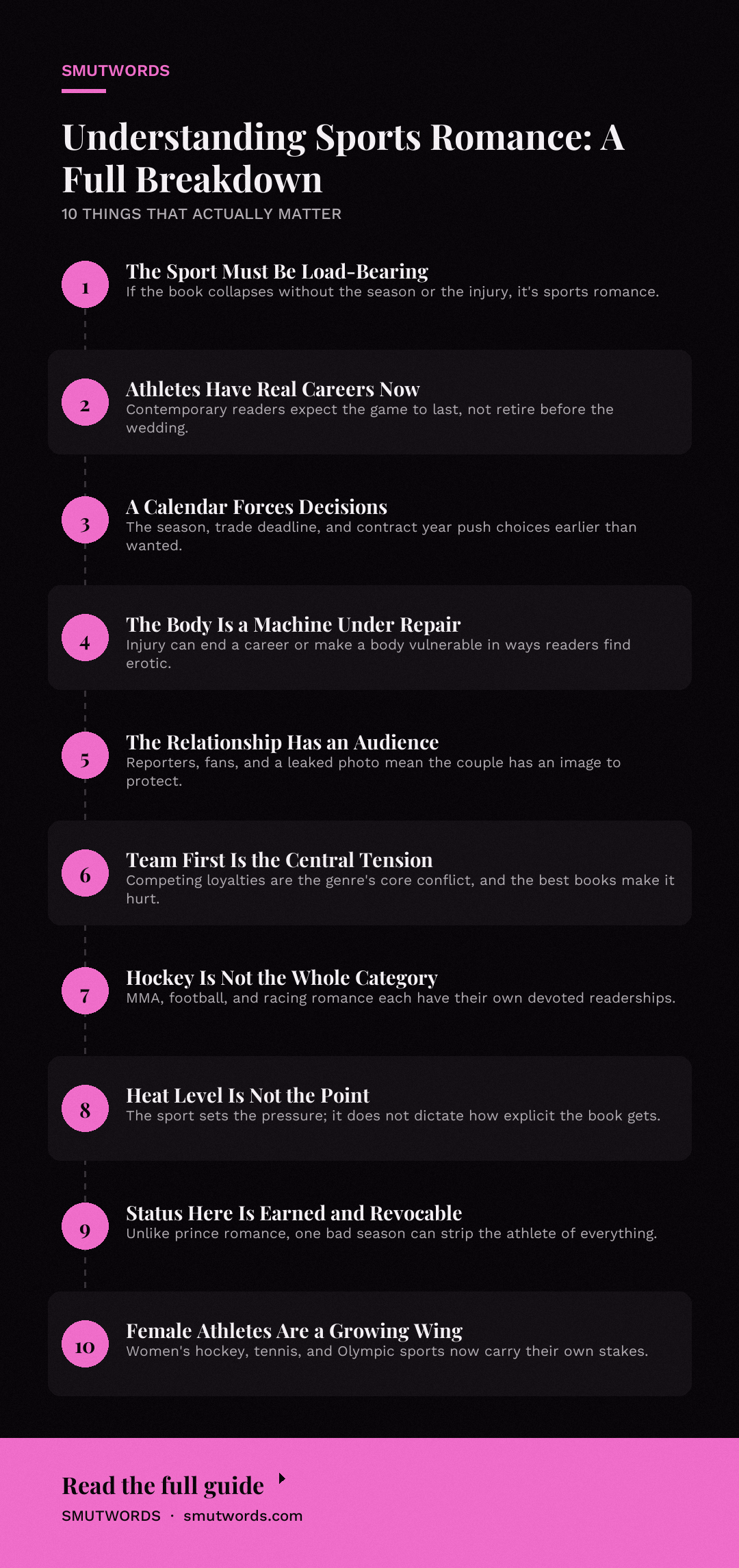
It does not sit in the background as a hobby the hero happens to enjoy. If the book would collapse without the season, the training montage, the locker-room politics, or the injury that ends a career, you are reading sports romance.
It is one of the fastest-growing categories in contemporary romance, and for good reason. It comes preloaded with rivalry, discipline, public scrutiny, and bodies that are paid to stay in condition.
What Sports Romance Actually Means
The name is literal. It describes a subgenre defined by its setting and its protagonist's profession, the same way soldier romance is defined by military service and prince/princess romance is defined by royal power. The sport supplies the structure: a finite season, a draft, a playoff run, a contract year. That clock is what makes the category tick.
What counts: a heroine who is the team's physiotherapist, a quarterback in a fake relationship with his coach's daughter, an MMA fighter afraid of losing his license, a figure skater paired with a rival for a comeback season. The athlete can be the lead of any gender. The sport can be hockey, football, soccer, baseball, basketball, racing, boxing, gymnastics, tennis, or curling, though the market is dominated by a handful of American and Canadian favorites.
What does not count: a book where the hero played college football a decade ago and it never comes up again. A single scene on a treadmill does not make a sports romance. The sport has to be load-bearing. If you could swap it for a career in finance and lose nothing but a few set pieces, the book is a workplace romance wearing a jersey.
Common Misconceptions
The biggest one is that sports romance is a synonym for hockey romance. Hockey is currently the category's loudest and most commercially dominant wing, largely thanks to TikTok and its appetite for large men on skates who are secretly tender. But MMA romance, football romance, and racing romance each have devoted, distinct readerships and different conventions.
The second misconception: that "sports romance" means the sex is about athletic endurance. Plenty of these books lean on stamina, physique, and locker-room heat. Just as many are slow-burn and emotionally focused, especially the coach and single-parent variants.
The sport sets the pressure. It does not dictate the heat level.
The third: that you have to know the sport. You do not. The best sports romance explains exactly as much of the game as the love story needs and lets the emotional stakes carry readers who could not name a single player on a roster.
Where Sports Romance Comes From
Sports fiction has a long history, but sports romance as a recognizable publishing category is a child of the 1980s and 1990s. Early category romances used athletes as heroes, then treated the athletic career as a temporary phase the hero had to outgrow before he could marry. The sport was a plot obstacle to be retired, like a motorcycle or an ex.
The real shift came in the 2000s and 2010s, when contemporary romance authors started writing athletes as someone with a real, ongoing career. Susan Elizabeth Phillips's 1990s Chicago Stars series is a landmark here: it put professional football at the center of the story and made the team owners, coaches, and staff part of the romance. That model proved the genre's core idea, that a football franchise could function as a whole social world the way a small town does.
By the 2010s, indie authors were flooding the category, especially hockey romance, helped by the fact that so many readers follow real sports. Self-publishing pushed series billing, tropes baked into book titles, and a season-by-season franchise structure that traditional publishing rarely matched. The category's enormous TikTok presence since 2020 has turned hockey romance in particular into a mainstream bookstore category rather than an online niche.
Its history matters for one reason. If you write or read the older kind of sports romance, you may notice the sport treated as a passing phase for the hero. Contemporary readers expect the game to last. It is the difference between a story about a former athlete and one about an athlete who is still playing.
How It Shows Up in Erotica
On the page, sports romance uses the sport to generate pressure, proximity, and public stakes. The most reliable engines are:
- Built-in proximity. Road trips, shared hotel floors, locker rooms, training camps, and years-long team investment put the leads in each other's orbit with an excuse that does not feel contrived.
- A ticking clock. The season, the playoffs, the trade deadline, the contract year. Every sports romance has a calendar that forces decisions earlier than the characters would like.
- Physical stakes. An injury can end a career or make a body vulnerable in ways readers find deeply erotic. The athlete's body is a machine under repair.
- Public scrutiny. Reporters, fans, a camera in the tunnel, a leaked photo. The relationship has an audience and an image to protect.
- Competing loyalties. The team comes first. That conflict is the genre's central tension, and the best books make it genuinely painful.
The craft question is how authors use those engines. A strong sports romance makes the sport mean something specific to the athlete: not "he loves hockey" but "hockey is the only place he has ever known who he is" or "hockey is the family legacy he never chose." That specific meaning creates the denial, the sacrifice, the moment in the final act where the two priorities collide.
The Sport as an Emotional Vocabulary
The strongest versions mine the sport's own language. Discipline, control, choking under pressure, playing hurt, the loneliness of the off-season, the fear of losing it all to one bad hit. These are all erotic and emotionally legible. A hockey romance can use a shifted training schedule to dramatize how a character only understands love as performance.
Weaker versions use the sport as set dressing: a few game scenes, a jersey, a line about the crowd. The sex scenes are good but generic. The sport disappears whenever the couple are alone in a room. That works for a romance; it leaves a hole in a sports romance.
Enjoyed this? Get a free book.
Join the list and we will send a complete free story straight to your inbox, plus new releases every week after that. No credit card, no catch.
Heat and Kink in Sports Romance
Plenty of sports romance is vanilla-adjacent, and that is fine. The genre naturally supports a light-dominance dynamic: the coach, the captain, the veteran, the trainer who knows the athlete's body better than anyone. If you are drawn to the power-exchange side of the category, the same instincts that make first restraints worth choosing carefully apply to how a sports romance handles control: name the specific authority, then make it mean something.
Athletic discipline is also a natural bridge to practice-focused eroticism. The same way a reader might follow a guide on vibrator training, a good sports romance can build arousal out of repetition, drills, and the slow conditioning of a body that responds better to instruction than to comfort.
Variants Worth Knowing
Sports romance has developed a family of recognizable subvariants. The main ones:
- Hockey romance. The current commercial giant. Cold-weather setting, team as found family, a heavy emphasis on loyalty and protective instincts.
- Football romance. Larger-than-life public figures, small-town or college settings, coach and owner archetypes, and the strongest tradition of franchise series.
- MMA romance. The hardest-edged of the family: cage fighting, trauma, and a male lead who is often more damaged than the heroine.
- Fake relationship with a rival. Usually a PR move or a publicity stunt that becomes real. The rivalry provides the friction and the public lie.
- Coach's daughter. An older subgenre staple, essentially a forbidden-love structure with the coach as both authority and potential in-law.
- Enemies to lovers on rival teams. Two athletes, usually in a sport with individual competition, who cannot be together without the world noticing.
- Single-parent athlete. The veteran with custody, the road schedule as the entire problem, and a heroine who is not impressed by the fame.
Over the last decade the most notable change is that more sports romance is being written from the female athlete's perspective. Women's hockey, professional tennis, and Olympic sports have become a whole wing of the category. The stakes shift, but the structural engines stay the same.
Sports Romance vs Prince/Princess Romance
These two are genuinely confused by readers who say they want "high-status hero, public scrutiny, duty pulling him away from love." That is a fair description of both. The difference is where the status comes from and what the conflict is about.
In prince/princess romance, the hero's status is inherited. The conflict is duty, lineage, and the institution of monarchy.
In sports romance, the status is earned and revocable. The athlete is one bad injury or one bad season away from losing everything that makes him impressive. That fragility is what makes sports romance feel more contingent and more desperate, and it is the whole reason the genre works.
The comparison to soldier romance is also worth making: both are defined by a profession that demands the body, both have a public-service or public-performance dimension, and both hinge on a schedule the characters do not control. Soldier romance has deployment; sports romance has the season.
Frequently Asked Questions
What is sports romance in simple terms?
It is a romance novel where the hero, heroine, or both work in and around competitive sport, and the sport drives the plot, the schedule, and the emotional stakes. The athlete's career is not a phase to outgrow. It is the engine of the story.
Is sports romance always spicy?
No. Heat levels vary from closed-door to explicit, and the sport is the defining feature, not the spice. The heaviest spice in the category tends to cluster around hockey, MMA, and coach/athlete dynamics.
Do I need to understand the sport to enjoy a sports romance?
No. Good sports romance explains only what the love story needs and keeps the focus on the couple. A hockey romance should make sense to a reader who has never watched a single game.
What is the difference between a sports romance and a hockey romance?
Hockey romance is a subcategory of sports romance, just as football romance and MMA romance are. Any hockey romance is a sports romance, but not every sports romance is a hockey romance.
Are sports romance novels realistic about athletic careers?
Some are researched and precise; others treat the sport as a backdrop. If accuracy matters to you, look for authors who clearly follow the sport, and expect those books to get the realities of injury, contracts, and public life exactly right.
What are the most common tropes in sports romance?
Enemies to lovers on rival teams, fake relationships, the coach's daughter, single-parent athletes, and forbidden coach/player dynamics. Hockey in particular leans hard on found-family and protective-veteran tropes.
Final Thoughts
Sports romance earns its readers because it makes desire and ambition fight for the same body. The best books in the category do not choose between the game and the romance. They make the game the language the couple can finally speak in.
If you are new to the category, start with a hockey romance set inside a full season. If you want one that earns its angst without ever leaving the ice, the ranked list of sports romance books on this page is the place to begin.





Loading comments…