
Tentacle creature romance is a romance or erotic fiction trope in which a human or humanoid protagonist becomes romantically and sexually involved with a being that has tentacles: an alien, a sea monster, an eldritch god, a lab-grown hybrid. The tentacles are not background decoration. They are the point, the main instrument of intimacy, and usually the reason the book exists.
If you have ever finished a monster romance and thought the hands were the least interesting part of the anatomy, this is the subgenre built for you. It overlaps heavily with alien abduction romance and with the broader monster romance shelf, but it has its own conventions, its own reader expectations, and its own internal logic for why the tentacles matter.
What Tentacle Creature Romance Actually Means
The name is literal. A tentacle creature is any love interest whose body includes flexible, prehensile appendages, and the romance genre uses that anatomy as the engine of the erotic scenes. Octopus, squid, kraken, alien, deep-sea horror, interdimensional entity, bioengineered experiment.
The origin story varies. The function does not.
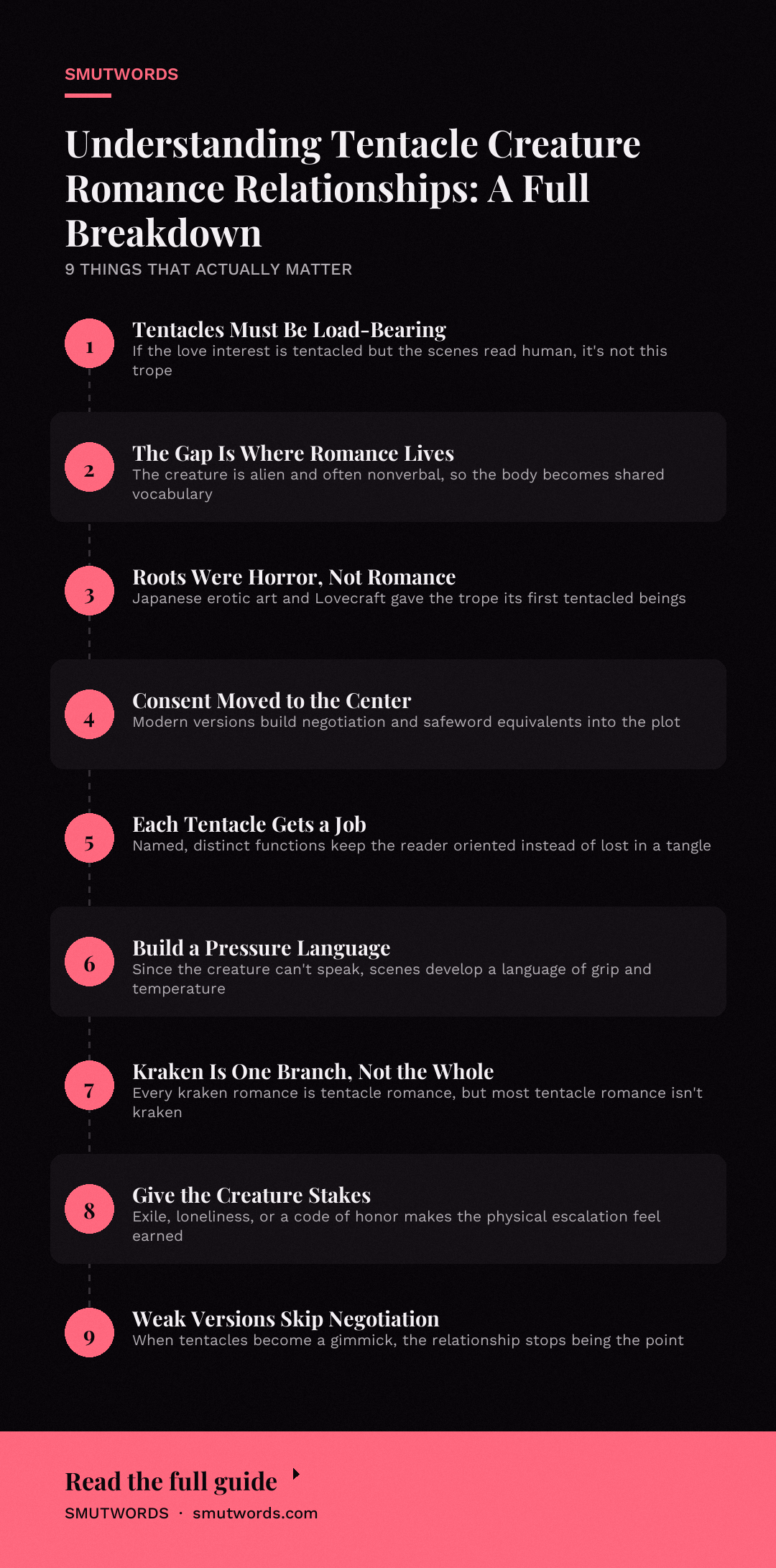
What counts: the tentacles do real work in the intimacy. They restrain, they penetrate, they caress, they grip, they multitask in ways two human hands cannot. A book where the love interest happens to be tentacled but the sex scenes read like any other human scene is not really a tentacle creature romance. The appendages have to be load-bearing.
What doesn't count: a brief mention of tentacles in a horror novel with no romance, or a fantasy where the creature is a villain with no arc toward intimacy. The trope lives in the overlap of romance and eroticism. Readers come for the romantic payoff and stay for the physical logistics.
A few misconceptions worth clearing up before anything else:
- It is not a single kink. It is a trope container that can hold almost any kink inside it, including breeding, restraint, size play, and power exchange.
- It is not always non-consensual. Plenty of tentacle creature romance is explicitly consensual and negotiated, sometimes even tender.
- It is not limited to aliens. Kraken and sea-monster variants are a huge slice of the category, and mythological and Lovecraftian versions are common too.
- It is not the same as general monster romance. A werewolf or vampire love interest with no tentacles belongs on a different shelf.
The trope also has a strong emotional register that gets overlooked when people reduce it to anatomy. The creature is usually deeply alien, often nonverbal or limited in speech, and frequently from a culture or species where human courtship makes no sense. That gap is where the romance actually lives. The tentacles are the physical vocabulary two beings use when they share no other one.
Where Tentacle Creature Romance Comes From
The visual and literary lineage runs through Japanese erotic art and anime, where tentacle imagery has been part of adult illustration for decades, and through Western weird fiction, where Lovecraft's Cthulhu mythos and similar eldritch horror gave English-language readers their first recognizable tentacled beings. Those roots are horror, not romance. The move from horror monster to romance love interest is the story of the trope's publishing history.
The shift happened in stages. Early tentacle erotica in translation leaned on abduction, capture, and non-consent, and the creature was usually a threat. Through the 2000s and 2010s, indie publishing and serialized online fiction started recasting the creature as a partner, not a predator. Authors writing for Kindle Unlimited and similar platforms found a hungry readership for monster love interests of every description, and tentacles were the obvious next step after shifters and vampires.
The real turning point was the mainstreaming of monster romance as a category. Once readers were openly buying books about a human woman falling for a seven-foot orc, an alien warlord, or a dinosaur shifter, the tentacle creature was no longer a niche curiosity. It was a logical extension of a category already built on "what if the love interest were profoundly not human."
Three shifts mark the current era for tentacle creature romance specifically:
- Consent moved to the center. Modern versions often build explicit negotiation into the plot, including safeword equivalents, check-ins, and a creature that reads the protagonist's cues.
- The creature got a personality. Early versions were mostly bodies. Contemporary versions give the tentacled love interest interiority, a species history, and usually a protective streak.
- Breeding and biology plots exploded. The alien breeding trope and its tentacle-flavored cousins turned the anatomy into a plot device, complete with eggs, brooding, and cross-species gestation.
Kraken romance deserves its own nod here because it is the most recognizable sub-branch. Kraken romance pulls from maritime folklore and turns a ship-sinking monster into a lonely, possessive love interest, and it is arguably the entry point for readers who come to the trope from fantasy rather than from erotic fiction.
How It Shows Up in Erotica
On the page, the trope is a logistical gift and a logistical problem. The gift is obvious: a partner with six or eight appendages can do things a two-handed human cannot, including simultaneous stimulation, full-body restraint, and grip that never has to choose between holding and touching. The problem is that a scene with too much happening at once reads like a checklist. The strongest tentacle creature romance scenes are choreographed, not catalogued.
What a good scene actually does, mechanically:
- Assigns each tentacle a role. One grips the wrists. One holds the hips. One moves between the legs. Named, distinct functions keep the reader oriented instead of lost in a tangle.
- Uses the creature's non-human perception. It senses heat, pulse, or breath instead of reading facial expressions, which changes how the scene builds.
- Paces the restraint. The best restraint is gradual. Tentacles that tighten slowly do more for tension than tentacles that snap shut in one sentence.
- Builds a communication system. Since the creature often can't speak fluently, the scene or the book develops a language of pressure, temperature, and grip that both partners learn to read.
- Delivers on the specific promise of the trope. A reader here wants the multi-point stimulation and the possessive entanglement. Giving them a standard two-handed scene with tentacles mentioned in passing breaks the contract.
Variations authors reach for most often:
- Alien tentacle romance. A spacefaring creature, often a stranded or exiled one, meets a human protagonist. The alien setting justifies the biology and lets the author build an entirely new species' mating customs.
- Kraken or deep-sea romance. Maritime setting, often a lonely creature, frequently a protective or territorial dynamic.
- Eldritch romance. Lovecraftian being of incomprehensible age and power, bonded to a human who can perceive it. Tends toward cosmic, worshipful, and body-horror-adjacent tones.
- Tentacle abduction erotica. The capture plot, where the protagonist is taken and the relationship develops inside confinement. This variant needs the most careful consent scaffolding to work for modern readers.
- Tentacle breeding kink. Reproduction becomes the plot: eggs, brooding, cross-species pregnancy, and a creature driven to provide and protect. This is where the trope brushes against the wider breeding kink audience.
- Hybrid or lab-created creature. A being engineered or mutated, which lets the author blend tentacles with other creature traits.
What separates a strong version of this trope from a flat one comes down to character work. A tentacled love interest with no interiority is a sex toy with a personality disorder. The books that hold up give the creature stakes: a species dying out, an exile, a loneliness that predates the protagonist, a code of honor that makes the physical escalation feel earned.
Size and scale matter too, and authors usually lean into it. A creature that dwarfs the protagonist creates a built-in power imbalance, which is exactly what makes the trust arc interesting. That dynamic shares DNA with size difference romance and with the possessive streak readers already know from the territorial shifter trope. The tentacle version just makes the imbalance physical in a more literal way.
Enjoyed this? Get a free book.
Join the list and we will send a complete free story straight to your inbox, plus new releases every week after that. No credit card, no catch.
Where weak versions go flat: the tentacles become a gimmick rather than a relationship. The creature has no wants beyond the protagonist. The scene relies on shock value instead of tension.
The plot also skips the negotiation and trust-building that make the extreme physicality land. Readers who love this trope have read a hundred versions of it and can tell the difference immediately.
One craft note for writers and one for readers. Writers: the creature's body is the setting for most of the intimacy, so treat it like a setting. Describe the texture, the temperature, the weight, the way it moves before it moves.
Readers: pay attention to how the author handles consent. The books that do it well, with explicit cues and a protagonist who has real agency, tend to be the ones that hold up on a second read.
Tentacle Creature Romance vs Kraken Romance
These two get conflated constantly, so it is worth separating them. Kraken romance is a specific sub-branch of tentacle creature romance, not a synonym for it. Every kraken romance is a tentacle creature romance. Most tentacle creature romances are not kraken romances.
The kraken version has fixed constraints: a sea or ocean setting, a creature drawn from maritime mythology, and usually a size and power gap that emphasizes the scale of the thing against a ship or a coastline. Tentacle creature romance as a whole has none of those constraints. It can happen in space, in a lab, in an interdimensional rift, or in a small town where the creature across the street is quietly not human.
The practical difference for a reader is tone. Kraken romance tends to lean into loneliness, isolation, and the romance of a monster that has been alone at the bottom of the sea for a very long time. The broader tentacle category borrows from that register but also includes comedy, horror, and science fiction.
If you want a specific mood, kraken is the more reliable search. If you just want tentacles, the wide category is the better bet.
Frequently Asked Questions
Is tentacle creature romance the same as monster romance?
No. Monster romance is the umbrella category covering love interests who are not human, including orcs, minotaurs, shifters, and demons. Tentacle creature romance is one slice of that umbrella, defined specifically by the appendages playing a central role in the intimacy. A monster romance with no tentacles is still monster romance but not this trope.
Can tentacle creature romance be consensual?
Yes, and in current publishing it usually is. The capture and non-consent variants exist, and they are a recognizable historical slice of the category, but most contemporary books build in negotiation, cues, or a safeword equivalent. Look at the content warnings if this matters to you; the good ones are specific.
What is tentacle breeding kink?
It is a variant where reproduction becomes part of the plot: eggs, brooding, gestation, or a creature driven to build a nest and provide. It overlaps with the wider breeding kink audience, and it usually comes with a heavy protective and domestic streak once the creature's mate is established.
Where do I start if I've never read one?
Start with something that names its consent rules clearly and has a plot outside the bedroom. Kraken romance is a common entry point because the maritime setting gives the story structure. Alien settings are the other common door, especially if you already read science fiction romance.
Do these books always involve non-human anatomy in detail?
Usually yes, and that is part of the appeal. The physical description is a core feature of the genre, not an optional layer. If detailed non-human anatomy in sex scenes is not for you, this is probably not your shelf.
Is there real-world guidance for people who want to roleplay this?
Yes. Keep it consensual, agree on safewords before anything starts, and negotiate specifics around penetration, restraint, and duration. If you are figuring out how to raise the interest with a partner, the same groundwork that applies to any kink applies here, and our guide on how to tell your partner about a kink covers the conversation itself.
Abstraction and props are your friends. No fantasy requires literal accuracy to be satisfying.
Final Thoughts
Tentacle creature romance works because it takes a monster and asks what happens when the monster is lonely, careful, and very good with its hands. The books that last in this category are not the ones with the most appendages on the page. They are the ones where a being that shares nothing with its partner still finds a way to be understood. If you want the strongest example of the trust-building version of the trope, start with a kraken romance and work outward from there. The shelf below has your next read.






Loading comments…