
A breeding kink is the erotic charge that comes from the fantasy of impregnation: the raw, possessive idea of filling someone up, marking them from the inside, and claiming them so completely that the result shows on their body. It doesn't require an actual pregnancy, and it doesn't require anyone involved to want a baby. It's about the language, the risk, the primal entitlement of the moment, and the way that moment reads on the page.
In romance and erotica, a breeding kink scene can be a whispered demand against someone's ear, a heat-cycle haze in omegaverse, or a soft, devastating confession between two people who've already decided they belong to each other.
What Breeding Kink Actually Means
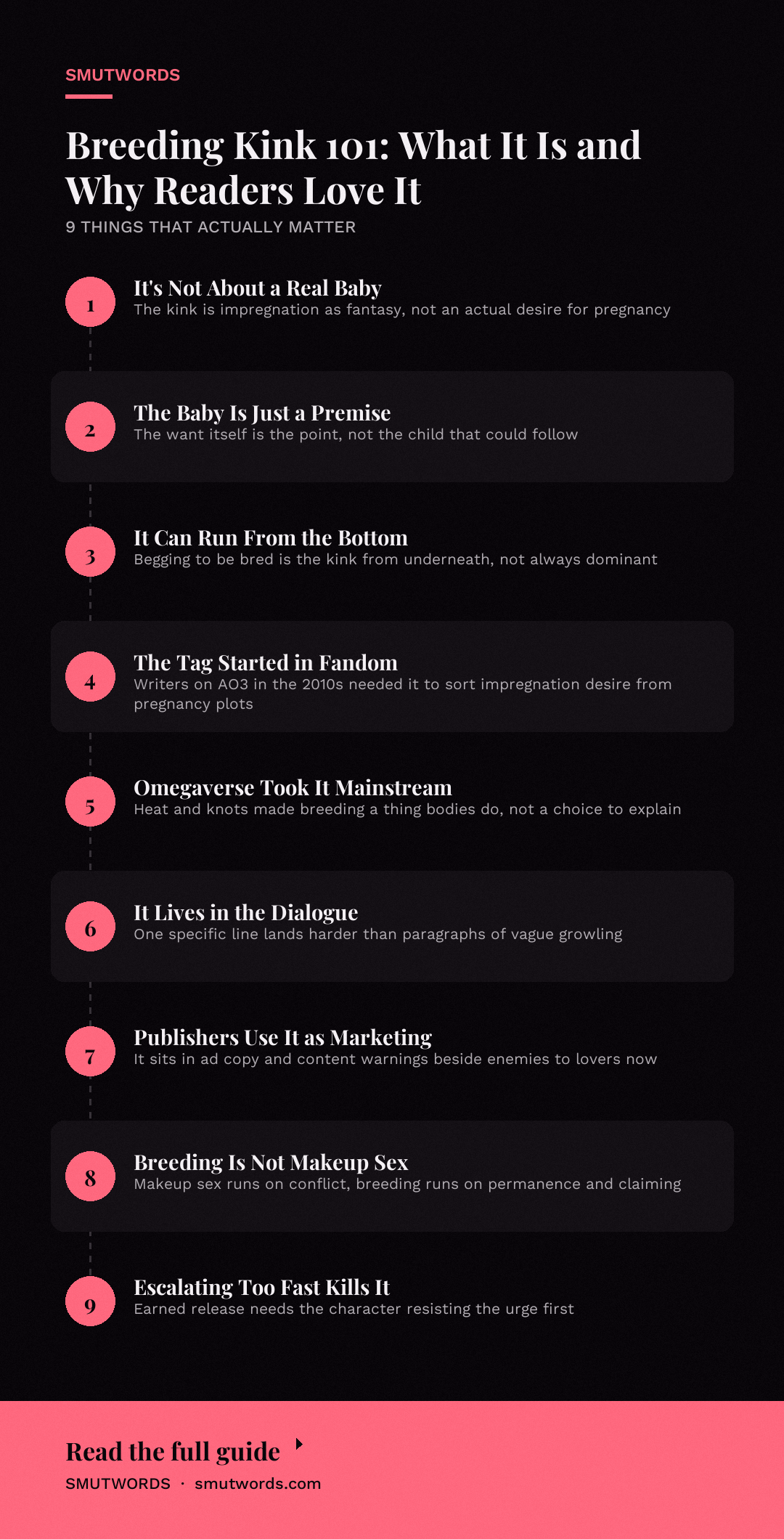
The name is blunt on purpose. "Breeding" is the term for what animals do when the goal is offspring, and the kink borrows that bluntness to strip the act down to its most animal logic: I want to put a child in you, or I want you to put one in me, and that want is the point. The kink isn't the baby. The baby is a premise the desire can hang on.
What counts as breeding kink is broader than the label suggests. Any fantasy where impregnation is the erotic core qualifies, including:
- Verbal breeding talk during sex, with no intention of acting on it
- Creampie emphasis, where the specific act of finishing inside becomes the focal image
- Pregnancy risk play, where the possibility of conception is the thrill
- Fertile window roleplay and ovulation tracking as a scene element
- Oviposition, the fantasy of egg-laying or being filled with eggs, usually in monster and alien romance
- Knotting in omegaverse and shifter stories, where the physical lock functions as permanent claiming
- Heat and rut cycles that make conception seem inevitable rather than chosen
What doesn't count: a book where a pregnancy happens at the end and nobody was particularly turned on by the mechanism. An accidental pregnancy plot can run entirely separate from breeding kink. The distinction is whether the impregnation itself carries erotic weight in the scene, not whether a baby eventually appears in the epilogue.
The most common misconception is that enjoying this means wanting a real baby. It doesn't. Plenty of readers who love breeding kink have no interest in pregnancy at all, and plenty of people who are surgically, permanently done having kids still find the fantasy hot.
The appeal sits in the symbolism and the intensity, which is why the subreddit is full of people sheepishly asking whether it's normal to get off on something they'd never want in real life. Yes. It's normal. Fantasies aren't applications.
A second misconception is that breeding kink is inherently dominant. It can run dominant, and often does, but it works just as well from the bottom. A character begging to be bred, or demanding it, or taking control of the moment by asking for it, is running the kink from underneath. The power doesn't have to flow one direction, and some of the best scenes make that ambiguity the whole point.
Where Breeding Kink Comes From
As a named term in online fandom spaces, breeding kink is relatively young. It shows up in fandom kink memes and Archive of Our Own tag systems starting in the 2010s, where writers needed a way to tag stories about impregnation desire separate from actual mpreg or pregnancy plots. The tag let readers find the specific flavor they wanted and filter around the flavors they didn't, which is exactly the kind of sorting infrastructure fanfiction built before publishing caught up.
As a narrative device in romance, though, it's much older than the label. The "my heir, my bloodline" thread runs through historical romance going back decades, where a duke's obsession with producing a son was frequently written as possessive and charged rather than administrative. Those books were doing breeding kink without calling it that, and the language is often identical: mine, my seed, carry my child, the line continues through you.
Paranormal and portal romances of the nineties and two-thousands pushed the theme harder into the erotic register. Shifter heroes with mating urges, vampire heroes fixated on lineage, alien heroes needing to propagate a dying species. The species-continuation angle gave authors a plot excuse for characters to obsess over conception without anyone having to sit down and have a conversation about feelings.
The biggest shift came with omegaverse, which took the concept and built a fictional biology around it. Heat cycles, slick, knots, and a body that announces its own fertility created a system where breeding isn't a choice the characters make so much as a thing their bodies do. That removed the need for explanation and let the kink run at full volume.
The omegaverse boom is the single clearest reason breeding kink crossed from niche tag into a mainstream romance expectation.
Dark romance then stripped out the biological excuse and left the raw possessiveness. In a lot of contemporary dark romance, there's no heat cycle and no dying species. There's just a man who has decided this woman belongs to him so completely that the deepest version of that claim is putting a child in her. That's the version most readers encounter today, and it's the one that made the tag explode far beyond science fiction and fantasy.
In publishing terms, the tag does heavy commercial work too. Publishers now put "breeding kink" and its cousins in ad copy and content warning lists because it signals a specific reader appetite, the same way "enemies to lovers" or "forced proximity" does. The term did what all useful kink terms eventually do: escaped fandom and became a marketing vocabulary word.
How It Shows Up in Erotica
On the page, breeding kink lives almost entirely in the dialogue and the internal monologue. The physical logistics are ordinary. What makes a scene work is what the character says and what they mean by it.
The strongest version usually gets one clear, devastating line. Something like "I'm going to fill you up" or "let me put a baby in you" or "you want me to claim you so it shows," delivered at the exact moment the character has stopped pretending to be reasonable. The line does the work of a whole chapter. Everything before it is buildup and everything after it is aftermath.
Common variations authors reach for:
- Verbal only. Nothing changes about the sex itself, but the dirty talk is entirely about breeding. This is the most common and the most flexible version because it never has to break the plot.
- Risk play. Characters acknowledge that conception is possible right now and choose to proceed anyway. The danger is the turn-on, whether or not the story ever mentions it again.
- Biological imperative. Heat, rut, mating season, or a dying species means the urge is outside anyone's control. This is where imprinting often does the heavy lifting, since a mystical bond justifies the obsession.
- Claiming through a third party. Arranged marriages and arranged marriage plots use breeding as the mechanism of ownership, where the whole point of the union is producing an heir and the protagonist's resistance or surrender is the arc.
- Aftermath-focused. The scene is less about the act than what happens after, the intimacy or horror of the two of them lying there knowing what might now be happening inside her.
What makes a weak version flat is usually the same problem across the board: the writer treats the kink as a plot device instead of a desire. If breeding only exists to produce a pregnancy that advances the story, the reader feels the machinery. If breeding is something a character wants, and the wanting is specific and dirty and a little shameful, the scene works even if nothing comes of it.
The possessiveness angle connects this to a whole family of adjacent kinks. The "mine" declaration that powers breeding talk is the same engine behind possessive sex, and the two are frequently the same scene. A character who wants to leave a physical mark on someone is often the same character who wants to leave a permanent one.
Breeding kink also crosses over with rougher register choices. The urgency and entitlement that make breeding talk land often come with the physical intensity of rough sex, where the same scene is doing multiple jobs: the hardness communicates dominance, and the breeding talk communicates permanence. When a scene is framed around a partner being used for a purpose, that's the same territory as use kink, and authors who handle breeding well often borrow that framing deliberately.
Enjoyed this? Get a free book.
Join the list and we will send a complete free story straight to your inbox, plus new releases every week after that. No credit card, no catch.
There's also a natural pairing with the language of approval and affirmation. A "good girl, take it, that's it" register is doing praise kink work while the breeding talk is doing its own, and the two stack well because both are about the partner being singled out as exactly the right one.
Getting the dirty talk to sound natural rather than ridiculous is its own craft problem, and it's covered in detail in how to talk dirty without feeling ridiculous. The short version that applies directly here: specificity beats volume. "I want to put a baby in you" lands harder than three paragraphs of vague growling, and the specificity is what makes the reader believe the character means it.
Where authors most often get it wrong is the same place they get every intense kink wrong: they escalate too fast. A breeding scene works when the character has spent some portion of the book resisting or denying the desire, and the moment it breaks out is a release of pressure. If the character is already talking like that on page ten, there's nowhere to go, and the reader feels it.
The second most common mistake is failing to decide what the breeding talk means for these specific characters. In a dark romance, it might be pure dominance and threat. In a warm contemporary, it might be the most romantic thing either of them has ever admitted.
In omegaverse, it might be an undeniable biological truth they're both surrendering to. The writer has to pick, because "breeding kink" read three different ways produces three different scenes and only one of them will fit the book.
Breeding Kink vs Makeup Sex
These two get compared mostly because both are high-intensity kinks that often appear at the emotional peak of a story, and both are frequently confused by readers who aren't sure what to call the scene they just read.
Makeup sex is about conflict and resolution. The sex is charged because there was a rupture, and the physical act is how the characters come back together. The heat comes from the fight, not from any specific fantasy about the body. You can have a makeup sex scene with no pregnancy talk whatsoever.
Breeding kink is about permanence and claiming. There doesn't need to be any conflict at all.
Two characters who are entirely happy with each other can have a breeding scene that's purely about how deeply they want to belong to each other, and the scene carries the same charge. The two overlap when a couple reconciles and the breeding talk comes out as part of the resolution, but the engines are different and mixing them up is why some scenes feel oddly motivated.
Frequently Asked Questions
Is a breeding kink the same as wanting a baby?
No. The fantasy is about the erotic charge of impregnation as an idea, not the practical reality of parenting. Many readers who love the kink are actively avoiding real pregnancy. The distinction matters because it's the single most common question people have about whether they're allowed to enjoy this.
Can you have a breeding kink scene without an actual pregnancy in the story?
Yes, and this is the most common version in published romance. The scene is about the language and the desire. Whether the character actually conceives is a separate plot decision that can go either way, and a lot of authors deliberately leave it open.
Where did the term "breeding kink" come from?
It emerged in online fandom tagging systems, particularly in fanfiction communities in the 2010s, as a way to tag impregnation desire separate from actual pregnancy plots. From there it migrated into romance publishing as a recognizable content tag and marketing signal.
What is knotting, and how does it relate to breeding kink?
Knotting is a fictional biology element common in omegaverse and shifter romance, where a physical lock occurs during sex. It functions as a permanent claiming mechanism, which is why it pairs so naturally with breeding kink. The physical lock and the reproductive symbolism are doing the same emotional job.
What is oviposition, and is it a breeding kink variant?
Oviposition is the fantasy of laying or being filled with eggs, most commonly in monster and alien romance. It's a breeding kink variant in the sense that it's about being filled with something that will grow, though it usually operates in a fully nonhuman biological register and is reserved for speculative fiction settings.
Is breeding kink always dominant?
No. The kink can run from the top or the bottom, and plenty of scenes feature a character begging to be bred rather than being told they will be. The power dynamic is flexible, and some of the strongest versions make the ambiguity between who's in control the whole point.
How do authors keep breeding talk from sounding corny?
Specificity and timing. One specific line delivered at a moment the character has spent the scene resisting the urge lands better than a wall of generic dirty talk. Earned escalation is the entire game.
What should you know about breeding kink in real life?
If you're playing with it, be explicit about whether conception is actually possible. Use agreed-upon birth control or barrier methods if pregnancy isn't the goal, and don't leave that to assumption. Intense possessiveness is a common part of this play, so have a safeword and a check-in for after, since the emotional intensity can run higher than the physical.
Final Thoughts
Breeding kink sits in that sweet spot where a primal, uncomplicated desire meets the most complicated thing humans do, which is decide to belong to each other permanently. It reads as dirty because it's honest about wanting that.
If you want to see the kink handled at full strength in a fantasy setting, with heat, claiming, and a bond that won't let go, start with a book that commits to the biology instead of apologizing for it. The omegaverse shelf is where this tag learned to breathe.






Loading comments…