Tentacle play is a fantasy kink where characters interact with tentacled beings or appendages, usually in a sexual context. It blends intense sensation with the thrill of the alien and the uncontrolled, and it's a genre staple of monster erotica. The theme shows up across fan fiction and illustrated works, prized for its ability to remove a scene from human limitations entirely. The appeal rests on complete surrender and the exploration of touch patterns no human partner could possibly replicate.
What Tentacle Play Actually Means
Tentacle play covers any erotic scenario where tentacles are the primary instrument of stimulation. These appendages can belong to a conscious alien, a summoned magical entity, a creature from the deep, or even a transformed human partner. The unifying feature is the tentacle itself: flexible, prehensile, and capable of movements, pressures, and simultaneous actions that human anatomy cannot match.
Tentacle play does not mean real-world practice with actual cephalopods. This is a fantasy kink, existing almost entirely in fiction, illustration, and animation. The creatures involved are fictional or fantastical, and the scenarios rely on impossible biology. When people do bring elements of this kink into physical play, they use toys, not animals.
Several misconceptions cling to the term.
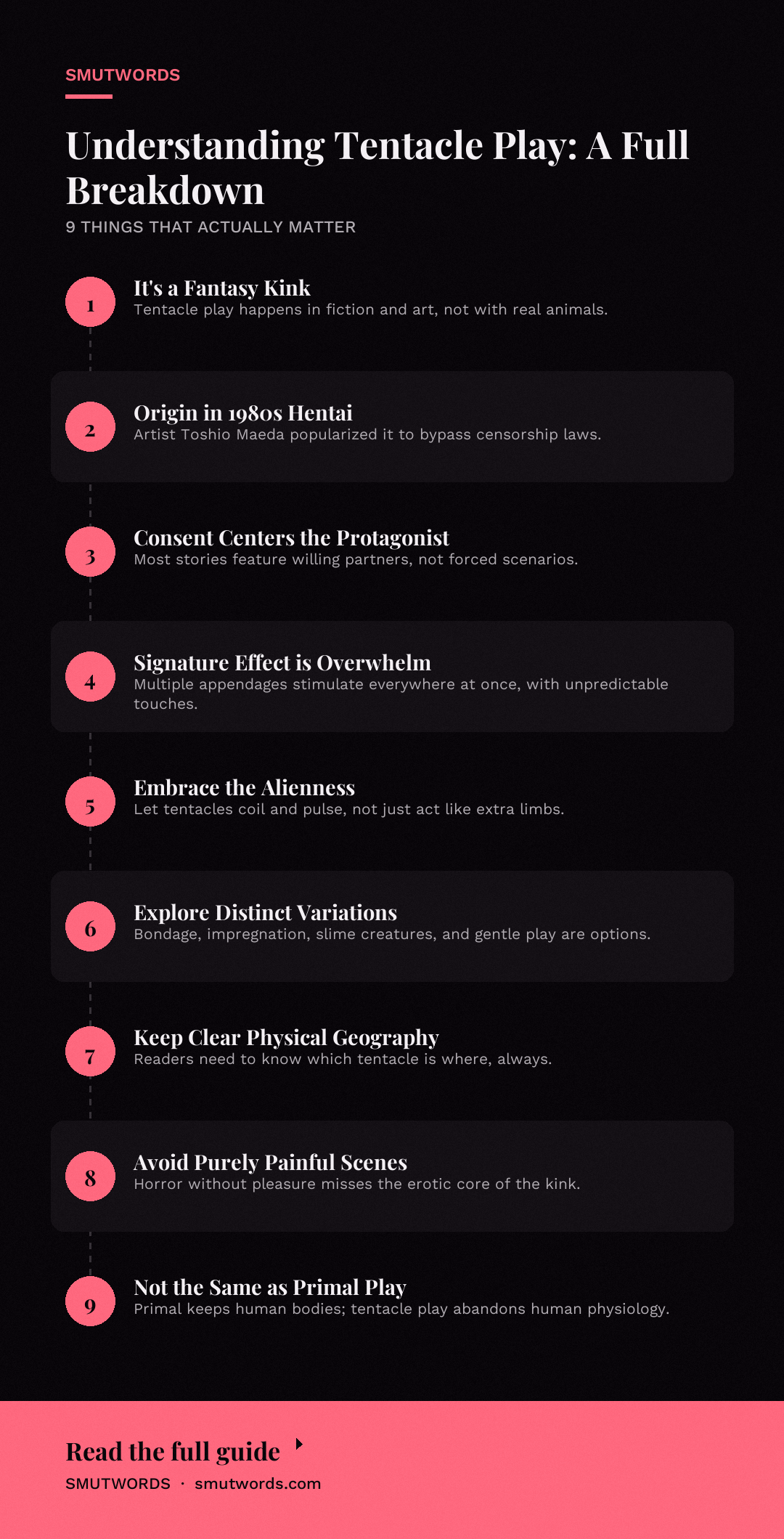
One is that tentacle play always involves non-consent or violence. While some stories lean into dubious consent or forced scenarios, the majority of popular tentacle erotica centers a willing protagonist who is curious, aroused, or actively seeking the encounter.
Another misconception is that all tentacle play is impregnation-focused. That is a distinct variant, not the default.
Consent operates differently in tentacle fiction than in human-partner erotica. The tentacled being might be incapable of verbal consent in the human sense, which shifts the dynamic. The protagonist's own consent becomes the central question. Most satisfying stories handle this with care, often showing clear internal desire or explicit agreement even when the creature cannot speak.
Where Tentacle Play Comes From
The visual language of tentacle erotica has a long and specific history. The most commonly cited origin point is the Japanese artist Toshio Maeda, whose 1980s work in hentai manga popularized the image of octopus-like appendages engaging with female characters. Maeda has stated that he created these scenes partly to work around Japanese censorship laws that prohibited the depiction of explicit genitalia.
By substituting tentacles for human anatomy, he could depict penetration and sexual acts without violating obscenity codes. The kink then spread through anime and manga fandom into global erotic art and fiction communities. Lovers of monster stories had been circling similar ideas for generations before that. Mythological figures like the Greek god Pan and various sea deities carried animalistic attributes, and Gothic literature of the 19th century played with monstrous suitors and forbidden desire.
H.P. Lovecraft's cosmic entities, while not explicitly sexual, contributed the imagery of writhing appendages and alien horror that later erotic writers would reclaim and redirect toward pleasure. What Maeda did was fuse that monstrous visual with explicit sexual content and present it as something desirable rather than purely terrifying.
The internet changed how tentacle play circulated. Web comics, illustrated stories, and written erotica communities gave creators a space to develop the kink beyond its Japanese origins. English-language monster romance and erotica genres absorbed it, producing a distinctly Western flavor that emphasizes romantic connection or character exploration alongside the physical strangeness. The popularity of alien romance fiction, from sci-fi romance novels to fan fiction archives, kept tentacle play in steady demand through the 2000s and 2010s.
A notable shift in recent years is the normalization of depicting the protagonist's perspective. Early tentacle works often focused on the spectacle of the act from an external viewpoint. Contemporary writing tends to spend far more time inside the protagonist's head, tracking the confusion, the escalating arousal, and the eventual surrender as something psychologically rich, not just physically vivid.
How It Shows Up in Erotica
Tentacle play scenes in published erotica follow discernible structural patterns. The setup introduces the alien or magical element early, since the reader needs to understand what kind of appendages they are dealing with. A good writer establishes how many tentacles exist, their texture, size, and whether they are controlled by a mind or move independently. This matters because the reader's imagination needs concrete details to build the scene.
The scene itself typically progresses through phases of sensory overwhelm.
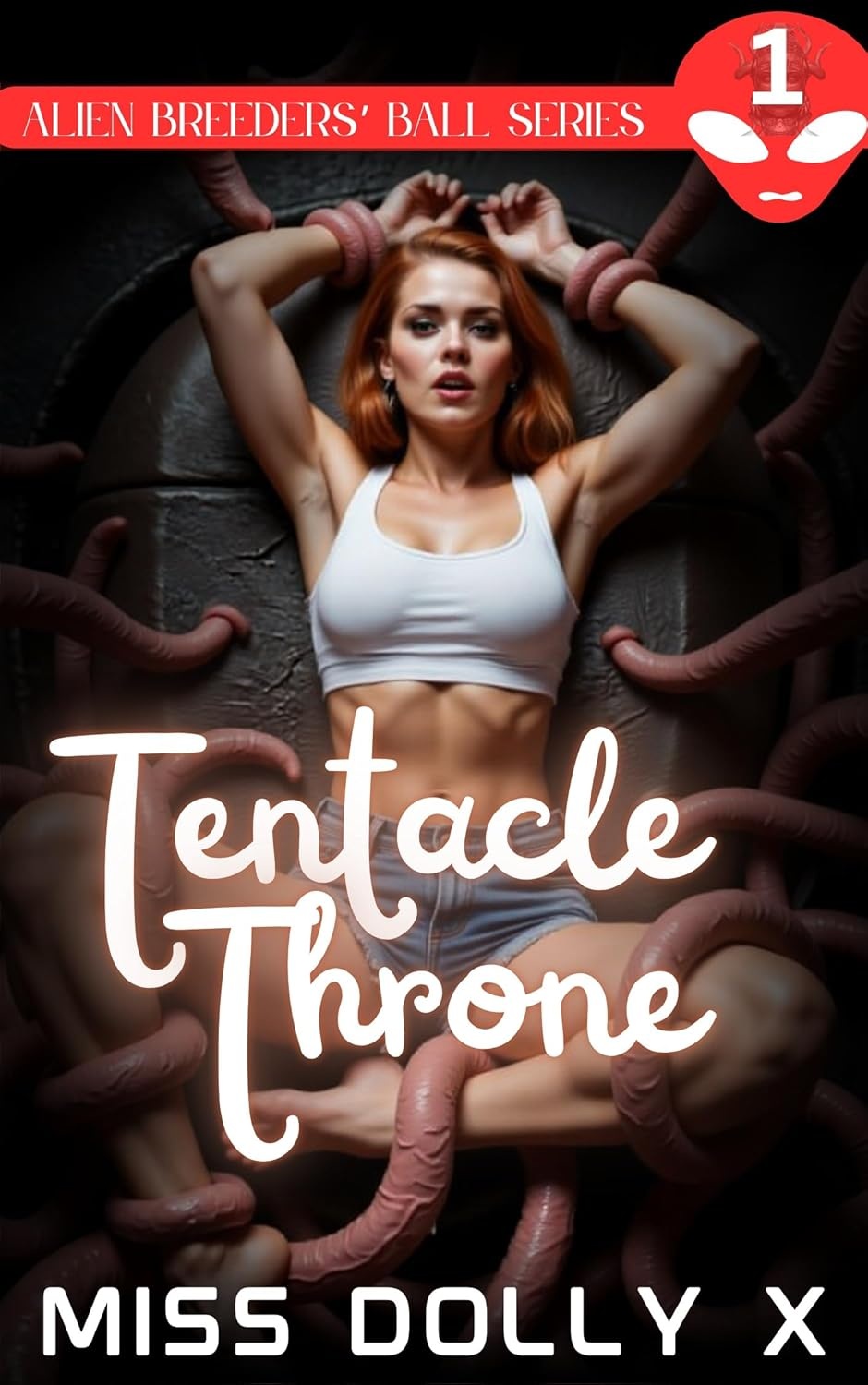
A single tentacle might initiate contact, testing and exploring. As the protagonist responds, more appendages join, each taking on a distinct role. One might secure a wrist, another wrap around a thigh, a third provide stimulation to the clitoris while a fourth enters the vagina or anus.
The simultaneous nature of the contact is the signature effect of tentacle play. Lovers of this kink are chasing the sensation of being addressed everywhere at once, with no ability to predict which touch will come next.
Effective tentacle erotica leans into the alienness rather than trying to make the creature behave like a human lover. The tentacles should not simply replicate a man with extra limbs. They should move in ways that feel biologically other: coiling, undulating, pulsing, tasting the skin, responding to arousal with visible changes in color or slickness. The creature might communicate through vibrations, chemical signals, or direct mental contact rather than spoken words.
Writers who treat the tentacle as a stand-in for a human penis usually produce flat scenes. Writers who let the appendages behave like the organs of an entirely different kind of being create the genuine thrill. Variations within the kink are numerous, and most readers develop preferences for one or two:
- Tentacle bondage: appendages restrain and immobilize the protagonist, removing the ability to move or resist while stimulation continues.
- Tentacle impregnation: a speculative biological variant where the creature deposits eggs or genetic material, often tied to breeding or transformation narratives.
- Magical tentacles: summoned or conjured, often with glowing qualities or the ability to phase through clothing, making the encounter sudden and invasive.
- Slime or goo creatures: related entities that lack defined appendages but still achieve the all-over, enveloping sensation, sometimes shifting between solid and liquid states.
- Transformation elements: the protagonist slowly changes during the encounter, growing more receptive, developing sensitivity to alien touch, or undergoing partial physical change.
- Gentle tentacle play: a softer take where the creature is tender, curious, and focused on the protagonist's pleasure, often with romantic undertones.
The strongest versions of tentacle play scenes share a few craft elements.
Enjoyed this? Get a free book.
Join the list and we will send a complete free story straight to your inbox, plus new releases every week after that. No credit card, no catch.
They maintain clear physical geography, meaning the reader always knows which tentacle is where. They escalate gradually rather than starting at full intensity, giving the protagonist a chance to acclimate and the reader a chance to build anticipation.
They also preserve the protagonist's internal voice throughout. The psychological journey from wariness to craving is what separates tentacle play from simple anatomical novelty.
A weak tentacle scene typically falls into one of two traps. The first is making the experience purely painful or frightening without any counterweight of pleasure, which can read as horror rather than erotica. The second is sanitizing the creature until it behaves exactly like an idealized human lover with a few extra limbs. The sweet spot sits between the two, where the writer sustains the discomforting strangeness while showing why the protagonist finds it arousing.
Tentacle Play vs Primal Play
Both tentacle play and primal play involve a departure from ordinary human sexuality, but they pull in opposite directions.
Primal play centers instinct, predation, and the raw physicality of animalistic behavior, often with a human partner adopting a predatory or preyed-upon headspace. The bodies remain human, even if the behavior is not. Those scenes stay rooted in recognizable physical interactions: grappling, biting, chasing, overpowering. The excitement comes from the animal brain taking over.
Tentacle play abandons human physiology entirely. The pleasure depends on anatomy that does not exist, on impossible flexibility, on appendages that can explore and stimulate in concert.
A primal play scene might involve a partner pinning you down with their body weight. A tentacle scene involves appendages that can hold in one moment and stroke something internal in the next. The contrast is worth noting because readers who enjoy the loss of rationality in primal play often also enjoy tentacle play, but the sensation fantasies differ considerably.
If you're curious about how consent gets negotiated in scenes that push past ordinary human limits, the way it does in kink negotiation is a useful companion read.
Frequently Asked Questions
Is tentacle play the same as monster romance?
No. Monster romance is a broad genre covering any romantic or sexual relationship with a non-human being, from vampires and shifters to aliens and cryptids. Tentacle play is one specific subset that focuses on the appendages themselves as the primary agents of stimulation. A monster romance might include tentacle scenes, but many monster romances never involve tentacles at all.
Does tentacle play always involve non-consent?
It does not. While some tentacle fiction draws on forced scenarios, the mainstream of the kink in contemporary erotica centers consenting protagonists who desire the encounter. The alien nature of the partner does not remove the protagonist's agency in the story. Many authors write tentacle encounters as something the protagonist actively seeks, negotiates with a creature that can communicate, or welcomes through curiosity and trust.
The consent dynamics here share DNA with free use household fiction, where clear agreement is what makes the fantasy work.
Why is tentacle play so popular in monster erotica specifically?
Tentacles offer writers a way to depict sensation and stimulation that exceeds the limits of the human body. Two human hands and one mouth can only do so much, but a creature with six, eight, or twelve appendages can stimulate every erogenous zone simultaneously. That creates a fantasy of total sensory saturation that is difficult to achieve in human-paired scenes, plus the psychological layer of yielding to something that operates on entirely different rules.
Can tentacle play involve anal penetration?
Yes. Tentacle scenes frequently include anal penetration alongside vaginal or oral contact, often at the same time. The flexible nature of appendages makes simultaneous penetration of multiple orifices a standard feature of the kink. As with any anal content in erotica, well-executed scenes typically show lubrication and gradual entry rather than sudden, painful force.
Is tentacle play related to monster cock kink?
The two are commonly associated but distinct. Monster cock kink focuses on the genital itself, usually a human-shaped or slightly modified penis at extreme scale, and the threat or thrill of accommodating it. Tentacle play replaces the singular organ with multiple moving appendages. A reader can enjoy one without the other, though many stories combine both elements for maximum otherworldly effect.
What should I know if I want to try tentacle-inspired play in real life?
Real-life exploration uses silicone or other non-latex toys specifically shaped to mimic tentacles. Establish clear safewords before play begins, since the sensation of multiple simultaneous points of contact can be more intense than expected. Inspect toys thoroughly before each use for damage or debris, clean them with appropriate sanitizer, and use generous lubrication. Discuss limits around depth and girth in advance, treating the practice with the same care as any other form of BDSM play.
Final Thoughts
Tentacle play survives across decades and cultures because it represents one of the few areas in erotica where the body can be met with something genuinely unknowable. The writer gets to translate that impossibility into text. The best stories in the genre keep the protagonist's inner experience central, using the tentacles as a vehicle for exploring surrender, curiosity, and the appetite for sensation that a human body alone cannot satisfy.
If you are new to reading it, look for a story where the creature feels designed, textured, and responsive, and where the protagonist's reactions feel earned rather than convenient. That combination, done well, is the entire reason the kink has staying power.





Loading comments…