
True mates are the destined partners of paranormal romance: two people (or a person and a creature, or two creatures) whose bond is written into their biology, their magic, or the universe itself, and cannot be undone by anything as small as an argument, a breakup, or a different person walking into the room.
The term shows up most in shifter romance, but it also runs through vampire fiction, fae books, alien romance, and any subgenre where the author wants the couple's commitment to feel cosmically guaranteed rather than negotiated. If you have ever finished a book where the hero scents the heroine across a crowded bar and immediately knows she is his, you have read true mates.
What True Mates Actually Mean
A true mates bond is a supernatural claim. The two people involved are matched on some level deeper than compatibility: fate, blood, magic, a goddess, a biological imperative built into the species. The bond announces itself through the body before the brain catches up, and once it is acknowledged, it does not break.
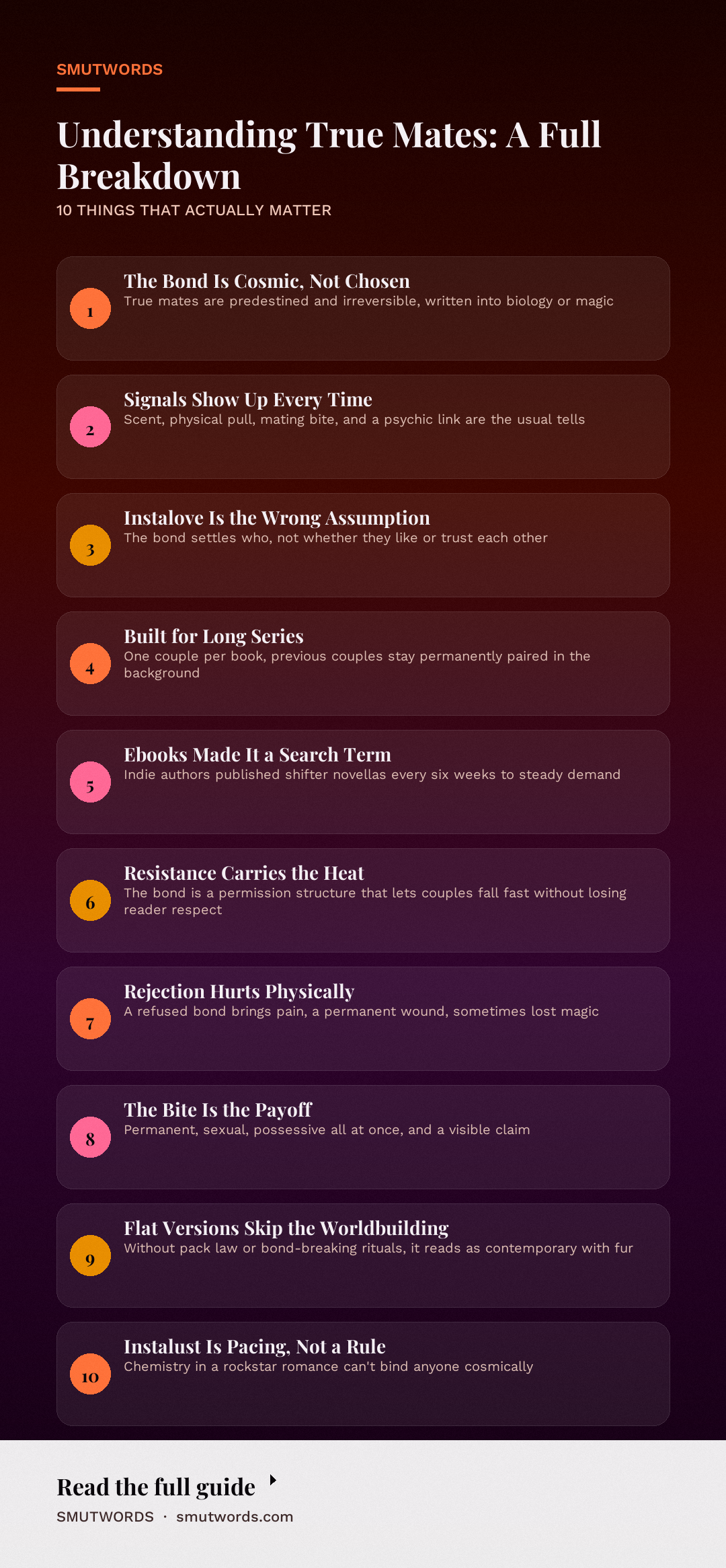
The mechanics vary from series to series, but most true mates books use two or three of the same signals. The most common are scent (he smells her and his wolf, dragon, or vampire goes still), a physical pull that feels like gravity, a mating bite that seals the bond in flesh, and a psychic link that lets each mate feel the other's emotions, pain, or arousal from a distance.
What counts as true mates: a pairing that is predestined and irreversible, whether or not either party wants it at first. What does not count: a couple who simply fall hard and fast, or a fated meeting that either person could walk away from without supernatural consequence. Plenty of romances use destiny as flavor. True mates make it a structural fact of the world.
Several related terms float around this one, and readers use them almost interchangeably. Fated mates, mate bond, chosen pairing, predestined love, and soulbond all describe roughly the same device. The differences are usually tonal. "Soulbond" tends to appear in fantasy and fae books, "fated mates" in paranormal romance marketing copy, and "true mates" in shifter series where the animal instinct is doing most of the work.
The most common misconception is that true mates means instalove with no conflict. The bond removes one specific question (will they end up together?) and replaces it with several better ones. Will she accept a bond she did not choose? Can he keep her alive long enough to complete it?
What happens when the mating instinct points him at someone his pack considers an enemy? The certainty is the setup. The plot is everything that gets in the way of it.
Where True Mates Comes From
Destined lovers are older than the printing press. Greek myth pairs people off by divine assignment, and medieval romance runs on courtly love that is fated, if usually adulterous and tragic. The specific machinery readers recognize today, though, is a product of late twentieth-century genre publishing.
Paranormal romance as a commercial category took shape in the 1990s, and the werewolf and vampire boom of the 2000s turned mate bonds into one of its load-bearing walls. Shifter series were built to run long, often ten books or more, and the mate bond solved a real problem for authors: it justified a new couple per book while keeping every previous couple visibly, permanently paired in the background.
No messy exes, no love triangles stretching across a decade of publishing. Each book gets its own guaranteed happy ending, and the pack stays intact.
Once ebook publishing exploded in the 2010s, true mates became one of the most reliably searched terms in self-published romance. Indie authors could publish a shifter novella every six weeks, and readers knew exactly what promise the cover was making. The trope's popularity is inseparable from that publishing rhythm: short, high-frequency, series-based releases with a repeatable emotional payoff.
The trope has evolved noticeably since. Early mate bond books leaned hard on biology as destiny, with the heroine's resistance framed as something to be overcome. Contemporary versions give the resisting partner more real agency; more often the mate bond is a fact both people have to negotiate rather than a verdict handed down to one of them.
Recent books also play more openly with the dark side of the device: bonds that feel like traps, mates who are enemies, bonds that can be rejected at genuine cost. That shift tracks with where the chastity and denial side of paranormal romance went too, toward the cost of the bond rather than the fantasy of it.
How It Shows Up in Erotica
On the page, the mate bond is a permission structure. It gives authors a way to write two characters who fall into bed (or against a wall) faster than a contemporary romance would allow, without the reader losing respect for either of them. The bond did the work of a slow burn in a fraction of the word count.
That speed is why the trope pairs so naturally with high-heat paranormal and monster romance. It also explains the crossover into subgenres that are not supernatural at all. An author writing soldier romance or motorcycle club romance often borrows the same certainty, just with "he knew the second he saw her" instead of a wolf.
Enjoyed this? Get a free book.
Join the list and we will send a complete free story straight to your inbox, plus new releases every week after that. No credit card, no catch.
The strongest true mates books understand that the bond is a starting gun, not a finish line. They use it to generate heat early and then run the real conflict on top of it. Here are the variations that show up most often:
- Rejected mates. One party refuses the bond, usually because of trauma, politics, or a misunderstanding. The rejection causes physical pain, which raises the emotional stakes considerably.
- Enemies by circumstance. The bond lands on two people whose packs, clans, or species are at war. This overlaps heavily with hate to love, though the true mates version has a supernatural tiebreaker waiting in the wings.
- Second-chance mates. They bonded years ago and something went wrong. The book is about re-earning a connection that was never severed.
- The mate who does not know. One character feels the pull from page one; the other is human, or a different species, and has no idea what is happening to either of them.
- Bonded but not completed. A mating bite, a ceremony, or a first sexual encounter is required to finish the bond, and everything conspires to delay it.
- Forced proximity via bond. The bond creates a physical need to be near each other, which is a very efficient way to trap two people in one cabin, one bed, or one mission.
The mating bite deserves its own note because it is where the trope gets genuinely carnal. A bite that marks a mate hits several kinks at once: body fluid kink, a taste for possession and marking, and the scent-driven intensity that scent fetish readers come to shifter books for. The bite is also a permanent visible claim, which is why it works so well as a climax beat.
What separates a strong version from a flat one comes down to resistance. If both characters accept the bond instantly and completely, the book has nothing left to burn. The best mate-bond writing puts one or both people in conflict with the bond itself, or with what accepting it will cost them: a pack, a family, a career, a version of themselves they were not ready to give up.
The flat version is also usually thin on worldbuilding. If the mate bond is the only supernatural element, the story reads as a contemporary with a werewolf skin. The books that hold up build institutions around the bond: pack hierarchies, mating laws, bond-breaking rituals, the social cost of a rejected mate. That is what gives the trope something to push against.
True Mates vs Other Fated Pairings
The comparison readers actually confuse is between true mates and the broader category of just falling fast. A rockstar romance can open with two people locked onto each other across a green room and immediately falling into bed. The reader feels the instant chemistry, but nothing in the world of the book says these two are cosmically bound.
The author could write a sequel where they break up. In a true mates book, that sequel is impossible, and most series make that explicit.
That is the useful distinction to carry into other subgenres. Instalust is a pacing choice. A mate bond is a rule of the universe. When a contemporary uses the language of destiny, it is usually borrowing the emotional texture of true mates without the supernatural enforcement mechanism underneath it.
Frequently Asked Questions
What is the difference between true mates and fated mates?
Functionally none. The two terms describe the same device, and most readers use them interchangeably. "True mates" shows up more in shifter series where the animal side does the recognizing; "fated mates" is the broader marketing term used across paranormal romance generally.
Can a true mates bond be rejected or broken?
In most series, the bond can be rejected, but the cost is severe: physical pain, a permanent wound, and often a loss of the character's own magic or animal. Breaking a completed bond is much rarer and usually requires a ritual, a death, or a very special kind of magic.
Why is the mating bite such a common element?
It makes the bond physical and visible. A bite is permanent, sexual, and possessive all at once, and it gives the book a discrete act to build toward. It also plugs directly into scent and fluid kinks that shifter romance readers tend to enjoy.
Are true mates books always instalove?
No, and the strongest ones are not. The bond establishes that the two people are matched. It says nothing about whether they like each other, trust each other, or are willing to accept what the bond will cost them. Those are the questions the book still has to answer.
Do true mates only appear in shifter romance?
Shifter romance is where the trope lives, but it also turns up in vampire fiction, fae and fantasy romance, alien romance, and even contemporary books that borrow the certainty without the magic. Any subgenre that wants a guaranteed, unbreakable commitment can use it.
What makes a true mates book better than the average one?
Conflict that survives the bond. If the couple's only obstacle is each other's denial, the book runs out of steam by the midpoint. The good ones put the pack, the law, the war, or the hero's own history between the couple and the happy ending the bond already promises.
Final Thoughts
True mates guarantees the couple before the first kiss and still finds a way to make the reader nervous. No contemporary romance pulls that off without cheating. That is why the device keeps showing up across shifters, vampires, fae, and everything downstream of them, and why readers who love it go looking for the exact mechanics every time.
If you want the trope at full intensity, with the rejection cost on the page and the mating bite as the payoff, pick up a book in a long-running shifter series and start at book one. The bond shows up in the first few chapters. Everything after that is the author earning a certainty the reader already knows is coming.





Loading comments…