
A widow's new love is the romance trope where a woman who has buried a husband opens herself to a second partner, and the story treats that opening as the whole plot rather than a subplot. She is usually still grieving, or only just stepping out of mourning, and the new lover becomes the person who helps her want things again: sex, company, a future, her own body on her own terms.
The appeal sits in the difficulty. A widow's new love is desire that has to be earned back from grief, and readers come to it for the ache before the relief.
It shows up across contemporary romance, historical romance, small-town series, and erotic romance with a heavy emotional through-line. The widow may be young or old, freshly bereaved or years out, a virgin by circumstance or a woman with a full sexual history behind her. What holds the trope together is not her age or her past but the structure: loss first, thaw second, a love that feels like it was paid for.
What Widow's New Love Actually Means
Strip the marketing language away and the trope is a specific emotional engine. A woman has loved and lost. The story asks whether she can love again without betraying the first love, and it answers yes, on terms she sets.
The new partner is not a replacement for the dead husband. He is the next chapter, and the good books are careful about that distinction.
The term itself is descriptive rather than technical. It names the premise plainly: a widow, a new love. Variants travel under softer labels such as second love after loss, grief to grace, romantic recovery, or mourning to blooming. The widower version (a man widowed, finding love again) exists and sells, but it carries a different cultural weight, and the widow's new love is the more crowded shelf.
What counts as this trope: the heroine is genuinely widowed (not divorced, not merely broken up with), the loss is felt on the page or in her history, and the new relationship is the central arc. What doesn't count: a dead husband mentioned once as backstory color in a book that's really about something else, or a widow who functions as a side character in someone else's romance.
Common Misconceptions
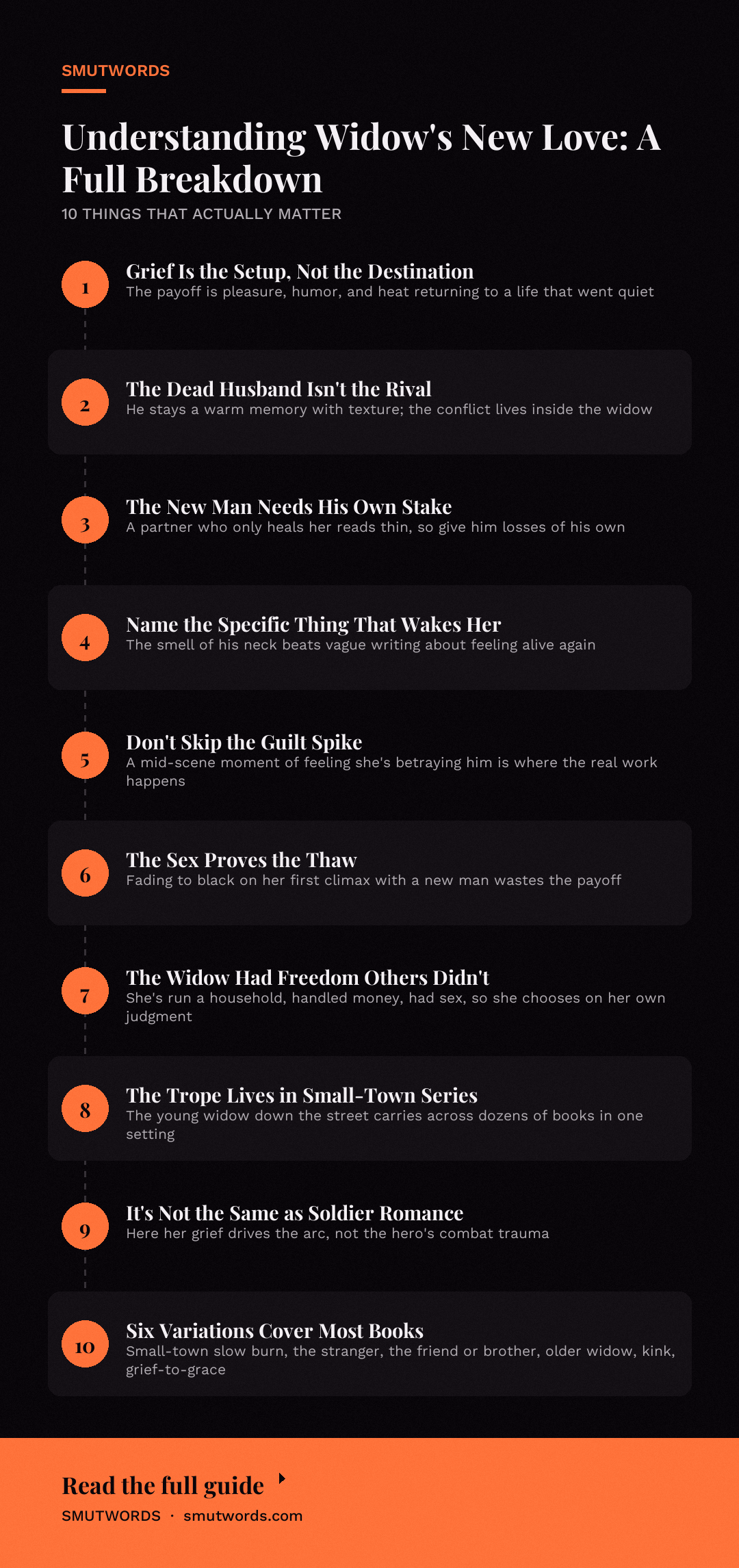
The biggest one is that the trope is inherently sad. It isn't. Grief is the starting pressure, and the payoff is pleasure, humor, and heat returning to a life that had gone quiet. The good versions are often funny and very dirty, because a woman rediscovering her own desire is a natural engine for explicit scenes.
The second misconception is that the new love must compete with the dead husband. In strong versions he doesn't. The dead husband is often a warm presence, sometimes even a benign one whose memory the new partner respects. The conflict lives inside the widow, not in a rivalry with a ghost.
The third is that this is a "clean" or sentimental trope. Plenty of the best widow's new love books are explicit erotic romance, and the sexual reawakening is the emotional spine. The grief makes the sex mean more, not less.
Where Widow's New Love Comes From
Widow romance is old. Nineteenth-century fiction is full of widows who remarry, often with a frankness about money and sex that the marriage-plot novels of the same era avoid. A widow in historical fiction has a legal and social freedom a never-married woman doesn't: she has run a household, managed money, and had sex. That made her a natural figure for stories about a woman choosing a second partner on her own judgment.
The modern romance-genre version is younger. Through the mid-twentieth century, category romance and its predecessors used widowhood mostly as a convenient way to make a heroine sexually experienced without making her "fallen." The widow could have a past and still be sympathetic, which made her useful for books that wanted heat without scandal.
The real shift came with the rise of emotional contemporary romance and, later, erotic romance in the 2000s and 2010s. Writers started treating the grief itself as the subject rather than a box to tick, and the widow's new love moved from plot device to full emotional arc. Readers wanted the mourning shown, not skipped, and publishers responded with books that lingered on the thaw.
The publishing history is also a story about series. Small-town romance made the widow's new love a reliable recurring figure: the young widow down the street, the sheriff's widow, the woman everyone in town is gentle with until the new man arrives and isn't gentle at all. That framework let a single trope carry across dozens of books in a shared setting, and it remains one of the most bankable premises in the category.
The widower version followed a parallel path but lagged in volume, partly because a grieving hero who withholds emotion is a harder sell as a romantic lead than a grieving heroine who slowly opens. Both exist. The widow's new love is simply the more established shelf.
How It Shows Up in Erotica
On the page, the trope runs on a specific sequence: numbness, friction, first wanting, first touching, the guilt spike, and then the decision to keep going. A skilled writer doesn't rush the numbness. The opening chapters show a woman going through motions, and the erotic charge comes from the first flicker of wanting something she thought was closed to her.
The craft move that separates strong versions from flat ones is specificity about what reawakens her. Vague "she felt alive again" writing kills the trope. The good books name it: the smell of a man's neck, a hand at the small of her back, the embarrassment of noticing she's wet for the first time in two years. Concrete sensory detail is the whole game here.
Common Variations Authors Use
- The small-town slow burn. The new love is a longtime acquaintance, often someone the dead husband knew, and the town's watchful eyes add pressure.
- The stranger who doesn't know. A man who meets her without knowing she's widowed, so the grief surfaces later and the relationship has to survive the reveal.
- The dead husband's friend or brother. High-taboo version, where the new love carries his own grief and loyalty to the dead man, and the guilt is doubled.
- The older widow, younger man. A woman past forty rediscovering sex with a partner who has no history with her loss, often written with a frankness about bodies and appetite.
- The widowed dominant or submissive. In kink-forward erotic romance, the widow re-enters a power dynamic she'd shared with her late husband, and the new partner has to earn trust she'd already given once. Books that do this well handle the emotional aftermath carefully, much like the dynamics covered in writing Dom drop and sub drop on the page.
- The grief-to-grace arc. The softest version, closer to women's fiction with heat, where the sexual reawakening is one strand of a broader recovery.
What Makes a Strong Version Work
Strong widow's new love books give the dead husband a real presence without letting him run the story. He's a memory with texture, sometimes a source of comfort, sometimes a source of complicated relief if the marriage was imperfect. The reader needs to believe she loved him, and needs to believe the new man is genuinely different.
Enjoyed this? Get a free book.
Join the list and we will send a complete free story straight to your inbox, plus new releases every week after that. No credit card, no catch.
The best versions also let the new partner have his own emotional stake. A man who is only a healing device for the heroine reads thin. When he has his own losses, his own reasons for wanting her specifically, the relationship becomes reciprocal and the sex scenes carry weight.
Heat matters here more than in some tropes. The erotic scenes are where the thaw is proven, and a writer who fades to black on the first time she comes with a new man has wasted the payoff. Explicit, emotionally grounded sex scenes are the engine of the trope's appeal, and readers expect them.
The same goes for the D/s framework if the book runs that way; the daily rules and check-ins that make a power exchange feel lived-in are covered in building a D/s rhythm, and widow books lean on that groundwork more than most.
A strong version also respects the guilt spike. Many of the best books include a moment where she feels she's betraying him, sometimes mid-scene, sometimes after, and the resolution of that moment is where the real work happens. Skipping the guilt makes the happy ending cheap.
What Makes a Flat Version
Flat versions treat the dead husband as a plot obstacle to be disposed of, so the new romance can proceed without friction. Flat versions also over-narrate the grief in abstract language and under-deliver on the physical specificity that makes the reawakening land. A widow who cries beautifully for three chapters and then has a perfect first time with no internal conflict is a missed opportunity.
Flat versions also make the new man a saint. A partner with no flaws, no history, and no needs of his own reads as a fantasy healing object rather than a person, and the reader loses interest in the sex because there's no tension in it.
Widow's New Love vs Soldier Romance
These two get confused more often than you'd think, because both center on a woman loving a man marked by death and both lean on grief as the emotional core. The difference is the source of the loss and whose grief drives the plot. In a soldier romance, the central man is the one carrying trauma, often from combat or deployment, and the heroine is the one who helps him heal.
In a widow's new love, the woman is the widow, and her grief drives the arc. The new partner may have his own wounds, but the story belongs to her thaw. A book can be both (a widow who falls for a soldier), and those hybrids work well, but they aren't the same trope and they deliver different emotional payoffs.
The confusion runs the other way too, since some soldier romances open with a woman who has lost a partner in service. If the loss happens on the page and drives her arc, you're reading the widow's new love with a military setting. If the loss is her backstory and the hero's trauma is the engine, you're reading a soldier romance.
Frequently Asked Questions
What is the widow's new love trope?
It's a romance plot where a widowed woman finds a new partner who helps her reclaim desire and a sense of self after loss. The arc centers on her grief and her decision to love again. The dead husband stays present as a memory, never as a rival.
Is the widow's new love always a sad story?
No. Grief is the starting pressure, and the payoff is pleasure, humor, and heat returning to a life that had gone quiet. Many of the best examples are funny and very explicit. The sadness is the setup, not the destination.
What's the difference between widow's new love and second-chance romance?
Second-chance romance usually means the same two people reuniting after a breakup, while a widow's new love involves a genuinely new partner after a death. The emotional work differs: second chance resolves a past mistake, and widow's new love resolves a fear of betrayal. Some books combine both when the new man turns out to be an old flame, which is one of the trope's best hybrids.
Why do readers like widow's new love books?
They offer hope that moving on is not betrayal but a new beginning, and that happiness is still available after loss. The love feels hard-won, so the happy ending lands heavier. Readers also like the sexual reawakening, which gives the trope natural heat.
Do widow's new love books always include the dead husband?
He appears as a memory, a photograph, a habit, a piece of her history, even when he's never on the page in flashback. Strong versions give him texture so the reader believes she loved him. Books that erase him entirely tend to feel hollow.
Can the trope work with a widower instead?
Yes. The widower version exists and sells, but it carries a different cultural weight, since a grieving hero who withholds emotion is a harder sell as a lead. The widow's new love is simply the more established shelf. Both can be written with real emotional depth.
Final Thoughts
The widow's new love rewards writers who take the grief seriously and the desire even more seriously, and it rewards readers who want a love that feels earned. If you want a gateway into the trope, start with a small-town version where the dead husband is a warm memory rather than a shadow.
Build the numbness, then break it with one specific, physical moment. Let the new man want her for reasons that are his own. Then let the heat land where it should, in a scene she chose and can't take back. That's what readers are here for, and a book that delivers it will stay on their shelf long after the last page.





Loading comments…