A wolf pack romance is a love story built around a shifter hero who belongs to a wolf pack, and a heroine who either mates into that pack or becomes the reason its hierarchy rearranges itself. The couple is never alone on the page. Every kiss, every claim, every fight happens inside a web of rank, loyalty, and animal instinct that the pack enforces.
That pressure is the whole appeal: a possessive, primal hero whose devotion comes with a family attached, and a heroine who has to earn her place in it or tear it apart to build something better.
What Wolf Pack Romance Actually Means
The name is literal. "Wolf" names the species of shifter. "Pack" names the social unit the story refuses to let the couple escape. "Romance" names the guarantee that the couple ends the book together, however much fur and blood gets shed on the way there.
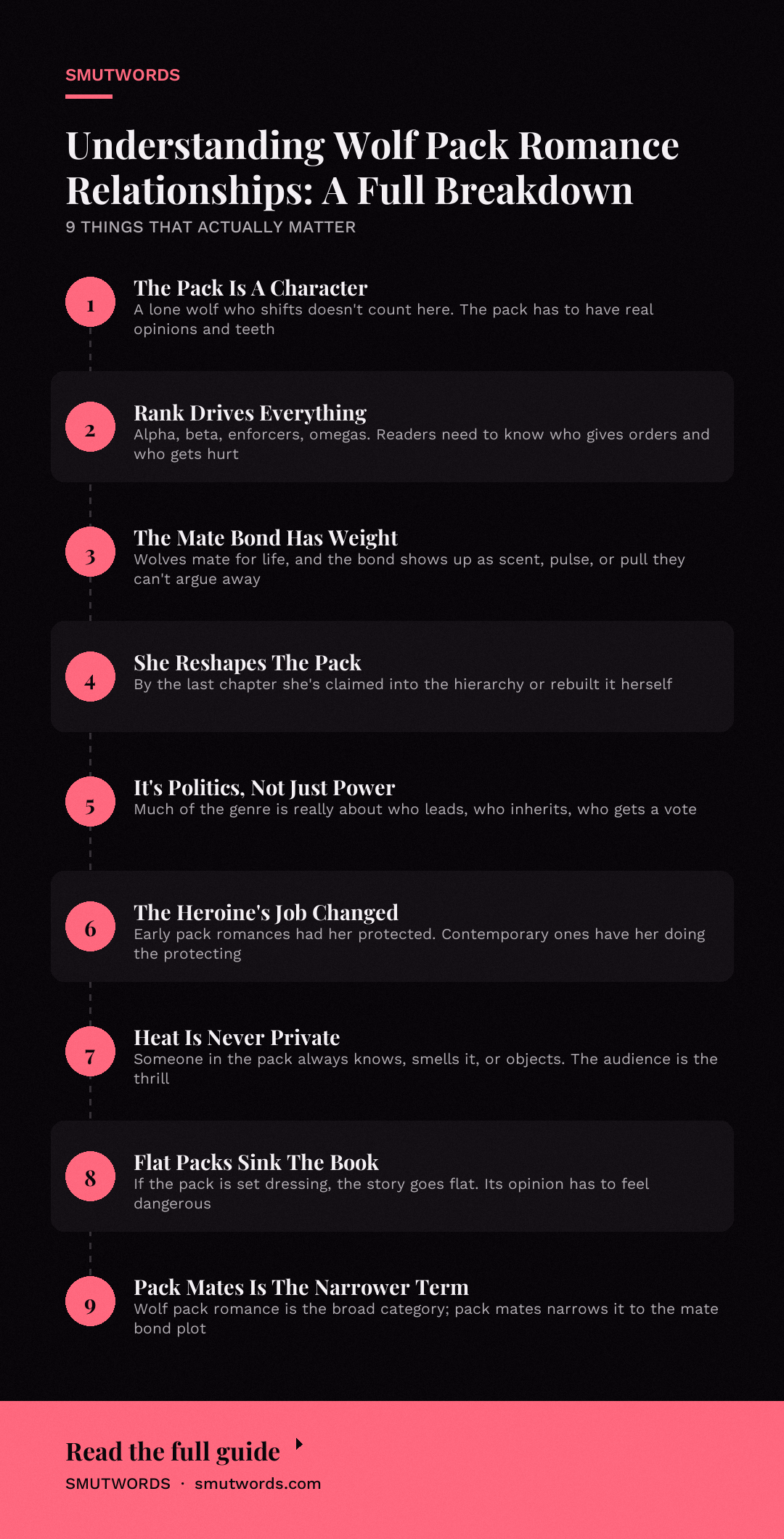
What counts as a wolf pack romance is narrower than "any book with a werewolf in it." A lone wolf who happens to shift does not make a pack romance. The pack has to function as a real character: it has opinions, a chain of command, and consequences for anyone who defies it.
Three ingredients separate the subgenre from general shifter fiction:
- A ranked structure. Alpha, beta, enforcers, elders, omegas. The reader needs to understand who gives orders and who can be hurt by them.
- A mate bond with weight. Wolves in these books mate for life, and the bond usually registers physically: a scent, a pulse, a pull the characters cannot argue their way out of. The soulbond glossary entry covers the broader supernatural version of this mechanic.
- A heroine who changes the pack. She is not a guest. By the last chapter she has either been claimed into the hierarchy or restructured it, often by exposing a corrupt alpha or claiming a rank nobody expected her to hold.
The most common misconception is that these books are simple alpha-and-submissive power fantasies. Plenty of them are, and they work. But a large share of the genre is really about institutional politics: who leads, who inherits, who gets a vote. The sex is the reward for surviving the politics.
The second misconception is that "wolf pack romance" is interchangeable with "shifter romance." It is a subset. Bear, dragon, and big-cat packs exist, and cross-species stories get their own category entirely. The hybrid shifter romance glossary entry maps out what happens when a wolf mates outside its own species.
Where Wolf Pack Romance Comes From
The trope's real history is a publishing history, so that is what this section covers. The werewolf as a romantic lead has existed in Gothic fiction for two centuries, but the pack as a structured, ranked romance setting is a product of the late twentieth and early twenty-first century mass-market paperback.
Paranormal romance as a shelf category took off in the 1990s and 2000s, when publishers realized readers would buy vampires and shifters in long series with recurring casts. The pack was an ideal franchise engine. A single book gives you one couple. A pack gives you a bench of alpha brothers, enforcers, and rivals, each ready for their own volume.
Online fiction pushed the form somewhere print could not follow. Serial platforms and reader forums made the "rejected mate" and "omega verse" variants into their own micro-genres, driven by reader requests and rapid chapter-by-chapter feedback. What used to take a publisher two years now takes an author six weeks.
The most visible shift over the last decade is the heroine's job. Early pack romances cast her as the outsider who gets protected. Contemporary ones increasingly cast her as the person doing the protecting, the negotiating, and sometimes the alpha-ing. The hero's wolf still growls; he just growls while taking orders.
How It Shows Up in Erotica
On the page, a strong wolf pack romance runs on tension between the private and the public. The intimate scenes carry the same hierarchy as the dinner-table scenes. Who is allowed to touch the heroine, in what order, and in front of whom becomes its own erotic language.
Editors see the same handful of structures again and again. Each has a distinct heat profile:
- The claiming. The hero marks the heroine in front of the pack. Sex becomes a public declaration, and the pack's reaction (approval, fury, challenge) is half the scene.
- The rejected mate. The heroine is repudiated, usually by a hero who thinks he is protecting her or who has been manipulated into it. The grovel and the reunion carry the heat.
- The omega verse pack. A bonded group of wolves shares one omega, with nesting, heat cycles, and a full ensemble cast in the bedroom. The MMF threesome guide is useful for authors building group scenes that keep every participant distinct.
- The alpha challenge. A rival wants the heroine or the throne. The hero and rival fight for dominance, and the winner claims. The erotic charge lives in the audience watching.
- The outsider who earns rank. A human or lone wolf proves herself to a hostile pack. Slow burn, heavy on scent and instinct, light on immediate sex.
What makes these work versus what makes them flat comes down to the pack itself. A flat version treats the pack as set dressing: a few names, a group howl, no real stake in the outcome. A strong version makes the pack's opinion genuinely dangerous. The reader should feel that choosing the heroine costs the hero something concrete: a rank, a brother, a home.
Enjoyed this? Get a free book.
Join the list and we will send a complete free story straight to your inbox, plus new releases every week after that. No credit card, no catch.
Craft-level, the sensory work matters more here than in most subgenres. Wolves track by scent, so the heroine's smell gets described constantly, and skilled authors use that to escalate intimacy before any clothes come off. Muscle and body description do similar labor in the physical scenes; the muscle worship guide breaks down why that kind of attention lands.
Dialogue carries the rank. An alpha who says "mine" in public is performing for the pack, and the reader needs that performance to feel different from what he says alone with her. The best books make the difference explicit. If you want to see how that public-versus-private tension gets handled elsewhere in the genre, the sci-fi romance guide covers the same dynamic in a different setting.
One more craft note: heat in these books is never fully private. Someone in the pack always knows, smells it, hears it, or objects to it. The humiliation and the thrill live in that audience. Books that forget the pack is listening lose the genre's best trick.
Wolf Pack Romance vs Pack Mates Romance
These two get used as synonyms, and they overlap heavily. The distinction is useful for readers sorting a large catalog. A wolf pack romance is the broader category: any love story set inside a wolf pack, with the pack as a driving force.
Pack mates romance narrows the lens to the mate bond itself. The central plot is the pairing or group-bonding of wolves within the same pack, and the mate bond mechanic does the heavy lifting. If the book is about two wolves in one pack discovering they are fated, that is pack mates. If it is about a human outsider fighting a corrupt alpha for her place in the hierarchy, that is wolf pack romance at its fullest.
Most books blend both. Readers looking for a specific flavor should check whether the heroine is a shifter (leaning pack mates) or an outsider (leaning full pack romance).
Frequently Asked Questions
What is a wolf pack romance novel?
A romance novel where the hero belongs to a wolf shifter pack, and the plot involves the heroine either mating into that pack or reshaping its hierarchy. The pack acts as a character with its own rules and consequences, not just background.
What is the "rejected mate" wolf pack romance?
A variant where the hero repudiates the heroine after their mate bond forms, and she has to survive, rebuild, and eventually choose whether to take him back. The grovel is the emotional center of the book. It is one of the most popular online serial variants of the genre.
What is omega verse in a wolf pack romance?
An alternate-universe structure where wolves are sorted into alpha, beta, and omega roles with heat cycles and nesting instincts. Pack romances using it usually involve one omega bonding with several wolves at once, and the group dynamic carries the story.
Do I need to read wolf pack romance series in order?
Usually each book follows one couple and ends with them together, so you can start anywhere. The pack and its power structure build across the series, so starting with book one gives you the clearest picture of who answers to whom.
Are wolf pack romances always dark?
No. The genre runs from sweet and small-town to extremely dark and violent. Check the content warnings; a "dark" pack romance may include forced bonding, non-consent between characters, or graphic pack violence, while other titles are cozy and low-conflict.
What is the difference between a shifter romance and a wolf pack romance?
Shifter romance is the wider category covering all animal shifters. Wolf pack romance is the wolf-specific version, where the pack's hierarchy, loyalty, and politics drive the plot. Alien, kraken, and other shifter romances use different settings and rules entirely.
Final Thoughts
The genre rewards readers who love a hero whose devotion comes with an entire community attached. Start with a pack that feels genuinely dangerous to defy and a heroine who earns her rank rather than being handed it. If you want the full 20-book backlog that follows the same pack from first bonding to final alpha challenge, the recommendation list below has your first pick.




Loading comments…