
Eighty-five books into a shared universe, Vera Nyx has a spreadsheet that would frighten most publishing houses. Not for the sales figures. For the eye colors.
Somewhere around book forty, a secondary character in the Zorgon arc showed up with amber eyes in one scene and grey in another three chapters later. A reader flagged it inside a week. That reader was right.
Nyx fixed it, then built a tracking document that now runs to eleven tabs, cross-referencing species lineages, planetary climates, and which characters have already been claimed by whom. This vera nyx author interview started with the obvious question: how do you keep eighty-five books from contradicting each other?
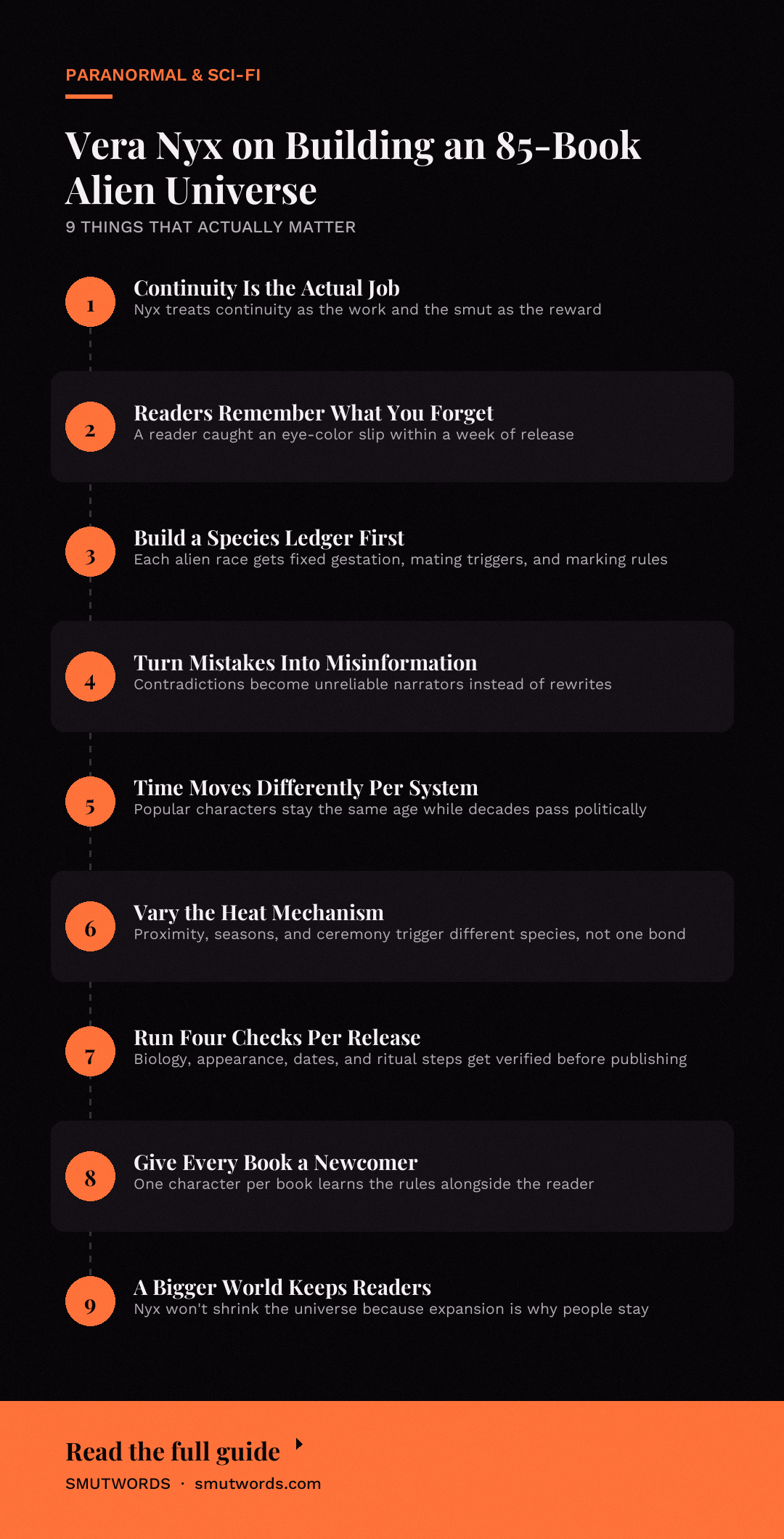
Her answer was immediate. You don't, unless you decide early that continuity is the actual job and the smut is the reward for getting it right.
Why 85 Books Is a Continuity Problem Before It's a Writing Problem
Most long-running romance series solve continuity by shrinking the world. Keep the cast small, keep the setting fixed, let readers memorize the diner on the corner. Nyx did the opposite. The Alien Hearts universe spans at least nine inhabited systems, three political factions, and a breeding program that gets referenced in some books and quietly ignored in others.
"Every new species I invented for a single scene became a liability around book fifty," she said. "Readers remember what you forget."
The solution wasn't to stop inventing. It was to build a bible with rules strict enough to survive eighty-five separate emotional arcs, each one needing its own heat level, its own power dynamic, its own resolution.
The Species Ledger
Each alien race in the series gets a fixed profile before it appears on the page: gestation period, mating triggers, whether they mark their partners, and how many of them exist in the galaxy at large. That last number matters more than it sounds. Once you've written that a species numbers in the low thousands, you can't casually produce a tenth cousin with a grudge.
Nyx keeps the ledger in a document she describes as "ugly and correct," organized by system rather than by book. When she needs a character for a new release, she pulls from the ledger instead of building one from scratch.
- Fixed traits: biology, scent, heat cycles, and marking behavior that never changes between books
- Flexible traits: personality, backstory, and how much each individual character actually knows about the wider political situation
- Retired traits: anything from an early book that later contradicted a better idea, patched in-universe as "cultural misinformation" rather than rewritten
That third category is where the real craft lives. Instead of retconning a mistake, Nyx turns it into an unreliable narrator problem. A character believes something false about a rival species because their own people told them so. The correction becomes a plot point later.
How the Breeding Program Stays Consistent Across Nine Systems
Breeding runs through nearly every thread in the series, from the ritualized lactation cults of the Moonpit to the political marriages that keep two warring houses from collapsing into open conflict. For a case study, look at Milked in the Moonpit: A Sci-Fi Cult Lactation And Breastmilk Ritual Erotica, where the biology of the cult has to line up with the biology established for two other species that appear later in the timeline.
"If a Moonpit ritual produces a child in book twelve, that child has to still be a child in book eighty," Nyx said. "Which means I either age the whole universe forward or I freeze it and explain why nobody's aging."
She chose the second option, with a twist: different systems experience time differently relative to the central planet, which lets her keep popular characters at a consistent age while still letting decades pass in the political background. The trade-off is that readers have to hold two timelines in their heads at once.
The payoff shows up in The Heir of Two Worlds: An Alien Hybrid Breeding Erotica, where a hybrid pregnancy that would be biologically implausible under one timeline's rules becomes the entire tension of the book under the other.
Tracking Heat Cycles Without Making Every Book Feel Identical
The obvious risk with a breeding-heavy universe is that every book reads like the same story with new names. Nyx avoids that by varying the mechanism. One species triggers on proximity to a mate bond, another on a seasonal environmental shift, a third on a political ceremony that has nothing to do with attraction at all.
The generic version of this is a mate bond treated as a catch-all explanation. Nyx's version gives each system a different flavor of thralldom, which means the same trope can carry a completely different emotional weight depending on which planet you're reading about.
Enjoyed this? Get a free book.
Join the list and we will send a complete free story straight to your inbox, plus new releases every week after that. No credit card, no catch.
What Breaks When You Write This Many Books This Fast
Nyx is direct about the failure modes. Names are the first thing to go, especially for minor characters who appear once and then resurface forty books later with a different personality. Titles are second. She's caught herself assigning the same ceremonial rank to two unrelated characters in different systems, which readers noticed and she had to solve by making it a shared cultural import rather than a coincidence.
The fix wasn't discipline. It was a review pass before every release, run through the species ledger and a running character index that now lists over six hundred names.
- Check 1: Does this character's biology match the ledger entry for their species?
- Check 2: Has this character appeared before, and do their eyes, height, and voice match?
- Check 3: Does any political event in this book contradict a date established in an earlier release?
- Check 4: If a ritual is repeated, does it follow the same steps as the first time it appeared?
That last one is where the Moonpit and Nebula Lord storylines meet. She treats ritual beats as structural, not decorative, and readers who pay attention can feel it. If you want the deeper vocabulary she's working from, the breakdowns of primal play and predator/prey dynamics cover the same instinct to give each ritual its own logic instead of recycling a generic version.
Claimed by the Nebula Lord uses a claiming ritual that reads very differently once you know it shares structural beats with the Moonpit cult's initiation. That overlap is intentional and never explained outright in either book.
The Books That Tested the Continuity Hardest
Not every release in the series plays by the same rules, and Nyx points to a few that forced her to widen the ledger rather than write around it. Planet Of Orgasms introduced a pleasure-based economy that had to be reconciled with the resource scarcity established in earlier political books, which meant retroactively giving an earlier system a trade relationship that wasn't originally there.
Alien Heatwave: An Alien Breeding First Contact Erotica sits at the opposite end, acting as an entry point that can't assume the reader has read eighty-four prior books. Nyx's solution is a recurring device: every book includes one character who's as new to the universe as the reader, which gives her a legitimate excuse to explain rules that longtime readers already know.
And then there's Zorgon's Pet, which she calls the book that "almost broke the timeline." It required a character to have been held captive for a span of years that overlapped with a political summit she'd already dated precisely in an earlier release. The fix was a captured-captor dynamic across two systems that she'd set up in passing fifty books earlier and forgotten she'd written.
Where a Reader Should Actually Start
The honest answer, per Nyx, is that starting at book one is optional. The Alien Hearts series is built so that most entries stand alone, with continuity functioning as texture rather than a barrier. If you want the intended entry point, the reading order guide lays out which books assume prior knowledge and which don't.
For readers new to the whole genre rather than just this series, the beginner's list covers the gentler on-ramps before you commit to eighty-five books of interconnected politics.
Why She Won't Shrink the Universe to Make It Easier
The obvious question is why not collapse everything into one planet and one species and sidestep the whole problem. Nyx has a specific reason, and it has less to do with worldbuilding than with what readers actually want from a series this long.
"The reason people stay for eighty-five books is that they're watching a world get bigger, not smaller," she said. "If I contract the universe to make my life easier, I'm admitting the premise was too thin to sustain itself."
So the ledger grows. The character index grows.
Every new release adds at least one entry that some future book will have to respect, and Nyx has accepted that this is the actual shape of the job now. The smut is the easy part. The amber eyes are the hard part.
Final Thoughts
If you want to see the continuity work under pressure, start with The Heir of Two Worlds. It's the book where the shape of the whole timeline, the hybrid biology, and the political stakes all converge, and it's the clearest proof that eighty-five books can hold together without a single contradiction showing through the seams.







Loading comments…