
Ghost romance is a love story where one or both partners are dead. The living half falls for a spirit who lingers for unfinished business, unfinished love, or unfinished revenge, and the relationship unfolds across the veil. Often the ghost can't touch or be fully touched until something gets resolved.
That's the engine of the whole subgenre: desire with a barrier built into it, and a resolution that has to be earned rather than assumed. Readers come for the ache and stay for the moment the barrier finally drops, whether that means a body, a goodbye, or a door closing for good.
It's one of the oldest emotional setups in speculative fiction and one of the most durable in romance. No mortal love interest can make longing this literal.
The ghost is right there. You can see them. You usually can't hold them.
Every scene carries that gap. Every writer working in the subgenre is really working on that gap.
What Ghost Romance Actually Means
The term covers any romance in which a spectral partner is central to the love story, not just present as atmosphere. A haunted house novel where the ghost is a menace and the couple is alive is not ghost romance. A novel where the heroine falls for the ghost, negotiates with the ghost, wants the ghost, is ghost romance even if the touching stays chaste for three hundred pages.
The key distinction is who the love interest is. If the spirit functions as obstacle, backstory, or jump scare, you're reading horror or gothic suspense with romantic elements. If the spirit is the person the protagonist aches for, you're in the subgenre. Plenty of books live on the line, and those are often the best ones, but the line exists.
What counts:
- A living protagonist in a romantic relationship with a deceased character
- Two ghosts in love, or a ghost reunited with a partner who has just died
- Reincarnation setups where one partner remembers a past life and the other has returned to finish it
- Spectral intimacy, including sex with a ghost, whether the ghost can manifest physically or only on certain nights, in certain rooms, under certain conditions
- Mediums and psychics who fall for the dead they're supposed to be helping cross over
What doesn't count, or counts only partly:
- Grief romance where a dead partner haunts the living one's memory but never appears as a character
- Horror with a romantic subplot where the ghost is the threat
- Stories where the "ghost" is later revealed to be alive, a hallucination, or a con
The most common misconception is that ghost romance is automatically tragic. It isn't. The ending can go several ways, and readers have strong preferences about which way.
The ghost can be restored to life. The living partner can die and join them. The ghost can cross over while the living partner keeps living, changed.
Or the haunting can be permanent, resolved into something like a marriage across the veil. All four are legitimate endings for the subgenre. They just deliver different kinds of catharsis.
The second misconception is that it's a niche. Ghost romance sits close to several bigger categories, and its readership overlaps heavily with gothic romance, paranormal romance, and the sort of eerie, doomed-toned love story that shows up in cosmic horror romance, where the beloved is vast, unknowable, and not entirely safe to want.
Where Ghost Romance Comes From
The literary ancestor is gothic fiction, and specifically the ghost bride and spectral lover figures that ran through eighteenth and nineteenth century novels and ballads. Those stories were rarely romances in the modern sense. The ghost was there to punish, warn, or haunt, and the love story, if any, was usually a cautionary one.
What changed is the ending. Through the twentieth century, the spectral lover in most fiction was a one-way ticket to tragedy: you love the ghost, you lose the ghost, you learn something about mortality. Gothic romance kept that structure for a long time, and it still works.
The shift toward ghost romance as a genre with actual happily-ever-afters tracks the broader rise of paranormal romance from the 1980s onward, when readers started expecting monsters, vampires, and eventually spirits to be viable long-term partners rather than cautionary figures. Once vampires got to keep their girlfriends, ghosts were next. The publishing math was obvious: a love interest who can't touch you is a problem, and romance is a genre that solves problems.
The internet era accelerated it. Fan fiction, serial platforms, and self-publishing let writers push the premise further than traditional print would have allowed in the nineties. Explicit spectral sex especially. The whole subgenre's current shape, where a ghost can be funny, horny, tender, and terrifying in the same chapter, is a product of that loosening.
If you want the broader picture of how that shift played out across the industry, the state of erotica publishing right now covers the trend lines.
Two other developments matter. The first is the boom in reincarnation romance, where the ghost is less a dead person and more a soul who keeps coming back to find the same partner. That pulls in a completely different set of tropes around fate and recognition.
The second is the rise of medium and ghost-hunter protagonists, which gave the subgenre a way to combine a love story with a mystery structure. The ghost needs help, the living partner needs answers, and the romance grows out of the investigation.
How It Shows Up in Erotica
On the page, ghost romance is a craft problem with a delicious solution. Every writer has to answer one question early: what can this ghost physically do? The answer determines the entire heat level and rhythm of the book.
The common options:
Enjoyed this? Get a free book.
Join the list and we will send a complete free story straight to your inbox, plus new releases every week after that. No credit card, no catch.
- Intangible ghost. No physical contact at all. The tension lives in proximity, in almost, in the ghost watching and the living partner wanting to be watched. Very high ache, low explicit contact, though writers get creative with dreams.
- Conditional tangibility. The ghost can touch only at certain times or in certain places: midnight to dawn, inside one house, during storms, on the anniversary of their death. This is the most popular version because it gives you both restraint and release, and it lets the writer ration contact for maximum effect.
- Fully manifest ghost. The spirit can appear solid at will, which removes the physical barrier and shifts the story toward other obstacles: the ghost's unfinished business, the cost of staying, the fact that manifesting drains them.
- Possession or borrowed body. The ghost experiences touch through someone else, or through an object, or through the living partner's own hands on themselves. This is where a lot of the subgenre's filthiest and most inventive writing lives.
- Spectral intimacy with no body at all. Sensation without contact, described as cold, pressure, weight, a feeling of being held by something that isn't there. This is the version most likely to show up in literary-leaning erotica, and it's hard to write well.
The strongest ghost romances treat the touch problem as the plot, not a decoration. The question of whether they can touch tonight is the same question as whether the ghost is getting stronger, which is the same question as whether the resolution is coming, which is the same question as whether this ends in a body or a goodbye. Good writers braid those threads so a single scene of contact carries all the stakes at once.
What makes a flat version: a ghost who exists mainly to be sad. If the spirit's only trait is tragic yearning and the living partner's only trait is being drawn to them, the book runs out of fuel by the midpoint. The specters who work have appetites, opinions, and a past that's genuinely inconvenient. They want things the living partner might not want to give.
What makes a strong version: friction between the ghost's unfinished business and the relationship itself. The thing keeping the ghost here is often the thing that makes loving them dangerous, and the climax usually forces a choice between resolving that business (which might send them away) and keeping them (which might mean the relationship stays incomplete forever). That's a real dilemma with no cheap answer, and it's why the subgenre produces so many endings that readers argue about.
The other craft move worth naming is humor. A lot of the best ghost romance is funny, because the logistics of dating a dead person are absurd and the genre knows it. Ghost who can't hold a coffee cup. Ghost who is territorial about furniture.
Ghost who discovers they can turn lights off and becomes insufferable about it. The comedy doesn't undercut the ache. It makes the ache bearable enough to keep reading toward it.
Writers also use the subgenre to explore the same pull that drives merman romance and other impossible-partner categories: the beloved who is close enough to want and structurally unable to be had on ordinary terms. In ghost romance the barrier is death itself, which is the hardest barrier available and therefore the most dramatic to dissolve.
Variations worth knowing
Haunted house romance keeps the love story inside a single location the ghost can't leave, which turns the house into a third character and usually a source of trapped heat. Ghost bride stories lean on the wedding imagery and often involve a spirit who died before a marriage could happen, giving the romance a built-in ceremonial climax. Reincarnation romance swaps the veil for time, with partners who keep finding each other across lifetimes.
Spiritual medium romance puts the living partner in the role of translator, which creates an inevitable power imbalance the writer has to handle with care. Afterlife romance sets the whole thing on the other side, sometimes with both partners dead. And ghost sex, as a tag and as a reader expectation, covers any of the above where the physical contact is explicit, which is a growing share of the market.
If you like the doomed, overwhelming quality of ghost romance, the same emotional register shows up in the complete guide to secret relationship, where the barrier is social rather than supernatural and the longing works the same way. The mechanics of impossible desire transfer between subgenres more than readers expect.
Ghost Romance vs Cryptid Romance
These two get lumped together under "weird romance" but they're built differently, and the confusion is worth clearing up. In ghost romance, the love interest is human, or was. They have a personality, a history, and a recognizable interior life. The barrier is that they're dead, and the story is usually about closing that gap.
In cryptid romance, the love interest is a creature with its own biology and its own rules, and the story is usually about the living partner learning to want something that was never human. You can write a book that's both, and people have. But the emotional engine differs. Ghost romance runs on grief and unfinished business; cryptid romance runs on discovery and otherness.
If you're trying to figure out which shelf a book belongs on, ask whether the love interest is a person who died or a being who was never a person. That question sorts almost every case.
Frequently Asked Questions
Can a ghost romance have a happy ending?
Yes, and most do, though "happy" covers four distinct shapes: the ghost comes back to life, the living partner dies and joins them, the ghost crosses over peacefully while the living partner survives and grieves, or the haunting becomes permanent and the couple settles into a life across the veil. Publishers and readers tend to prefer the first two for romance-shelf expectations, but the subgenre has room for all four.
Is ghost romance the same as haunted house romance?
No. Haunted house romance is a setting-based variant where the couple's relationship develops inside a location the ghost is bound to. Ghost romance is the broader category and includes stories set anywhere, from a rented apartment to a battlefield to the afterlife itself. Every haunted house romance is ghost romance; not every ghost romance is set in a haunted house.
What is ghost sex, and how does it work in these books?
Ghost sex is the reader tag for explicit physical intimacy between a living person and a spirit. Writers handle it a few ways: the ghost manifests a solid body temporarily, touch happens only in dreams or at certain hours, or the intimacy is entirely sensory, described as cold, pressure, and weight with no physical body involved. Which version a book uses is usually decided by how much the author wants contact to be rationed.
Why do readers like ghost romance so much?
Because the barrier is total and the resolution is earned. Death is the one obstacle that can't be argued away, so any contact between the partners carries real weight. The ghost's unfinished business also supplies plot stakes without a villain, and the eventual reunion, in whatever form it takes, lands harder than a mortal happily-ever-after because the couple had to fight the one thing nobody beats.
Are ghost romances always tragic?
No, and the assumption turns a lot of readers away from books they'd love. The tragic version exists and remains popular, especially in gothic and literary-leaning work, but a large share of the subgenre ends in reunion, resurrection, or a settled haunting. Check the tags before assuming. Authors tend to signal which ending they're building toward well before the final chapter.
Do I need to read ghost romance in any particular order or subgenre first?
No, it's a category rather than a series, and each book stands alone. If you're new and unsure whether you want the ache or the heat, start with a conditional-tangibility story. That version gives you the barrier and the payoff in roughly equal measure, and it's the most common entry point for readers coming from paranormal romance.
Final Thoughts
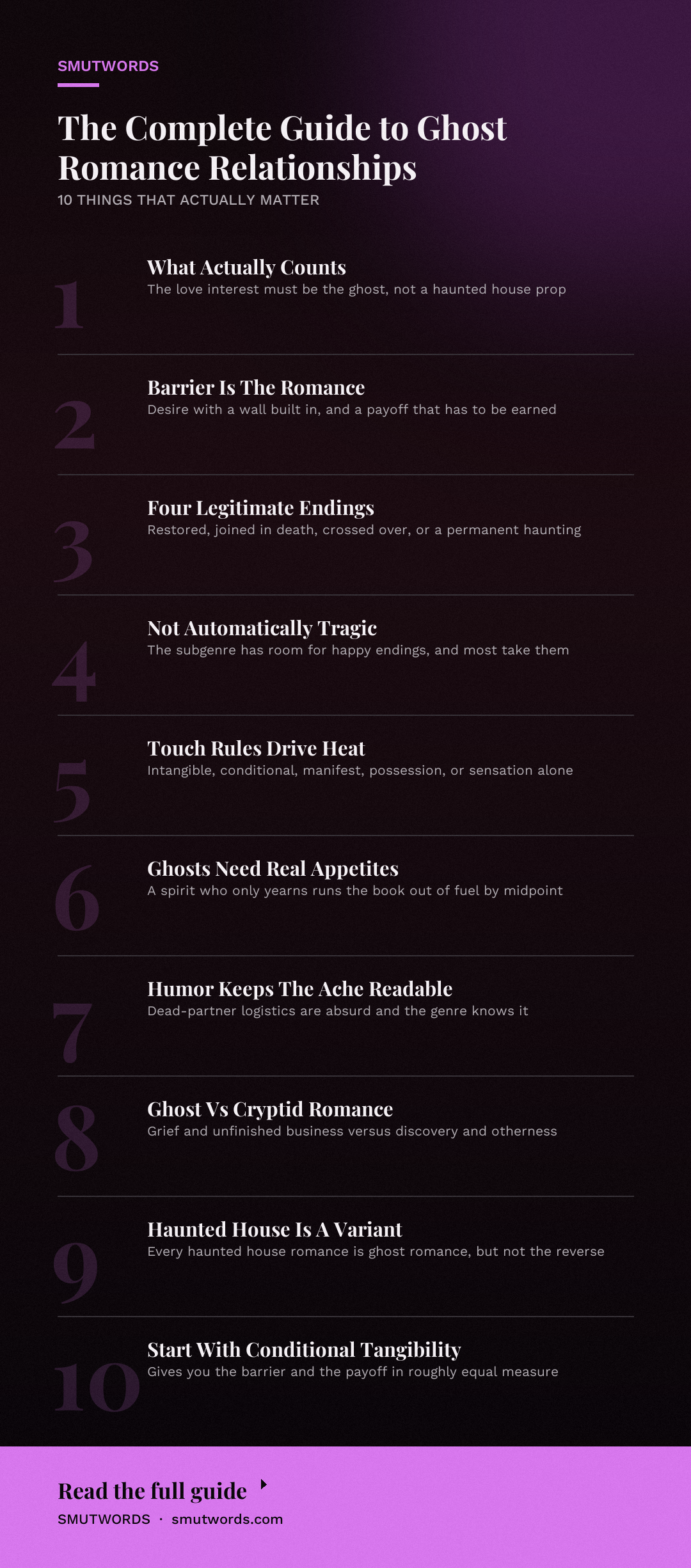
Ghost romance works because it takes the oldest problem in love, which is that you cannot fully have another person, and makes it visible. The ghost is right there and still out of reach. When a book in this subgenre lands, it lands because the writer understood that the barrier is the romance, not the obstacle to it.
If you want one place to start, pick up a reincarnation romance and read it with the touch rules in mind. Notice when contact is allowed, what it costs, and how the ending pays off the exact gap the book spent three hundred pages widening. That's the whole craft of the subgenre in one read, and the fastest way to learn what you like in it.





Loading comments…