
A wedding planner romance follows a protagonist whose literal job is manufacturing other people's happily-ever-afters while their own love life sits in shambles. She has a seating chart for three hundred guests and no plus-one. He has a color palette locked to the Pantone and a client's brother who keeps showing up without a tie and staying until the candles burn out.
The job throws these people together under artificial intimacy, tight deadlines, and somebody else's vows. The genre's core promise is watching a professional whose entire livelihood depends on composure lose it for the right person. It's one of the most reliable contemporary romance tropes for a reason: the setting does half the plotting for the author, and the conflict arrives pre-installed.
What Wedding Planner Romance Actually Means
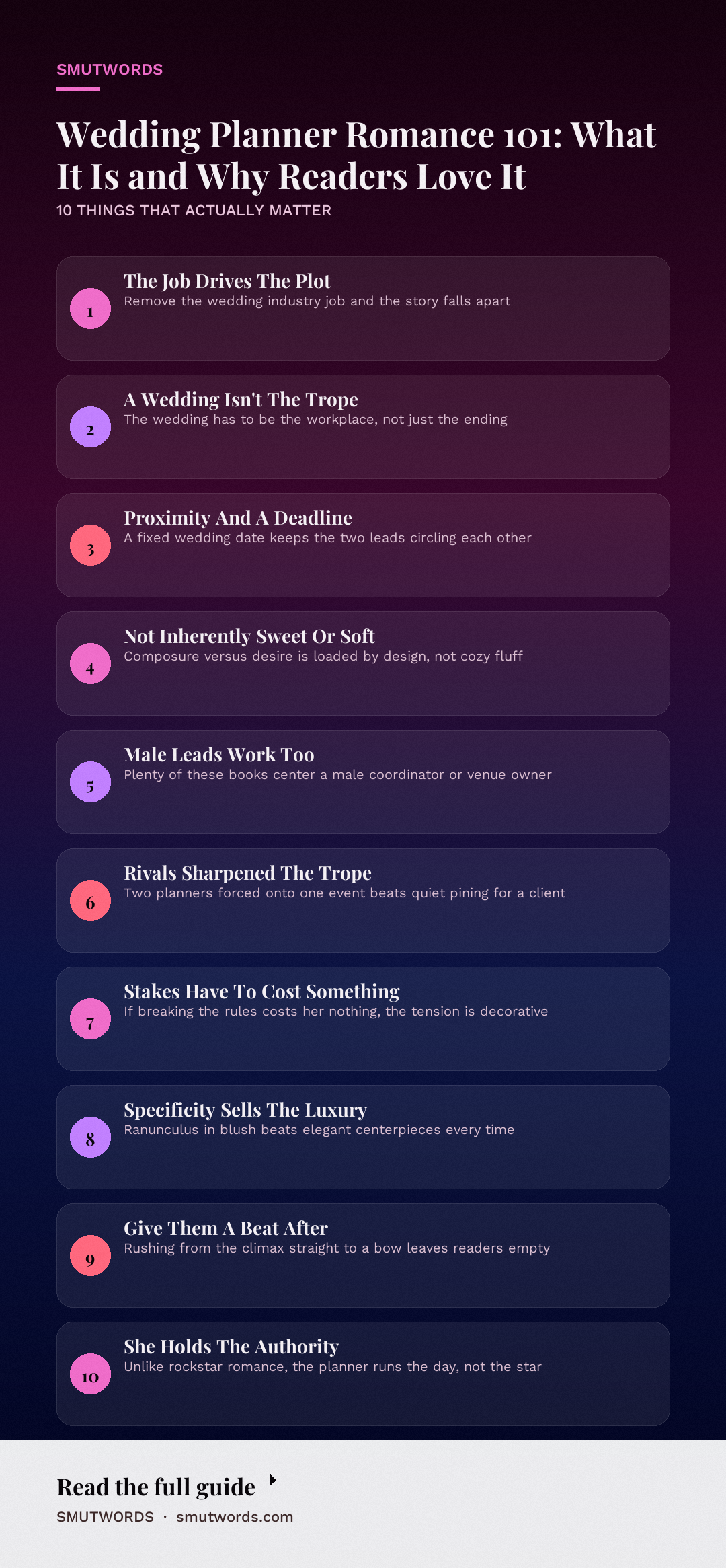
The term describes a romance where the central character works in the wedding industry itself (planner, coordinator, venue owner, florist, caterer, photographer) and the courtship grows directly out of that work. The profession is not background texture. It is the engine. Remove the job and the plot collapses.
This separates it from a romance that simply contains a wedding. A book where the hero and heroine marry at the end is a romance with a wedding in it. A wedding planner romance is one where the wedding is the workplace, and the workplace keeps putting the two leads in the same room with a clipboard between them.
What counts:
- The lead's employment or ownership stake in the wedding industry drives the plot.
- The love interest is a client, a vendor, a coworker, a rival, or a member of the wedding party.
- Professional obligation and romantic desire are in direct conflict, not just mildly inconvenienced by each other.
- The wedding itself functions as a ticking clock, forcing decisions before the big day arrives.
What doesn't count: a heroine who happens to be a caterer in one scene, a story where the couple gets engaged in chapter one and plans their own wedding for three hundred pages, or a romance that uses "wedding" as a metaphor for commitment without any actual event logistics on the page.
A common misconception is that the trope is inherently sweet and low-heat. The professional-composure-versus-personal-desire tension is sexually loaded by design. The best versions of this trope understand that a woman who has spent six months controlling every detail of someone else's evening is primed for a night where she controls nothing. Authors who treat the trope as cozy fluff miss the heat the premise is built to deliver.
Another misconception: that the lead must be female. Plenty of wedding planner romances center a male coordinator, a male photographer, or a male venue owner. The dynamic shifts in interesting ways when the person holding the timeline is the one being undone by a client's sister or a rival planner with better taste in suits.
Where Wedding Planner Romance Comes From
As a publishing phenomenon, the trope's modern boom tracks the broader explosion of the contemporary romance category through the 2000s and 2010s. Wedding culture itself became a mass-media industry in the 1990s, and the romance genre absorbed that imagery fast. The planner as heroine was the natural next step once readers had consumed a decade of bridal magazines and wanted a protagonist who stood behind the bride rather than at the altar.
Early iterations leaned heavily on the fantasy of the perfect day. The heroine was competent, the venue was aspirational, and the love interest was usually a client or a colleague who threatened her professionalism. The sex, when it appeared, was often delayed until after the wedding as though the ceremony itself had to bless it. That restraint has largely evaporated.
The trope's real evolution came with two shifts. First, destination wedding settings let authors push budgets and locations into pure escapism, giving readers the same lavish-access thrill they get from celebrity romance: a world of money and taste most readers will never inhabit, rendered in sensory detail.
Second, the rise of rivals-to-lovers and hate to love structures gave the trope a sharper edge. Two competing planners forced to collaborate on one impossible wedding is a cleaner engine for conflict than a planner quietly pining for a client.
What has not changed is the fantasy's center of gravity. Readers still want the competence porn of a woman running a flawless event, and they still want to watch that competence crack the moment the right person touches her wrist during a cake tasting. The industry backdrop modernizes every few years. The dynamic underneath is stable.
It's worth noting the trope's relationship to reality, which is loose at best. Real wedding planning is logistics, vendor negotiations, and a lot of phone calls. Fiction compresses that into glamour and proximity, which is exactly what the genre is for.
How It Shows Up in Erotica
On the page, the trope runs on proximity and pressure. A wedding has a fixed date. That deadline does work no artificial conflict can match, because the reader knows the two leads cannot keep orbiting each other for long. Every scene has a reason for them to be alone together: a walkthrough, a tasting, a vendor who cancels, a bride who goes missing two hours before the ceremony.
Strong versions of this trope lean into the sensory world of the industry. Fabric swatches, the smell of the florist's cooler, tasting menus, late nights folding place cards, a reception hall after everyone has gone home.
Filthy versions use that same sensory attention on bodies. The hand adjusting a boutonnière. The zipper on a bridesmaid's dress. A stolen ten minutes in a coatroom while the string quartet plays.
Common variants authors reach for:
- Planner and client's sibling. The forbidden-adjacent hook. She can't touch him and she can't stop thinking about him.
- Rival planners. Two professionals with clashing aesthetics forced onto one event. The friction is intellectual before it's physical, which makes the physical land harder.
- Photographer falls for the subject. The camera as an excuse to stare. A built-in voyeurism that pairs naturally with kinks around watching and being watched, similar in energy to what you'll find in our breakdown of predator/prey play.
- Venue owner and the planner renting his space. Forced proximity with a lease. Domestic tension in a beautiful building.
- Fake engagement for a client. The planner pretends to be the date of a client's relative to keep a wedding peace, and the performance stops feeling like performance.
- Destination chaos. A tropical storm, a lost officiant, one hotel room left. Classical escalation.
What separates a strong wedding planner romance from a flat one comes down to how honestly the author handles the professional stakes. If she sleeps with the groom's brother and loses the account and nothing changes in her career, the tension was decorative. If the same mistake costs her a referral she spent two years earning, the reader feels the price of the desire, which is what makes it hot.
Enjoyed this? Get a free book.
Join the list and we will send a complete free story straight to your inbox, plus new releases every week after that. No credit card, no catch.
The other marker of quality: specificity. Flat versions describe "elegant centerpieces." Strong versions describe ranunculus in blush and dusty rose arranged in low gold vessels on ivory linen. Specificity is what gives the reader the vicarious luxury the trope promises.
It works the same way in the sex scenes. A vague hookup reads as filler. A scene that remembers where the bride's bouquet ended up on the floor does not.
The trope also plays well with established structure building blocks. A rival planner who starts cruel and softens across the book is running a redemption arc romance.
A wedding-industry lead who slept with a rock star client and got burned is doing a lighter version of rockstar romance with better table linens. The trope is a container. What you pour into it determines the heat.
One craft note that matters more here than in most tropes: endings. The trope's natural climax is the wedding itself, which means the emotional payoff (the confession, the first real kiss, the decision) often lands in a coatroom or a parking lot while a reception rages inside.
Authors who rush from that moment straight to a bow leave readers empty. The best versions give the couple a genuine beat alone after the event, when the adrenaline has drained and the choice is made. That's the same principle our piece on aftercare in fiction makes about physical intimacy, and it applies just as much to the emotional landing of a hundred-thousand-dollar event.
Wedding Planner Romance vs Rockstar Romance
These two get confused more than you'd expect, mostly because both are workplace-adjacent tropes where the love interest is a larger-than-life figure and the protagonist is the grounded professional managing his chaos. The tour manager and the rock star. The wedding planner and the celebrity client.
The difference is in the power structure. In rockstar romance, the star holds the fame and the money, and the protagonist's job is to serve him while staying invisible. In a wedding planner romance, the planner holds the authority. She's the one with the timeline, the budget, the vendor relationships, and the power to say no.
That reversal is the entire appeal for a lot of readers. The man may be the client, but she's the one running the day.
Frequently Asked Questions
What is a wedding planner romance?
It's a romance novel where the main character works in the wedding industry (planner, coordinator, photographer, florist, venue owner) and the love story grows out of that work. The job creates the proximity, the deadline, and the conflict. The wedding is the workplace, not just the ending.
Is wedding planner romance always enemies to lovers?
No, but the trope skews that direction because the setup naturally pits two professionals against each other. Rival planners, a client's hostile sibling, or a venue owner with clashing priorities all deliver easy friction. Plenty of books run a softer version where the two leads are already fond of each other and the obstacle is purely professional.
Does the couple always end up together at the wedding?
Usually the wedding is the climax, but not always the couple's own. Many books end with the planner watching someone else's ceremony and realizing what she wants, then pursuing it in the final chapters. Others close with a proposal during someone else's reception, which the genre treats as fair game.
Are there male-lead wedding planner romances?
Yes, and they're a growing share of the category. A male coordinator running a luxury venue and falling for a bride's skeptical sister changes the power dynamic considerably, since he's both the authority figure on the timeline and the outsider in the family drama.
How explicit do these books usually get?
It ranges widely. The subgenre includes closed-door versions built on longing and imagery, and it includes fully explicit books that use the wedding backdrop for coatroom and late-night venue scenes. Readers should check content notes the same way they would with any contemporary romance.
What makes a wedding planner romance boring?
Two things: stakes that don't cost anything, and a wedding described in vague generalities. If she breaks every professional rule and her career absorbs no damage, or if the reception hall reads like an empty stage, the book loses the two things the trope exists to deliver.
Final Thoughts
The wedding planner romance works because it hands the protagonist a job that is fundamentally about other people's love while denying her her own. Every seating chart, every cake tasting, every rehearsal dinner is a reminder of what she's organizing for someone else.
The satisfaction comes from watching her finally take some of it for herself. If you want the version that best demonstrates what the trope can do with real heat and real professional stakes, start with the planner who gets involved with the client she should have turned down in chapter one.







Loading comments…