
Collar and leash play is a power exchange dynamic where one partner wears a collar, often with a leash attached, as a physical sign of ownership, submission, or a pet-like role. In erotica, it's one of the most direct visual shorthand devices a writer can use. The collar marks the submissive as claimed. The leash turns that claim into something the Dominant can hold in one hand.
The appeal sits in that tangibility. A collar and leash play scene makes the power dynamic impossible to ignore, and readers who love it come back for the moment the clasp closes.
What Collar and Leash Play Actually Means
The term covers a wide range of practice, from a purely symbolic day collar worn under a shirt to full pet play with paws, ears, and a handler. What ties it together is the collar itself as an object with meaning. A collar is not a bracelet or a ring. It sits at the throat, which is why it carries so much weight.
It is also visible, which means it can be shown to other people in a scene, or hidden under clothing as a private reminder.
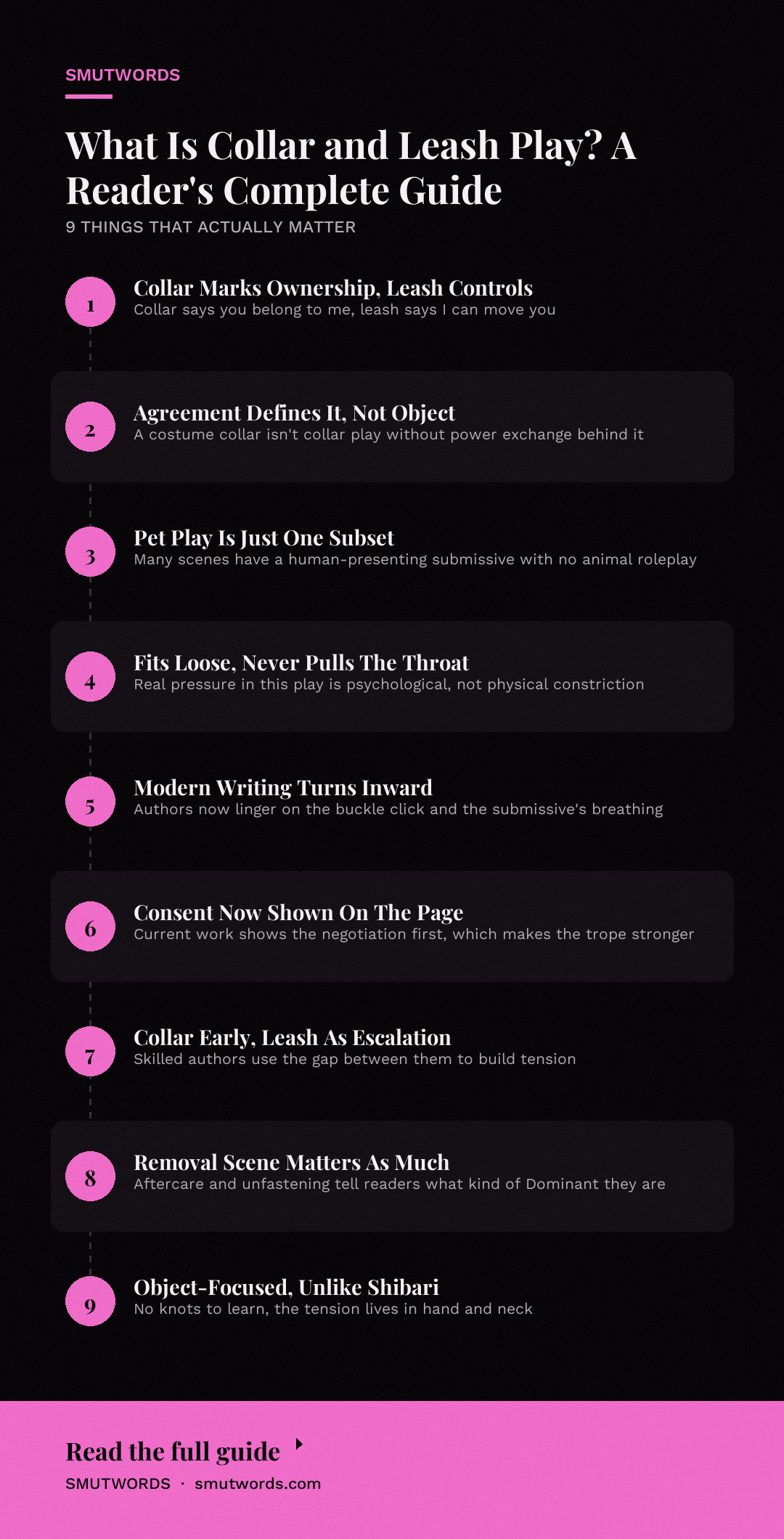
A leash is the accessory that changes the dynamic from static to active. A collar alone says "you belong to me." A leash says "and I can move you wherever I want." That shift from a symbol of ownership to a tool of guidance is what most readers are actually chasing when they seek out collar and leash play.
Not everything involving a collar counts. A costume collar worn for a Halloween party has no power exchange behind it. A collar that is purely decorative in a fashion scene, without a Dominant who put it on and a submissive who accepted it, is an accessory. What makes it collar and leash play in the erotic sense is the agreement: someone chose to wear it, someone else chose to place it, and both understand what that placement means.
A common misconception is that collar and leash play is always about pet play. Pet play, including puppy, kitty, and pony variants, is a subset. Many collar and leash scenes involve no animal roleplay at all. The submissive might be human-presenting in every way, kneeling at the Dominant's feet on a leather lead while speaking in full sentences.
The collar is doing the work. The leash is doing the work. The headspace does not have to be canine or feline for the object to land.
Another misconception is that the collar has to be restrictive or tight. It does not. A well-fitted collar sits loose enough to slip a finger under, and a leash is never used to pull against the throat.
The pressure readers respond to is psychological, not physical constriction. Any scene that puts real pressure on the windpipe has crossed out of play and into danger.
Where Collar and Leash Play Comes From
The collar as a marker of ownership has deep roots in real-world BDSM communities, where collaring ceremonies have functioned for decades as the kink equivalent of an engagement or marriage ritual. The collar in those communities is not a prop. It is a commitment object, sometimes worn daily, sometimes only during scenes, depending on the couple's agreement. That real-world weight is part of why the object translates so well to fiction.
In erotica and romance specifically, the collar and leash have been a recognizable trope since at least the underground BDSM publishing boom of the 1970s and 1980s, when leather-culture imagery made its way from community spaces into commercial fiction. Early published versions leaned heavily on the visual: black leather, silver rings, studded bands. The collar was a signifier of an entire lifestyle, and the story around it was often about a newcomer being initiated into that world.
The shift over the last two decades has been toward interiority. Modern collar and leash play in romance is less about the object as a lifestyle badge and more about what the object does to the wearer's head. Authors spend pages on the moment the Dominant fastens the buckle, the sound it makes, the way the submissive's breathing changes. The collar became a psychological device rather than a costume piece.
The other major shift is in who wears it and why. Earlier fiction overwhelmingly framed the collar as something a female submissive received from a male Dominant. Contemporary erotica has opened that up considerably. Collars now appear on male submissives, on nonbinary characters, and in same-sex pairings across the spectrum.
There is also a growing strand of fiction where the collar is worn outside the bedroom as a day collar, a private signal in a public setting. That lets authors write tension into ordinary scenes like a workday or a family dinner.
The genre has also gotten better at consent. Older published versions often skipped negotiation entirely, treating the collar as something that simply happened to the submissive. Current work, especially from authors with community ties, tends to show the conversation first. That change has made the trope stronger rather than softer, because a collar that was actively chosen carries more weight than one that was imposed.
How It Shows Up in Erotica
On the page, collar and leash play is a pacing device as much as a sex act. The collar is often introduced early as a symbol, then the leash arrives later as an escalation.
A skilled author will use the gap between those two moments to build tension. The reader knows the leash is coming. The submissive might not.
The strongest scenes tend to linger on the mechanics. The click of a buckle. The weight of the leather settling against the collarbone. The first tug on the lead, gentle, just enough to suggest direction.
These small physical beats are what make the dynamic feel real rather than declared. A scene that announces "she was his submissive now" without showing the collar going on is doing half the work.
Writers also use the leash to control movement within a scene, which opens up spatial possibilities. A Dominant can lead a submissive across a room, position them where they want them, or hold them in place with a single hand. That control over where the submissive's body goes is often more erotic to readers than any explicit act, because it externalizes the power exchange into visible choreography.
Enjoyed this? Get a free book.
Join the list and we will send a complete free story straight to your inbox, plus new releases every week after that. No credit card, no catch.
Common variations authors reach for:
- Formal collaring ceremony — a ritual scene where the collar is presented and fastened in front of witnesses or in private, often functioning as an emotional climax rather than a sexual one.
- Day collar — a subtle piece, sometimes a necklace or choker, worn in public as a private reminder of the dynamic. Great for slow-burn tension across a whole book.
- Pet play crossover — puppy, kitty, or pony play where the collar and leash are part of a larger roleplay with ears, tails, or a handler dynamic.
- Punishment collar — a heavier or more restrictive collar used specifically during discipline scenes, often paired with degradation kink for submissives who respond to being talked down to.
- Training lead — a short leash used for close-quarters control, popular in scenes where the Dominant wants the submissive at their feet.
- Public leash — the submissive led through a club or party on a lead, which is where collar and leash play can overlap with an orgy setting or a group scene.
What separates a strong collar and leash scene from a flat one usually comes down to specificity of sensation and emotional stakes. A flat version describes the collar as "a symbol of her submission" and moves on. A strong version tells you what the leather smells like, how the submissive's pulse feels against the band, and what the Dominant's voice does when they give the first command.
The object is the same. The attention is what differs. For a related device built on the same principle, our breakdown of sensory deprivation shows how one physical object can carry an entire scene.
Praise and collar play pair well together, and authors who understand that often layer them. A Dominant fastening a collar and then telling the submissive how well they wear it hits two responsive buttons at once. If you want to understand why that combination works so reliably, our guide to praise kink breaks down the psychology behind it.
Intensity also scales. A collar and leash scene can be tender, almost ceremonial, with the Dominant speaking softly and the submissive crying happy tears. Or it can be rough, with the leash used to pull the submissive into position during rough sex. Both versions sell, and both require the same underlying trust to land emotionally.
Feral energy is another direction worth noting. Some authors write collar and leash play where the submissive is meant to feel untamed, and the collar is the one thing keeping them contained. That overlaps with feral play, where the submissive leans into animalistic behavior and the Dominant's grip on the leash becomes the tether to control.
It is a harder edge than the ceremonial version, and it works best when the author has already established that both parties want to be there.
The moment of removal matters as much as the moment of placement. Aftercare scenes where the Dominant unfastens the collar and checks in with the submissive are increasingly common in contemporary erotica, and readers respond to them. The collar coming off is the signal that the scene is over, and the way a Dominant handles that transition tells the reader everything about the kind of Dominant they are.
One craft note for anyone writing this: the leash should never be the thing that creates danger. If a scene has the Dominant yanking the submissive by the throat, that is not an intensification of collar and leash play. That is a scene where the author did not do their homework, and readers who actually practice will notice immediately. Tension comes from the hold, not from the force.
Collar and Leash Play vs Shibari
These two get compared because both involve restraint and both are visual, but they do different things. Shibari is rope-based, and the appeal is in the pattern, the wrapping, and the aesthetic of the ties themselves. The rope is often the point of the scene.
Collar and leash play is object-focused rather than technique-focused. There is no knot work to learn. The collar goes on, the leash clips to it, and the dynamic is live. Where shibari scenes tend to build slowly and reward patience and precision, collar and leash scenes tend to be immediate, and the tension comes from the ongoing relationship between the Dominant's hand and the submissive's neck.
Both can appear in the same scene, and frequently do. A submissive in rope with a collar over the top of it is a common composition in club settings. But if you are reading for the feeling of being claimed and led, you want collar and leash play. If you are reading for the feeling of being wrapped, suspended, and displayed, you want shibari.
Frequently Asked Questions
Is collar and leash play the same as pet play?
No. Pet play is a specific roleplay where one partner takes on an animal persona, complete with behaviors like barking, purring, or trotting. Collar and leash play does not require any animal roleplay. Many scenes feature a fully human submissive wearing a collar purely as a symbol of submission, with no pet identity involved.
Do you have to wear a collar around the clock?
Only if both partners agree to it. Some people wear a day collar constantly as a private commitment marker, while others only wear one during scenes. Neither is more valid. The collar's meaning comes from the agreement behind it, not from how many hours it stays on.
What is a day collar?
A day collar is a subtle version of a collar designed to be worn in public without drawing attention. It might look like a necklace, a choker, or a simple chain. The point is that it signals the dynamic to the wearer and their partner while remaining invisible to everyone else, which makes it a favorite device in slow-burn romance.
Is it safe to pull on a leash?
Gentle guidance is fine. Pulling hard against the throat is not. The leash should never restrict breathing or jerk the neck. A properly fitted collar sits loose enough to slip a finger underneath, and any scene involving a collar should be paired with a clear safeword that either partner can use at any time.
Can the submissive be the one holding the leash?
Yes. While the more common arrangement has the Dominant holding the lead, some dynamics flip the script, with a submissive leading a collared partner as part of a service role or a switch scene. The object stays the same. The authority is what moves.
Why is the collar so central to so many BDSM romances?
Because it is a single object that communicates everything a reader needs to know about the relationship in one image. Ownership, consent, chosen submission, and ongoing commitment all fit into one band of leather. Few props in the genre do as much narrative work with so little description.
Final Thoughts
Collar and leash play earns its place in erotica because it turns an abstract power dynamic into something a reader can see, hear, and feel. The click of the buckle, the weight of the lead, the shift in a submissive's posture the moment the collar goes on. If you want to read a book that gets all of that right, and that treats the collar as a commitment rather than a costume, the ranked list below is where to start.








Loading comments…