Flogging is impact play built around a multi-tailed whip: a handle, a fall of leather or suede or rubber strips, and a rhythm struck against a partner's skin. That's the plain definition.
What keeps readers coming back to flogging in erotica is everything around the strike. The sound of the tails before they land. The way a scene can start as a tease and end as something much heavier without ever changing implements. The person holding the handle deciding exactly how much the other one gets.
It sits close to caning, whipping, and single-tail play, and it shares a family tree with all of them, but the flogger has its own texture on the page. A cane is precise and punishing. A single-tail is a threat before it's a sensation. A flogger is broad, rhythmic, and theatrical, which is why it turns up in so many scenes where the point is the ritual as much as the sting.
This guide covers where the term comes from, how it actually functions in a scene, what separates a good flogging scene from a lazy one, and the safety details that fiction tends to skip.
What Flogging Actually Means
The word comes from the Latin flagellum, a whip, and it entered English through the verb flagellare, to whip. Historically the flogger was a punishment instrument: naval discipline, penal sentences, religious self-mortification.
In BDSM, the same object gets repurposed as a tool for negotiated sensation. The implement didn't change. The consent framework around it did.
Not everything with tails counts as flogging. A few distinctions matter for reading and writing these scenes accurately.
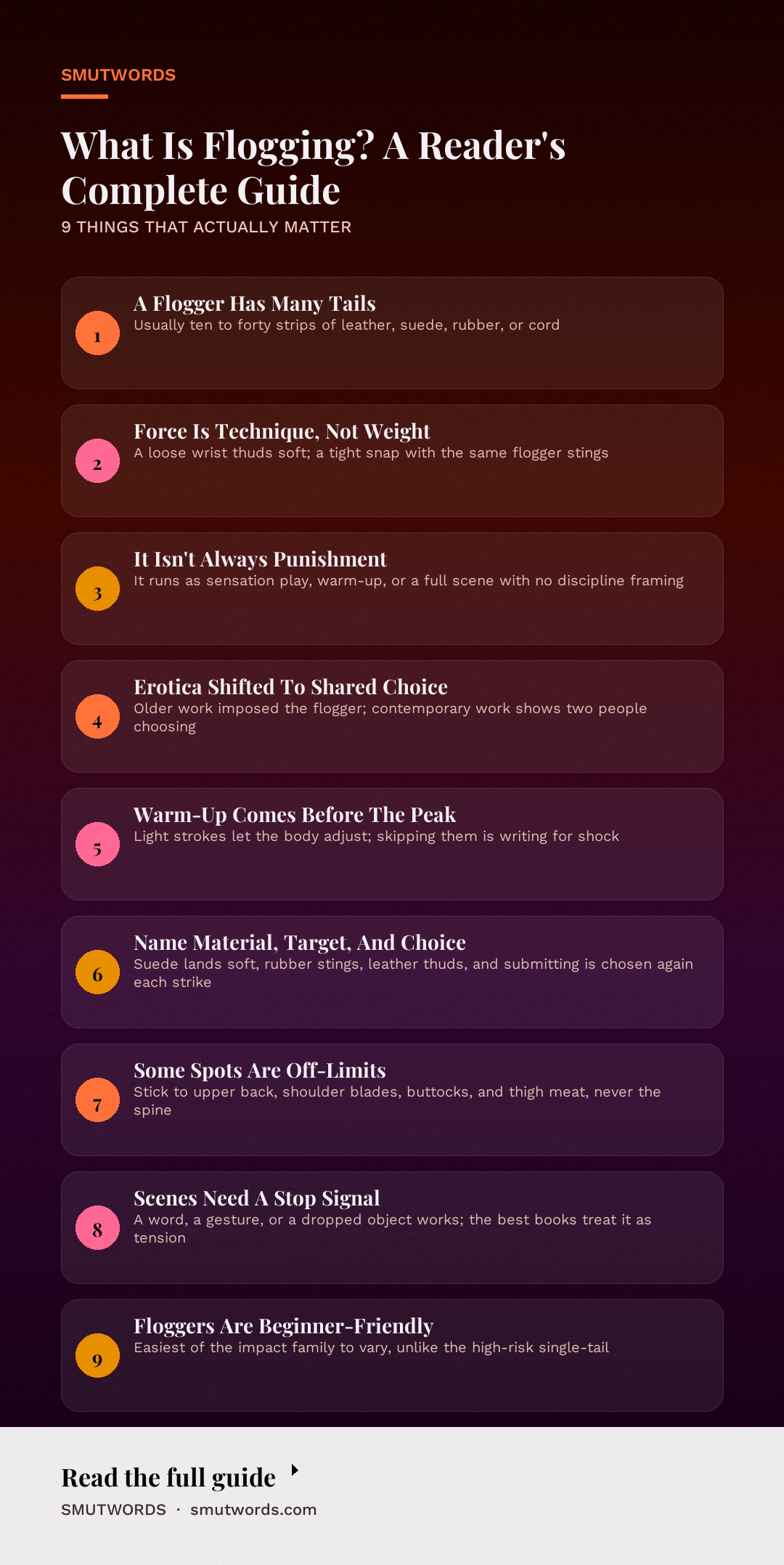
- A flogger has many tails. Usually somewhere between ten and forty, made of leather, suede, rubber, or synthetic cord. More tails spread the impact across a wider area.
- A single-tail whip has one. One tail concentrates force into a much smaller point, which is why single-tail play reads as sharper and more dangerous in fiction. It genuinely is.
- A cane is a solid rod. No tails at all. Caning delivers a narrow, precise line of sting and is a separate discipline with its own technique.
- A paddle is flat and broad. Also impact play, also its own thing. Paddles thud and slap; floggers can sting or thud depending on how they're thrown.
The most common misconception is that heavier always means harder. A flogger thrown with a loose wrist lands as a soft, almost pleasant thud across the back. The same flogger snapped with a tight wrist and full follow-through delivers a sting that lights up the whole area. Force is a technique question, not an implement question, and that's the detail most bad scenes get wrong.
Another misconception: flogging is a punishment. Plenty of scenes use it as sensation play, a warm-up, a trust exercise, or a full scene in itself, with no discipline framing at all. The punishment angle is one costume the practice wears, and a popular one, but it isn't the definition.
Where Flogging Comes From
As a real-world practice, whipping and flogging have centuries of grim institutional history: military punishment, judicial flogging, and religious flagellation traditions across multiple cultures. That history matters for understanding why the flogger carries so much weight as an object, but it isn't erotica history. The publishing history is what's relevant here, and it's shorter.
Flogging shows up in erotic writing long before the modern BDSM scene existed as a named, organized community. Victorian flagellation literature is a whole subgenre, sold discreetly, built around schoolroom and domestic punishment scenarios. Those stories were less interested in negotiated sensation than in discipline and humiliation, and the flogger or birch rod was the delivery mechanism for both.
The shift came in the late twentieth century, when BDSM communities started writing about their own practice with more attention to technique and consent. Erotica followed. The scene stopped being only about punishment and started including scenes where the person receiving the flogging wanted it, asked for it, and negotiated the specifics beforehand. If you want to see a related shift in how kink gets written honestly, roleplay kinks in erotica go through the same arc.
That change is visible in how the language moved. Older erotica treats the flogger as an instrument of someone's will being imposed on someone else.
Contemporary erotica treats it as a shared tool, with a person on each end of it making choices. The dramatic tension shifted from "will they be punished" to "how much will they take, and how much will the other one give." That's a richer scene, and it's why the trope still works in new books instead of reading as a period piece.
Genre-wise, flogging moved from specialty publishing into mainstream romance and BDSM romance as the latter became a shelf category with real commercial weight. Now it's a standard scene beat in dominant/submissive romance, and readers evaluate it the same way they evaluate any other scene: does the author actually know how this works, or are they guessing?
How It Shows Up in Erotica
On the page, a flogging scene lives or dies on rhythm and buildup. The strike itself is one second of sensation. The scene around it is where the writing happens, and the strongest authors treat the flogger as a metronome for the emotional arc.
A typical scene has phases. Negotiation or implied negotiation first, which can be a conversation, a formal ritual, or a glance across a room that establishes who is in charge.
Then the approach: the flogger comes out, gets shown, sometimes gets drawn across skin before a single strike lands. Then the warm-up, light strokes that let the receiver's body adjust. Then the build. Then the peak and whatever comes after, whether that's sex, aftercare, or a held moment.
Authors who skip the warm-up and open with full-force strikes are usually writing for shock value. Authors who spend three pages on the approach understand that anticipation is doing most of the work.
Enjoyed this? Get a free book.
Join the list and we will send a complete free story straight to your inbox, plus new releases every week after that. No credit card, no catch.
Common variations you'll see in published erotica:
- Formal scene. A planned, ritualized session with negotiation, safewords, and aftercare shown on the page. Heavy on protocol. Popular in BDSM romance with explicit consent framing.
- Impulsive scene. A flogger that happens to be in the room gets used. Common in historical settings or in contemporary books where a character discovers the practice through a partner.
- Public or semi-public scene. A club setting, a party, a demonstration. The audience angle pulls in voyeurism (there's a whole glossary entry for that) and lets the author write the reactions of onlookers alongside the scene itself.
- Flogging as foreplay. Short, light, integrated into a larger sexual scene rather than treated as the main event.
- Flogging as escalation. A scene that starts with hands or a belt and moves to the flogger when the dominant wants more intensity.
- Flogging as degradation. Rarely about the flogger alone, but when a character gets called names between strikes or forced to count out loud, it intersects with degradation kink and the psychological layer becomes the real subject.
What makes a flogging scene land well is specificity of sensation. Vague descriptions ("he whipped her and it hurt and she liked it") read as thin. Strong scenes name the material.
Suede tails land soft. Rubber stings. Leather with a wide cut thuds.
Strong scenes name the target: upper back, shoulder blades, the meat of the thighs, never the spine.
Strong scenes register the receiver's internal experience, which is often less about pain than about decision. Submitting to the next strike is a choice made over and over, and the good authors let the reader see the choosing.
Frequent weakness in weaker scenes: treating the flogger as decoration. It gets mentioned once, then the actual interaction shifts to something else. If the implement is in the scene, the scene should be about what it does, or it should not be there.
A second weakness: pure sensation without stakes. Impact play is interesting because something is being risked, even if the risk is just composure. If the scene has no tension around how much a character can take, or whether the other one will stop, the strikes become procedural. Procedural writing is dull no matter what's happening on the page.
Floggers also work as a prop in non-BDSM romance, usually in a "decadent object" role: a decorative piece in a rich character's apartment, a costume accessory, an inside joke between partners. That usage is fine, but it's not flogging. Flogging requires the strike, and the strike requires the two people.
Flogging vs Caning and Single-Tail Play
These three get grouped as "impact play" and treated as interchangeable in a lot of writing. They aren't, and the differences matter if the scene is going to feel accurate.
- Flogger: many tails, wide coverage, sensation ranges from soft thud to sharp sting depending on force and material. Easiest of the three to vary mid-scene.
- Cane: one solid rod, narrow line of impact, high sting, low coverage. Precision instrument. Marks are more visible and last longer.
- Single-tail: one long leather tail, focused tip, highest risk of serious injury of the three. Usually reserved for advanced practitioners in real life, and often treated as a "serious" implement in fiction to signal that a dominant is experienced or dangerous.
A flogger is the beginner-friendly implement of the family, which is why it dominates literary scenes that want the iconography of impact play without the credibility problem of a character who's supposedly skilled but picks up a single-tail on day one. If you're writing a scene where the point is the power dynamic rather than the technical mastery, the flogger is the right instrument.
Frequently Asked Questions
What is flogging in BDSM?
Flogging is impact play using a multi-tailed whip called a flogger, struck rhythmically against a partner's skin. Sensation ranges from light thudding to sharp stinging depending on technique, material, and force. It's usually done within a negotiated power exchange, with the receiver consenting to the scene and often to specific intensity levels beforehand.
Is flogging the same as whipping?
Related, not identical. Whipping usually refers to single-tail whips, which concentrate force into a much smaller area and carry higher injury risk. Flogging uses many tails spread across a wider surface. Both are impact play, but they feel different and are written differently.
What does flogging feel like?
It depends almost entirely on technique. A loose throw with soft suede lands as a warm thud, close to a massage. A snap with a tightly gripped wrist stings sharply across a wide area. Experienced receivers often describe the sensation building across multiple strikes rather than any single one, which is why rhythm matters more than individual force.
Where is it safe to flog someone?
The upper back, shoulder blades, buttocks, and the meat of the thighs are the standard targets. The kidneys, spine, neck, tailbone, and joints are off-limits. Real practitioners avoid striking the same spot repeatedly without a break, and they check in with the receiver during longer scenes.
Do flogging scenes need safewords?
Any scene with significant physical sensation benefits from a clear signal to slow down or stop, whether that's a word, a hand gesture, or a dropped object. Fiction often skips this, but the strongest BDSM romance treats negotiation and signals as part of the scene's tension instead of an interruption. That same instinct shows up in how body fluid kink gets written: the mechanics are the tension when the author commits to them.
Why is flogging so common in BDSM romance?
It's visually readable and emotionally flexible. A flogger can carry a scene from light teasing to full intensity without the author changing implements, and the rhythm of the strikes gives any writer a natural pacing tool. It also reads clearly on the page: readers who've never held one still understand what a multi-tailed whip looks like and what it implies.
Final Thoughts
The flogger earns its place in a scene because it's legible. A reader who's never picked one up still knows what it looks like, what it implies, and roughly what it would feel like. What they don't know, and what the writer has to supply, is why these two particular people are in the room doing this to each other.
Get the rhythm right, get the choosing right, and the strike is almost beside the point.







Loading comments…