
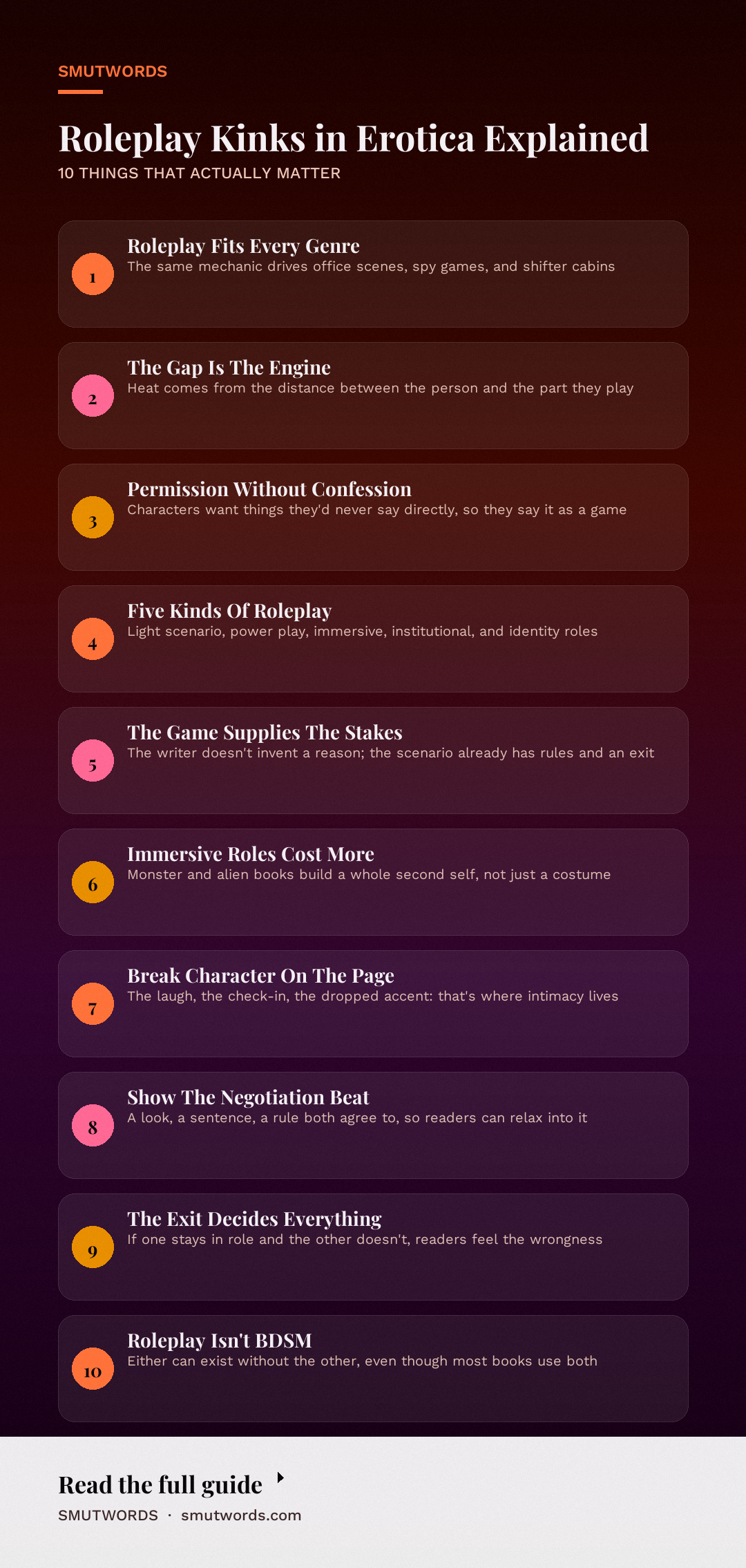
Roleplay is the most versatile kink in erotica because it doesn't stay in one lane. The same mechanic that drives a boss-secretary scene in a contemporary office romance also powers a captured-spy interrogation, a stranger-at-the-bar pickup, and whatever a shifter and a human negotiate in a cabin with no cell service. If you read across genres, you've already been reading roleplay kink erotica whether or not the book labeled it that way.
The characters agree to be someone else for a while, and the heat comes from what that permission lets them do.
What makes it work on the page is the same thing that makes it work in bed: the gap between the people and the parts they're playing. A shy librarian can be a demanding dominatrix for one night without becoming one. A man who'd never cheat on his wife can play the stranger who picks her up at a hotel bar because the game belongs to both of them.
Roleplay is a container, and everything inside it is consensual by construction, which is why it shows up in almost every genre SmutWords stocks.
What Counts as Roleplay in Erotica
Broadly, any scene where at least one character is performing a role they don't hold in real life. The roles can be as thin as a borrowed name at a bar or as thick as a full alternate identity with its own backstory, accent, and rules of engagement. The spectrum matters because readers want different things from each end of it.
- Light scenario play: a costume, a fake name, a single night. The teacher-student scene where both are adults at a conference. Low commitment, high clarity.
- Structured power play: boss and employee, captor and captive, owner and pet. The roles come with built-in hierarchy, which is the whole appeal for readers who want the power exchange explained without a formal BDSM framework.
- Full immersive roleplay: sustained identities across multiple scenes, sometimes across a whole book. The characters stay in character outside the bedroom. This is where alien, monster, and historical erotica live.
- Institutional roleplay: free use, breeding programs, mate selection auctions. The role isn't a costume, it's a system the characters are inside of. Free Use Casino builds an entire economy around it.
- Identity roleplay: the wife who becomes a hotwife for a night, the husband who watches. The role is relational rather than occupational.
Most books mix two or three of these. A single scene can start as light scenario play and end with the characters so far inside the roles that coming back out is its own kind of aftercare.
Why Roleplay Kink Erotica Works So Well
Permission without confession
The central trick is that roleplay lets characters want things they'd never admit to wanting. She doesn't have to tell her husband she fantasizes about being shared; she can propose a game where a stranger picks her up and he happens to be watching. Shared Without Shame: A Hotwife Exhibition & Sharing Fantasy runs on exactly this structure, where the exhibition is the point and the marriage is the thing making it safe.
That's not cowardice on the character's part. It's how a lot of real desire actually moves. Saying the thing directly is hard. Saying it inside a frame both people agreed to is easier, and erotica is very good at showing the relief that follows.
The gap between actor and role
Readers get two characters for the price of one. The mild-mannered boyfriend and the predator he plays. The quiet wife and the woman who takes what she wants in a hotel room.
The tension lives in that gap, and good writers keep poking at it. She notices his voice drop into the character and feels something different than she feels about his normal voice. He watches her hold eye contact in a way she never does at home. That frisson is the genre's entire engine.
Built-in stakes and structure
A roleplay scene arrives with its own rules, which solves a real craft problem. The writer doesn't have to invent why these two people are suddenly doing this. The game supplies the reason.
It also supplies the exit. There's a clear moment when the scene ends, and what happens in that moment is often the most emotionally loaded part of the chapter.
Who breaks character first. Who laughs. Who's still trembling twenty minutes later.
Scenario Play vs. Immersive Roleplay
The practical difference is duration and cost.
Scenario play is cheap and fast. A wig, a fake accent, a hotel bar, one night. It resolves in a scene or a chapter. It's ideal for readers who want the kink without a book-long identity commitment.
Blind date setups are basically this in structural form, and you can see the shape of it in the blind date romance entry: two people performing best-foot-forward versions of themselves and then having to reconcile that with who shows up on date three.
Immersive roleplay costs more and pays off bigger. The character builds an entire second self, with rules and vocabulary and a reason to exist. Monster and alien erotica is where this gets most extreme, because the role isn't a costume at all. The human really is a captive, really is being bred, really is the pet.
Lured by the Lizard Beast and Zorgon's Pet both live at this end of the spectrum, where the roleplay is so complete that the reader stops noticing it's roleplay.
Neither is better. The failure mode at each end is different, though. Scenario play fumbles when the writer forgets to give the characters any reason to want the game. Immersive roleplay fumbles when the writer forgets the characters are people underneath, so the roles flatten into pure plot furniture.
Roleplay Across the Genres
Contemporary and hotwife
Modern settings use roleplay to route around monogamy guilt. The husband who watches is a role. The stranger who fucks her is a role. The marriage stays intact and often gets stronger, because the game is something they built together.
Enjoyed this? Get a free book.
Join the list and we will send a complete free story straight to your inbox, plus new releases every week after that. No credit card, no catch.
Permission Slip: A Cuckold Erotic Short Story handles the permission grant explicitly, which is where the heat actually lives for this subgenre. The conversation where he agrees is frequently hotter than the scene that follows.
Monster, alien, and shifter
These genres lean into full immersion because the role isn't optional. She's taken. She's claimed. She's bred by something that doesn't ask.
The writing problem is that this reads as non-consent on the surface, so the better books solve it by making her willing participation part of the setup, or by building in a mate bond that overrides the human rules.
That's the work the alien breeding trope does in the best examples. If you want to see how the consent architecture differs between monster and shifter books, the breakdown of big cat shifter romance relationships is a useful place to compare the two.
Cyberpunk, club, and structured worlds
Some settings hand the characters their roles before they walk in the door. Motorcycle club romance assigns rank and loyalty codes. Cyberpunk assigns corporate status and body modification. Both are roleplay systems, just with a stronger architecture than a hotel bar pickup.
The motorcycle club romance glossary entry lays out the rank structure if you want to see how much of the sexual tension is produced by the hierarchy alone.
Dark romance and redemption
Here the roleplay is often retrospective. The character was a villain, then becomes the love interest, and the reader has to accept both versions. That's a role transition written at the plot level rather than the scene level, and the redemption arc romance definition covers how the genre handles it. The same actor-versus-role tension from a one-night scenario, stretched over 300 pages.
What Separates Good Roleplay Scenes From Bad Ones
Three things, consistently.
- The role has a reason to exist. The character wants something and the role is how they get it. When a scene has a costume and no motive, it reads as filler.
- The character breaks are written. The moment she laughs and drops the accent, or he checks in with his real voice. Those breaks are where the intimacy lives, and skipping them makes the scene feel mechanical.
- The negotiation is on the page. Not a legal document, but something. A look, a sentence, a rule they both agree to. Readers who care about consent (and the vast majority do) need that beat to relax into the scene.
If you want a hard test: cover the character names and read the scene. Can you still tell who's playing who? If the roles are doing nothing, the scene is decoration.
Common Reader Questions
Is roleplay in erotica the same as BDSM?
Overlapping but separate. Roleplay can exist with zero power exchange, like a fake dating scenario.
Power exchange can exist with zero roleplay, like a married couple with a standing collar rule. Most books use both, which is why the two get conflated. The basics of power exchange are worth knowing separately so you can spot which one a scene is actually running on.
Does roleplay require a costume or a setting change?
No. The strongest scenes in the genre often happen in a character's own bedroom with nothing changed but the voice and the name. The hotel bar version is more photogenic but not more effective.
Destined lovers and second-chance setups do something adjacent, where the roleplay is temporal rather than situational: the character is pretending the past didn't happen, or performing the version of themselves from ten years ago. What Is Destined Lovers? A Reader's Complete Guide covers how that temporal layer changes the game. So does Second Marriage Romance: Everything You Need to Know, where both partners are usually playing at being unbothered newlyweds while the first marriage sits in the room.
Why does the scene ending matter so much?
Because the exit is where the reader learns whether the game was mutual. A scene that ends with one character still inside the role and the other already back to normal feels wrong, and readers register that wrongness even if they can't name it. The best books spend real page time on the come-down. A shower, a glass of water, a joke, a hand on the back.
Where Roleplay Kink Erotica Goes Next
You can see the range across the catalog. Free Use Casino builds an institutional role, which is the deepest end of "you are what the system says you are." He Paid Him to Fuck Me does the same thing at the transactional level, where money transfers function as a permission slip and the roleplay is the reason the money isn't the actual subject.
Both books understand the same rule: the role is scaffolding, and the emotional payload sits underneath it.
If you're new to the kink and want to read it in its clearest form, start with a hotel bar scenario. If you want to see how far the genre takes it, start with a captive or pet book and watch how quickly the role becomes the reality.
Both readings teach you the same thing about why this mechanic keeps showing up, genre after genre, and why it's still the most reliable way erotica lets characters want what they'd never say out loud.
Final Thoughts
If you only read one book from this post, make it Permission Slip: A Cuckold Erotic Short Story. It's short, it runs the entire arc from proposal to scene to come-down in a single sitting, and it shows the negotiation beat on the page in a way most full-length novels skip. Read that one and you'll recognize the structure in every roleplay scene you pick up afterward, which is a good place for a reader to be.








Loading comments…