
Single mom romance is a love story built around a heroine who already has a full life before the hero shows up: kids, a job, an ex somewhere in the rearview, and a schedule with no room in it for nonsense. The romance happens in the gaps. School pickup, a late shift, a kitchen that never stays clean for more than an hour.
What makes the subgenre tick is that love has to fit into a life that was working fine without it. The hero has to prove he belongs in that life rather than expecting her to rearrange everything around him. It is one of the most reliably popular setups in contemporary romance, and it rewards authors who understand why.
What Single Mom Romance Actually Means
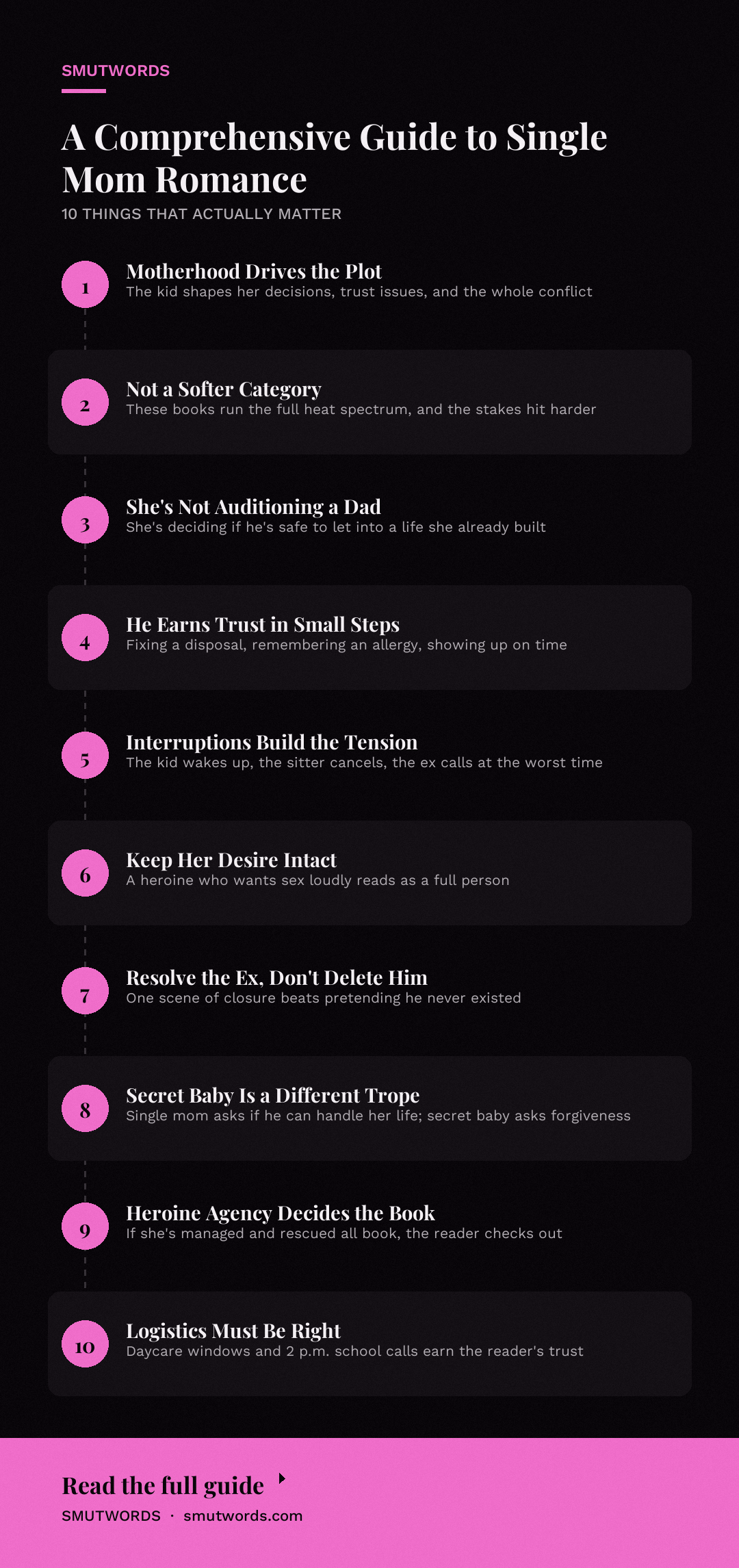
The term describes a romance where the heroine is a mother, and her motherhood is central to the plot rather than a background detail mentioned once and forgotten. She is not just a woman who happens to have a child. The child shapes her decisions, her availability, her trust issues, her priorities, and usually the entire conflict of the book.
What counts: the heroine has at least one dependent child living with her for most of the story, the hero has to interact with that child in some meaningful way, and the romance cannot be resolved without addressing what his presence means for the family unit.
What does not count: a heroine with a grown child who lives in another state, a pregnancy-only plot with no existing kids, or a book where the child exists purely as a prop who appears in two scenes and never affects anything.
The most common misconception is that single mom romance is a softer, lower-heat category. That is wrong. These books run the full heat spectrum, from closed-door to explicit, and the emotional intensity is often higher than standard contemporary romance because the stakes are not just "will they end up together." The real question is whether he can be trusted around her kid, and readers feel that question in their chest.
Another misconception: that the heroine is looking for a replacement father. Most strong single mom romance refuses that framing. She is not auditioning a dad. She is deciding whether this man is safe to let into a life she has already built.
Where Single Mom Romance Comes From
The trope has roots in mid-century category romance, where widowed or divorced heroines appeared as sympathetic figures who deserved a second chance at love. Those early versions were usually chaste, and the child often existed to demonstrate the heroine's virtue rather than to complicate her life. The hero typically rescued the family financially or socially, and the happy ending was marriage and stability.
The real shift happened in the 1980s and 1990s as category lines like Harlequin Superromance and Silhouette Special Edition built entire readerships around family-centered stories. Divorce rates were climbing, single motherhood was becoming a visible and normal part of the cultural conversation, and readers wanted heroines who looked like their own lives. The child stopped being a symbol and became a character.
The 2000s brought the small-town single mom boom. Authors set these books in tight communities where everyone knew everyone, which meant the hero had to win over not just the heroine but the neighbors, the ex, the kid, and the kid's grandmother. This is also when the subgenre started overlapping heavily with lumberjack romance and other blue-collar settings, where the hero's competence with his hands became a stand-in for his reliability as a partner.
Indie publishing changed the shape again after 2012. Without category length constraints, authors started writing single mom romance at 90,000 words with detailed kid dynamics and real co-parenting conflict.
They also stopped faking the sex. Explicit scenes now acknowledged how logistically difficult it is to have a sex life when a seven-year-old is asleep in the next room.
That logistical honesty is the genre's signature. A hero who can keep his voice down and set an alarm for 5 a.m. is doing more for the reader than one who owns a penthouse.
How It Shows Up in Erotica
On the page, single mom romance lives and dies on interruptions. The kid wakes up. The babysitter cancels. The ex calls at the worst possible moment.
Skilled authors use these interruptions as pacing tools, stretching the tension instead of killing it, so that the first time the hero and heroine get an uninterrupted hour together it feels like an event the reader has been earning alongside them.
The strongest versions share a few craft habits:
- They make the kid a real person. Specific. Opinionated. Sometimes annoying. A child who exists to be adorable and convenient flattens the whole book.
- They let the hero earn trust in small increments. Fixing a garbage disposal. Remembering the kid's allergy. Showing up on time. Grand gestures land weaker than consistent competence.
- They write the heroine's exhaustion honestly. Not as self-pity, but as a lived condition that shapes how she receives affection.
- They keep her desire intact. A single mom who wants sex loudly and specifically reads as a full person. One who only wants comfort reads as a device.
- They resolve the ex storyline rather than just deleting the ex. Even a single scene of closure does more than pretending he never existed.
Heat level varies enormously. Some books keep the door closed and rely on emotional intimacy. Others are as explicit as anything in the genre, and the sex scenes tend to carry an extra charge because privacy itself is scarce. A locked door and a single hour are their own kind of kink, and authors who lean into that get scenes that feel stolen in the best way.
Common variants readers will recognize immediately:
Enjoyed this? Get a free book.
Join the list and we will send a complete free story straight to your inbox, plus new releases every week after that. No credit card, no catch.
- Billionaire single dad: the roles flip, and the hero's money often creates friction rather than solving it.
- Nanny romance: the heroine is hired to care for his kids, and the power imbalance drives the tension, similar to how an office kink story uses workplace pressure to raise the stakes.
- Single mom and ex-military: the hero's discipline and protective instincts meet her wariness of anyone who carries that much intensity.
- Best friend's mom: an age-gap variant where the taboo comes from loyalty to someone else, not from the age difference itself.
- Single mom second chance: the hero from her past returns, and the kid is often his, which pushes the book toward enemies to lovers territory if the breakup was ugly.
What separates a strong single mom romance from a flat one usually comes down to whether the heroine has agency. If she spends the book being managed, rescued, and shuffled around by the men in her life, the reader checks out.
If she is making active choices, including choices the hero does not like, the book works. The best heroines in this subgenre are tired and sharp and funny, and the hero's job is to be worth the extra work, not to make the work disappear.
Authors who write this trope well also understand that the reader is often doing emotional work alongside the heroine. Many readers of single mom romance are single moms, or were raised by one. Getting the logistics right, from daycare pickup windows to the specific dread of a school call at 2 p.m., is what earns their trust. Sloppy details read as disrespect.
Single Mom Romance vs Secret Baby
These two get confused constantly, and the confusion is worth clearing up because they scratch different itches. Single mom romance is about the heroine's present. The child exists from page one, everyone knows about them, and the story works through how a new relationship fits around an existing family. The tension comes from trust and logistics.
Secret Baby is about a hidden past. The hero does not know the child exists, and the reveal is the plot engine. The tension comes from betrayal, withheld information, and the fallout when the truth lands.
A secret baby book can contain single mom elements, and plenty do, but the two tropes answer different questions. Single mom romance asks whether he can handle her real life. Secret baby asks whether he can forgive her for hiding it.
If you like one, you will probably like the other, but the emotional beat you are chasing is different. One is a slow build of earned trust. The other is a bomb.
Frequently Asked Questions
Is single mom romance the same as single dad romance?
No. The heroine's role is the defining feature of single mom romance. Single dad romance centers a hero raising kids alone, and the heroine is usually the one entering his established family. Some books split the difference and give both leads kids, but the marketing label follows whichever character carries the heavier parenting load.
Do all single mom romances have kids in the sex scenes?
No, and this is a common worry for new readers. Children may appear in the book and shape the relationship, but explicit scenes stay between the adults. Authors handle the logistics with closed doors, locked rooms, overnight babysitters, or a scene cut at the bedroom threshold. The kid is part of the story, not part of the sex.
What is the appeal of a single mom romance if the heroine is exhausted all the time?
The appeal is the realism and the payoff. A heroine with real responsibilities has real reasons to be cautious, so when she chooses the hero, the choice means something. Readers describe the satisfaction as watching a woman who has been carrying everything alone finally get supported without being diminished.
Can single mom romance include BDSM or kink?
Absolutely. A number of authors write single mom heroines who are exploring kink for the first time after a marriage that left them flat. The dynamic pairs well with negotiated trust, and books like these often borrow structure from kinky couples stories where communication is part of the heat.
Are single mom romances clean or explicit?
Both exist. The subgenre spans the entire heat range from sweet small-town romance to full explicit erotica. Check the heat rating or content notes before buying if that matters to you, since the trope label alone tells you nothing about how explicit the book is.
Why is the hero often in a blue-collar job?
Because the trope rewards demonstrated reliability. A man who can fix things, show up on time, and handle a crisis without drama reads as safe in a way that a man with an abstract high-status job often does not. This overlaps heavily with lumberjack romance, where the hero's physical competence functions as a promise about his character. If you want a full rundown on the grumpy-hero version of that dynamic, our grumpy/sunshine breakdown covers it.
Do single mom romances always end in marriage?
Most traditional and small-town single mom romance ends in engagement or marriage, but plenty of contemporary and indie titles stop at a committed partnership. The genre's real promise is that the family unit is stable and chosen by the final page, not that a ring appears.
Final Thoughts
Single mom romance works because it refuses to pretend that love happens in a vacuum. Real lives have carpool schedules, custody agreements, and a toddler with a stomach bug on the one night that mattered.
A good book in this subgenre takes all of that seriously and still finds room for a heroine who wants, and gets, an excellent time. If you want a version that leans hard into the trust-earning, slow-burn, small-town end of the spectrum, start with a small-town single mom title where the hero is a contractor and the ex is genuinely irritating. You will know within one chapter whether the author understands the assignment.






Loading comments…