
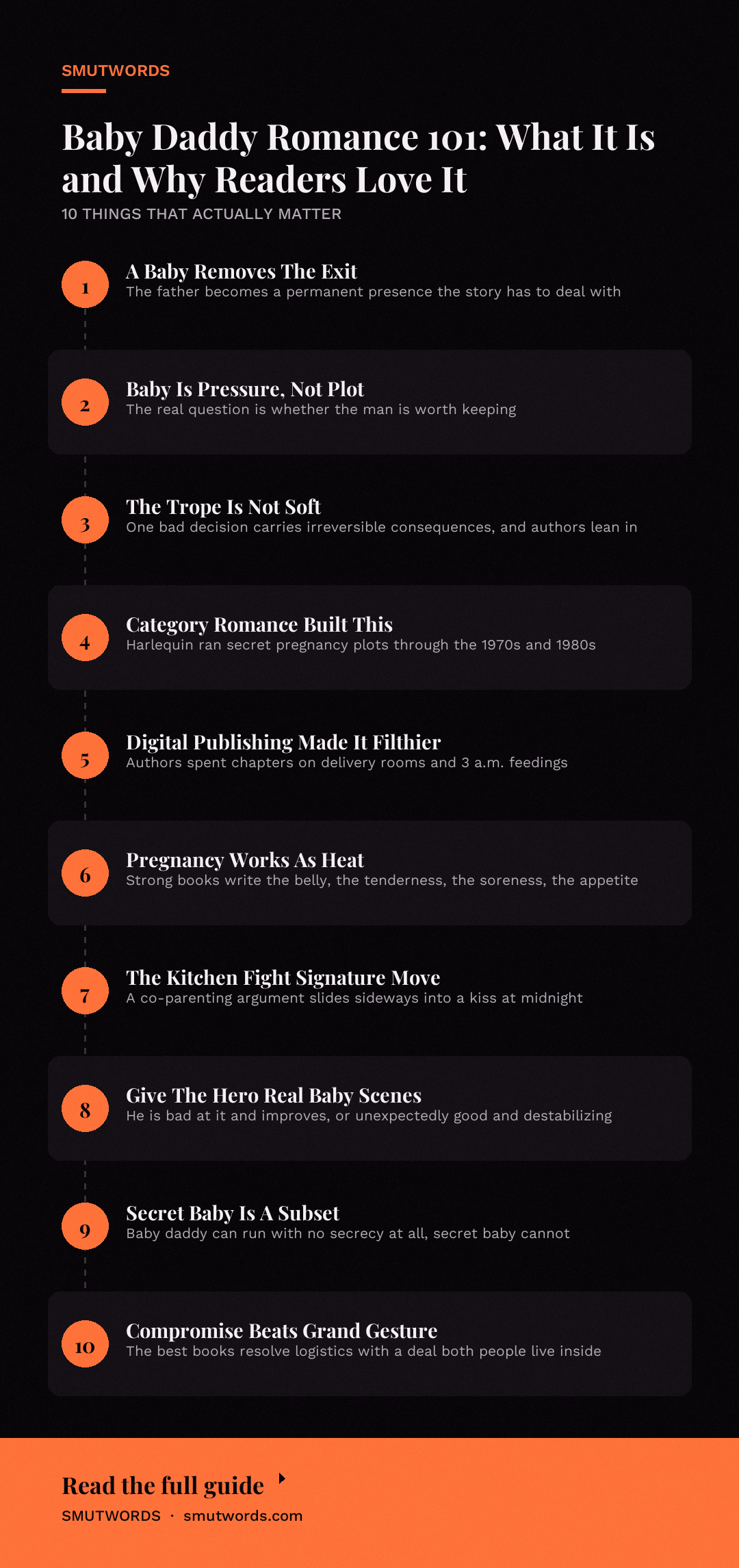
Baby daddy romance is the corner of the genre where a pregnancy, a birth, or a child already on the ground forces two people into permanent orbit around each other.
Sometimes they were already lovers. Sometimes they were strangers, exes, enemies, or one reckless night neither of them planned to repeat. The baby arrives, or is on the way, and suddenly the hero is not just chasing a woman. He is auditioning for a role that has no exit clause.
That is the whole engine of the trope: a relationship with a deadline and a dependent, which turns every fight into a custody question and every kiss into a decision about the next eighteen years.
Read enough of these books and the pattern gets obvious. The heat comes from proximity that cannot be undone, and the tenderness comes from watching a man decide, on the page, that he wants the job. It sells reliably for exactly that reason.
What Baby Daddy Romance Actually Means
The name is slang, and the slang is doing real work. A "baby daddy" is the father of your child, whether or not he is your partner, and the term carries the whole tension of that ambiguity. He is family by biology and a question mark by choice. Baby daddy romance takes that question mark and builds a full novel around answering it.
The defining feature is not the pregnancy itself. Plenty of books have a pregnant heroine and no baby daddy dynamic at all.
What makes the trope is that the father is a presence the story has to deal with, as a co-parent, a love interest, a threat, or a man who does not yet know he is any of those things. If the hero could walk away and the plot would survive intact, you are not reading this trope.
What counts:
- A pregnancy that binds the hero to the heroine, planned or not.
- A hero who steps into fatherhood before, during, or after the birth.
- Co-parenting logistics as a source of both conflict and intimacy.
- Stakes that extend past the couple into a child's life.
What does not count, even though readers conflate them constantly: a single parent heroine whose love interest is not the father, unless the book is explicitly about him choosing to become one. That is single parent romance and it plays differently, because the biological claim is absent and the choice is pure.
The most common misconception is that these books are soft. They are not. The accidental pregnancy setup is one of the few structures in romance where a single bad decision has irreversible consequences, and good authors lean into that dread rather than smoothing it over.
The second misconception is that the baby is the point. The baby is the pressure. The point is whether the man is worth keeping.
Where Baby Daddy Romance Comes From
This is a category romance inheritance before it is anything else. Harlequin and its competitors were publishing secret pregnancy and secret baby plots by the truckload through the 1970s and 1980s, because the premise solved a structural problem: how do you make two people who barely know each other stay in a room long enough to fall in love? A baby does it in one sentence.
Those early versions ran on shame and silence. The heroine hid the pregnancy, the hero found out years later, and the reunion was built on betrayal. The 1990s and 2000s softened the shame and kept the secrecy, and the trope became a staple of contemporary category lines and later of indie and self-published romance, which is where it exploded.
The real shift came with the rise of digital publishing. Once authors could write to a specific, hungry readership without a category line's page limits, baby daddy stories got longer, filthier, and more emotionally granular.
Authors started spending chapters on the delivery room, on the 3 a.m. feedings, on the awkwardness of two people who are not together sharing a nursery. The genre stopped treating the baby as a plot device and started treating it as a roommate.
The most recent evolution is the darker version. Baby daddy setups now appear inside stalker romance and mafia romance, where the pregnancy is a possession claim as much as a love story, and inside monster breeding romance, where the biological stakes get literal. The trope has proven flexible enough to bolt onto almost any subgenre, which is why it has not faded.
How It Shows Up in Erotica
Craft question first: what does a scene actually do with this? The strongest baby daddy books treat the pregnancy as a heat source, not a pause button. Hormones, body changes, the specific charge of a man who is visibly affected by what his body did to hers. Authors who understand the trope write the belly, the tenderness, the soreness, the appetite.
They also write the logistics of sex late in pregnancy, which is its own set of scenes and a reliable source of reader enthusiasm.
The second engine is the co-parenting argument that turns into something else. Two people in a kitchen at midnight, one of them holding a screaming infant, both of them exhausted and furious, and the fight slides sideways into a kiss because the alternative is admitting how much they need each other.
Enjoyed this? Get a free book.
Join the list and we will send a complete free story straight to your inbox, plus new releases every week after that. No credit card, no catch.
That transition is the trope's signature move. When it lands, the reader believes it. When it does not, it reads as the author forcing contact.
Common variations, roughly in order of how often they appear:
- Accidental pregnancy. The condom failed, nobody planned anything, and now they have to decide whether to try.
- Secret baby. She never told him. He finds out years later. Built on a reveal scene and a furious, wounded hero.
- One-night stand with consequences. They do not even know each other's last names before the test comes back positive.
- Exes with a surprise. The breakup did not take. Now there is a reason to talk.
- Fake relationship for the baby's sake. They move in together for appearances or logistics, and the performance becomes real.
- Single dad. He already has the child; she is the one choosing to join a family that exists without her.
- Nanny romance. She is paid to care for his kid and the proximity does the rest.
A strong version of this trope does one thing that weak versions avoid: it gives the hero a specific relationship with the child. Not a generic tenderness, but a scene where he is bad at it and improves, or where he is unexpectedly good and it destabilizes the heroine's assumptions about him. The lazy version keeps the baby offstage as a concept and lets the couple have uninterrupted adult conversations. Readers notice immediately.
The other thing strong books do is let the conflict be real. He has a job that will take him away. She has a life she built without him. There is a custody arrangement already in motion.
The best baby daddy novels do not resolve the logistics with a grand gesture; they resolve them with a compromise that both people have to live inside.
Chemistry across the whole cast matters here more than in a two-hander. The grandmother, the best friend, the ex who is now a co-parent, the doctor: all of them are load-bearing. If you want a sense of how a whole ensemble can be pulled into a couple's erotic life, our piece on kinky couples and shared fantasies is a useful companion read, because baby daddy books trade heavily on the fact that the couple's sex life is not private anymore.
Baby Daddy Romance vs Secret Baby
These get used interchangeably and they should not be. Secret baby is a specific plot mechanism: the heroine conceals the pregnancy or the child, and the story turns on the reveal and the aftermath. Baby daddy romance is the broader category, and secret baby is one way to run it.
You can have a baby daddy romance with no secrecy at all. He is in the delivery room. He is on the birth certificate. He is at every appointment. The tension comes from whether he is actually going to stay.
You cannot have secret baby without the concealment. If you are searching for the reunion scene, the "you kept her from me" confrontation, and the slow rebuild of trust, you want secret baby specifically.
The distinction matters for readers who are picky about it, because the emotional temperature is different. Secret baby runs hot with betrayal. Straight baby daddy romance runs warm with negotiation. Both can be filthy, and both can be devastating, but they scratch different itches.
Frequently Asked Questions
Is baby daddy romance the same as accidental pregnancy romance?
They overlap almost completely in practice, but accidental pregnancy is the narrower premise. It describes how the baby got conceived. Baby daddy romance describes what happens next, including the relationship between the father and the child, which is why the term covers planned pregnancies and secret babies too.
Do baby daddy romances always have a happy ending?
In traditional publishing, yes, because romance as a genre guarantees one. In darker indie corners the couple ends up together but the arrangement is possessive rather than tidy. If you need a genuinely uncomplicated happily ever after, read the category romance versions first.
Why is this trope so popular?
It collapses the will-they-won't-they into a single irreversible fact. Once a child is involved, the couple cannot simply walk away from each other, and readers get to watch commitment happen under pressure. The instant family stakes also deliver found family payoff without a slow build.
What is the difference between a baby daddy romance and a single dad romance?
In a single dad romance, the child predates the relationship and the heroine is joining an established family. In a baby daddy romance, the hero is usually the biological father and the pregnancy or birth is part of the current story, which means he is deciding in real time rather than arriving as a finished parent.
Are there baby daddy romances with LGBTQ+ couples?
Yes, though they are a smaller share of the market. They typically involve surrogacy, adoption, or a previous heterosexual relationship, and the co-parenting tension still works the same way. The trope's core mechanism does not depend on who conceived whom.
How explicit are baby daddy romances?
They span the full range from closed-door to extremely explicit. As a rule, the trope skews spicier than average because pregnancy and postpartum bodies naturally generate intimate scenes. If you want the version with the most heat, look for authors writing in the darker indie space.
Final Thoughts
Baby daddy romance works because it removes the option to leave. Every argument has a witness, every reconciliation has a crib in the next room, and the hero has to prove himself in front of an audience that will not be charmed by a speech. That is a harder test than most romance heroes face, and the books that pass it are the ones readers reread.
If you want to see the trope run at full intensity, start with a stalker romance where the pregnancy doubles as a possession claim. It will tell you quickly whether this corner of the genre is yours.






Loading comments…