
Why Kinky Couples Tend to Know Each Other Better
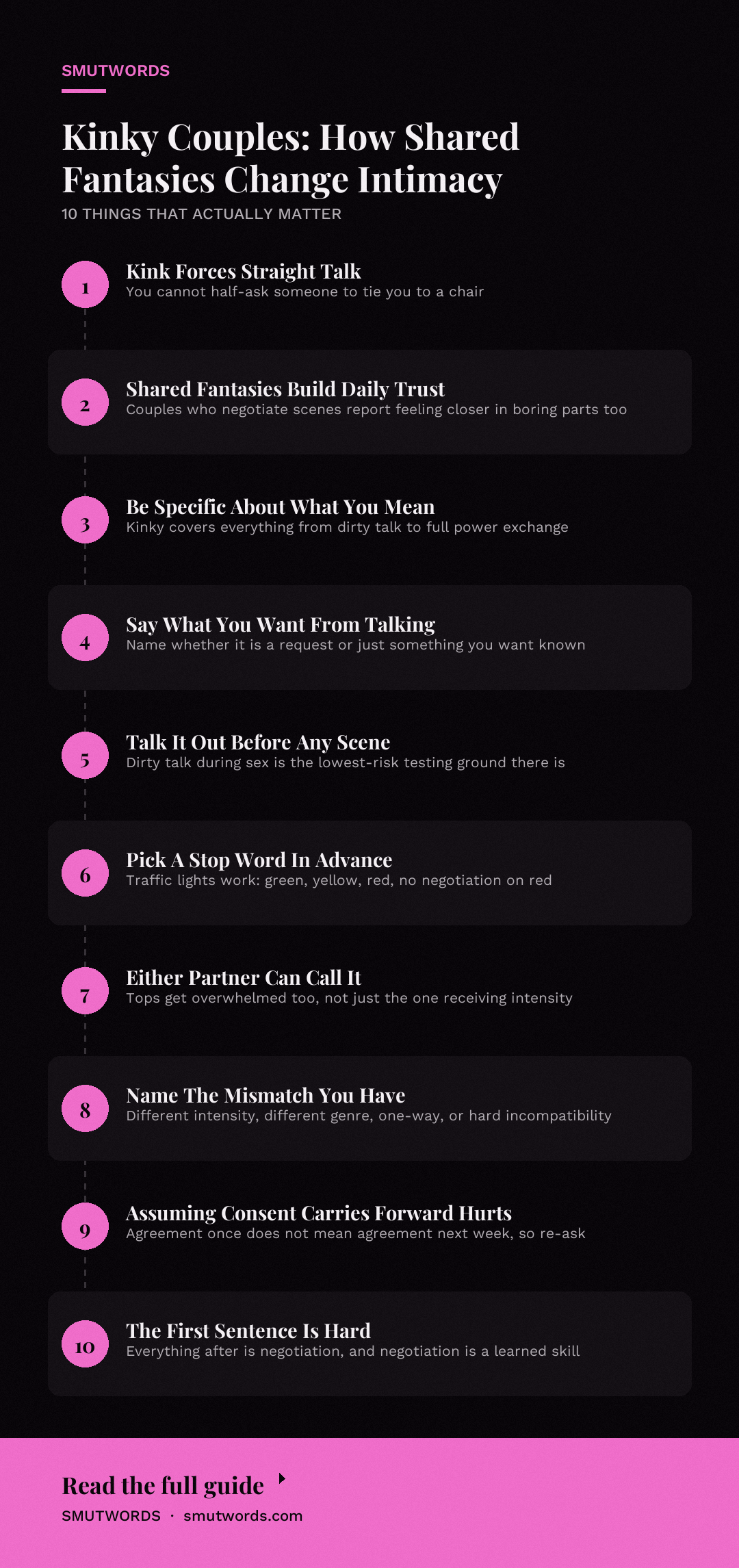
Most couples learn to talk about sex sideways. A joke here, a hint there, a slightly pointed comment about something they saw in a movie. Kinky couples have to learn to talk about it straight, because the thing they want to do together doesn't work if one of them is guessing. You cannot half-ask someone to tie you to a chair.
That forced directness is the whole mechanism. Every time two people say out loud what turns them on and then survive the saying, they've added another layer of evidence that the other person can be trusted with something fragile.
The trust that builds up from that is not a side benefit. It's the thing itself. Couples who negotiate a scene and then come out the other side still liking each other tend to report feeling closer in the boring parts of the relationship too.
This guide is for people who want that. Whether you're brand new to the idea, or you've been circling it with a partner for two years and haven't said the words out loud yet, the how is the same. Go slow, say the actual thing, agree in advance on what stops it, and check in when it's over.
What "Kinky" Actually Covers for Couples
The word gets used to mean anything from light dirty talk to full-time power-exchange dynamics, and that range is why it can be so hard to bring up. If you tell your partner you're "into kinky stuff," they might imagine something wildly different from what you mean. Better to be specific from the start.
In a couples context, the common categories look roughly like this:
- Power exchange. One partner takes charge in a scene, or in a broader dynamic. Top, bottom, dominant, submissive, and everything between. This is the umbrella most other things sit under.
- Restraint and sensation. Cuffs, rope, blindfolds, spanking, ice, wax, pinching. The body gets unusual input and the mind does the rest.
- Roleplay. Doctor and patient, boss and employee, stranger pickup, and variations on who you are to each other for the length of a scene.
- Verbal kinks. Dirty talk, praise, teasing, degradation and humiliation (which are cousins but not the same thing, and the difference matters once you're actually trying to ask for one).
- Immersive scenarios. Things like mummification, where the whole body is wrapped and movement stops entirely for a set time. Higher risk, needs clear limits, an easy escape, and someone watching closely. Not a beginner activity.
- Fantasy-only kinks. Scenarios that feel hot in your head but you'd never actually do. That's allowed. Plenty of couples use them for talk during sex and nothing else.
The useful thing about that list is that it separates "I want to try this" from "I want to think about this while we fuck." Those are two different asks, and the second one is a much easier conversation to start.
How Sharing Fantasies Changes Trust
A lot of couples operate on an unspoken agreement that certain things stay private. The fantasy you've had since you were nineteen, the one you'd rather die than say to anyone. Carrying that alone is not actually neutral. It subtly tells you that part of you is unshareable, and partners sense that guardedness even when they can't name it.
Saying it changes the math. If your partner hears the thing and doesn't flinch, doesn't laugh, doesn't use it against you five months later in an argument, a piece of ongoing tension just dissolves. You stop managing yourself around them. Most people don't realize how much management they were doing until they stop.
What tends to go wrong is treating a shared fantasy as a promise. You tell your partner about a fantasy involving someone else, and now they think you want it in real life. You mention a roleplay scenario and now they're waiting for you to bring the props.
The way to avoid that is to say what you want from the conversation, right at the start. "I want to tell you something that turns me on. I'm not asking for it to happen. I just want you to know." Or name the request directly: "I'd actually like to try this. Can we talk about whether you'd be up for it?" Then the conversation is a conversation.
Closeness shows up in weird places
Couples who negotiate kink often report that the same skills spill over into non-sexual parts of the relationship. Asking for something directly. Tolerating a no. Checking in after a hard conversation. Agreeing on an exit before things get heated.
Practicing those in a scene where everyone's naked and vulnerable turns out to be decent rehearsal for practicing them in a fight about money.
If you like the emotional texture of that already, the fiction on the site gets at it from the other direction. A book like No Touching Without Permission runs on exactly the tension this guide is describing: two people who have to build a shared vocabulary before anything physical happens.
Those slow-burn dynamics show up all over romance, and if you want to see how the same push-pull gets handled in a purely fictional register, the site's breakdown of grumpy/sunshine is a decent companion read.
How to Start Slowly Without Overthinking It
The biggest mistake new kinky couples make is trying to launch straight into the fantasy. Slow the whole thing down by about four notches and start with a conversation that isn't a pitch.
- Pick a neutral time. Not during sex, not during a fight, not five minutes before bed when one of you is already half asleep. A weekend afternoon works. So does a long drive.
- Start with a low-stakes reveal. Something true but small. "I've been thinking about this lately." Give your partner a chance to receive it before you go further.
- Ask about theirs. Turn it into a two-way thing fast, or you'll feel like you're confessing and they'll feel like they're being propositioned.
- Try the fantasy in talk first. Dirty talk during sex is the lowest-risk testing ground in the world. If it lands, you've learned something. If it doesn't, you can drop it and nothing broke.
- Graduate to a small scene. Blindfold. Ten minutes. No rope, no power exchange, no script. You're testing how each of you feels about being in a scene together at all.
- Debrief afterward. This is the part people skip and it's the part that matters most. What was hot, what was weird, what surprised you, what do you want to change next time.
Realistically, a couple that runs through that sequence is looking at several weeks, maybe a couple of months, before they're doing anything that qualifies as a scene with stakes. That's not a bug. You're building a shared vocabulary from scratch, and the vocabulary is the entire point.
Agree on a stop word before you need it
Every scene needs a way to stop instantly that neither partner can accidentally trigger. "No" doesn't work if part of the fantasy involves saying no. Traffic lights are the simplest version: green for keep going, yellow for slow down and check in, red for stop everything right now.
No negotiation. No "just one more minute." Red means red, and the scene ends, and then you take care of each other.
Whoever is on the receiving end of the intensity isn't the only one who can call it. Bottoms sometimes check out and stop speaking up. Tops sometimes get overwhelmed and push further than they meant to. Either partner can call red.
Enjoyed this? Get a free book.
Join the list and we will send a complete free story straight to your inbox, plus new releases every week after that. No credit card, no catch.
Either partner can call yellow just to change something without ending the scene. Practice saying the word out loud before you're in a position where you might need it, because the first time saying "red" should not be under pressure.
What to Do When Your Desires Don't Match
This is where most couples get stuck. One of you wants X, the other wants Y, and X and Y aren't compatible. Or one of you wants nothing kinky at all and the other wants to try everything. No amount of communication makes the mismatch disappear, so the real question is how to live in the gap without resentment building on one side and shame on the other.
Sort what's actually going on
Before anything else, figure out which of these you're dealing with:
- Different intensities. You want the same genre at different volumes. Solvable through negotiation, since it's about dialing an existing thing.
- Different genres. You want power exchange, they want roleplay, neither of you is interested in the other's thing. Harder, but often solvable by alternating who gets their scenario.
- One-way interest. Only one person has a fantasy to negotiate, the other is neutral. The neutral partner may be genuinely happy to participate in service of the other person's pleasure. That's real and it counts.
- Hard incompatibility. One wants a hard limit the other needs, and that's not going to change. This is where you have to decide what the relationship can hold.
Naming which one you're in changes the conversation. It stops being "you don't love me enough to try" and starts being "we have a structural problem, how do we want to handle it."
Options that aren't just "give up"
For couples facing a genuine mismatch, the actual menu of options is broader than most people think:
- Keep the fantasy fantasy-only. Talk about it during sex, use it as fuel, never act on it. Lots of couples do this permanently and it works fine.
- Rotate. You get your scene this month, they get theirs next month. Nobody's kink is permanently on hold.
- Split the kink from the relationship. Some couples open up, or bring in a third, or negotiate a specific exception for one activity. This is where jealousy gets real, and if you're thinking about it, the relevant conversation is comparable to the one in bull dynamic relationships: what exactly is shared, with whom, and what stays between the two of you.
- Read and watch together. Fiction scratches the itch for a lot of people without any negotiation at all. A specific power dynamic isn't the same as the real thing, but the real thing isn't always necessary.
- Accept the limit and grieve it. The honest option that nobody likes. Some desires will not be met inside a particular relationship, and pretending otherwise just builds resentment over years.
What does not work is pressuring a partner into something they don't want, and what also does not work is agreeing to something you don't want in order to keep the peace. Both of those end the same way, which is with one of you quietly checked out of the relationship and the other one not sure when it happened.
Real Risks and How to Lower Them
Kink carries actual risks. Not in the "the pearl-clutchers were right" sense, in the practical sense that bodies and feelings are involved and both can get hurt.
- Physical risk. Rope can cut off circulation. Cuffs can bruise nerves. Blindfolds can turn a small stumble into a fall. Learn the basic safety for anything you're doing, keep safety shears within arm's reach for rope, and never restrain someone in a position where they can't breathe freely.
- Emotional risk. Scenes can open things up that neither partner expected. Some people drop hard after a scene and need reassurance. Some people discover mid-scene that the thing they wanted to try is actually triggering. Both of those are normal and both are survivable, but they require you to actually check in afterward rather than just rolling over and going to sleep.
- Consent risk. The most common source of it among couples is assuming consent carries forward. It doesn't. Agreement to something once doesn't mean agreement to it next week. Re-ask. Yes can change.
- Substances. Alcohol and kink do not mix. Some of it for physical safety, some of it because consent gets sloppy and "I thought you were fine with it" stops being a defense when neither of you was clear-headed.
When to stop
Stop immediately if your partner uses the stop word. Stop if someone is dissociating, going quiet, freezing, or suddenly not into it, even if they haven't said the word. Stop if you're angry at them outside the scene.
Stop if either of you is relying on it as a substitute for a conversation you're avoiding. Stop if you're doing something you don't actually want because you're afraid of losing them. Stop doesn't mean the whole dynamic is over. Usually it means this specific scene ends, you get water, you get a blanket, you talk, and you either try again later or you don't.
Couples Who've Been Doing This a While Do These Things Differently
The kinky couples who clearly have a good thing going tend to have a few habits in common, and they're almost all boring. They check in before a scene, not just after.
They keep a mental list of what each of them has said yes and no to recently, rather than relying on vibes. They have a way for one person to say "not tonight" without it meaning "not ever." They can talk about the fantasy in the kitchen, fully clothed, without turning into a pitch.
A lot of it looks less like a sex thing and more like a project two people are working on together. The couple who've been doing this for a decade sound mostly like they've gotten extremely good at saying what they want and hearing the answer without flinching.
If you're reading this and thinking that the emotional texture is the interesting part, a book like The Crimson Reclamation: Captive to the Alien Breeding Commander gets at exactly that: two people building a shared language under pressure, in a genre that has no patience for small talk.
And if you and your partner have already negotiated a roleplay or a stranger-scenario fantasy, the fiction on the site gives you plenty of material to borrow. She Picked Him Up: A Hotwife Stranger Husband Dare Pickup Erotica is built entirely around the "I want to watch this happen" conversation, which is the exact negotiation most couples flinch away from.
For a purer power-exchange pitch, Breed Me, General gives you the dynamic with full throat. If you like the free-use scenario, Free Use Doctor: A Dark Medical Free-Use Fantasy is the one to read aloud to a partner who's been circling the idea.
Final Thoughts
Start with one sentence, said out loud, on a neutral afternoon when neither of you is in a scene or a fight. Something true and specific about what you've been thinking about. Then ask what they've been thinking about.
The first sentence is the hard part. Everything after that is negotiation, and negotiation is a skill two people get better at the more they practice it.
If you'd like a little fiction to prime the conversation, No Touching Without Permission is the easiest place to start: a book about the same slow build you're trying to have at home. Reading it together in bed when nothing's expected is often the least threatening way to say "this is what I've been thinking about" without actually having to say it first.







Loading comments…