
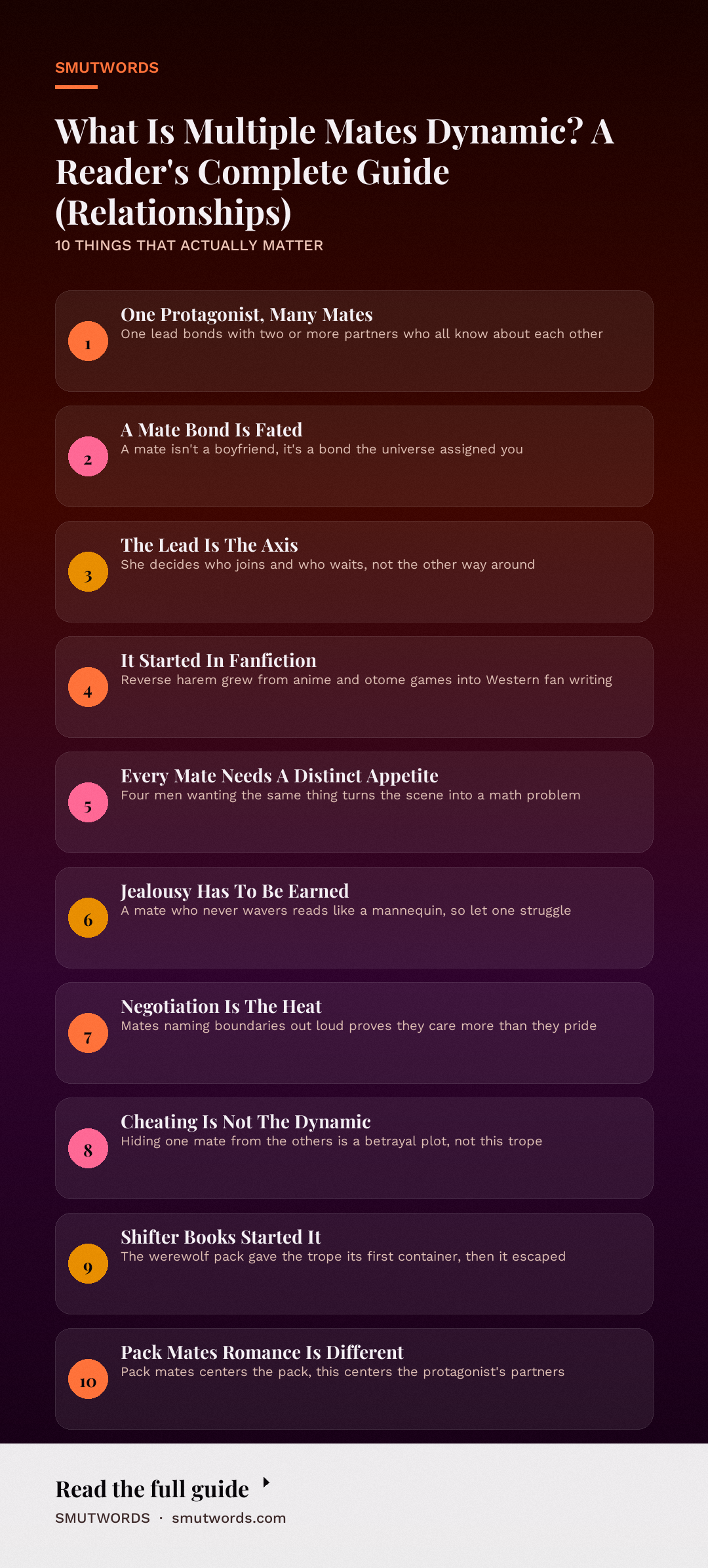
A multiple mates dynamic is a romance or erotic storyline where one protagonist bonds sexually and emotionally with two or more partners at the same time, and everyone involved knows about it and wants it. The partners might be a werewolf pack, a demon triad, a fae court, a household of monsters, or three unrelated men who happen to share one very lucky woman.
What defines it isn't the number of bodies in the bed. It's that the protagonist sits at the center of a group whose attention, desire, and protection all point at her (or him, or them) at once, with nobody being deceived about any of it.
If you've spent any time in the shifter aisles, you've already met this trope under a dozen names. Publishers call it reverse harem. Reviewers call it why choose. Readers call it "the good stuff." The multiple mates dynamic is one of the fastest-growing structures in indie romance, and once you understand how it works on the page, you'll spot it everywhere.
What Multiple Mates Dynamic Actually Means
The word mates is doing specific work here. In most romance subgenres, a mate is not a boyfriend. A mate is a biological, magical, or fated bond, a person the universe has assigned to you, often marked by scent, a scar, a shared dream, or an involuntary physical reaction that can't be faked or ignored.
A multiple mates dynamic takes that loaded concept and multiplies it. Instead of one fated partner, the protagonist has two, three, four, or more. Sometimes the bond snaps into place all at once. Sometimes it arrives in stages, one mate at a time, which is a very effective way to keep a long series moving.
What counts: a shared household where every partner is sexually and romantically involved with the central protagonist, with transparency between all parties. What also counts: a closed triad or quad where partners are involved with each other as well.
What does not count: a love triangle where the protagonist must eventually choose one person. A harem where the protagonist collects partners who never interact, never negotiate, and never express opinions about the arrangement. Cheating dressed up as fate.
The most common misconception is that a multiple mates dynamic is just polyamory with extra steps. Pack mates romance and polyamorous romance overlap, but the fated-bond element changes the emotional math entirely.
Polyamory is a choice people make and renegotiate. A mate bond is a fact people have to survive. That shift from opting in to being claimed is where most of the heat lives.
A second misconception: readers assume the protagonist is passive, a prize handed around. The best versions do the opposite. The protagonist is the axis.
She decides who joins, who waits, who gets told no, and the entire group reorganizes itself around her comfort and pleasure. The fantasy isn't being used. It's being the reason four dangerous men learn to share.
Where Multiple Mates Dynamic Comes From
The honest history starts in fanfiction, not traditional publishing. Reverse harem as a term migrated from anime and otome games, where a female protagonist is surrounded by a cast of eligible love interests, into Western fan communities in the 2000s. Fan writers who were tired of the love triangle's forced choice started writing stories where the heroine simply kept everyone, and the audience response was immediate and enormous.
Original fiction followed. By the mid-2010s, indie authors on serial platforms had figured out that reverse harem readers were voracious, loyal, and willing to follow a series across ten or fifteen books. The economics were irresistible.
A traditional romance novel ends with one couple and one happily ever after. A reverse harem series can add a mate in book three, resolve a pack conflict in book five, and keep going.
Shifter romance drove the first wave hard, because the werewolf pack already provided the perfect container: a hierarchy, a territory, a group of dominant males who answer to a single leader. Writers realized they could take the territorial shifter trope and turn it inward, so the tension was not the pack against an outsider but the pack negotiating itself around one woman.
Then the trope escaped the shifters. Reverse harem spread into fae courts, demon princes, angelic choirs, monster households, and eventually cryptid romance, where a protagonist might find herself bonded to a mothman, a bigfoot, and something that lives in the lake. The fated mate mechanic stretched to cover anything with a supernatural pulse. That flexibility is why the multiple mates dynamic now shows up in fae romance, elf romance, and even the stranger corners of the genre.
The most recent shift is tonal. Early reverse harem leaned on jealousy as fuel, with mates snarling at each other for chapters. Contemporary versions are more likely to foreground negotiation, group communication, and genuine domestic affection. The audience has matured alongside the trope, and the stories have followed.
How It Shows Up in Erotica
On the page, a multiple mates dynamic lives or dies on one craft question: does each mate have a distinct appetite? A flat version gives you four men who all want the same thing in the same way, and the scene becomes a math problem. A strong version gives you four men with four different textures of desire, four different things they are good at, and four different reasons they need the protagonist.
Editors who read these books by the dozen tend to see the same working parts over and over. The authors who make it sing handle all of them with intent.
- The bond reveal. The moment the mate bond activates is the hook. It can be scent, a mark, a fever, a voice in the head, or a physical pull the protagonist cannot explain. The stronger the sensory detail, the harder the reader falls.
- The hierarchy. Even in a flat group, someone leads. Readers want to know who ranks where, who defers, who bristles. The pack dynamics glossary entry covers the power structure; a mate group almost always borrows from it even when nobody is a wolf.
- The jealousy beat. Somebody has to struggle. A mate who never wavers is a mannequin. The jealousy arc, handled with care, is what makes the eventual harmony feel earned.
- The first shared scene. This is the payoff the reader has been waiting for, and it needs choreography. Who touches whom, who watches, who waits his turn, who breaks first.
- The negotiation. The best authors show the group talking. Boundaries get named out loud. Expectations get set. This is where consent does its erotic work, because a group of powerful beings agreeing on terms for the protagonist's sake is its own kind of devotion.
Common structural variations you will see across the genre:
- Pack-based. The mates are wolves, or another animal shifter species, bound by hierarchy and territory. The pack is the world.
- Triad or quad. A small, tight group, often with the mates also involved with each other. More intimacy, less crowd control.
- Reverse harem. A larger group, sometimes five or more, each mate with a distinct personality type, so the reader can pick a favorite.
- Why choose. A newer marketing label that emphasizes the protagonist refusing to pick one, often used for contemporary or paranormal settings without a fated bond.
- Monster household. The mates are wildly different species, which lets the author play with anatomy, size, temperature, and appetite. This is where kraken romance and similar niche corners get very creative.
- Fated-but-reluctant. The protagonist fights the bond, the mates fight each other, and the resolution is a slow, hard-won surrender.
What separates a strong multiple mates dynamic from a flat one usually comes down to specificity. A flat version says "her three mates wanted her." A strong version tells you which one is patient, which one is jealous, which one talks her through it, and which one ruins her while the others watch. The reader does not need more bodies. The reader needs more texture.
Enjoyed this? Get a free book.
Join the list and we will send a complete free story straight to your inbox, plus new releases every week after that. No credit card, no catch.
The other thing strong authors do is give the protagonist real agency inside the group. She sets the pace. She withholds. She rewards.
When she is the one who decides what happens and when, the fantasy sharpens dramatically, because the reader is not watching a woman get passed around. The reader is watching a woman run a room.
Communication is not a mood killer on the page, and the genre has figured that out. The best scenes include the mates naming what they want before they take it, checking in mid-scene, adjusting when someone's face changes.
That negotiation reads as hot, not clinical, because it is proof that four dangerous men care more about one woman's comfort than their own pride. If the dynamic never shows the group discussing jealousy, expectations, or limits, the whole thing starts to read as fantasy built on a cracked foundation, and readers notice.
Multiple Mates Dynamic vs Pack Mates Romance
These two concepts overlap enough that readers mix them up constantly, so it is worth drawing the line.
Pack mates romance centers on the pack as a unit. The bond is collective, the hierarchy matters to everyone, and the story tends to be about belonging and rank. A pack mates romance can absolutely be monogamous, two people inside a larger structure.
A multiple mates dynamic centers on the central protagonist and the partners bound to her specifically. The pack, if there is one, is the container. The mates are the point.
You can have one without the other, and you frequently do. A pack mates romance with a single couple is not a multiple mates dynamic. A multiple mates dynamic set in a fae court with no pack at all is still a multiple mates dynamic.
The confusion is common because shifter authors often run both at once, layering a multiple mates dynamic on top of a full pack structure so the protagonist has to win not just her mates but the group around them.
Frequently Asked Questions
What is a multiple mates dynamic in romance?
It is a storyline where one protagonist bonds romantically and sexually with two or more partners at once, with everyone aware and consenting. The mates may be a pack, a triad, or an unrelated group bound by a fated connection. The bond is usually supernatural, fated, or otherwise impossible to ignore.
Is a multiple mates dynamic the same as reverse harem?
Reverse harem is one flavor of the multiple mates dynamic, usually with a larger group and a heavier emphasis on the protagonist "collecting" partners. A multiple mates dynamic can also be a small triad or quad, and it does not need a harem structure at all. The terms overlap but are not identical.
Do you need a supernatural bond for a multiple mates dynamic?
No. Contemporary why choose romance runs the same structure with no fated bond at all, relying on emotional and sexual chemistry instead. The fated mate element intensifies the pull, but the dynamic works fine without it as long as all parties are clear about what they are building.
Is cheating ever part of a multiple mates dynamic?
No, and readers are emphatic about this. The dynamic depends on transparency between every partner. A protagonist hiding one mate from the others is not a multiple mates dynamic; it is a betrayal plot. The whole appeal rests on nobody being lied to.
How do authors handle jealousy in these books?
Jealousy is usually a real beat, not a flaw to eliminate. A mate who struggles with sharing and then works through it gives the reader a payoff. The resolution almost always runs through conversation, boundary-setting, and the whole group choosing the protagonist's happiness over individual pride.
Is the multiple mates dynamic only for shifter books?
Not anymore. Shifter romance made it famous, but it now appears in angel romance, fae courts, demon politics, monster households, and contemporary settings. Any genre with powerful love interests and a fated or chosen bond can carry it.
Final Thoughts
The multiple mates dynamic is doing two things at once: it is a fantasy of being the absolute center of a devoted group's attention, and it is a story about a group of complicated people learning to share, negotiate, and protect.
The books that do it best keep both halves alive, giving you heat and tenderness, hierarchy and harmony, the jealously guarded heroine and the men who eventually figure out that guarding her together beats guarding her alone.
If you want to see how a long-running series sustains a dynamic like this across dozens of installments, the SmutWords interview with Penny Pepper on building a 65-book free use series is worth your time.
Want the flip side, where the mates are demons and the mate bond is a leash nobody asked for? The piece on monster breeding romance digs into how fated bonds and mating instincts get reworked when the lovers are not remotely human. Start there, then follow your instincts into the catalog below.







Loading comments…