Why 65 Books Isn't a Flex, It's a Worldview
Most erotica series die around book three. The author doesn't run out of ideas. They built a premise that only supports a handful of scenes before the seams show. Penny Pepper's free use series is sitting at 65 books and counting, which makes the penny pepper author interview question less "how do you stay motivated" and more "how did you design a premise that doesn't collapse under its own weight."
The answer, according to the series itself, is that Pepper treats world rules the way a showrunner treats a writers' room bible. The fantasy isn't the plot. The setting is.
If you've read even five of these, you already know the pattern. A location gets established. The free use rule applies there and nowhere else. Then the book explores what that rule does to the people inside it.
Casino. Airport lounge. Hospital ward. County fair.
Each book is a self-contained scenario built on a single, rigid premise, and that rigidity is what lets the series stretch past sixty entries without repeating itself.
The Core Rule: One Location, One Law
Pepper's structural trick is simple and almost nobody does it this cleanly. Every book establishes one enclosed space with one rule about who can touch whom, and then the story lives entirely inside that rule.
Free Use Casino runs on the idea that the floor is open and the concierge decides who plays. Free Use Airport Lounge uses the limbo of travel, the shared understanding that everyone in the lounge is delayed and anonymous and unlikely to see each other again.
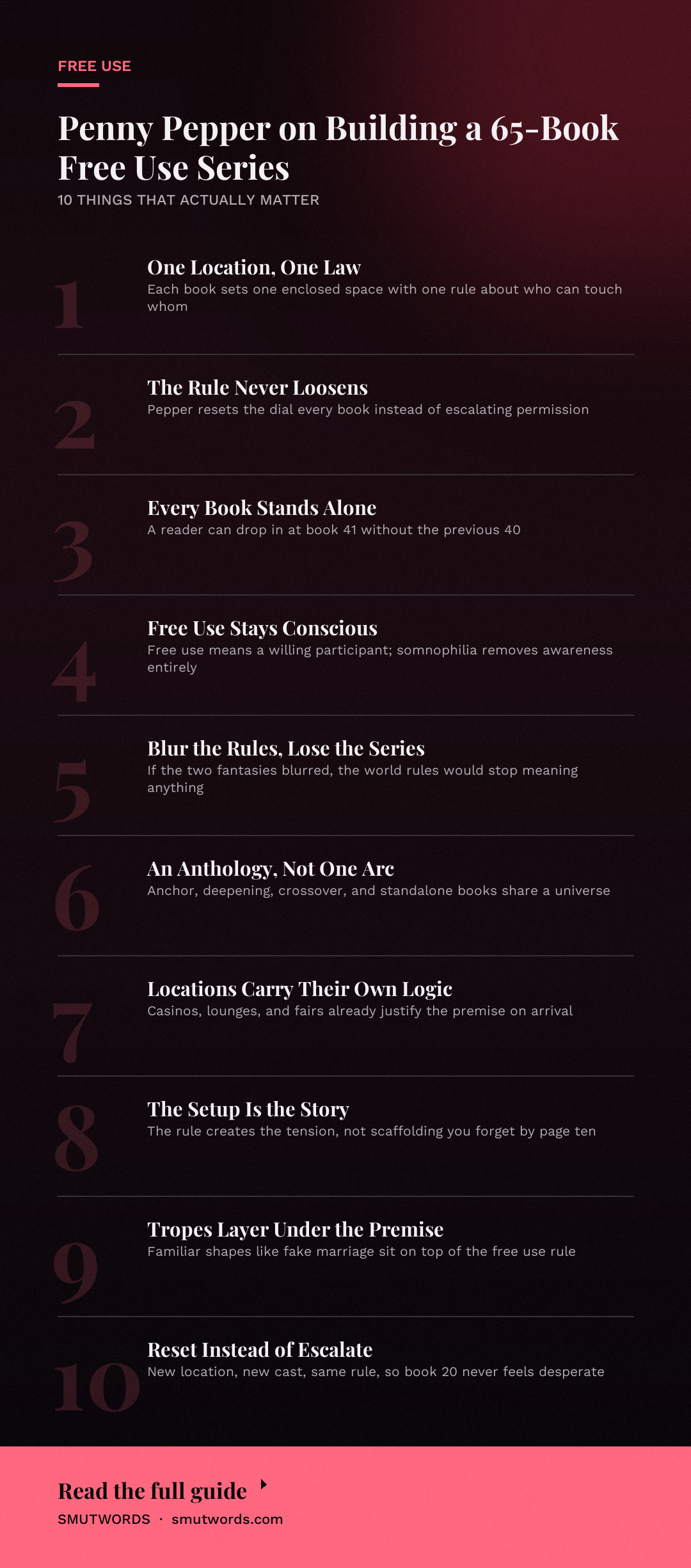
What makes this work over 65 books is that the rule never loosens. Pepper doesn't escalate the permission level book by book until the whole thing becomes chaos. Each new entry resets the dial and picks a fresh environment, which means a reader can drop in at book 41 without needing the previous 40.
That's a publishing decision as much as a creative one, and it's why the series keeps finding new readers instead of exhausting its original audience.
There's a reason this matters for anyone trying to write in the subgenre. The free use world-building piece on this site covers the mechanics of how authors justify the premise, and Pepper is the cleanest example in the catalog of getting the justification out of the way fast so the scene can start.
The Difference Between Free Use and Somnophilia (And Why Pepper Keeps Them Separate)
One thing that trips up new readers of the series is assuming free use covers every "no resistance" scenario. It doesn't, and Pepper is deliberate about the line.
The free use somnophilia difference comes down to awareness. Free use assumes a conscious, willing participant who has agreed to the terms. Somnophilia removes the consciousness entirely.
You can read the full breakdown in Somnophilia Explained, but the short version for series readers is that Pepper's free use books stay on the conscious side of that line almost without exception.
Keeping the two apart matters at scale. If the series blurred them, the world rules would stop meaning anything, and once the rules stop meaning anything you can't write 65 books on them. The fantasy only holds if the reader knows exactly which fantasy they're getting when they open the file.
How Pepper Paces a Long Series Without Burning Out the Reader
Long series have two failure modes. Either every book is the same book with a new cover, or the author keeps escalating until book 30 is unrecognizable from book 1 and nobody who loved the early ones still recognizes it. Pepper avoids both by treating the series like a seasonal anthology with a shared universe rather than a single continuous story.
Here's how the pacing actually breaks down if you're reading through in order:
- Anchor books establish a new location and its specific rule. These carry the most setup and tend to have the strongest sense of place.
- Deepening books return to an established location and push one character or one dynamic further than the anchor did.
- Crossover books bring a character or a location rule from one setting into another, which is where the series starts rewarding readers who've been keeping up.
- Standalone entries exist for readers who grabbed a random file off a recommendation list and want a complete story with no homework.
That mix is why 65 books doesn't feel like a wall. You can binge in order, or you can read three at random and never feel lost. If you want the actual sequence for doing it properly, Where to Start With Penny Pepper's Free Use Series lays out the reading order, and it's worth checking before you commit to a run.
Enjoyed this? Get a free book.
Join the list and we will send a complete free story straight to your inbox, plus new releases every week after that. No credit card, no catch.
Why Location Choice Does the Heavy Lifting
The single smartest decision in this series is that Pepper picks locations where free use already has a plausible social logic. A casino floor at 2am. An airport lounge full of strangers. A county fair packed with people who came for something else entirely.
Each setting arrives with its own built-in justification, so the book never has to spend ten pages explaining why this is happening.
Free Use County Fair: A Public Free-Use Exhibition Fantasy is the clearest example. Fairs are already public, already crowded, already full of people behaving slightly outside their normal selves. The rule slots in without friction. Compare that to a setting where the premise would need a paragraph of machinery to work, and you see why the series stays in spaces that carry their own charge.
The medical entries run the same play with higher stakes. Free Use Nurse: A Hospital Free-Use Fantasy leans on the trust and vulnerability already baked into a hospital setting, while Free Use Doctor: A Dark Medical Free-Use Fantasy pushes into the darker version of the same dynamic. Two books, same basic environment, completely different tones. That's the location-first approach paying off.
World Rules Are the Plot, Not the Backdrop
In most erotica, the setup is scaffolding you forget about by page ten. In this series, the setup is the story. The rule about who can touch whom is what creates the tension, the negotiation, the moment where a character realizes what they've signed up for.
That's also why the series plays well with adjacent tropes without ever abandoning its core. When a book borrows a structure like revenge romance or a fake marriage frame, the free use rule doesn't disappear. It just gets layered underneath a familiar shape.
Readers who came for the trope get the trope. Readers who came for the premise get the premise. Both groups leave satisfied, which is the entire reason a series this long keeps selling.
The enemies to lovers dynamic shows up in a handful of entries too, usually when the rule forces two people who can't stand each other into the same space. It works because the rule doesn't care whether they like each other. The environment already decided what's allowed, and the characters have to deal with that, which is a much more interesting problem than whether they'll eventually kiss.
What Other Authors Get Wrong at This Scale
The failure mode Pepper sidesteps is treating a long series like a single escalating arc. If you write 65 books on the assumption that each one tops the last, by book 20 you're out of escalation room and the whole thing starts feeling desperate. Pepper resets every book instead. New location, new cast, same rule.
A few things that make the reset work:
- The rule stays fixed, so readers always know the terms before they open the file.
- The location carries the novelty, not the intensity.
- Characters are written to be complete within one book, so nothing depends on a reader's memory of book 8.
- Recurring rules allow crossovers without forcing continuity.
If you're writing in this space, that's the takeaway. The series doesn't survive because each book is hotter than the last. It survives because each book is a clean, closed scenario with a rule the reader already understands, and the location gives it a reason to exist. That's the whole engine, and it's why 65 books is a reasonable number rather than an insane one.
For a look at how the rules behave in a workplace setting specifically, Workplace Free Use covers a version of the premise that runs closer to office politics than casino floors. And if any of the scenarios in this series land in territory that resembles consensual non-consent, CNC Explained is the piece to read so you understand where the line actually sits.
The Breeding Thread Running Through the Catalog
Not every Penny Pepper book is free use, and the side catalog matters for understanding how she thinks about series-building. Billionaire’s Breeding Toy shares the series' obsession with rigid rules. In that one, the rule is ownership and consequence rather than public access, and it's the same structural principle wearing different clothes. Pepper writes premises with hard edges and then lets the characters live inside them.
Final Thoughts
If you want to see the whole system working in one book, start with Free Use Casino. The location does the world-building for you, and the rule is established in the first few pages. By the time the scene gets going, you understand exactly what kind of story you're in.
Once you've read that one, the rest of the series reads like a map instead of a mystery. Sixty-five books stops looking like a mountain and starts looking like a place you could comfortably spend a few months.







Loading comments…