
An orgy is a sex scene with three or more people in the same space, touching, pairing off, swapping, and watching, with the action overlapping rather than taking turns. In erotica, the orgy is a structure as much as an event: a way of arranging bodies so desire multiplies and nobody stands at the edge of the room.
The definition sounds simple. Writing one that actually works on the page takes real craft, because a crowd with no choreography reads like a phone book with moaning.
Readers come to the orgy for the fantasy of abundance: more hands, more mouths, more attention, pleasure that doesn't run out. There's also the social charge of watching and being watched, the sense that everyone in the room is caught up in the same escalating thing.
What follows is the deep version. What the term covers, how the trope grew up in erotic publishing, how strong group scenes get built, and the practical consent groundwork that makes the fantasy land without anyone getting hurt.
What Orgy Actually Means
The word comes from the Greek orgia, the secret nighttime rites of Dionysus: ecstatic, communal, and a little dangerous. The Romans had their Bacchanalia, and Roman authorities periodically tried to shut them down for exactly the reasons you'd guess. Over centuries the word slid from "religious rite" to "any wild communal indulgence," then narrowed again into the purely sexual sense.
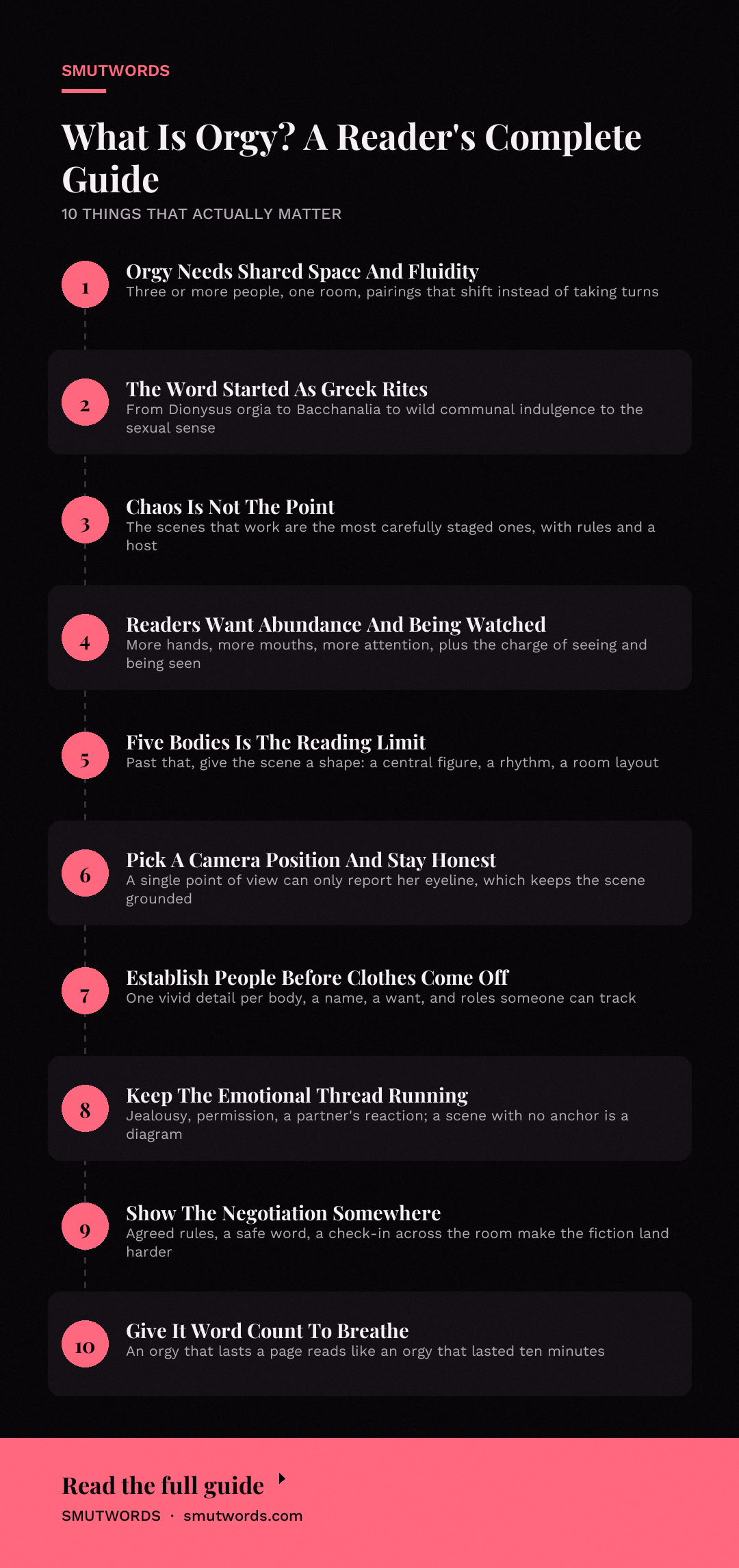
On the page, an orgy needs three things to earn the label. Three or more people, obviously. Shared space, meaning everyone can see and reach everyone else to some degree. And fluidity: the pairings shift, people join and leave, and the scene doesn't reduce to a tidy series of one-on-one encounters that happen to take place in the same room.
That last point separates a real orgy scene from a why choose romance where the heroine has separate intimate scenes with each love interest. A threesome can be an orgy if the energy stays open and the participants stay aware of each other throughout. A four-person scene where two couples pair off and ignore each other is something else. The distinction matters to readers searching specifically for group sex, because the fantasy they want is connection that spreads and multiplies.
Common misconceptions are worth clearing up. An orgy doesn't require a mansion, a masked ball, or a club in the basement. It doesn't require strangers, either; plenty of the best versions involve people who already know each other, which raises the stakes considerably.
And it doesn't mean chaos. The scenes that work are usually the most carefully staged ones. Someone picked the room, someone set the rules, someone decided who touches whom first.
The category also covers a spread of related labels. Group sex is the umbrella. A gangbang focuses on one person at the center with many partners in sequence. A daisy chain is a specific closed loop of bodies. Bukkake is a targeted, often ceremonial climax.
A swingers party is a social setting where multiple partnered couples pair off and swap. All of these are orgy-adjacent, and each has its own conventions.
Where Orgy Comes From
Communal sex is as old as writing, but the modern erotic orgy as a recognizable set piece is a publishing phenomenon with a traceable arc. Eighteenth-century libertine fiction set the template: the Marquis de Sade's work and the English libertine novels that followed put the group scene at the center of a philosophical argument about pleasure and freedom. The orgy was where society's rules visibly broke, which made it useful both as titillation and as satire.
Victorian underground publishing made it more explicit and more commercial. The decades of privately printed erotica that circulated in London and Paris leaned hard on group scenes, often framed as secret societies or aristocratic parties. The mask and the invitation card became the genre's standard props, and they've never really gone away.
The twentieth century moved the orgy into respectable literary fiction, where it often served as a signal of a character's moral exhaustion or liberation, depending on the author's mood. But the biggest development happened in genre romance and erotica from the 1970s onward. As the romance category expanded into explicit territory, the group scene became a standard test of a book's heat level: the moment the author proves she'll go anywhere.
The internet changed the orgy's function again. With online publishing, the group scene stopped being a rare peak and became a subgenre engine of its own. Harem and reverse harem structures made group dynamics the entire premise, and the polyamorous romance wave of the 2010s brought a level of emotional realism that older group scenes didn't bother with. Modern readers want the heat, and increasingly they also want the logistics, the negotiation, and the morning after.
The orgy's history in erotica is also a history of formatting pressure. Short-story collections needed a climax big enough to justify the price. Novels needed a set piece the reader would remember and recommend. The group scene answers both needs, which is why it survives every shift in publishing fashion.
How It Shows Up in Erotica
Here's the editor's seat view. Most orgy scenes fail for the same two reasons: too many names and no spatial logic. A reader can track maybe five bodies with clarity. Past that, the writer needs to give the scene a shape, whether that's a central figure, a rhythm of focus, or a room layout that lets the reader picture who is where.
The strongest scenes pick a camera position and stay honest about it. A single point-of-view narrator can't see everything, and the best group scenes use that limitation. The heroine can only report what's happening to her and what's in her eyeline, which keeps the scene grounded and keeps the reader close to her experience rather than floating above a depersonalized tangle.
Watch how strong versions handle the watchers. The social charge of an orgy comes from being seen, so a well-built scene will linger on eye contact across the room, someone pausing to watch, a partner narrating what they see. The voyeuristic charge is the whole point, which is why the trope pairs naturally with the voyeur husband trope and gets its discipline from anything that asks characters to sit still and be looked at, the way shibari rope work does.
Common variations authors use:
Enjoyed this? Get a free book.
Join the list and we will send a complete free story straight to your inbox, plus new releases every week after that. No credit card, no catch.
- The single-heroine reverse harem: one woman, many men, attention rotating to her. The emotional stakes come from each man's jealousy and devotion rather than the group itself. This is the dominant shape in harem romance and its reverse.
- The partnered couple's first group scene: a couple invites a third or another couple in, and the tension is about whether their bond survives the expansion. The hot part is the negotiation before anything happens.
- The masked or ritual party: unknown partners, shared rules, an almost ceremonial structure. Strong for suspense; weaker for emotional intimacy unless the author lets a familiar face slip through the mask.
- The gangbang centerpiece: one character surrounded, often with a monster cock theme, used when the writer wants overwhelming physical intensity as the entire point.
- The daisy chain and the closed loop: bodies arranged in a circuit so everyone gives and receives at once. This variant is mostly about the visual symmetry and the sense of a machine running.
- The polycule in steady state: not a party but a permanent arrangement, closer to group marriage, where the group is the relationship and the sex scenes are one part of running it.
What separates a strong version from a flat one comes down to a handful of moves. Strong group scenes establish who each person is before the clothes come off: one vivid detail per body, a name, a want. Flat scenes introduce fifteen people in one paragraph and expect the reader to care about the pile.
Strong scenes assign roles in the room. Someone leads, someone follows, someone watches. The dynamic becomes legible and the reader can track the power shifting. Flat scenes describe bodies in motion without hierarchy, and the result is frictionless and dull.
Strong scenes keep the emotional thread. There's a reason the reader is in that room and it isn't just lust; jealousy, permission, a partner's reaction, all of that needs to keep running through. A group scene with no emotional anchor is a diagram.
Strong scenes end on a specific image or moment, not a vague fade. Two people catching their breath in a corner of a torn-apart room beats a paragraph about how the night went on. If you're writing your first one, look at how a switch's dual role creates shifting power inside a scene; the same principle applies when you have to run a room with four people in it.
The practical consideration isn't optional, on the page or off it. Good group scenes show the negotiation at some point, even briefly: the agreed rules, the safe word, the check-in from across the room. Real group encounters run on consent and communication, and the fiction reads as more sophisticated when it reflects that. A scene where nobody ever asked is a scene where somebody is going to get hurt, and the reader knows it.
Length is the other under-discussed craft problem. Group scenes burn through word count fast. An orgy that lasts a page reads like an orgy that lasted ten minutes.
Writers who want the fantasy of abundance need to give the scene room, sometimes an entire chapter, sometimes more. The buildup across chapters is often where most of the charge is stored.
Orgy vs One Night Stand
The confusion is real and it's about the fantasy being sold. The one night stand is a story about one specific person: the stranger who turns out to be the one, or the stranger who marks a clean break. The stakes live in that face across the bar.
The orgy is a story about the room. The number of people is the point, and the appeal is a form of overwhelming that a single partner can't deliver. A one night stand asks "who is this person?" An orgy asks "what happens when all of them are here at once?"
The genres quietly borrow from each other. Plenty of why choose romances open with a one night stand before the rest of the group arrives, and many contemporary group scenes are first encounters with everyone at once. The line matters because readers search for one or the other specifically, and a book that promises a stranger and delivers a crowd disappoints.
The other distinction worth knowing is between orgy and group sex generally. Group sex is the umbrella term and orgy is a specific structure inside it: fluid, shared space, everyone aware of everyone. If you want a slow burn but the group still ends up together over time, you're reading a polyamorous romance, and you should search for that instead.
Frequently Asked Questions
Is an orgy the same as a threesome?
No. A threesome is exactly three people and often centers on all three equally. An orgy has three or more but is defined by open, fluid pairing and shared space, so a four-person scene where nobody ignores anyone can be an orgy while a polite three-person scene with two focused pairs usually isn't.
How many people count as an orgy?
The floor is three, though most writers reserve "orgy" for four or more. Three-person scenes are usually labeled threesomes in book blurbs because the search term is hotter. Six or more tends to shift into gangbang or party territory.
Is there a safe way to write or read an orgy scene?
Fiction is fiction. In real life, adding partners works best when everyone discusses limits and safe words in advance, agrees on what happens if someone wants to stop, and checks in during. A scene where consent is shown being negotiated reads better because the stakes feel real.
Why do books call a group scene an orgy when it's really a party?
Publishing shorthand. "Orgy" is the search term readers use, so authors and blurb writers use it for any scene with four or more people regardless of exact arrangement. A party with multiple pairings, a harem finale, and a masked ball scene all get filed under the same word.
What should I know about group marriage versus an orgy scene?
Group marriage is a permanent arrangement with emotional commitment and shared life structure. An orgy is a single scene. A book can have both, but a group marriage romance typically treats the sex as one part of a relationship the characters built deliberately. Check the group marriage glossary entry for the fuller definition.
Are orgy scenes common in monster or fantasy romance?
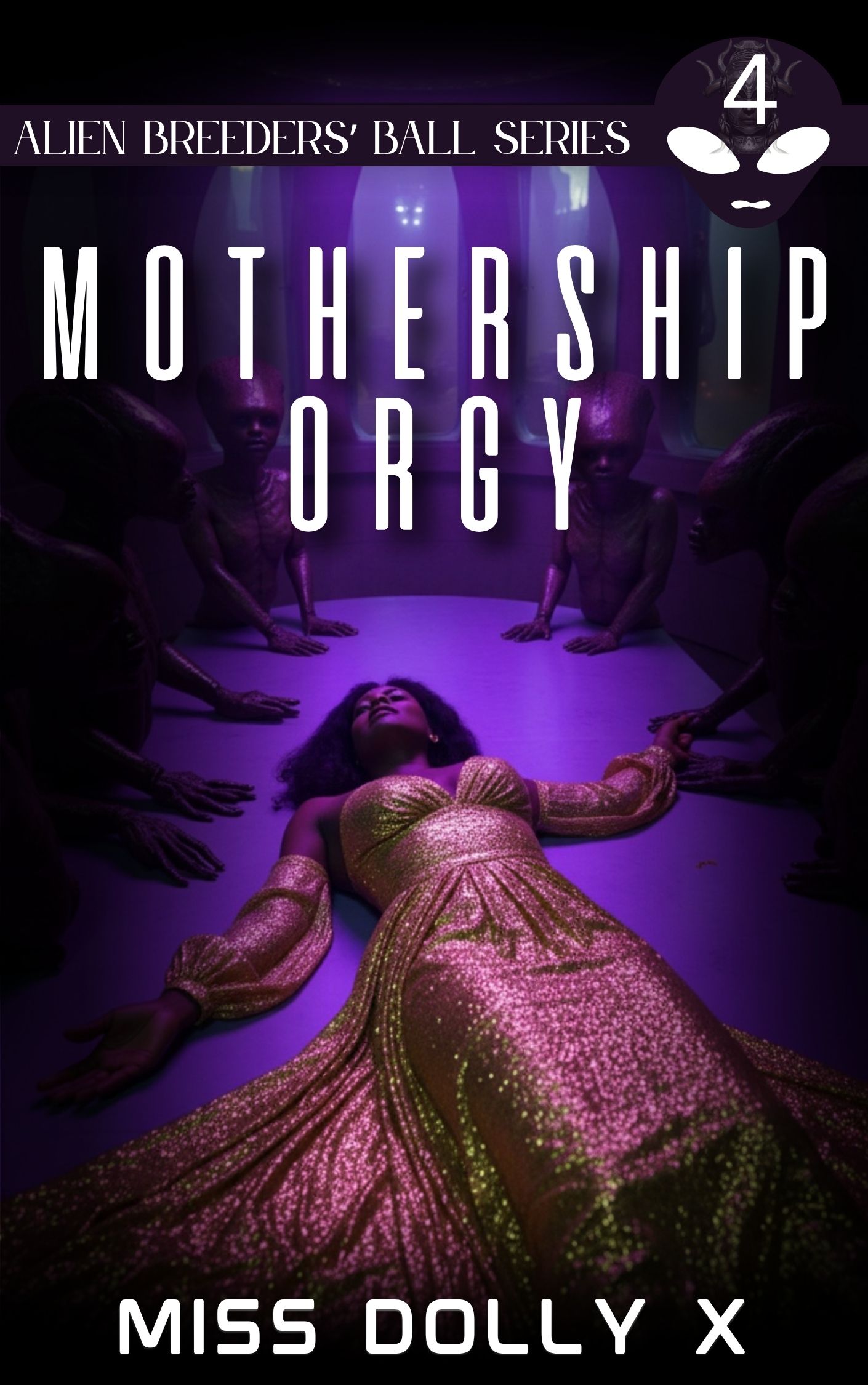
Very. Shape-shifter packs, alien fleets, and demon courts all use group scenes as a show of power or hierarchy. The genre often leans on a why choose structure where each partner has a distinct talent and role, which keeps the scene readable.
Final Thoughts
The orgy is the hardest common scene in erotica to write well and the easiest to write lazily. When it lands, it lands because the author treated the room like a character: gave it rules, gave it a host, gave it a reason to exist beyond the number of bodies.
Start with a book that respects its own group. Emily Snow's The Faire builds a group dynamic with a strong single point of view and keeps the emotional thread running through every pairing, which is the thing most debuts miss.







Loading comments…