
A car goes off a bridge. A soldier comes home from a deployment with three missing years. A billionaire wakes up in a hospital bed and doesn't recognize the woman crying at his bedside, the one his ring says is his wife.
Amnesia romance is the trope where memory loss wipes the relationship slate clean and forces two people who were already entangled to fall for each other again, or for the first time, without the history that shaped them. The other lead usually knows more than they're saying, and the whole book hums with the question of when the truth lands and what it destroys.
It's one of the most durable premises in the genre for a reason: it hands a writer a built-in second-chance structure and a built-in suspense clock at the same time. Readers who find this page are usually a few chapters into a book that just gutted them, or they're hunting for more of the exact feeling. Either way, here's the full picture.
What Amnesia Romance Actually Means
The term names a romance plot in which memory loss, temporary or permanent, partial or total, removes a chunk of one or both leads' shared past. The couple has to rebuild intimacy from whatever's left. Sometimes that's nothing. Sometimes it's a marriage license and a stranger's face.
The amnesia can be retrograde (lost memories from before the injury) or anterograde (can't form new ones), though fiction plays fast and loose with neurology. What matters for the trope is the gap: the stretch of relationship history that one person no longer has access to, and the other person's choice about whether to fill it in honestly.
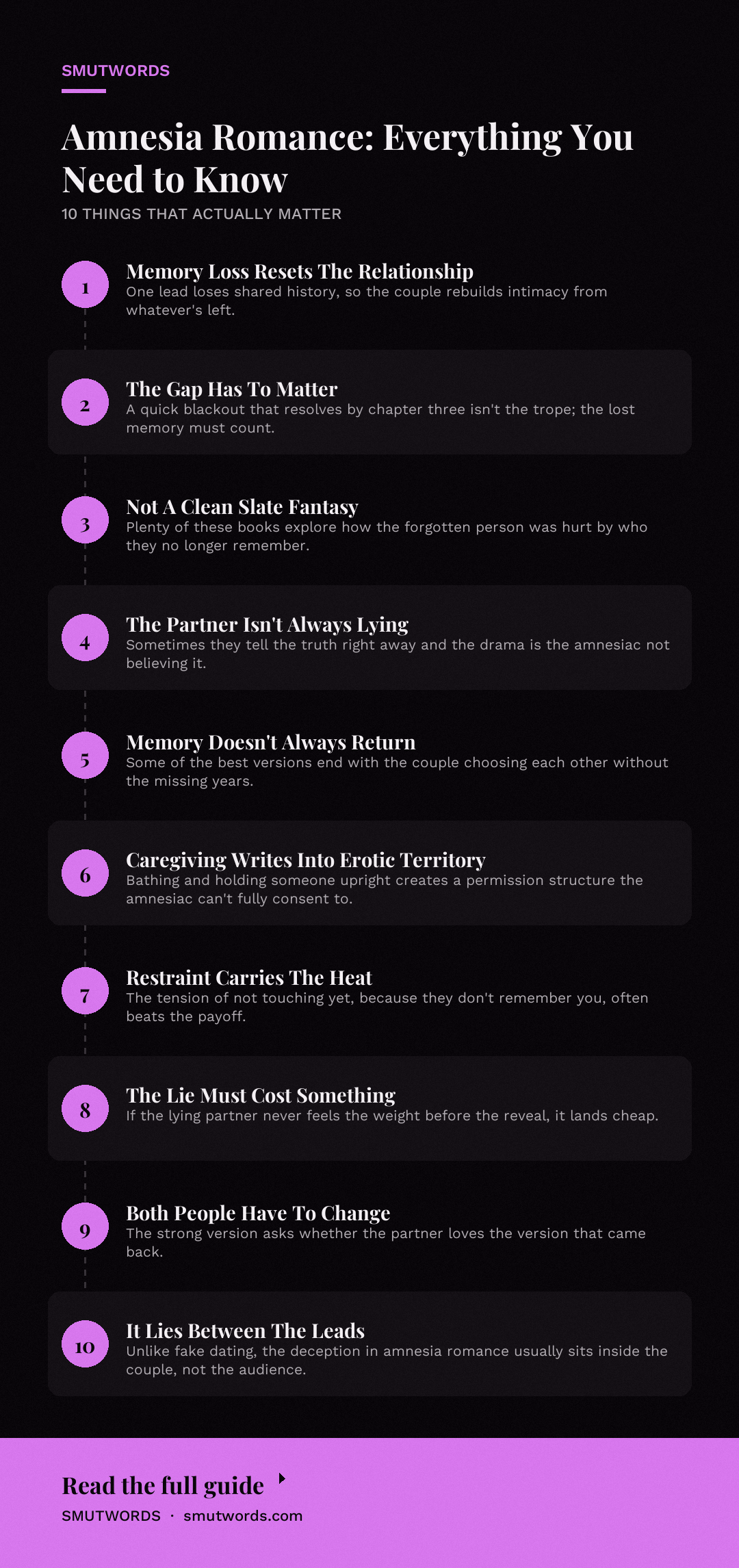
Not everything with a head injury counts. A character who blacks out for an hour and remembers everything by chapter three isn't amnesia romance, it's a plot device. The trope requires that the lost memory matters to the relationship and that the rebuilding takes real page time.
Common misconceptions worth clearing up:
- It's not always a "clean slate" fantasy. Plenty of these books are about how much the forgotten person was hurt by the version of themselves they no longer remember.
- The other lead isn't always lying. Sometimes they tell the truth immediately and the drama comes from the amnesiac not believing it, or not feeling it.
- It doesn't require a clinical diagnosis. Selective amnesia, dissociative fugue, and convenient fictional "stress-induced" memory loss all show up and readers roll with all of them.
- The memory doesn't always come back. The best versions sometimes end with the couple choosing each other without ever recovering the missing years.
Where Amnesia Romance Comes From
The amnesia plot is older than the romance genre itself. Serialized Victorian fiction loved a good lost-identity reveal, and the "who am I really" premise powered a century of melodrama before anyone thought to file it under romance. But amnesia romance as its own recognizable category is a twentieth-century publishing phenomenon, and its modern shape owes a lot to soap opera and to the category romance boom of the 1970s and 80s.
Those decades produced a flood of paperback romances with titles that practically shout the premise from the cover rack. The formula was tight: a car accident, a hospital, a handsome stranger who may or may not be the husband, a slow dawning horror that the life being rebuilt might be built on a lie. Presents and Desire lines ran these plots constantly because they hit a very specific emotional frequency: vulnerability plus suspense plus a guaranteed reunion.
Two things shifted in the 1990s and 2000s. First, the amnesia plot got psychologically smarter. Writers started asking what the forgotten person was running from, and memory loss became a way to explore dissociation, trauma, and self-deception rather than just a convenient reset button.
Second, the genre started letting women be the ones with the missing memories more often, and letting them be furious about it. The "she doesn't remember the marriage, he does, and he's been awful" setup became a whole subcategory of its own.
The indie and self-publishing era pushed the trope further into explicit territory. Today amnesia romance sits comfortably alongside darker and kinkier premises, and it crosses over constantly with possessive alpha dynamics, marriage-of-convenience setups, and second-chance arcs. The forced-intimacy machinery of those tropes pairs naturally with a memory gap, because both create the same question: how much of this is real and how much is performance?
How It Shows Up in Erotica
On the page, amnesia romance does three jobs at once. It resets the relationship, it creates an information imbalance between the leads, and it gives the writer a ticking clock. The best authors know which of those three is doing the heavy lifting and lean on it hard.
The reset problem
When one lead doesn't remember, every intimate moment becomes a first time. That's the trope's central erotic engine. The amnesiac is discovering their partner's body, preferences, and kinks all over again, and the partner is rediscovering what it feels like to be chosen by someone who hasn't yet seen them at their worst.
Writers who do this well treat the rediscovery as foreplay. A scene where he has to explain what she likes, because she genuinely doesn't know, can be one of the most vulnerable and charged setups in the genre. The power dynamic shifts constantly: the partner with memory has information, and information is a kind of control.
The information imbalance
This is where amnesia romance either soars or collapses. The partner with the missing years has to decide, scene by scene, what to reveal. Every withholding is a choice, and every choice has consequences that compound. A strong version makes the reader complicit: you know what the amnesiac doesn't, and you keep wanting the lie to hold and the truth to land in the same breath.
The flat version uses the secret as a plot device that only exists to be dramatically revealed in the last act, with no interior cost along the way. If the lying partner never feels the weight of the lie before the reveal, the reveal lands as cheap as a dropped phone.
Enjoyed this? Get a free book.
Join the list and we will send a complete free story straight to your inbox, plus new releases every week after that. No credit card, no catch.
Caregiver dynamics
A huge percentage of these books run on the caregiver-amnesia structure: one lead is injured, the other becomes the nurse, the driver, the one who bathes them and feeds them and sits at the bedside. Caretaking writes itself into erotic territory fast. The intimacy of physical vulnerability (dressing, bathing, holding someone upright) creates a permission structure for desire that the amnesiac didn't agree to and can't fully consent to in the usual sense.
The best writers handle the consent question head-on. The amnesiac's confusion is real, and the caretaker's restraint becomes part of the heat. The tension of not touching, yet, because the person under your hands doesn't remember you, is often hotter than the payoff. It echoes what skilled switch writing does: letting the power move back and forth instead of locking one person on top.
Common variations authors use
- Selective amnesia: the lead loses the trauma and the bad years but keeps the good ones, which inverts the usual geometry and lets the reveal land as a curse rather than a gift.
- Amnesia as a second chance: the couple had broken up or divorced before the accident, and the amnesiac thinks they're still happily together. The partner has to decide whether to restart the relationship while the amnesiac's memory of the breakup is still a landmine.
- Memory-loss betrayal reversal: the amnesiac is the one who did the betraying, but they don't remember, and their victim is the one now capable of either weaponizing the blank slate or protecting them from it.
- Both leads lose memory: rare and hard to pull off, but when it works it becomes a new-couple story with the added dread of two people who might not like who they used to be.
- Temporary amnesia with a time limit: the writer announces the clock (the doctor says maybe a week), and every scene has an expiration date stamped on it.
- Permanent memory loss: rarer, sadder, and often the best ending the trope has. The lost years stay lost, and the couple chooses each other without them.
What separates a strong version from a flat one
A strong amnesia romance lets the memory gap change both people. The amnesiac isn't just a vessel waiting to be refilled; they're a different person now, and the partner has to decide whether they love the version that came back. The flat version treats the amnesiac as a temporary glitch and the "real" person as waiting underneath.
The genre's best also earn the emotional stakes with specific detail. The partner remembers exactly which side of the bed she sleeps on, which song she hums, what she says when she's about to come. The scene where he gets one of those details wrong, because he's guessing, and she notices, is the kind editors remember.
Erotica writers in particular have learned to use the memory gap to reframe kink. A dominant who has to reintroduce a submissive to their own safeword, their own preferences, their own limits, writes a dynamic that's more careful and more charged than the average scene. A rockstar romance, for instance, might have the amnesiac partner rediscover backstage routines and performance rituals the press never saw.
Amnesia Romance vs the Forced-Intimacy Family
Readers sometimes lump amnesia romance together with fake dating and marriage of convenience, and there's real overlap worth mapping. All three are forced-intimacy setups. In a fake dating plot, the couple performs a relationship for an audience. In a marriage of convenience, a contract or a codicil forces proximity. In amnesia romance, the proximity is forced by the injury itself and by the caregiving that follows it.
The difference is the direction of the lie. Fake dating lies to the outside world. Amnesia romance usually lies between the two leads, or one lead lies to themselves. If you love one you'll probably recognize the mechanisms in the other; the fake dating vs marriage of convenience breakdown is worth reading alongside this one because it names the same tension from a different angle.
Frequently Asked Questions
What is amnesia romance?
Amnesia romance is a romance novel plot where one or both leads lose their memory and have to rebuild their relationship from scratch. The other lead usually keeps or hides the truth about their shared past, which drives the tension until the memory returns or the couple chooses each other without it.
Why do readers love amnesia romance?
It delivers a fresh-start fantasy in the most literal form: the chance to fall in love with the same person twice, without the weight of accumulated hurt. It also carries a suspense engine that keeps pages turning, since readers are constantly waiting for the truth to break open the rebuilt relationship.
Does the memory always come back in amnesia romance?
No. Most category romances return the memories in the final act so the couple can reunite fully, but a strong subcategory ends with permanent memory loss, where the couple chooses each other without recovering the missing years. Those endings tend to be the most emotionally brutal and the most memorable.
Is amnesia romance the same as a second-chance romance?
They overlap but aren't identical. A second-chance romance usually has both leads fully aware of the past they're grieving. In amnesia romance, at least one lead doesn't have access to that past, which makes the grief and the second chance strangers to each other.
What's the difference between retrograde and anterograde amnesia in these books?
Retrograde amnesia removes memories from before the injury, which is what most romance novels use: the character loses their shared history with their partner. Anterograde amnesia prevents new memories from forming, appearing far less often and usually forcing a different plot shape, one closer to the movie Groundhog Day than to a reunion narrative.
Can amnesia romance work in erotic fiction that leans on kink?
Yes, and some of the best do. The memory gap lets a dominant reintroduce a submissive to their own kinks and safewords carefully, which can make the kink scenes more charged and more considerate than the genre's baseline. The consent questions the trope raises are the point, not a speed bump.
Where does the trope come from?
The amnesia plot is a Victorian serial-fiction staple and a twentieth-century soap-opera workhorse, but amnesia romance as its own romance-category premise took shape in the 1970s and 1980s category boom. Writers in the decades since have pushed it into darker, smarter, and more explicit territory.
Final Thoughts
Amnesia romance earns its shelf space because it does something few other tropes can: it lets a couple fall in love twice, with the truth as a live grenade in the middle of the second falling. Whether you came here from a book that just wrecked you or you're building a reading list, the standalone recommendations below are the next stop.
When you click through to one, look for the version that respects the gap. The best amnesia romance lets the missing years stay genuinely missing for a while and makes the small kindnesses and small mistakes in the rebuilt present count for everything.







Loading comments…