
An adult foursome is a sexual encounter involving four people: two couples swapping partners, one couple inviting another pair into their bed, or a planned group scene where all four mix in shifting combinations. It's one of the most requested group scenarios in erotica because four is the smallest number that lets a scene split into pairs, shift alliances, and still keep everyone in the room.
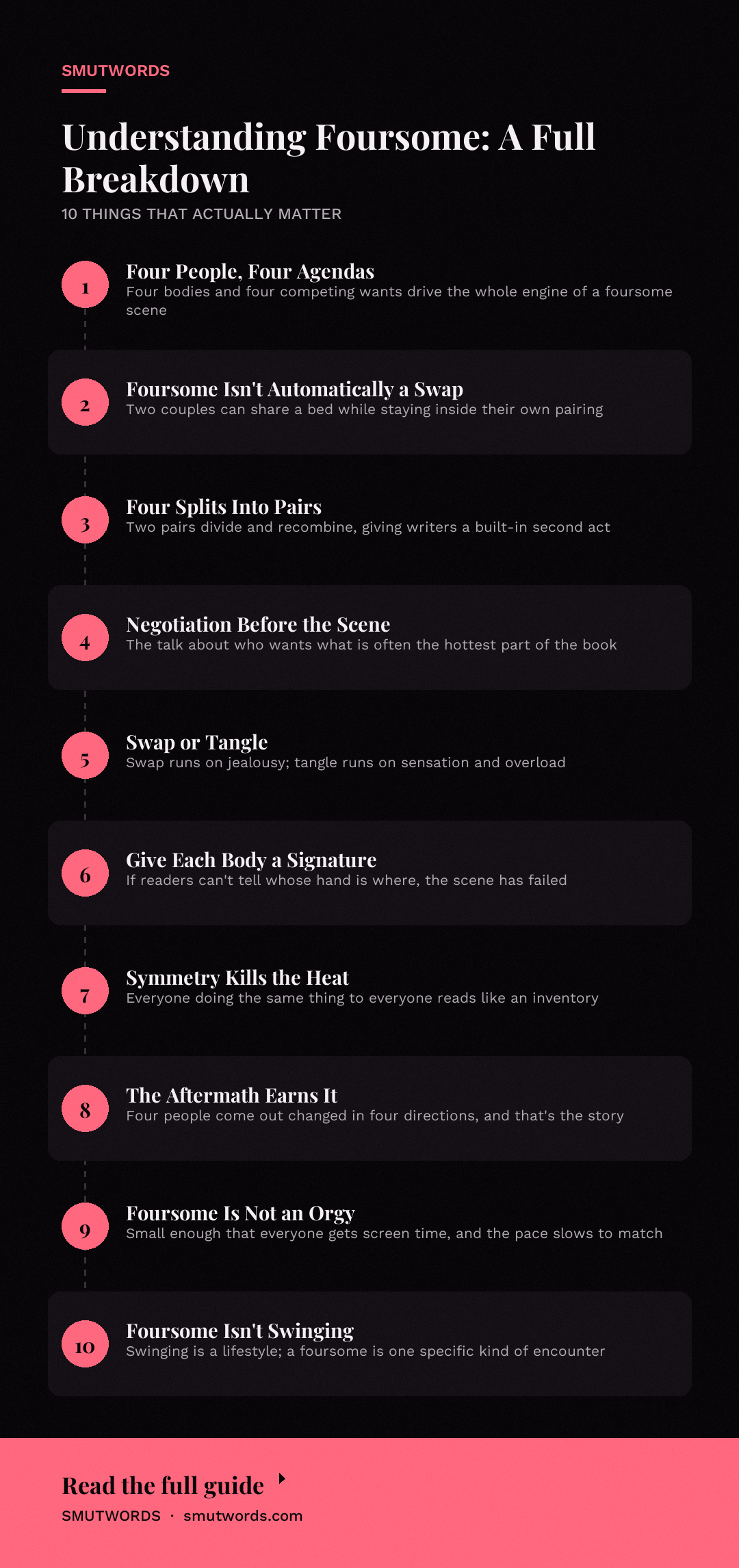
Four bodies, four sets of hands, four competing agendas. That's the whole engine of the thing.
This guide covers what the term means, where the foursome came from as a fixture of erotic publishing, how skilled authors actually build one on the page, and what separates a foursome that crackles from one that reads like a seating chart with genitals attached.
What Foursome Actually Means
The word itself is plain English arithmetic. A threesome is three, a foursome is four, and the suffix has been used to describe groups of people since the eighteenth century, long before anyone applied it to sex. The sexual usage settled in during the twentieth century. By the time swinging culture found a public face in the 1960s and 70s, "foursome" was already shorthand for the couple-plus-couple arrangement that defined early swinger advertising.
In erotica and romance, the definition is broader than the arithmetic suggests. A foursome can be:
- Two established couples swapping partners, which foregrounds loyalty, jealousy, and negotiated permission.
- One couple plus a guest pair, where the guests may be strangers, friends, or hired professionals.
- A closed four-person relationship (a quad or polycule foursome) where all four are romantically tangled, not just physically.
- Four strangers in a single night, closer to a small orgy with a tighter guest list.
- A staged scene with rules, roles, and a dominant party directing traffic.
What does not count: four people in a room where two of them never touch. A foursome requires all four participants to be sexually engaged, whether sequentially in pairs or simultaneously. The spectators-in-the-corner version belongs to voyeurism territory, and there's a whole separate trope for that.
The most stubborn misconception is that a foursome is automatically a swap. Plenty of foursomes are two couples playing inside their own pairing while sharing a bed, with heavy contact between the couples limited to kissing, watching, and hands. The category covers the arrangement, not a fixed menu of acts.
Where Foursome Comes From
The foursome's history as a publishing phenomenon runs alongside the history of the swinger memoir and the swinging magazine, both of which took off in the 1970s. Early swinger publications ran classifieds formatted around couples seeking couples, and the foursome became the default unit of the lifestyle in print. That shaped how erotica portrayed it for decades: two married couples, a suburban house, a bottle of wine, and a slow build of mutual permission.
Fiction followed the same track. Pulp erotica of the 1970s and 80s leaned heavily on the suburban swap as its central four-person scenario because it carried built-in drama: guilt, negotiation, the marriage contract straining under the weight of a new desire. The foursome in those books was rarely about pure sensation. It was about the wife's face while the husband watched, or the husband's jealousy arriving twenty minutes too late and then dissolving into something else.
Through the 1990s and into the online era, the fantasy became more varied and the publishing broader. Swinging sites and lifestyle forums normalized foursomes as a real practice, and fiction responded by getting more explicit about the mechanics: who talks to whom first, how consent gets sorted, what happens when a partner backs out.
The modern foursome in erotic romance inherited all of that and added the emotional architecture of the genre: connection, consequence, and at least one character having a feeling about it. The change is roughly this. Early foursome erotica treated the scene as a closed event with a beginning and an end, often a moral one. Contemporary erotica treats it as an ongoing negotiation between people with histories, and the scene's heat comes from how well or badly that negotiation goes.
How It Shows Up in Erotica
Four is the most dramatically useful number for a group scene, and the writers who handle it well know why. Two pairs can divide and recombine, which is a whole second act built into the premise. Three people can't split evenly. Five gets crowded.
Four gives you a clean choreography: origin pairs, first crossing, second crossing, then either a return to pairs or a full tangle.
The foursome also solves a specific pacing problem. A two-person scene needs external interruption or internal resistance to stay interesting. A foursome generates its own friction, because at any moment one participant is watching two others, or being watched, or waiting.
The two structural models
Most foursome scenes in erotica run on one of two engines.
The swap: two couples exchange partners more or less cleanly. The heat comes from the comparison: how the new body differs, how the new partner's hands move differently, what it means that your wife moaned louder. This model leans hard on jealousy converted into arousal, and it's where a lot of the emotional weight lives.
The tangle: four bodies in continuous contact, with no clean pairing. This model leans on sensation and overload, and it's where the scene's descriptive technique gets tested. A tangle is harder to write well because the reader needs a body to track the action through. Authors who pull it off usually anchor each beat to one character's sensory point of view.
The consent engine
The strongest foursome scenes are structured around permission. The negotiation before the scene is often the hottest part, because it's where the characters say out loud what they want and what they're afraid of. This is also where real-world practice bleeds into the fiction, and it should.
Real group scenes require explicit ground rules: who plays with whom, what acts are on the table, and a check-in system if someone needs out. A foursome novel that skips this step and has four people just tumble into bed can still be hot, but it reads flatter. A scene where one partner says "not him, but I want to watch you with her" has a spine.
Writers who want a model for translating negotiation into heat should look at how other tropes handle structured intimacy. The possessive alpha trope runs on the same logic from the opposite direction: who owns what, and under what terms. The bodyguard romance uses physical proximity and professional restraint as its negotiation. Both show how talk before touch can be the best scene in the book.
Common variations on the page
- The anniversary swap: an established couple marks a milestone by inviting another pair in. Tends toward emotional complexity and a marriage examined under shared pressure.
- The vacation foursome: two couples meet on holiday, no history, low stakes, high spontaneity. Popular in short-form erotica for obvious reasons.
- The professional arrangement: one couple hires two people, or a professional domme brings a third. Leans on power exchange and formality.
- The polycule foursome: a quad whose members already have romantic ties. The machinery is relationship logistics rather than seduction.
- The competitive foursome: characters who want the same person and end up sharing, with a rivalry undertone that can shade into degradation kink depending on how the dialogue goes.
- The domination-led foursome: one participant runs the scene and directs the other three. Ropes, rules, and instruction. Rope work in this variation benefits from the same technical grounding as any bondage scenario, which is why the complete guide to rope bondage covers group logistics alongside pair work.
What makes it work versus what flattens it
A foursome scene goes flat when all four participants are interchangeable. If the reader can't tell whose hand is on whose thigh, the scene has failed. Give each body a signature: a different rhythm, a different smell, a different way of saying a partner's name.
Enjoyed this? Get a free book.
Join the list and we will send a complete free story straight to your inbox, plus new releases every week after that. No credit card, no catch.
The other common failure is symmetry. A foursome where everyone does the same thing to everyone is boring because it's an inventory.
Good foursome writing is asymmetrical. One partner is patient. One is greedy. One needs to be told what to do. The contrasts are the scene.
Finally, the aftermath matters more than in a two-person scene. Four people come out of a bed changed in four directions, and the emotional sorting after the scene is where the book earns the heat it spent. A foursome without a morning after reads like an act. A foursome with one reads like a story.
Writers building a foursome into a larger romantic plot can borrow technique from elsewhere. The way a switch character's position changes the power in a scene has direct application to a foursome where roles shift mid-scene. The forced-intimacy mechanics in the fake dating vs marriage of convenience breakdown show how manufactured situations create real feelings. A foursome arranged by friends, a couple who owe another couple a favor, a holiday booking gone wrong: these are forced-intimacy setups with four chairs.
Foursome vs Orgy (and Other Close Terms)
The foursome is the smallest group arrangement that qualifies as group sex, and readers search for the two terms in different moods. An orgy is a party: more people, more anonymity, less individual attention. A foursome is intimate group sex, where four people can still know each other's names and histories by the end.
The distinction matters for writing. An orgy scene can move fast and loose because the crowd covers the gaps. A foursome scene slows down because every participant gets screen time, and every pairing gets its own beat.
Handle a foursome like an orgy and it reads rushed. Handle an orgy like a foursome and it reads like four separate small scenes that happen to share a room.
The foursome also overlaps with swinging, and the terms get used interchangeably by readers even though they aren't the same. Swinging is a lifestyle and a practice; a foursome is a specific encounter type. Swinging couples have foursomes regularly, and plenty of foursomes happen between people who would never call themselves swingers.
Fiction that conflates the two ends up with couples who sound like they've been doing this for years on page one, which erases the tension that made the scene worth writing.
A final comparison point: the foursome is often the setting for feral play, where characters drop into instinct and rough demand, or for a different flavor of intensity entirely, the pull toward primal play with its animal dynamics and chase.
Those scenes can be a foursome with specific kinks layered on, but the arrangement and the kink are separate things. Four people can get primal with each other. Four people can also be tediously polite. The number doesn't do the work.
Frequently Asked Questions
What is an adult foursome?
A four-person sexual encounter, most often two couples swapping partners or one couple inviting another pair in. It can also describe four strangers in a single scene or a closed four-person relationship. The essential element is that all four participants are actively involved.
Is a foursome the same as swinging?
No. Swinging is a lifestyle and a set of practices involving partner exchange; a foursome is one possible form a swinging encounter can take. Foursomes also happen between people who don't identify as swingers at all, including one-off encounters between friends or strangers.
How do foursomes usually start in erotica?
The most common setups are a planned swap between two couples, a holiday encounter where two couples meet, and a professional arrangement where a third and fourth person are brought in deliberately. Many contemporary books spend significant page time on the negotiation before the scene.
What's the difference between a foursome and an orgy?
Scale and intimacy. An orgy involves a larger group where individual attention is diluted. A foursome keeps the group small enough that every participant can be individually tracked, which changes both the writing and the emotional stakes.
Why is four the most popular group scene number?
Four splits evenly into pairs and recombines, which gives writers a natural scene structure: initial pairs, first crossing, second crossing, resolution. It's also intimate enough that jealousy and loyalty stay in play, which is where most of the drama lives.
What should a foursome scene get right in fiction?
Distinct participants, a negotiation that carries real weight, asymmetry between the four characters, and an aftermath that acknowledges all four changed. Scenes that skip consent conversations and treat the four bodies as interchangeable tend to read flat.
Final Thoughts
The foursome is the tightest version of group sex fiction has, which makes it the hardest to fake. Four bodies, four sets of wants, one room, and every pairing visible.
The books that get it right treat negotiation as foreplay and aftermath as plot. For a non-foursome book that handles group desire with the same precision and the same emotional follow-through, read through the SmutWords catalog for the chapter that keeps everybody's hands accounted for, and pay attention to how the author tracks four bodies at once. That's the technique worth stealing.







Loading comments…