
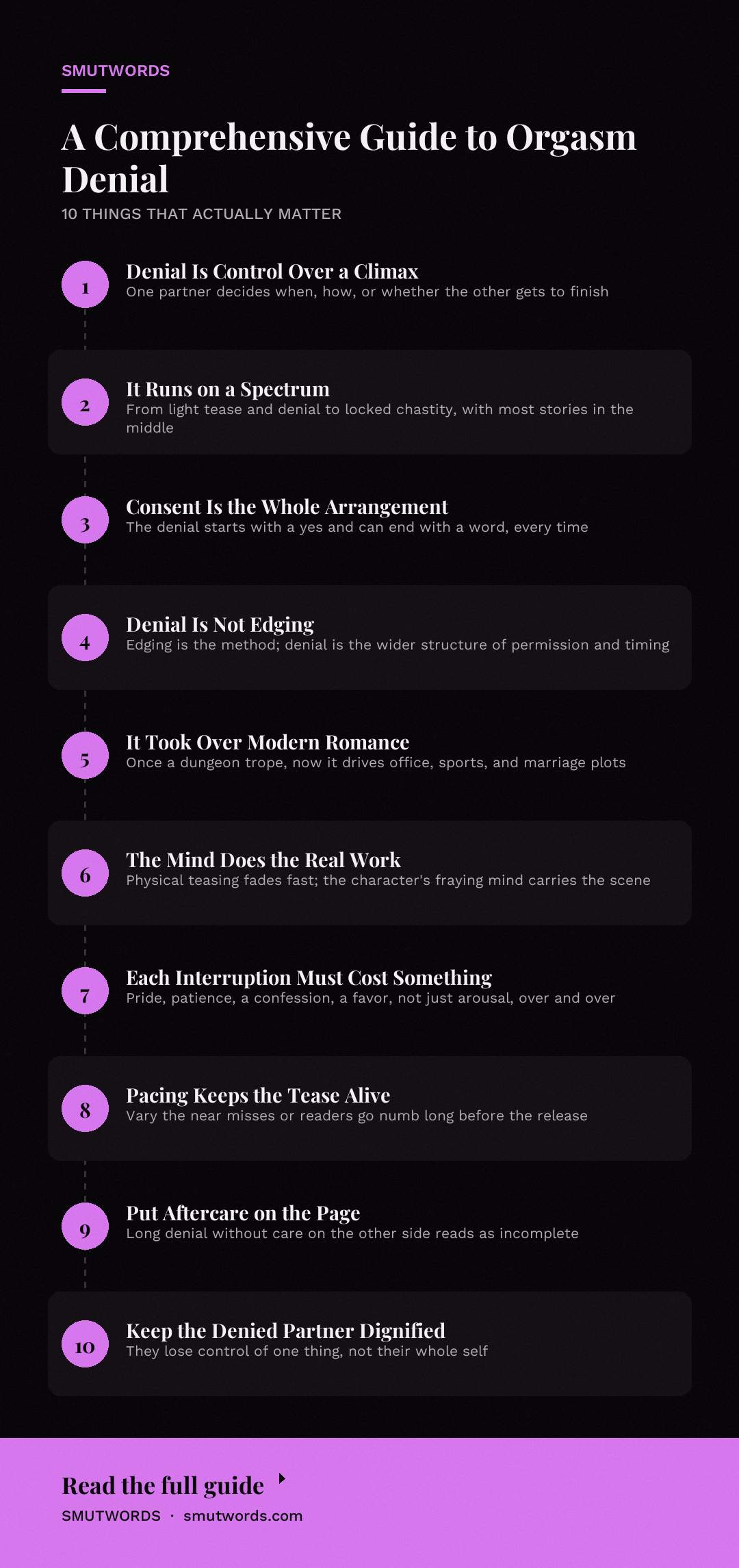
Orgasm denial is a kink in which one partner takes control of another's climax: deciding when it happens, how it happens, and whether it happens at all. The denied partner gets strung out on prolonged arousal, held at the edge through teasing and edging, sometimes for hours or days, with release dangled as a reward or pulled away as punishment.
It's one of the most reliable tension engines in erotic fiction because it turns the body itself into a plot device. Every scene becomes a negotiation over a single question, and the reader keeps turning pages to find out when that question finally gets answered.
What Orgasm Denial Actually Means
The term covers a spectrum of control, and the spectrum matters more than the name. At the mild end you have tease and denial: a partner is brought close to orgasm repeatedly and then backed off, without any device or formal arrangement. At the harder end you have chastity, where a cage or belt physically prevents release and the keyholder decides when it comes off.
Most written orgasm denial lives somewhere in the middle, in the space of permission and timing.
The key figure in nearly every version is the person holding the decision. In kink vocabulary that's the keyholder, a term borrowed from chastity practice but applied broadly to anyone who controls another person's release. You can read more about that role in the keyholding glossary entry. The denied partner surrenders a specific, physical decision, and the power exchange lives in that small, total thing.
What counts as orgasm denial is narrower than people assume. A partner who simply lasts a long time isn't denying anyone. A scene where someone is overstimulated after orgasm (post-orgasm torture) involves release happening first, then continuing, which is a different mechanic.
Ruined orgasm sits closer, since the climax is interrupted or allowed to spill without satisfaction, but the release still occurs. Denial proper is about the gap before. The withheld thing.
Common misconceptions cluster around coercion. In fiction and in practice, orgasm denial is a consensual arrangement, which means the denial begins with a yes and can end with a word. The control is real inside the scene and revocable outside it. A story that treats denial as something done to a person without their agreement is writing a different, darker thing, and readers notice.
Where Orgasm Denial Comes From
Tease and denial has been a recognizable practice in kink communities for decades, and its literary life runs just as long. Erotic writing from the mid twentieth century onward used withheld pleasure as a structural device before the term "orgasm denial" was in wide circulation.
The vocabulary crystallized later, largely through online kink communities and chastity subcultures in the 1990s and 2000s, where terms like keyholder and edging moved from forum posts into shared language.
The publishing story is more interesting than the practice history. Erotic romance spent the 2000s and 2010s leaning hard on power-exchange frameworks, and denial became a favorite tool for authors writing dominant heroes who controlled everything, including a partner's pleasure.
Chastity devices started appearing in erotic fiction as a symbol of total possession. The denied orgasm became shorthand for a relationship where one person's body followed another person's schedule.
The genre shift of the last decade moved denial from the dungeon into the everyday. Contemporary romance now uses the trope in office settings, sports romances, and marriage-of-convenience plots, with the denial played for tension rather than leather-and-chains atmosphere. The mechanism stayed the same while the settings widened, which tells you something about why the trope endures: it doesn't need a dungeon to work.
One more thread worth naming. Long-form serial fiction and online erotica pushed the trope toward extreme duration, with stories built around weeks-long denial and elaborate rules. That subgenre raised the stakes and also raised the responsibility, since the longer the denial runs, the more the writing has to account for what it does to a person. More on that below.
How It Shows Up in Erotica
Craft-wise, orgasm denial is a tension delivery system. The scene sets a target (orgasm) and then builds an obstacle course between the character and the target, with the dominant partner running the course. Every beat of touch that stops short is a fresh obstacle, and every chapter that ends without release is a cliffhanger. Authors who understand the mechanic write denial scenes that read like chase sequences: forward motion, near misses, and a payoff that lands because it was earned.
The variations authors reach for are specific enough to catalogue. These are the ones that show up most:
- Tease and denial: the baseline. Repeated near-climaxes, each one backed off, with no device involved.
- Edging: the hands-on version, where the dominant partner keeps the submissive at the brink for an extended stretch before deciding whether to allow release.
- Chastity: physical denial via a cage or device, with the keyholder controlling access. The denial is locked in, sometimes literally for days.
- Ruined orgasm: the climax is permitted but interrupted or allowed to spill without satisfaction, so the denied partner gets the physical event without the relief.
- Post-orgasm torture: release happens, then stimulation continues past the point of comfort. Denial's mirror image, often paired with it in the same scene.
- Forced orgasm control: the opposite pressure, where the denied partner is made to climax on command, then again, then again, until the control is the point.
The strongest versions of this trope live or die on the psychology of the denied partner. A scene that only describes the physical tease gets old fast; a scene that shows the character's mind fraying, the bargaining, the way they start agreeing to things they'd never agree to otherwise, does the real work. Denial is a mind game with a body attached, and the best writing keeps the camera on the mind.
Pacing is the second pillar. Authors who overdo the denied scenes numb the reader; the tease has to escalate or vary, and the near misses need to feel different from each other.
Enjoyed this? Get a free book.
Join the list and we will send a complete free story straight to your inbox, plus new releases every week after that. No credit card, no catch.
A good rule from editing a few hundred of these: the longer the denial runs, the more each interruption should cost the denied character something new. Not just arousal. Pride, patience, a held-back confession, a favor. Physical frustration alone flattens by the third scene.
The dynamic also pairs naturally with other kinks, and good authors know which pairings work. Degradation and humiliation are common companions, and the degradation kink glossary entry covers how that language layers onto denial scenes. Denial also sharpens possession-driven dynamics, which is why it fits so cleanly into the possessive alpha trope: an alpha hero who controls his partner's pleasure is a short step from one who controls everything else.
For authors building a denial scene from scratch, the editorial checklist is short and unforgiving:
- Establish consent on the page early, even obliquely, so the control reads as negotiated rather than stolen.
- Give the denied partner an interior voice between interrupts. The reader needs to hear the fraying.
- Vary the near misses. Touch, words, distance, silence, a new setting, a new rule.
- Track the physical cost: the ache, the distraction, the sleep lost, the concentration gone. Denial has a body budget.
- Make the eventual release earn its page. If the payoff lands in one line after fifty pages of buildup, the reader will feel cheated.
- Show aftercare, or at least acknowledge it. Long denial scenes without any care on the other side of the release read as incomplete to experienced readers.
The flat version of this trope is easy to spot. The dominant partner teases, the submissive partner moans, the scene repeats, and the release arrives at whatever page count the author needed. The strong version gives the denial a shape: a rising cost, a relationship that shifts under the pressure, and a payoff that affects what the characters become afterward.
Denial is also a useful engine in slower relationship structures. In bodyguard romance, the proximity and protocol make denial an easy fit: the guard who is supposed to protect the client and can't touch them has a built-in denial mechanism before the author writes a word. Authors writing longer arcs, including harem romance, use denial to keep multiple partners in play without resolving the physical plot too early.
One craft note that separates experienced erotic writers from beginners: denial scenes have to keep the denied partner's desire legible without making them pathetic. The character is losing control of one specific thing, not their whole self, and the writing should find the dignity in surrender. Readers want the ache to be real; they don't want the character to become small.
Orgasm Denial vs Degradation Kink
Readers often blur these, so it's worth drawing the line. Orgasm denial is about control over a physical event (the climax), and the power exchange lives in timing and permission. Degradation kink is about the verbal and emotional charge of being brought low, and it has nothing inherently to do with climax control.
The two overlap frequently. A dominant partner can deny orgasm while narrating the denial in degrading terms, and the combined charge hits harder for readers who like both.
The mechanics stay distinct, though. Denial without degradation is clinical and hot. Degradation without denial is verbal and hot. Writing one while thinking it's the other produces muddled scenes, so name the mechanic you're actually using.
Frequently Asked Questions
Is orgasm denial the same thing as edging?
Edging is the hands-on technique of keeping a partner at the brink of orgasm, and it's often a component of orgasm denial. Orgasm denial is the wider arrangement: the control over when and whether the orgasm happens, which can include edging but also chastity, rules, scheduled releases, and other forms of withholding. Edging is the method; denial is the structure.
How long can orgasm denial realistically last?
In kink practice, denial runs from minutes to weeks depending on the people involved and their communication. In fiction, the practical ceiling is reader patience. Longer denial arcs need more variation and more interior cost to stay fresh, and most authors find the sweet spot in a few days of story time with intense, escalating scenes.
Is chastity necessary for orgasm denial?
No. Chastity is one delivery mechanism, useful for stories where the dominant partner can't be present to enforce denial directly or where the locked device carries symbolic weight. Plenty of denial scenes involve no device at all. The mechanic is permission, and permission doesn't need hardware.
What is a ruined orgasm?
A ruined orgasm is a climax that's permitted but interrupted or allowed to spill without physical satisfaction. In practice it involves stimulation stopping right at the point of no return, so the release happens without the pleasure of release. In fiction it's used to deliver a scene-ending beat where the denied partner gets nothing they wanted.
Why do readers like orgasm denial so much?
It's one of the cleanest tension structures in erotic fiction. The reader knows exactly what's being withheld and exactly who's withholding it, so every scene becomes a countdown. The eventual release lands harder for the build, and the emotional payoff (trust, surrender, being seen by someone who knew how far to push) gives the trope weight beyond the physical tease.
Does orgasm denial need a safeword in a story?
A written denial scene should show consent being established somewhere, even in a single line, and a story that runs long enough to build a formal dynamic usually names a safeword or an equivalent signal. Skipping this leaves the scene reading as coercion, and most experienced readers will flag the omission before they finish the chapter.
Final Thoughts
Orgasm denial works because it makes pleasure a moving target. The reader wants the release as much as the characters do, and every withheld beat raises the stakes of the eventual payoff. Write the mechanic with care, give the denial a cost, and put the aftercare on the page, and the trope will carry a story further than almost anything else in the kink catalogue.
For readers who want to see it done well, The Complete Guide to Rope Bondage covers the restraint side of the same power-exchange toolkit, and the ranked list below is the place to find your next full-length denial read. Start at the top of that list; the pick there builds the denial slowly enough to feel it.







Loading comments…