
Swinging is a consensual non-monogamous arrangement in which people in committed partnerships have sex with other people, together or with full mutual knowledge and permission. The couple stays the couple; the extra sex happens at the edges. In erotica and romance, swinging is the engine that lets a story have both at once: the safety of a chosen person and the adrenaline of somebody new. The genre loves that math.
If you landed here from a search bar, you probably want the real version: what swinging actually means, where it came from in fiction, how authors build good scenes out of it, and how it differs from the kinks it gets confused with. That's all below. Nothing watered down.
What Swinging Actually Means
At its core, swinging is partner-sharing. Two people in a relationship agree that they can have sexual contact with others, and they generally do it in the same space, at the same time, or with detailed reporting afterward. The defining feature is the couple as unit. Both know, both consent, both stay.
The name comes from mid-twentieth-century American slang. "Swingers" described married couples hosting and attending parties where partners swapped. The word stuck, and the swinger culture that grew up around it built its own vocabulary, etiquette, and club scene. That history matters for fiction because so much of the fictional furniture (the key bowl, the suburban house party, the "no strings" rule) came straight from it.
What Counts
- Soft swap: kissing, touching, oral, sometimes same-room play, but no penetrative sex with anyone outside the primary partner.
- Full swap: penetrative sex with another person, often with the couple in the same room or the same bed.
- Same-room play: two couples having sex alongside each other without exchanging partners.
- Partner play: one partner watches or participates while the other plays with somebody new.
- Ongoing arrangements: a repeat partner or couple, which is where fictional complications really start.
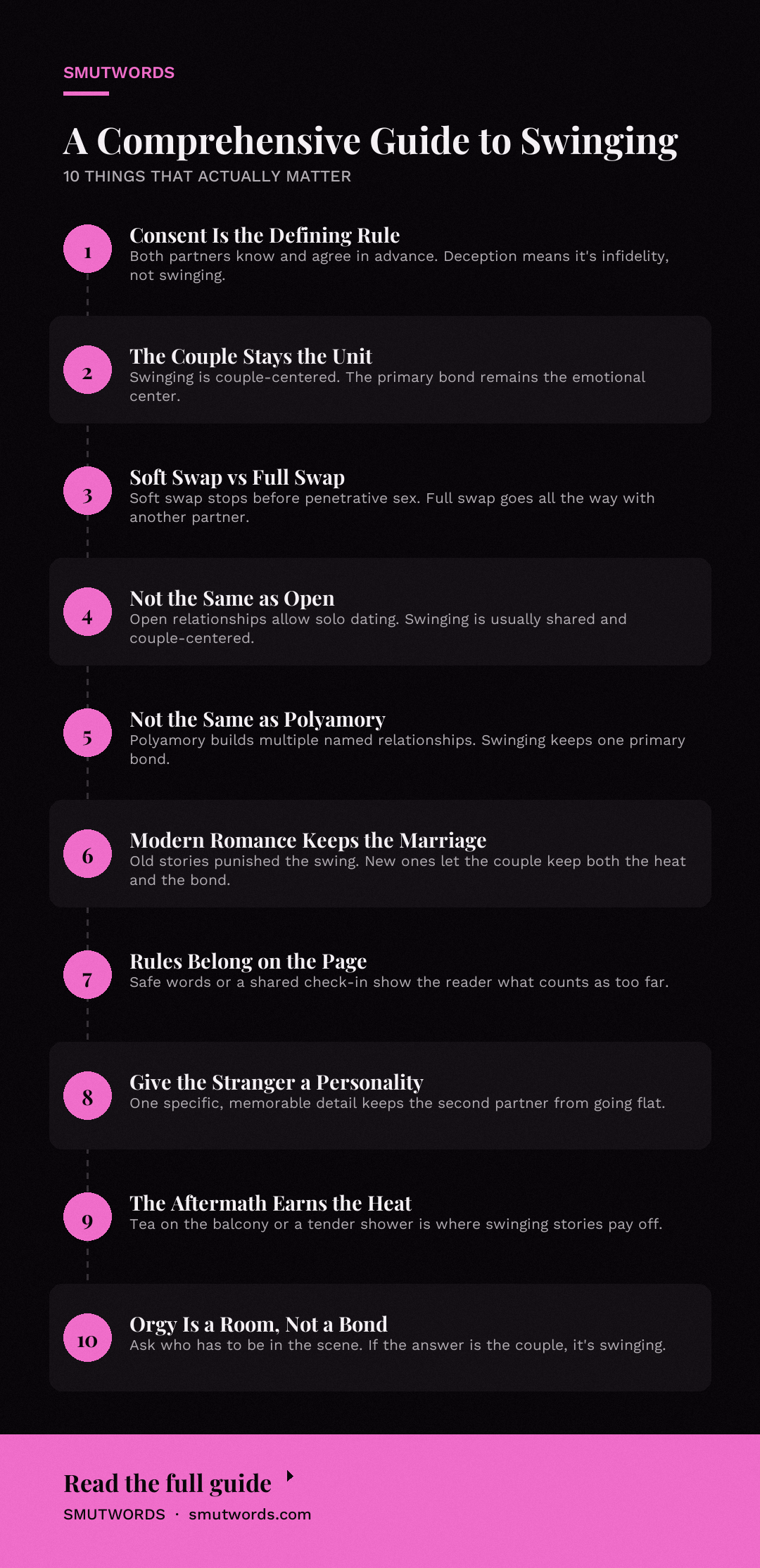
The one rule that separates swinging from cheating is agreed-upon consent, in advance, with a shared understanding of what is allowed. Nobody in a swinging story is being lied to. If a partner is being deceived, you are not writing swinging. You are writing infidelity with a costume on.
What Doesn't Count
An open relationship and swinging overlap but are not identical. In an open relationship, each person may date or sleep with others independently, sometimes on their own time and address. Swinging is more often shared and couple-centered. The two get blurred in fiction, and that's fine, but they aren't the same shape.
Polyamory is a separate thing again. It builds multiple felt, named relationships, not one primary bond with sexual excursions around it. Group marriage is a different structure entirely, and so is harem romance, which is usually one person at the center of many. None of these are swinging, even if the scenes look similar for a paragraph.
The most common misconception: swinging is just cheating with extra steps, or it's only for couples who secretly hate each other. Neither is true. The genre has gotten plenty of mileage out of those ideas, but they describe a specific dramatic failure, not the practice itself.
Where Swinging Comes From
As a real-world subculture, swinging walked out of the postwar American middle class and into the public imagination through magazines, the sexual revolution, and a string of books and films that treated partner-swapping as the ultimate suburban scandal. The publishing story is what matters for us here. From the 1960s onward, swinging became shorthand for "respectable people doing unrespectable things," which is a fantasy the reading public has never gotten tired of.
Pulp erotica picked it up early. Soap-opera paperbacks built plots around one bad weekend at a lake house. By the time mainstream women's fiction and then romance got hold of it, swinging was already a familiar narrative device. Its appeal in fiction has always been less about the act and more about what the act reveals: the cracks in a marriage, the strength of a bond under pressure, the raw animal part of a person who is usually buttoned up.
Contemporary romance has changed one big thing. Earlier swinging stories treated the extra partners as plot obstacles and moral warnings. The couple either collapsed or repented. Modern erotica and romance let the couple keep the swing and the marriage.
The heat is no longer a threat to the love. It runs alongside it. That shift is huge, and it's why swinging has become a comfort fantasy more than a scandal one.
There's also the recent wave of "why choose" and shared-partner stories that borrow the visual language of swinging without the structure. For a deeper look at that adjacent form, read our piece on why choose romance first, then come back. It's the closest cousin swinging has on the shelf right now.
How It Shows Up in Erotica
A strong swinging scene does three jobs at once. It delivers heat. It shows you the couple's actual relationship. And it gives the reader a window into the character who is being watched, chosen, or appraised.
Flat swinging scenes only do the first job, and the reader feels it. You get bodies in a room with no reason for the reader to care.
The best versions feel like the scene is about the couple even when they are in bed with strangers. The stranger is a mirror. Their reaction tells us what the primary partner already knows or is just discovering.
Common Variations Authors Use
- The first-time couple. They've talked about it for months. Tonight is the night. Every glance across the room is a question.
- The experienced couple and the newbie. One partner is a guide. The other is disarmed. This variant is where the tenderness usually lives.
- The same-room couples. Two committed relationships in one bedroom. The heat comes from eye contact with your own partner while someone else is touching you.
- The watched partner. One person sits back and watches. The turn-on is the exhibition, the small humiliations of being seen, and the calm afterward.
- The vacation arrangement. Rules that apply only in another city, in another country, for one week. Very popular in erotica because the rules are self-contained.
- The recurring third. A friend, an ex, or a neighbor who becomes a regular. This is where the emotional stakes get real.
- The roleplay-turned-real. The couple pretends they are strangers meeting in a bar. The play lets them access things they can't quite say out loud.
If your story involves a recurring third, you'll be working in territory close to friends with benefits. Those stories and swinging stories share the same central tension: how long can "no strings" stay that way. The line between the two tropes is blurry on purpose, and readers cross it happily.
What Makes a Strong Scene
The strongest swinging scenes respect three craft rules.
The rules are on the page. Not as a lecture, but as the couple's shorthand. Maybe they have a safe word. Maybe one partner always checks in with a raised eyebrow and the other nods.
The reader should know, without being told, what counts as too far in this specific relationship. The stranger has a personality. A cardboard second bed partner flattens the whole scene. Give them one specific, memorable detail, even if the scene is short.
Enjoyed this? Get a free book.
Join the list and we will send a complete free story straight to your inbox, plus new releases every week after that. No credit card, no catch.
The aftermath matters as much as the act. The best erotica earns the quiet chapter after. Tea on the balcony. A weirdly tender shower.
A conversation that is honest in a way the couple hasn't managed for months. That's where swinging stories pay off the heat.
Compare it to how a good rope bondage scene depends on trust and setup as much as on the knots themselves. Swinging works the same way. The mechanics are the punctuation. The trust is the sentence.
Where It Slips Into Other Kinks
Swinging gets mixed into a lot of nearby tropes because it is such a natural pressure source. In a possessive alpha romance, the alpha watching his partner with someone else is the entire point, and the jealousy has to be resolved before the HEA. In bodyguard romance, the bodyguard is often the only one who knows about the swinging arrangement, which creates instant intimacy and, usually, instant doom.
Swinging scenes also intersect with shibari in stories where one partner is tied while the other is free to play. They cross into orgy territory when the couple joins a larger group scene, though the couple-focused logic usually stays intact.
A quick note on primal play: some authors blend the instinct-and-chase energy of primal into their swinging scenes, and the results can be electric. Just be clear about which kink is doing the work. Also worth reading alongside this one: our piece on what it means to be a switch, since the give-and-take between partners maps onto a lot of the same territory.
Swinging vs Orgy
Readers confuse these two constantly, so it's worth drawing the line. An orgy is a group sex scene. The unit is the room.
Swinging is a relationship structure. The unit is the couple. An orgy can happen inside a swinging story, but a swinging story can happen without any group scene at all.
In practice, that means orgy scenes prioritize the group dynamic, cumulative heat, anonymity, and the sense of being one body among many. Swinging scenes prioritize the couple's eye contact across the room, their specific rules, and the private conversation waiting for them after.
Same bodies, different plot engine. If you're not sure which you're writing, ask yourself: who has to be in this scene for it to work? If the answer is "the couple, specifically," you're writing swinging.
Frequently Asked Questions
What is swinging, exactly?
Swinging is a consensual arrangement in which partners in a committed relationship have sex with other people, usually together or with full mutual knowledge and agreement. The primary couple remains the emotional center. Extra partners are typically understood as part of the arrangement, not a replacement for the relationship.
Is swinging the same as an open relationship?
No. They overlap, but an open relationship usually allows each partner to pursue sex or dating independently, while swinging is more often shared and couple-centered. Same-room play, soft swap, and partner swap are swinging. Solo dating outside the primary bond is usually labeled open relationship.
What's the difference between soft swap and full swap?
Soft swap means affection, touching, or oral with another partner but no penetrative sex. Full swap means penetrative sex with someone other than your primary partner. Many couples start with soft swap and decide later whether to move further, and a lot of romance novels use that progression as their structural spine.
Can swinging work in real life without hurting the relationship?
For many people, yes, and the working parts are unglamorous: clear rules written down, ongoing check-ins before and after, and a willingness to stop entirely if one partner is having a bad time. The couples who do it well tend to be the couples who already communicate well. Swinging doesn't fix a shaky relationship. It exposes it.
Why do readers love swinging romance so much?
Because it lets a story have both security and novelty in the same person's life. The couple gets to keep their marriage and their heat. The reader gets the jealousy-thrill of watching a devoted partner be desired by someone new, with the comfort of knowing the primary bond survives it.
Does swinging always involve the couple being in the same room?
No. A lot of real-world and fictional swinging happens in separate rooms, on separate vacations, or with one partner reporting back afterward. Same-room play is one variation, not the definition. Many couples find same-room play reassuring because they can see what's happening in real time.
What if a book's swinging scene feels cold or mechanical?
That's usually a craft problem, not a genre problem. The scene is missing the couple's specific rules, the aftermath chapter, or a genuinely interesting second partner. Skim to the end of the scene and see if the couple talks about it afterward. If they don't, that's the missing piece.
Final Thoughts
Swinging earns its place in erotica because it can hold the two things readers want most from a single book: deep, proven devotion and the shock of new skin. The couples who get it right in fiction are the ones who were honest with each other before they ever walked into that room.
So start with a story that respects that rule, then let yourself feel the floor tilt. The romance shelf has plenty of swinging stories worth a long weekend. The best ones leave you with the couple long after the last chapter.






Loading comments…