
A painting kink is the erotic use of a body (or group of bodies) as a canvas. That means fingers dragging wet acrylic across skin, a brush loaded with chocolate sauce, or a model posed while pigment dries on their chest.
It sounds gentle, almost artsy, which is exactly why it surprises people with how charged it gets. The kink lives in the brushstroke, not the paint itself. The slow attention, the stillness required, the way one person gets to look their fill while the other is turned into something on display.
It overlaps with body worship, but runs hotter because it leaves a mark. A visible record of who was touched and where.
What Painting Kink Actually Means
The painting kink, sometimes called body painting play or an art kink, is a sexual dynamic where applying paint, pigment, or a paintable substance to a partner's body becomes the central erotic act. It covers real body paints made for skin, food-grade materials like chocolate or honey, and even substances like clay or foundation makeup when the intent is artistic eroticism rather than everyday grooming.
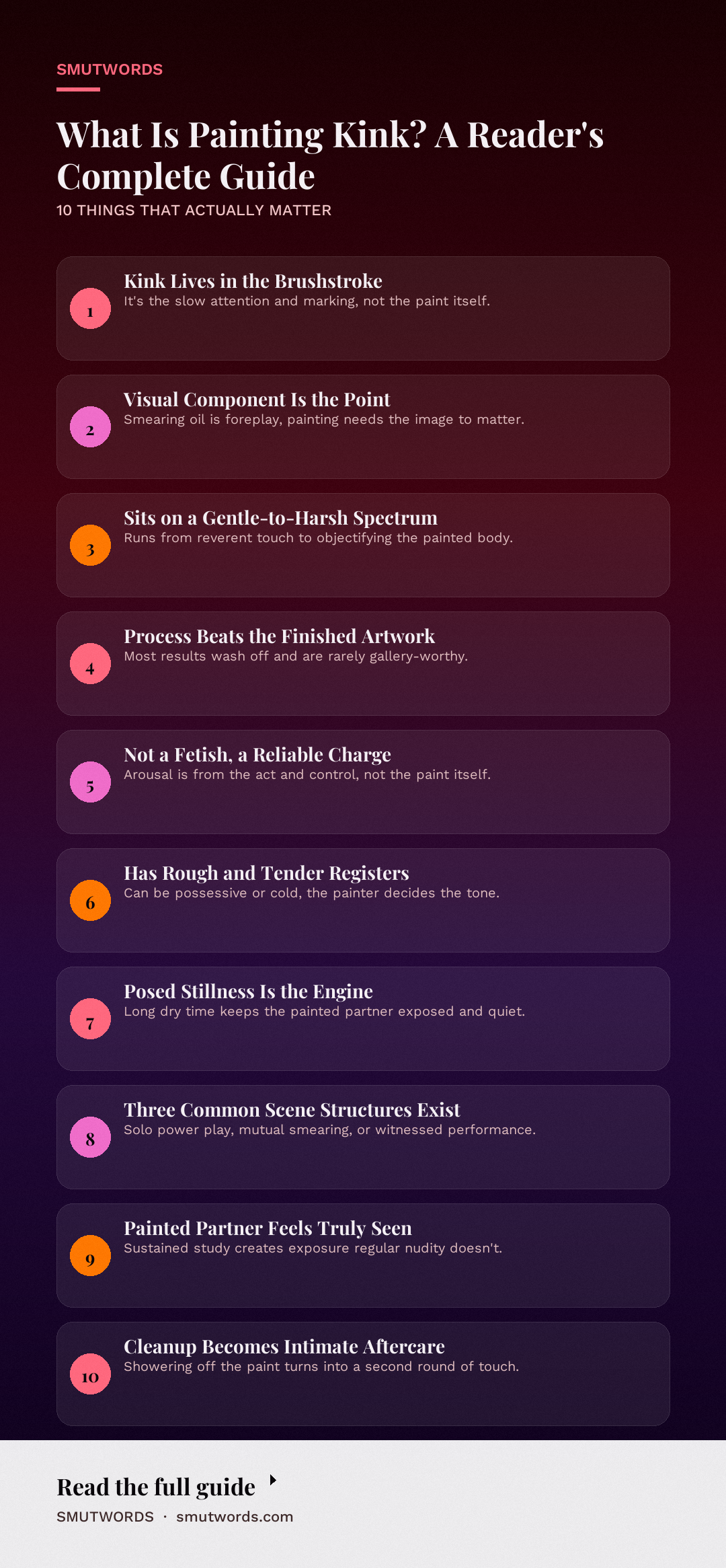
What counts as the kink requires some precision. A couple smearing massage oil on each other before sex is foreplay with a slippery texture, not a painting kink. Painting kink needs the visual component to matter. The act should be about creating an image, pattern, or color field on skin, with the looking and the marking as the point.
When one partner paints a design on the other's back and then they have sex, that is adjacent. When the painting itself is the sexual event, lasting twenty minutes or two hours, with arousal building from the brush contact and the posing and the observation, that is the full thing.
The kink sits on a spectrum between two poles. On one end you have the gentle, almost reverent version where painting functions as an elaborate form of touch and concentration, a way to map a body inch by inch. On the other end you have a degradation-tinged version where the painted body is treated as an object, a blank surface for the top to use and then discard.
Most erotica falls somewhere in the middle, using the paint as an excuse for prolonged, deliberate contact and vulnerability.
Common misconceptions abound. Painting kink is not a costume party activity or a pretext for a PG-13 scene. It is not about the finished artwork. Most painted bodies wash off in a shower and the result is rarely gallery-worthy.
The kink is the process. It is also not inherently romantic or soft just because it involves paint brushes instead of restraints. The same dynamic that makes it tender can make it possessive or cold, depending on who is holding the brush.
The word "kink" matters here too. This is not a fetish, because the paint itself is not the object of arousal for most people. The arousal comes from the act of being painted, the control, the exposure, the slow deliberate touching. A true fetishist might need body paint to get off at all. A person with a painting kink simply finds the practice reliably, intensely hot.
The glossary's definition of voyeurism gets referenced in a lot of these scenes, because watching someone paint a partner is as much of the charge as doing it yourself. And if the dynamic veers into possessive territory, the complete guide to possessive sex covers how that ownership impulse plays out in other contexts too.
Where Painting Kink Comes From
Body painting as erotic practice has roots older than written history, but the recognizable trope in erotica and romance is a much younger phenomenon. Ancient cultures used pigment on skin for ritual, status, and warfare, and the erotic charge of decorated bodies shows up in classical art, but none of that history feeds directly into the modern romance-novel scene. The publishing-genre history is what matters here.
The erotic potential of body painting entered Western popular imagination through the 20th century art world. Yves Klein's "Anthropometry" performances in the 1960s, where naked women coated in blue paint pressed their bodies onto canvas, sparked scandal precisely because the line between art and erotic spectacle blurred. That cultural moment seeded the idea that painting on a living, naked body is transgressive.
Mainstream media kept the association alive for decades. Magazines photographed models with paint strokes strategically placed, and movies used body painting scenes as a safe way to imply nudity without showing it.
Romance and erotica picked up the motif in the 1980s and 1990s, usually as a device in a seduction montage. A hero would paint a heroine's portrait, or a couple would fingerpaint on each other in a bathtub, and the scene existed to get the characters wet and hungry without an explicit sex scene. The kink was rarely the point of the book, just a visual beat on the way to the actual coupling.
The shift toward painting as a genuine kink in its own right happened alongside the rise of indie erotica and self-publishing in the 2010s. Once authors no longer needed a traditional publisher's approval, scenes could stretch. Body painting stopped being a two-paragraph prelude and became a full chapter.
The trope developed mechanics: the choice of paint, the posing instructions, the slow dry time that keeps the painted partner still and exposed. Writers realized the kink offered a perfect engine for power exchange without any of the typical bondage gear.
The modern version also absorbed influence from the shibari aesthetic, borrowing the language of rope art to describe paint as a way of "marking" a body as a form of visual restraint. The painted design functions like rope, a pattern that holds the eye and signals ownership. That crossover helped body painting move from soft-focus romance to a legitimately versatile kink with both gentle and harsh registers.
How It Shows Up in Erotica
Erotica uses the painting kink in three dominant scene structures.
The first is the solo canvas, where one person paints the other while the unpainted partner stays in control. The painted partner stands, sits, or lies in a pose while the painter works. The power dynamic is built into the stillness. The painted one must hold position, stay quiet, endure the ticklish brush strokes and the cool wet paint.
A strong version of this scene draws out the patience. The painter corrects a pose with a hand on the hip, and the painted partner's arousal builds from being observed and directed for so long.
Enjoyed this? Get a free book.
Join the list and we will send a complete free story straight to your inbox, plus new releases every week after that. No credit card, no catch.
The second structure is the mirrored or mutual version, where both partners paint each other. This plays differently. Less power exchange, more escalating sensory play. Each stroke invites a response, and the scene usually devolves from careful art into smearing, which is its own release valve.
Strong mutual scenes use the loss of control as the arc: they start neat and end messy, the paint becoming an excuse for raw, unplanned touch. This version overlaps heavily with rough sex when the smearing turns aggressive, paint tracked down a back while hands push someone against a wall.
The third structure is the performance scene, where a painting kink is witnessed. This could be a third party watching through a doorway, or an entire gathering where body painting is the exhibition. These scenes pull in voyeuristic energy, the painter narrating their work, the audience reacting as the design takes shape.
Because body painting takes time and requires stillness, it gives the reader a rare chance to see a character held in a gaze for long minutes rather than the usual frantic chase. That patience is the kink's signature strength.
Authors who write this kink well know the paint itself is a character. The details matter: the chill of wet pigment on warm skin, the drag of a bristle across a nipple, the way paint catches in the hollow of a collarbone or the dip of a lower back. Sensory specifics do the heavy lifting, not the dialogue.
Flat versions of these scenes skip the physicality and just say "he painted her body" before cutting to sex. The good ones make the painting the sex, with the eventual penetration or oral as a reward for the endurance.
Variations on the theme keep the kink fresh across a series. Some authors use food-grade materials to add taste into the scene, so the painter licks paint off the model in selected spots. Others use glow-in-the-dark or UV-reactive paint so the design appears only under blacklight, adding a reveal beat where the painted body transforms under the light. Temperature variants run warm and cold, melted chocolate versus chilled body paint, each changing how the model reacts to every stroke.
The best painting kink scenes respect the vulnerability of being a canvas. The painted partner cannot cover themselves, cannot move, cannot do anything but be looked at. Strong writing leans into that exposure rather than rushing past it.
The painted character feels seen in a way that normal nudity does not produce, because their body is actively being studied, stroke by stroke. That sustained, deliberate observation is the emotional core of the kink, and the most successful scenes make the reader feel the weight of that gaze.
Painting Kink vs Jealousy Kink
These two get compared because the painting kink often appears inside jealousy plots, but they are distinct engines. The painting kink is about artistic control over a body, the slow visual claim that paint provides. The jealousy kink is about the arousal generated by a partner's real or threatened desire for someone else.
A painting scene can trigger jealousy if a third person watches the painter work, but the paint is not required for jealousy play to function. Compare a scene where a top paints their partner's chest with a possessive design, versus a scene where the top simply tells the partner to kiss someone else at a party. The first uses pigment to mark ownership, the second uses action.
The two kinks combine well. A painter making a show of their canvas in front of an envious observer carries both charges at once. But readers looking for one should know they are not interchangeable. The painting kink delivers its charge through touch and visual transformation, not through triangulated desire.
If you want to explore the third-party angle further, the explainer on the bull trope digs into why the observer matters so much in those dynamics.
Frequently Asked Questions
What kind of paint do you use for a painting kink?
Alcohol-based body paint or cosmetic-grade water-based paint is the standard choice. Food-grade materials like chocolate sauce, honey, or pudding work for scenes that add licking and tasting. Avoid craft-store acrylic and tempera paints, which are not skin-safe and dry into a cracking film that pulls at hair and skin.
Is the painting kink always about being gentle?
No. The kink has a rough register where the painter treats the model as an object, dragging paint with force, smearing designs with no care, or painting degrading symbols. The same scene can start tender and turn aggressive. The power exchange is the true variable, not the viscosity of the paint.
Do you need to be an artist to enjoy the painting kink?
No skill is required. The arousal comes from the touch, the observation, and the marking, not from producing art worth framing. Finger painting, handprints, or simple shapes carry the same charge as a skilled mural. The messier the approach, the more the focus stays on the body instead of the result.
Is the painting kink the same as body painting at a festival or event?
Not really. Event body painting is about the finished look for photos and crowds. The kink version keeps the painting as the sexual act itself, with erotic intent behind every stroke and the painted state as a form of exposure. A festival artist painting a tourist's arm has no erotic dynamic. A partner painting a nipple with slow deliberation does.
How do you wash off body paint after a scene?
Water-based body paint removes with warm water and mild soap. Alcohol-based paint needs a makeup remover or baby oil before a final wash. The cleanup is a natural extension of the scene for many couples, the shower together becoming a second round of intimate touch as the paint streaks and fades.
Can the painting kink happen in a group setting?
Yes, and it works well as group play. One person paints a model while others watch, or multiple painters work on a single canvas in different zones. The group version leans on the voyeurism of the process and the contrast of styles touching the same body. Some scenes turn into swinging dynamics when the painted body becomes a shared resource for the group to appreciate and touch.
Final Thoughts
The painting kink rewards patience in a way most bedroom activities do not. It forces a slower tempo, demands that someone hold still and be studied, and gives the painter permission to touch everywhere while looking the entire time.
If you want to read a version that captures the full arc of the kink, from the first cool stroke to the shower that washes it all away, look for a scene that spends its word count on the process, not just the payoff. The best books treat the paint as the plot.








Loading comments…