
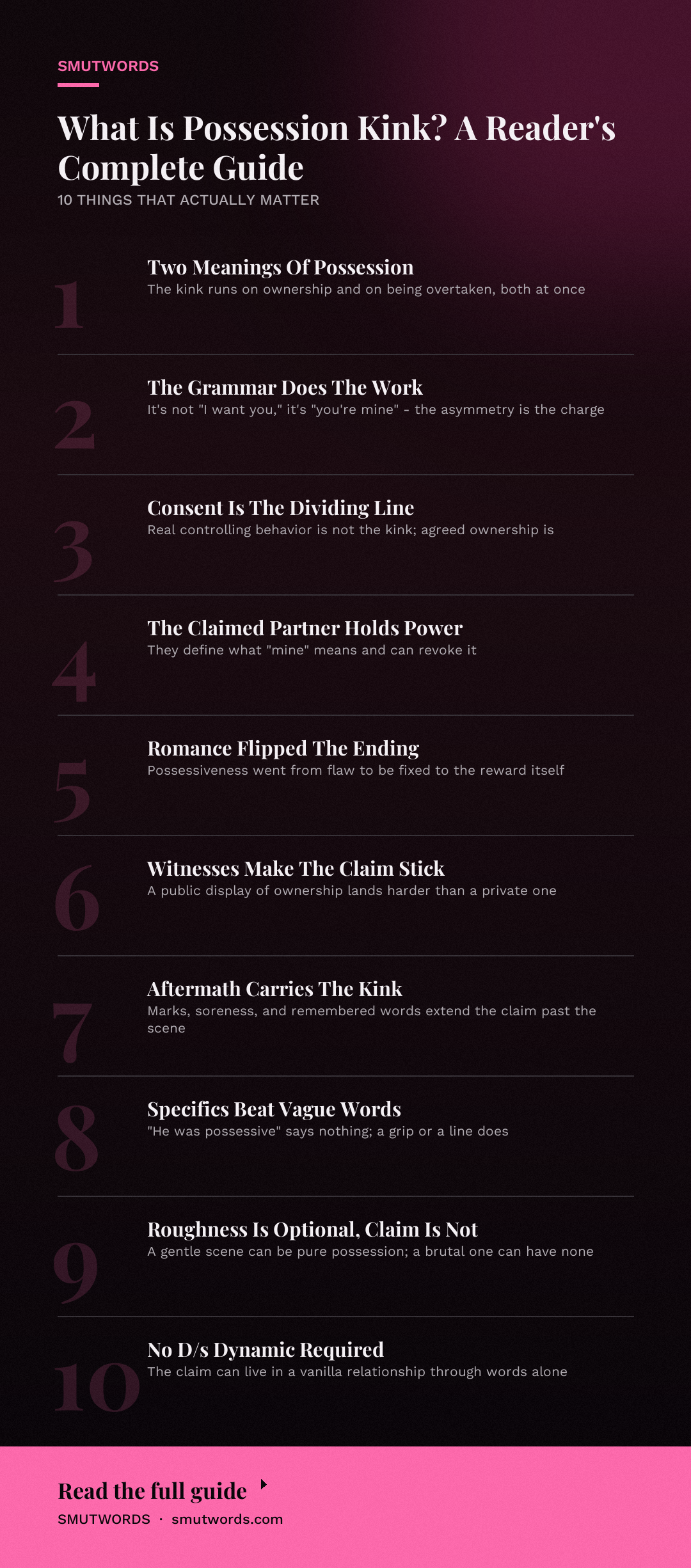
Possession kink is the erotic charge that comes from being claimed. One person tells another "you're mine," grips a wrist a little too firmly, leaves a mark that outlasts the night. Both parties get off on the fact that ownership has been stated out loud.
The label covers a wide spread of behavior, from a whispered line during sex to full ownership play with negotiated rules, but the core is always the same: the thrill of belonging to someone specific, deliberately, and being treated as precious property rather than a casual option.
It shows up constantly in romance and erotica, often without readers naming it. Every "mine" growled against a throat, every hand pressed flat to a lower back in public, every scene where one character marks another as taken is running on this engine. Understanding what the kink actually does, and why it hits so hard, makes both writing it and reading it sharper.
What Possession Kink Actually Means
The word "possession" carries two meanings at once, and the kink leans on both. There's possession as ownership, one person holding another as theirs. There's also possession in the older, stranger sense: being inhabited, taken over, no longer fully in control of yourself.
A good possession scene usually runs on both at the same time. The submissive partner is owned and also overtaken, claimed from the outside in.
That double meaning is why the language of the kink is so specific. It's not "I like you" or "I want you." It's "you're mine." The grammar matters. One person is the subject doing the owning; the other is the object being owned, and the erotic charge lives in that asymmetry. Being someone's thing, chosen and kept, is the point.
What counts as possession kink is broader than people assume. A few common forms:
- Verbal claiming: Possessive language during sex or intimacy, including "mine," "you belong to me," and the possessive use of a name or title.
- Marking: Hickeys, bite marks, scratches, or any physical trace left on the body that the partner carries afterward.
- Ownership play: Negotiated dynamics where one partner is formally "owned," sometimes with collars, rules, or titles, which overlaps with feral play when the claiming goes instinctual and rough.
- Consensual objectification: Being treated as an object of value, a kept thing, a prized possession, in a way both parties have agreed to.
- Primal possessiveness: Claiming driven by instinct rather than ceremony, all growl and grip and no negotiation on the page (though plenty off it).
- Pet play ownership: A handler-and-pet structure where the ownership is explicit, titled, and often ongoing rather than scene-by-scene.
What does not count: actual controlling behavior dressed up as kink.
Possession kink is consensual and mutual. The person being owned has agreed to be owned, has limits, and can end it. The difference between a possessive partner and a possession kink is consent plus structure. One is a dynamic; the other is a problem.
A persistent misconception is that the submissive partner is passive or powerless in this. In practice they hold most of the power. They define what "mine" is allowed to mean, and they can revoke it. The fantasy is surrender; the reality is a negotiated exchange where the person being claimed sets the terms of the claim.
Where Possession Kink Comes From
The kink itself is old. Possessive language runs through the earliest erotic writing in English and well before it, from classical poetry to courtly love to the Gothic novels of the 1700s, where the brooding man who claims a woman as his own became a template that never really died. The vocabulary of ownership, belonging, and being kept has been erotic for as long as anyone has been writing it down.
What's newer is possession kink as a named, recognized thing in publishing. The term settled into common use through online kink communities in the 2000s and 2010s, where it served as an umbrella for a cluster of behaviors that had previously been described separately. Marking, ownership, and possessive dirty talk were all recognized on their own; grouping them under one label let readers and writers talk about the throughline.
In romance publishing, the shift is easier to trace. Through the 1980s and 1990s, possessive male leads were standard, but the possessiveness was usually framed as jealousy, a flaw to be overcome, or the engine of a conflict the heroine had to survive. The happy ending required the hero to loosen his grip. That has changed substantially in the last fifteen years.
Modern romance, especially in dark romance and the spicier end of contemporary, treats possessiveness as the reward rather than the obstacle. The hero doesn't learn to stop claiming; he claims harder, and the heroine is written as wanting exactly that.
The fantasy has moved from "he'll learn to respect my independence" to "he'll never let me go, and I'll never have to wonder where I stand." That's a real shift in what the genre promises, and it explains why the kink has grown so fast.
The rise of self-publishing and serialized erotica accelerated it. Writers no longer had to soften the claiming for a traditional publisher's comfort, and readers responded to unapologetic versions of the dynamic. The popularity of stepbrother romance books and other taboo subgenres in the same period is not a coincidence; those stories often run on exactly this possessive charge, with the taboo raising the stakes of the claim.
Today the kink has a recognizable set of conventions, a body of reader expectations, and its own vocabulary. That's what makes it a trope and not just a preference: readers search for it by name, know what beats they want, and judge books on how well the claiming is done.
How It Shows Up in Erotica
On the page, possession kink is mostly a pattern of small physical and verbal beats rather than a single act. An editor who's read hundreds of these books starts to notice which writers land it and which ones just repeat the word "mine" and hope.
The most common element is verbal claiming during sex. A partner says "you're mine" or "tell me who you belong to," and the other answers. This is close kin to a praise kink: the charge comes from being named, valued, and confirmed as someone's. Possessive talk and praise overlap constantly, because being told you're owned is also being told you're wanted above everyone else.
Physical claiming is the second element. Hands that grip rather than hold. A thumb pressed into a hip hard enough to leave a print. Teeth on the shoulder.
The scene where someone is fucked hard enough to bruise, and both parties treat the bruise as a keepsake, is a possession beat even when the word "mine" never appears. Writers who understand this use rough sex as a delivery system for the feeling of being marked, not just for intensity's own sake.
Enjoyed this? Get a free book.
Join the list and we will send a complete free story straight to your inbox, plus new releases every week after that. No credit card, no catch.
Third is the audience. Possession kink gains enormous power from witnesses: someone sees the claim and understands what it means.
A hand on the back of the neck in a crowded room. A partner who answers a stranger's interest with a deliberate, public display of ownership. The claim is being made in front of people, which is what makes it stick.
Fourth is aftermath. Strong possession scenes don't end when the sex does. The partner carries the mark, remembers the words, notices the soreness the next day. Aftercare in these stories often doubles as reinforcement of the claim: the same hands that gripped now hold, and the ownership is tender rather than sharp.
Where a flat version goes wrong is treating the dynamic as one-directional. A scene where one person claims and the other is simply claimed has no tension after the first beat. The version that works shows the claimed partner actively participating: provoking the claim, testing it, choosing it again. The ownership becomes exciting when both people are invested in maintaining it.
A second failure mode is vagueness. "He was possessive" tells the reader nothing. A specific gesture, a specific sentence, a specific mark on a specific part of the body gives the kink something to land on. The general rule: if you can't point to the physical detail or the line of dialogue that made the claim, the scene is describing the kink instead of doing it.
Variations writers reach for most often:
- Marking with witnesses: The claim is made in public, and the audience's reaction is part of the thrill.
- Ownership rules: The dynamic has negotiated terms, titles, or rituals, which pushes the story toward a formal d/s dynamic.
- Primal claiming: Language drops away and the claiming becomes physical and instinctual, often bleeding into a feral play register.
- Slow-burn possessiveness: The claim builds over chapters through accumulating small signs before either character says it out loud.
- Claiming the unclaimed: A character who has only had casual sex romance gets claimed for the first time, and the contrast between being one of many and being someone's does the emotional work.
That last one is a favorite structure because it makes the possession legible by contrast. A character who doesn't do this, who has never belonged to anyone, suddenly being told "you're mine" is a different event than it would be for someone who belongs to someone easily.
Possession Kink vs Primal Play and Rough Sex
Possession kink is not the same thing as being rough, and it's worth separating them because the overlap confuses readers. Rough sex is a set of physical intensities: force, speed, grip, impact. Possession kink is a claim.
You can have a brutal scene with no claiming in it at all, and you can have an extremely gentle scene that is pure possession. What the possessive scene needs is the statement of belonging, not the force.
Primal play is closer to the confusion. Primal play is a style of play that leans into animalistic, instinct-driven behavior, often without verbal negotiation inside the scene. Possession kink is about being claimed, which can be primal or can be formal and spoken. A primal scene often includes possessive elements, because claiming is a natural expression of the instinct, but a scene can be primal without anybody being owned.
The cleanest way to hold it: possession kink is about the relationship, while the other two are about the intensity and the register. A scene can stack all three, and often does, but the possessive thread is carried by the words "mine" and the physical marks, not by how hard anyone is fucking. If you're writing a character who needs to feel owned, the roughness is optional. The claim isn't.
Frequently Asked Questions
Is possession kink the same as jealousy?
No. Jealousy is fear of losing someone. In a character it reads as insecurity.
Possession kink is confidence that someone is yours, acted on deliberately. Jealousy is a wound; possession is a declaration. A character can be possessive and not jealous, and plenty of books run on exactly that distinction.
Does possession kink require a formal D/s dynamic?
It doesn't. The claim can live inside a completely vanilla relationship, expressed through dirty talk and physical marks. Formal ownership play, with titles and rules, is one version of the kink, not a requirement. Many readers prefer the version where the possessiveness lives in a relationship with no protocol at all.
What's the difference between possession kink and marking?
Marking is one technique possession kink uses. A mark on the body, like a bite or a bruise, is a physical way of saying "taken." Possession kink is the broader charge: being claimed, owned, and held as someone's, which can be done through words alone.
Is being objectified in bed healthy?
Consensual objectification can be part of a healthy dynamic when both people want it and have agreed on what's allowed. The word does a lot of work here. The person being treated as an object is an active participant and holds the right to end it, which is what separates it from something harmful.
How do you write a possession scene without it reading as abusive?
Show the claimed partner wanting the claim, and give the scene a structure that both people are aware of. The possessiveness should read as chosen rather than imposed. A quick aside about what the characters negotiated, or a moment where the claimed partner prompts the claim, does most of the work. For a related case, see how age gap romance books handle the power difference as the entire point rather than a problem to solve.
What should partners negotiate before possessive play?
The specific words and actions allowed, and what isn't. Agree on whether marks are okay and where. Agree on what "mine" means in the relationship and what it doesn't. For writing a dynamic with a strong ownership element, the same care that goes into a consensual non-consent (CNC) scene applies: the intensity is safe because the limits were set first.
Final Thoughts
Possession kink works because it answers a question the reader is already asking: do I matter enough to be kept. The claim is the answer, stated in a grip or a growl or a bruise that lasts past the night. When a writer gets it right, the moment a character hears "you're mine" lands differently than any other line in the book, because it's the moment they stop being an option and start being a home.
If you want a novel that does this better than almost anything else on the shelf, start with our top pick in the list below. It's the book we point readers to first when they want the claim done with real teeth.






Loading comments…