
Consensual non-consent (CNC) is the kink where everyone involved agrees, ahead of time, to act out a scene in which consent appears to be absent. It is a fantasy of force, capture, or refusal, staged inside a container built entirely from trust and negotiation.
The paradox sits right in the name, and readers who love it do not find that contradiction confusing. They find it thrilling. CNC is one of the most searched kinks in erotica for exactly this reason, and the genre has been writing it, under various labels, for decades.
What Consensual Non-Consent Actually Means
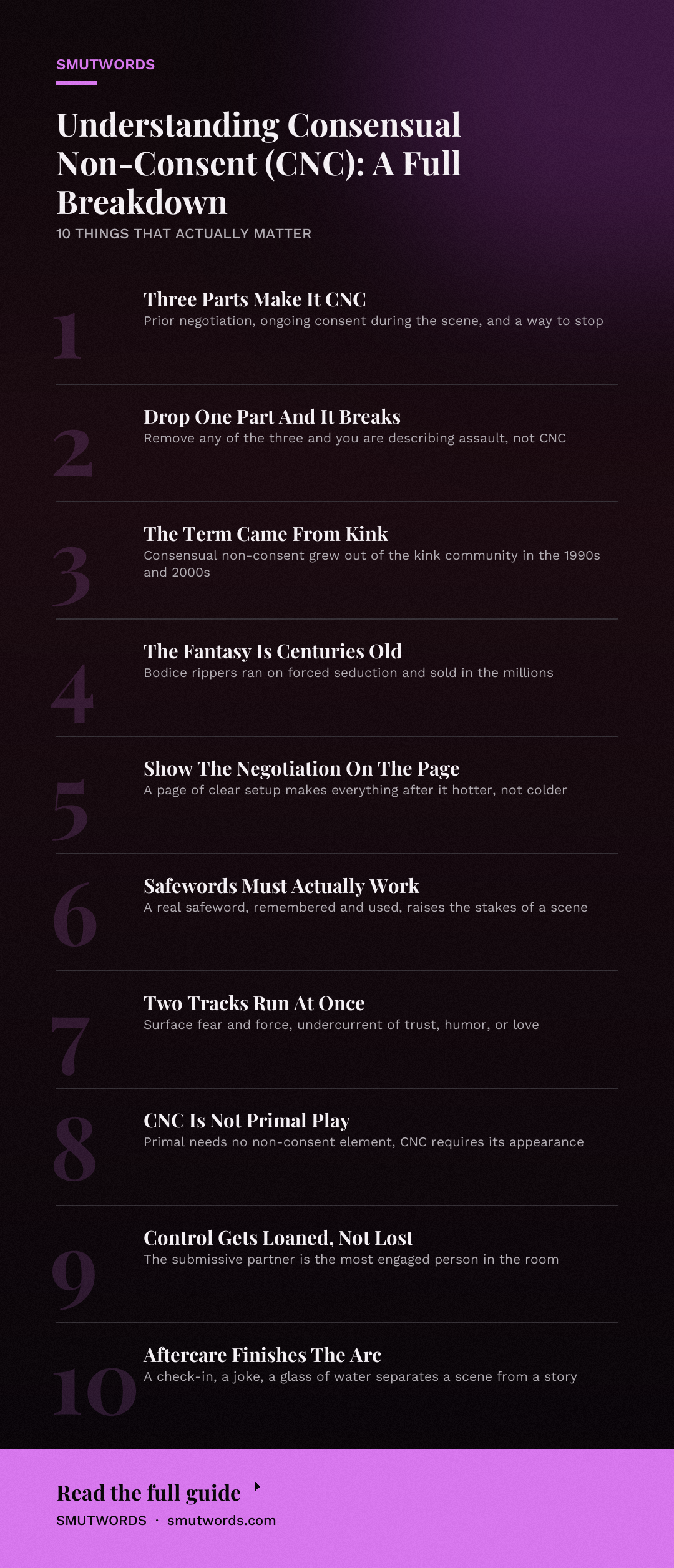
The short glossary version says it is a consensual roleplay involving forced or unwilling participation, with boundaries and safewords agreed on beforehand. That is accurate but thin. The fuller picture involves three moving parts that all have to be in place for the term to apply honestly: prior negotiation, ongoing consent during the scene, and a way to stop it.
Take away any one of those and you are not describing CNC. You are describing assault, or a fantasy that has not been examined yet, or a scene that has gone badly wrong. The term only earns its name when the "non-consent" is a performance and the real consent is active the entire time.
People confuse CNC with a few neighboring ideas. It is not the same as a scene where someone genuinely cannot say no, and it is not the same as free use, though the two overlap in the "no resistance" family of fantasies.
It is not the same as a dom simply doing whatever they want, either. Every CNC scene has a script underneath it, even when the script is loose.
If you have read a romance novel where a captured heroine eventually melts for her abductor and you felt a little guilty about enjoying it, you have already encountered CNC in its softest, most mainstream form. The published version is baked into the fantasy contract between author and reader. What happens on the page is understood, from page one, to be play.
Where Consensual Non-Consent Comes From
The fantasy of forced seduction is old. Older than the novel. Older than the printing press, probably.
What is newer is the vocabulary. "Consensual non-consent" as a phrase grew out of the real-world kink community in the 1990s and 2000s, where practitioners needed a term precise enough to separate what they were doing from actual violence.
That terminology migrated into erotica fast, because erotica had been writing the fantasy for a century without a clean label for it. The bodice ripper era of the 1970s and 1980s was built on it. Heroines were carried off, overpowered, and seduced against their stated wishes, and the books sold in the millions. Publishers marketed those scenes as passion, not assault, and readers understood the code.
The shift came gradually. By the 2000s, authors had started writing in explicit negotiation. The word "safeword" appeared inside scenes. Heroines stopped being surprised by their own submission and started choosing it out loud.
Dark romance kept the force fantasy intact but layered in a modern contract: the reader is trusted to know the difference, and increasingly, so is the character.
Today, the term shows up in published blurbs, in reader communities, and in the tags on fanfiction archives with millions of works. The vocabulary has matured. The fantasy itself has not changed much. Power, capture, and surrender still do the same thing to a reader's pulse that they did fifty years ago.
One more publishing note worth naming: CNC became a tag long before it became a plot device. Readers started filtering for it, authors started writing to it, and the result is that modern CNC erotica is often written by people who understand the real-world mechanics. That knowledge reads on the page.
How It Shows Up in Erotica
On the page, CNC is a structure more than a single scene.
The negotiation is usually visible somewhere, even if it happened "off camera" in a prior chapter. Sophie tells Marcus what she wants. He asks twice. She gives him a safeword, often something deliberately unsexy, and the scene runs.
Then the scene itself inverts everything the negotiation built. She struggles. He overpowers her. She says no, and he does not stop.
The reader knows, because the author has done the work, that the no is part of the script. That is the entire engine.
The strongest versions of the trope do at least two of the following well:
- Show the negotiation. A page of clear setup makes everything afterward hotter, not colder. Readers want the contract signed in front of them.
- Give the resisting character interiority. She says no with her mouth and yes with her body, or she says no because the scene requires it and her mind is narrating pleasure the whole way down. Both work. The flat version is a character with no inner life at all.
- Use a real safeword. Not "red" thrown in as decoration. A safeword that exists, is remembered, and gets used or nearly used raises stakes.
- Reward surrender. If the submissive character's fight collapses into pleasure, that arc has to feel earned emotionally, not like a switch flipped.
- Bring the scene back down. Aftercare on the page, done well, is some of the most intimate writing in the whole genre.
The most common variants fall into recognizable types. Capture and abduction scenes are the classic. Predator and prey dynamics borrow from primal play and from feral play, where one character runs and the other gives chase, with the chase itself understood as negotiated.
"Forced seduction" scenes push a resistant character into wanting it. "Free use" overlaps when the fantasy is standing availability rather than active force, and that distinction is worth understanding on its own if the two keep blurring for you.
Free Use vs Somnophilia walks through exactly how the "no resistance" family splits into different fantasies, and CNC belongs in that family tree. Some authors also work jealousy kink into CNC scenes, where a character is "taken" in front of a rival or a partner, turning the power dynamic into a public spectacle.
The flat version of CNC reads like a checklist. The author hits the beats: struggle, overpower, surrender, kiss.
What is missing is the tension underneath the tension. A good CNC scene runs on two tracks at once. The surface track is fear and force. The undercurrent is trust, humor, or love, and the reader is always aware of both.
Writers who do it best often drop a small tell early on. A shared look across a room before the scene starts. A private joke about the safeword. A character locking the door from the inside and then nodding.
These small beats are the author's signal to the reader: we both know what this is.
Dialogue does a lot of the lifting. "Say you don't want it" can be one of the hottest lines in a CNC scene when the negotiation has already happened on the page. "Stop" followed immediately by a whispered "not really" is another. The genre has more or less standardized the vocabulary, and readers of CNC erotica learn to read it fast.
Consensual Non-Consent vs Primal Play
These two overlap enough that readers mix them up constantly. world-building aside, primal play is a real-world and on-page dynamic built around animalistic roles: predator and prey, with chasing, wrestling, biting, growling, and a physical intensity that feels more feral than romantic. CNC sometimes borrows those elements.
The distinction is the script. Primal play can absolutely include a chase where the prey runs and does not want to be caught, but that is not required. CNC requires the appearance of non-consent as its defining feature. Plenty of primal scenes have no non-consent element at all, just two people rolling around on a floor, both fully willing, both having a wonderful afternoon.
Enjoyed this? Get a free book.
Join the list and we will send a complete free story straight to your inbox, plus new releases every week after that. No credit card, no catch.
You can have primal play without CNC. You can have CNC without primal. When they overlap, the scene usually starts with a chase and ends with a capture, and it reads as both. If you want the chase mechanics specifically, our primal play entry covers them in more detail.
Frequently Asked Questions
Is consensual non-consent the same as rape fantasy?
It is the umbrella term that includes rape fantasy as one of its variants. The distinction is that CNC is broader and more specific. It names the negotiation and the consent framework, not just the fantasy content. When someone writes "consensual rape fantasy," that is a narrower, more direct label for the same underlying scene.
Why do readers enjoy CNC if they would never want it in real life?
Because the fantasy and the reality are doing different jobs. The fantasy delivers fear, loss of control, and surrender without any real danger. The brain can enjoy that the same way it enjoys a horror movie or a roller coaster. The nervous system gets the intensity, and the prefrontal cortex keeps reminding you that you are safe the whole time.
What makes CNC different from a dark romance abduction plot?
Sometimes nothing, which is why the line is blurry. Dark romance frequently uses the aesthetics of CNC without the explicit on-page negotiation, because the genre contract between author and reader does the consent work instead. When the negotiation is written into the scene itself, it is CNC in the more literal sense.
Do CNC scenes need a safeword?
In real life, absolutely, yes, and the safeword needs to be a word neither person would naturally say in the heat of the scene. In fiction, the safeword serves the same function structurally: it gives the reader a guaranteed off-ramp and lets the scene go darker. Our guide to safeword use covers the mechanics in full.
What is aftercare and why does CNC erotica always mention it?
Aftercare is the re-grounding that happens after a scene: water, blankets, checking in, quiet conversation, physical contact without sexual pressure. In real CNC, it is not optional, because intense scenes can leave a body flooded with adrenaline and cortisol. In fiction, an aftercare beat is also a great intimacy scene, and good authors know it.
Is CNC only for submissives who want to be overpowered?
No. The fantasy runs both directions. Some readers want to be the one doing the taking, and some want to switch roles depending on the book. Keyholding and other D/s practices show the same appetite for structured power from the top side of the exchange.
What Makes CNC Scenes Work on the Page
Craft-wise, the difference between a CNC scene that lands and one that reads like a template comes down to tension authorship. The writer has to be conscious at every beat of the two-track structure: apparent danger, real safety. If the reader ever loses track of which track they are on, the scene collapses.
Pacing matters more than intensity. A CNC scene that jumps straight to force with no buildup reads as violence. A scene that lingers on the negotiation, the first locked door, the first whispered "are you sure," and then moves into the capture with deliberate control keeps the reader oriented.
Point of view does a lot of work here too. First person from the submissive character's perspective is the standard, because it lets the author narrate the internal yes while the external no happens. Third person omniscient can work, but it has to be handled carefully, because the narrator has to stay on the reader's side of the line without spoiling the scene's tension.
The best CNC erotica also respects the aftermath. Scenes that end on an orgasm and roll credits leave something unfinished. Scenes that end with a check-in, a joke, a glass of water, or a long silence in bed finish the arc. That closing beat is what separates a scene from a story.
Real-World Considerations Authors Get Right and Wrong
Because CNC walks such a specific line, authors who get the real-world mechanics right write better scenes. The details that most often show up correctly:
- Prior discussion of limits. Both partners know what is on the table and what is off, before the scene starts.
- A clear safeword system. Often the traffic light system: green for keep going, yellow for slow down, red for stop.
- A sober, trusting partner. Neither person is impaired. Both people know each other well enough to read nonverbal cues.
- Aftercare. Physical and emotional re-grounding, treated as part of the scene rather than an afterthought.
Authors who skip these steps often produce scenes that read as genuine assault, which is not the fantasy. The line between edgy and irresponsible is almost always that negotiation beat. Leave it out and the reader cannot tell if the author knows the difference either.
If you want to understand the real-world etiquette that surrounds this kind of play in group settings, play party etiquette is a useful companion read. Much of it applies directly to how authors should imagine their characters behaving in any scene involving public or semi-public play.
CNC Variations Across Subgenres
The trope looks different depending on where you find it. Paranormal romance uses it constantly, with alphas, pack dynamics, and mate bonds doing the negotiation work through worldbuilding instead of dialogue. Alpha male heroes are frequently written into CNC-flavored scenes because the role is already coded as dominant and impulsive, but the good versions still put consent somewhere on the page.
Historical romance leans on social power imbalances for the same effect. Contemporary romance tends to write the negotiation most explicitly, because the setting makes it natural. Dark romance sits closest to the edge and often skips the negotiation entirely, relying on the reader's knowledge that the genre has rules.
Mafia romance, motorcycle club romance, and romantic suspense all use CNC flavors, and each one has its own shorthand for the "everything is fine, this is play" signal. Sometimes it is a safeword. Sometimes it is a look.
Sometimes it is a chapter break that shifts into a tender scene where the characters acknowledge what just happened. All of these serve the same function.
Reverse harem and orgy scenes use CNC dynamics by multiplying them. One person being "overpowered" by several partners is a common configuration, and the negotiation surface area grows with the number of people involved. The best versions handle this by showing group discussion, safeword distribution, or a clear hierarchy of who is checking in on whom.
M/M and F/F erotica handle CNC in ways that often diverge from the straight-romance formula. Without the same historical baggage of gendered force, the scenes sometimes push harder and sometimes go sweeter. Both approaches work. Neither is more authentic.
Common Misconceptions About Consensual Non-Consent
Several ideas about CNC get repeated often enough that they are worth correcting directly.
It is not a loophole for actual harm. The whole reason the term has the word "consensual" bolted to the front is that without it, this is not CNC. Practitioners take that boundary seriously, and so do the authors writing the most respected scenes in the genre.
It is not a sign that someone has unresolved trauma, though some people with trauma do use it therapeutically. The fantasy is common in people with no trauma history at all. It reliably shows up across cultures and eras, in every genre of fiction and in plenty of private bedrooms.
It is not the same as a scene where someone has "let go of control completely." There is no such thing in CNC. The submissive partner is the most engaged person in the room, tracking every move the dominant partner makes, ready to call a stop at any moment. The control has not vanished. It has been loaned, deliberately, on a schedule.
It is not written for shock value, in the best examples. Writers who are good at CNC use the fantasy to get at something real about surrender, trust, and desire, and the taboo surface is the vehicle for that.
Final Thoughts
Consensual non-consent is one of the most misunderstood tags in erotica, and one of the most rewarding when it is written well.
The negotiation matters. The safeword matters. The aftercare matters. Get those three things right on the page and the fantasy can go as dark, as physical, and as intense as the story needs.
If you are ready to see the trope at full length, our ranked list of the best consensual non-consent books below is the place to start. Pick one that matches the flavor of CNC you already know you love, and let the negotiation begin.







Loading comments…