
The protective hero trope is the story engine where the male lead appoints himself the heroine's shield. He steps in front of danger, manages the threat, takes over the situation, and keeps her safe whether or not she asked him to.
The actual danger level in the plot matters less than his relentless drive to guard her from harm, real or invented. This is the trope that powers bodyguard romance, alpha protector stories, and roughly half the paranormal romance shelf. It is one of the most reliably bankable dynamics in the genre.
It sells because of what it promises the reader: a powerful character whose entire focus narrows to one person. Being the object of that kind of attention is the fantasy. The world gets heavy, and someone else picks it up.
What the Protective Hero Trope Actually Means
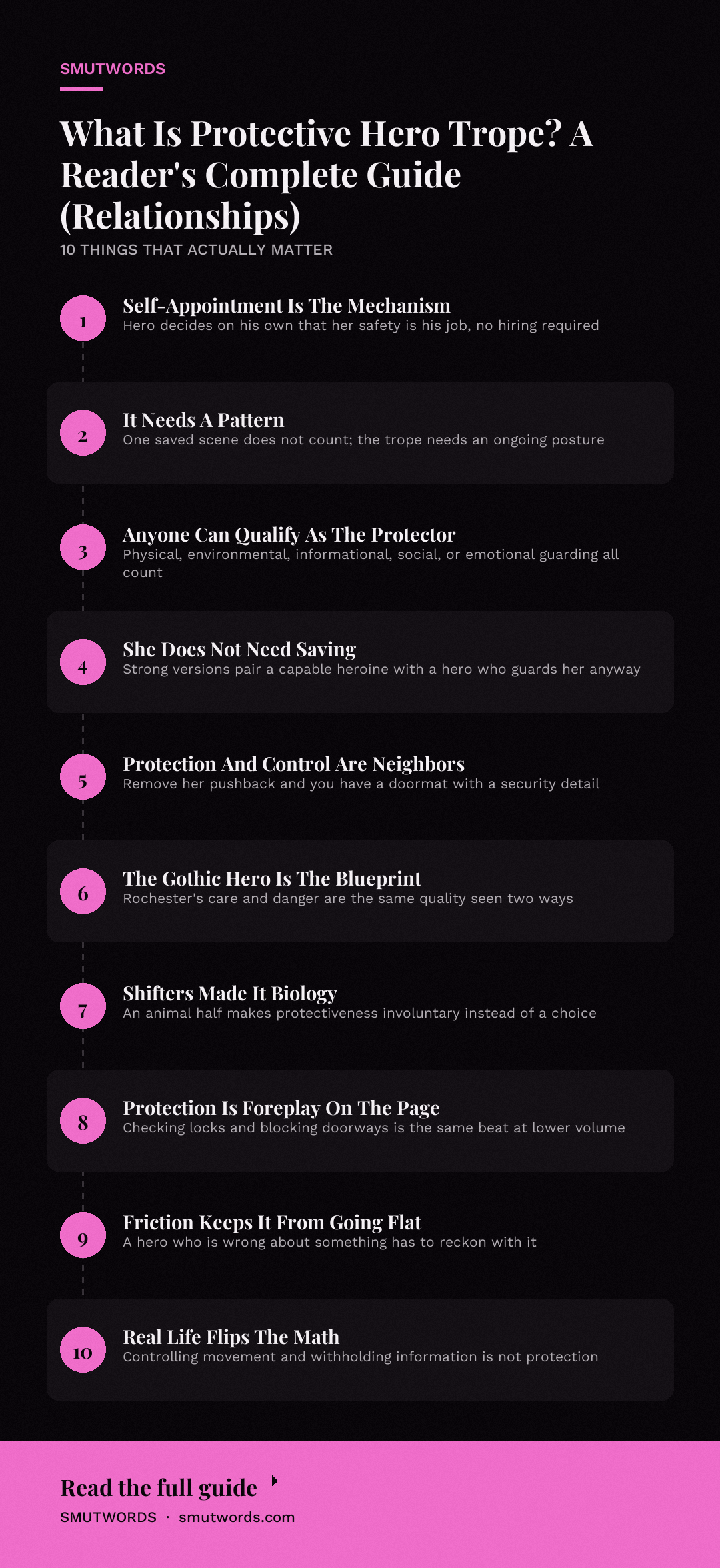
At its core, the protective hero trope is about assigned vigilance. The hero has decided, on his own authority, that the heroine's safety is his job. He did not apply for it. Nobody hired him.
He simply looked at her, decided she was his to protect, and now every decision he makes runs through that filter first. That self-appointment is the whole mechanism.
A hero who protects because he is literally employed to (a bodyguard under contract) is playing a slightly different game than one who protects because something in him snapped into place the moment he saw her. The contracted version is a job. The self-appointed version is a compulsion, and compulsion is where the heat lives.
The name is descriptive rather than literary in origin. It grew out of romance publishing's habit of labeling hero archetypes for readers who shop by type: the alpha, the rogue, the protector. "Protective hero" became the umbrella term for a cluster of related leads, and the label stuck because it tells readers exactly which emotional button the book is going to press.
What counts as this trope is broader than people assume. Any of these qualify:
- Physical intervention: he puts his body between her and a threat, catches her when she falls, carries her out of a burning building.
- Environmental control: he vets her apartment, follows her home at night, decides which routes she takes. Low-key surveillance dressed as care.
- Information management: he withholds bad news to keep her from worrying, handles a problem without telling her it existed.
- Social shielding: he stares down anyone who looks at her wrong, claims her publicly so nobody else tries.
- Emotional guarding: he absorbs her distress and refuses to let her carry it, sometimes against her explicit request.
What does not count: a hero who protects her once, in a single scene, and then returns to normal. The trope requires a pattern, an ongoing posture.
It also does not require her to be weak or helpless. Some of the strongest versions pair an extremely capable heroine with a hero who protects her anyway, and the friction between her competence and his compulsion is the entire point.
Common Misconceptions
The biggest one: that the heroine in these stories is passive. In good protective hero romance, she is often more competent than he is. She does not need saving. He saves her regardless, and her irritation at being managed is a genuine source of conflict rather than a formality.
The second misconception is that this trope and controlling behavior are the same thing on the page. They are neighbors, not synonyms.
Fiction can write a hero who oversteps precisely because it can let the heroine push back, and the tension between his instinct and her autonomy is where the story earns its keep. When a book skips that pushback entirely, it is not writing the trope well. It is writing a doormat with a security detail.
Where the Protective Hero Trope Comes From
This one has a long, unbroken lineage in romance specifically. The prototype is the Gothic hero: the brooding, powerful man with a dark house and a darker secret, whose protection of the heroine is inseparable from his threat to her.
Jane Eyre is the blueprint. Rochester is not safe, and his protectiveness and his danger are the same quality viewed from two angles. That duality is the oldest version of this trope and it has never really left.
Through the twentieth century, the historical romance boom refined it. The Highland laird, the pirate captain, the duke with a violent past: all of them operate on the same logic, which is that the heroine's safety is bound to a man whose capacity for violence is precisely what makes him a suitable guardian. His danger is the qualification.
Contemporary romance split the trope into recognizable subtypes. The bodyguard romance professionalized it, giving the hero an actual job so the protectiveness had a corporate excuse. Romantic suspense wired it into external plots, so the protection had somewhere to point. And paranormal romance blew the scale up entirely, which brings us to the version most readers are picturing.
The shifter era of the 2000s and 2010s is the single biggest evolution in how this trope gets written. When you give a hero a wolf inside him, protectiveness stops being a personality trait and becomes biology. He cannot help it.
The territorial shifter trope is the protective hero trope with the brakes cut, because the animal half does not negotiate. Fated mates did the same thing for the emotional side, and the soulbond takes it further still, because a bond the characters did not choose removes even the pretense of consent to the attachment.
More recently, the trope has spread into niche subgenres where "protector" means something extremely literal. A kraken romance hero guards his mate with tentacles and territorial fury. A dinosaur romance lead operates on predator instinct. Even the softer end of monster romance, including merman romance and fae romance, runs on the same current: a nonhuman being whose protective instinct is stronger and stranger than any human version.
The honest arc here is that the trope has moved from "his protection is a moral quality" to "his protection is an involuntary drive." The modern version is less about chivalry and more about a male lead who is, frankly, not in full control of himself when it comes to her.
How the Protective Hero Trope Shows Up in Erotica
On the page, protection is foreplay. This is the craft point most new writers miss: the protective gesture and the sex scene are not separate beats. They are the same beat at different volumes.
Watch what happens structurally in a well-built scene. He checks the locks. He notices she is cold before she does. He moves his body between her and the door when someone knocks.
Each of these is a small act of possession, and by the time he finally touches her, the reader has already been trained to read his body as a boundary that exists to keep her inside it. The first time his hands actually land on her, it reads as the conclusion of an argument the whole scene has been making.
The most common variations authors use:
Enjoyed this? Get a free book.
Join the list and we will send a complete free story straight to your inbox, plus new releases every week after that. No credit card, no catch.
- Unwanted protection: she did not ask for it, does not want it, and his refusal to stop is the conflict. Works best when she eventually admits she is glad he did not listen, not when she gives up her agency outright.
- Protection as punishment: he guards her because failing to once cost him something, and the guilt drives the behavior past reasonable. The dark romance version.
- Protection as courtship: every act of guarding is a love letter he refuses to say out loud. The slow burn version, and the one that pairs best with emotional repression.
- Reluctant protection: he resents the instinct, fights it, loses. Common with villains, antiheroes, and any hero who thinks caring is a weakness.
- Institutional protection: bodyguard romance, security detail, arranged guarding. The job gives a socially acceptable excuse for behavior he would do anyway.
Forced proximity is the trope's natural partner, and there is a reason it shows up in almost every protective hero book. If he has decided her safety is his responsibility, he needs to be near her, and the plot needs a reason he cannot leave.
Locked rooms, safe houses, road trips through hostile territory, one shared bed in a hotel with no other rooms. The only one bed setup does a huge amount of work here, because it converts his need to watch over her into a physical arrangement neither of them planned.
What separates a strong version from a flat one comes down to friction. A flat protective hero is noble, competent, and correct at all times. He is boring because nothing costs him anything.
A strong version is wrong about something. He oversteps. He withholds information she needed. He decides he knows better and gets burned for it. And crucially, he has to reckon with it.
The strongest versions of this trope also let the heroine's competence push back against his instinct. She solves a problem he was trying to handle. She goes somewhere he told her not to go and comes back fine. He has to sit with the fact that his protection was not necessary, and that discomfort is far more interesting to read than a hero who is simply always right.
Where the Sex Scene Comes In
Fifty shades of alpha male, and then the careful hands. The protective hero's love scenes tend to carry a specific charge: he is careful with her in a way that contradicts how dangerous he is to everyone else. The contrast does the work. A man who could break the world treats her like something breakable, and the reader gets to sit inside that double vision.
This is also where the trope needs real craft, not just positioning. A protective hero's sex scenes have to mean something about the dynamic, or the protective setup was decoration. For a deeper look at keeping those scenes load-bearing rather than ornamental, the guide to writing sex scenes that matter to the plot covers it directly.
Common moves: he asks permission constantly and in a low voice, which plays as restraint against his obvious urgency. He wraps his body around hers, covering her, even in bed. He refuses to be rough until she asks, and then goes further than she expected and checks in halfway through. Every one of these is an extension of the guarding behavior, translated into physical intimacy.
The jealousy version deserves its own note, because protection and jealousy are frequently bundled and are not the same thing. Protection is about her safety. Jealousy is about his claim. When a scene mixes them, he is usually protecting his position as much as her body, and readers versed in jealousy kink respond to that blend specifically because it makes the hero a little bit selfish.
Protective Hero vs the Possessive Hero
These two get confused constantly, so it is worth drawing the line. The possessive hero wants to own her. The protective hero wants to shield her. In practice, most books run both at once, since "she is mine to protect" is a possessive sentence.
The distinction shows up in motive. If the driving impulse is you belong to me, that is the possessive dynamic, and the guarding is a demonstration of ownership.
If the driving impulse is nothing gets to hurt you, that is the protective dynamic, and the ownership language is a byproduct. The protective angel romance lead is a clean version: his mandate is her safety, full stop, and his jealousy only shows up when her safety seems threatened by someone else's attention.
You can also think of it as: possessiveness wants her contained, protectiveness wants her unharmed. Those overlap about ninety percent of the time and diverge sharply in the tenth where they matter. If she wants to do something dangerous, a possessive hero says no because he owns her. A protective hero says no because he is afraid, which is a softer, more human motive.
The Real-World Caveat
Everything above is fiction, and some of the sharpest versions of this trope work precisely because they let the heroine name the overreach out loud. In real life, the math flips. A partner who controls your movement, withholds information you need, and decides unilaterally what is good for you is not protective. That is a controlling relationship wearing protective clothes.
Real-world boundaries around autonomy and consent matter more than the fiction suggests, and the fiction knows it. The best protective hero books are aware their hero's instinct is a problem he has to manage, not a virtue he gets to keep. When a writer treats the overreach as pure romance with no friction and no reckoning, readers notice, and the trope starts to feel less like a fantasy and more like a warning.
Frequently Asked Questions
What is the protective hero trope in plain terms?
A story dynamic where the male lead decides, on his own, that the heroine's safety is his responsibility, and structures his behavior around guarding her from harm. The danger can be real or invented, and her own wishes about being protected often get sidelined as a source of conflict.
Is protective hero the same as bodyguard romance?
No. Bodyguard romance is a subset where the hero has an actual job guarding her. The protective hero trope is the broader pattern, and it applies to any lead with the compulsion, including ones with no professional reason and no contract.
Why is this trope so popular in shifter and paranormal romance?
Nonhuman leads let the instinct be involuntary. When a hero has an animal half that reacts before his conscious mind does, the protectiveness is biology rather than choice, which removes the question of whether he should be doing it. The territorial shifter trope runs on exactly this mechanic.
What makes a protective hero become controlling on the page?
When the author removes the heroine's pushback. If she never resists, never names the overreach, and never gets to solve her own problems, the hero's guarding has no counterweight and reads as controlling rather than romantic. Friction between his instinct and her autonomy is what keeps the dynamic working.
Can the heroine be the protective one?
Yes, and a growing number of books run the reverse. The dynamic needs a guardian and someone being guarded, and there is nothing in the trope that requires the guardian to be male, though the term as published is overwhelmingly used for male leads.
Where did this trope start?
Its direct ancestor is the Gothic hero: the powerful, brooding man whose protection of the heroine is inseparable from the threat he poses her. Jane Eyre is the clearest early example, and the duality between his danger and his care has been the trope's engine ever since.
Final Thoughts
The protective hero trope works when the guarding costs the hero something and the heroine is never a passenger in her own story. Get that balance right and the protectiveness reads as devotion rather than control. Get it wrong and you have written the warning label, not the fantasy.
If you want to see the trope running at full volume, the shifter and monster romance shelves are where it lives now. Start there, then come back and write your own version with the friction left in.







Loading comments…