A slow burn romance is a story where the tension between the main characters builds gradually, with near-misses, denials, and agonizingly delayed first kisses. The payoff feels earned because the author makes you wait. Every small gesture or accidental touch carries weight. Readers pick up a slow burn to savor the ache of anticipation, not to rush to the finish line.
What Slow Burn Romance Actually Means
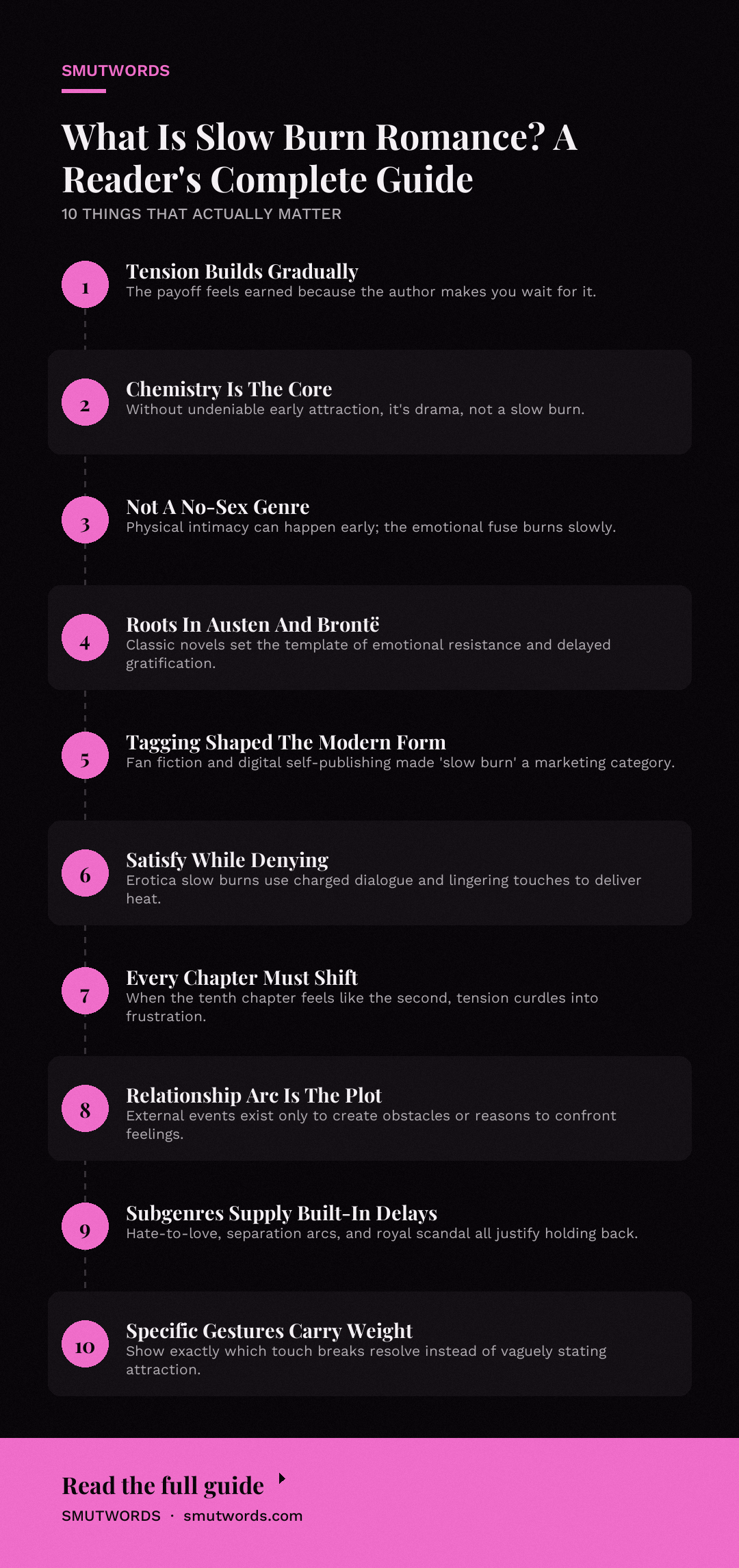
Slow burn romance is a pacing technique that prioritizes the buildup of tension over its release. The term describes a story where the central couple does not get together quickly, often not until the final chapters. The "burn" is the gradually intensifying attraction; "slow" signals the extended timeline, which can span months, years, or decades within the story's world.
What qualifies as slow is relative. In a short erotic story of 5,000 words, the first kiss might not land until the final 1,000. A full-length novel might hold off until the 60% mark, with consummation saved for the last act.
The key marker is that the reader spends a significant portion of the narrative in a state of unresolved desire. Not just a chapter or two of preamble.
Misconceptions abound. A slow burn isn't simply a story that's long, nor one that keeps the couple apart until the epilogue. It also isn't the same as having no romantic subplot at all.
The defining trait is undeniable chemistry between the leads that the narrative repeatedly refuses to satisfy. If the characters don't have palpable attraction from early on, you have a mystery or a drama, not a slow burn.
Another misconception is that slow burn means no physical intimacy whatsoever. Many excellent examples feature heavy petting, near-kisses, and sexual acts that stop short of full emotional commitment.
The term refers to the emotional fuse, not a total absence of activity. A couple can have mind-blowing sex in chapter three and still be in a slow burn if their walls stay up for another two hundred pages.
Where Slow Burn Romance Comes From
The slow burn has roots as old as the genre itself. Jane Austen's Pride and Prejudice and Charlotte Brontë's Jane Eyre run on it: couples misunderstanding each other, enduring separations, sharing barely a kiss until well past the midpoint. Those works set the template of emotional resistance and delayed gratification that modern romance still follows.
In the twentieth century, category romances from Harlequin and Mills & Boon formalized the structure. Strict page counts and predictable arcs forced authors to manage tension carefully. The slow burn became a dominant mode because it built investment across a serialized format. A couple who confessed on page 30 had nothing left for the remaining 150.
The biggest shift came with digital self-publishing and fan fiction in the 2000s and 2010s. Fan fiction communities, particularly on Archive of Our Own, popularized "slow burn" as a tagging convention. Readers used it to signal exactly how much emotional torture they wanted before a happy ending.
That system carried into original ebook publishing on sites like SmutWords, where the term now functions as a marketing category as much as a narrative technique. The modern slow burn is often longer, steamier in its individual scenes, and more explicit about internal desire than its Regency predecessors.
How It Shows Up in Erotica
In erotica, a slow burn walks a careful line. The genre promises explicit content, but the slow burn delays the full payoff. The craft lies in delivering gratification through other means: charged dialogue, intense staring, touches that linger, scenes where characters bring each other to the edge without tipping over.
You must make the reader feel satisfaction even while the characters are denied it.
The strongest slow burns in erotica use a few key structural tools:
- The near miss: Characters almost kiss, almost confess, almost act, then pull back. The best versions make interruptions feel organic. A phone call that stops a confession strains credibility; a character's own fear feels real.
- The escalating physical vocabulary: Touch starts with a hand on the arm, progresses to a hug that lasts a breath too long, then a kiss that gets cut short. Each level raises the stakes.
- The internal monologue: Erotica leans on point of view to show longing directly. The reader knows how desperate the protagonist is, creating dramatic irony when the other lead stays oblivious.
- The separation arc: Many slow burns pull the couple apart for a stretch to increase longing. Letters, phone calls, or remembered encounters sustain the connection while the space makes the reunion more charged.
A flat slow burn fails when nothing actually changes for long stretches. Readers need progression, even glacial progression. Each chapter should shift the dynamic: a secret revealed, a boundary lowered, a question left unanswered.
If chapter ten feels identical to chapter two, the tension curdles into frustration.
Enjoyed this? Get a free book.
Join the list and we will send a complete free story straight to your inbox, plus new releases every week after that. No credit card, no catch.
Common variations include the hate to love arc, where antagonism masks attraction, and the forced proximity setup, where circumstances trap two people together.
Other framings include the soldier romance, which uses deployment to create natural separations, or the celebrity romance, where public scrutiny keeps couples apart longer than either would like. The slow burn's built-in obstacles give the author a ready-made reason for delay.
A prince/princess romance has court politics and scandal to work through before the royal couple gets their moment.
What makes the strong versions work is specificity. Instead of vague "they felt a pull," show exactly which gesture breaks a character's resolve. Instead of generic "he was handsome," catalog what the protagonist notices and how it affects their body.
The reader should feel the sweat on the character's palms and the careful way they choose words. In a slow burn, every word and touch carries disproportionate weight.
If you're looking for other structures that build tension differently, public free use erotica explores openness as the central device. On the flip side, the deflowering kink offers an entirely different payoff shape. Or, for a trope built on delayed reveals rather than delayed intimacy, see our guide to secret baby.
Slow Burn Romance vs. Suspense and Plot Pacing
Some readers confuse slow burn romance with a story that simply has a subplot to resolve before the couple can unite. The distinction matters.
In a standard romance, the relationship arc runs parallel to the external plot. In a slow burn romance, the relationship arc is the primary plot. External events exist mainly to create obstacles, separations, or reasons to confront feelings.
If characters spend forty pages solving a mystery without thinking about each other, that's a mystery with a subplot. A slow burn keeps the couple's dynamic central in every single scene, even when they're apart.
Frequently Asked Questions
How long does a slow burn take to get to the first kiss?
There's no fixed rule, but a common marker lands the first kiss between 50% and 75% of the way through. Full consummation typically follows in the final quarter, sometimes on the very last page.
Is a slow burn the same as a "no sex" romance?
No. A slow burn can include explicit sex scenes. The slowness applies to emotional commitment and full union, not all physical contact. Many feature heavy intimacy that stops short of surrender.
What's the difference between mutual pining and a slow burn?
Mutual pining is a specific emotional state where both characters are in love and know it, but neither acts. Slow burn is the broader structure that contains that state. You can have a slow burn where only one character recognizes their feelings early on, or where both are in denial.
Can a slow burn still be steamy in erotica?
Absolutely. Erotica slow burns rely on heightened tension, extended foreplay, and near-consummation scenes to deliver heat. The craft is making the reader feel the fire without extinguishing it until the climax.
How many chapters should a slow burn last?
In a novel of 60,000 to 100,000 words, the slow burn usually spans the entire narrative, with the couple uniting in the final 15%. In shorter erotica, the proportion holds: roughly 85% of the story is buildup.
Why do readers find slow burns so satisfying?
The extended anticipation builds deep emotional investment. When the payoff arrives, the reader has experienced the frustration firsthand. That makes the happy ending feel like a victory they helped achieve rather than a foregone conclusion.
Final Thoughts
The slow burn rewards the patient reader and the careful author. Its power comes from discipline: delaying a kiss, letting a character walk away, trusting that the tension will hold. The best practitioners make the wait feel less like a tease, more like a privilege.





Loading comments…