The first time is the only sexual milestone that can never be repeated. The deflowering kink builds entire stories around that single, unrepeatable moment. In plain language, this kink centers the erotic fantasy of virginity itself: the taking of it, the giving of it, or both, often staged as a rite of passage, a sacred surrender, or a claim that bonds two characters forever.
It is less about the physical mechanics of first penetration and more about the emotional weight, the vulnerability, and the irreversible shift in power and intimacy that the moment carries. Romance and erotica have returned to this well for centuries, and it remains one of the most reliably intense narrative devices in the genre.
What Deflowering Kink Actually Means
The deflowering kink is a fascination with the erotic potential of a character's first sexual experience, specifically framed as an event of significance rather than just an act. The word "deflowering" itself carries floral imagery: the idea of a bloom being opened, a sealed vessel being breached, a state of untouched integrity giving way to experience.
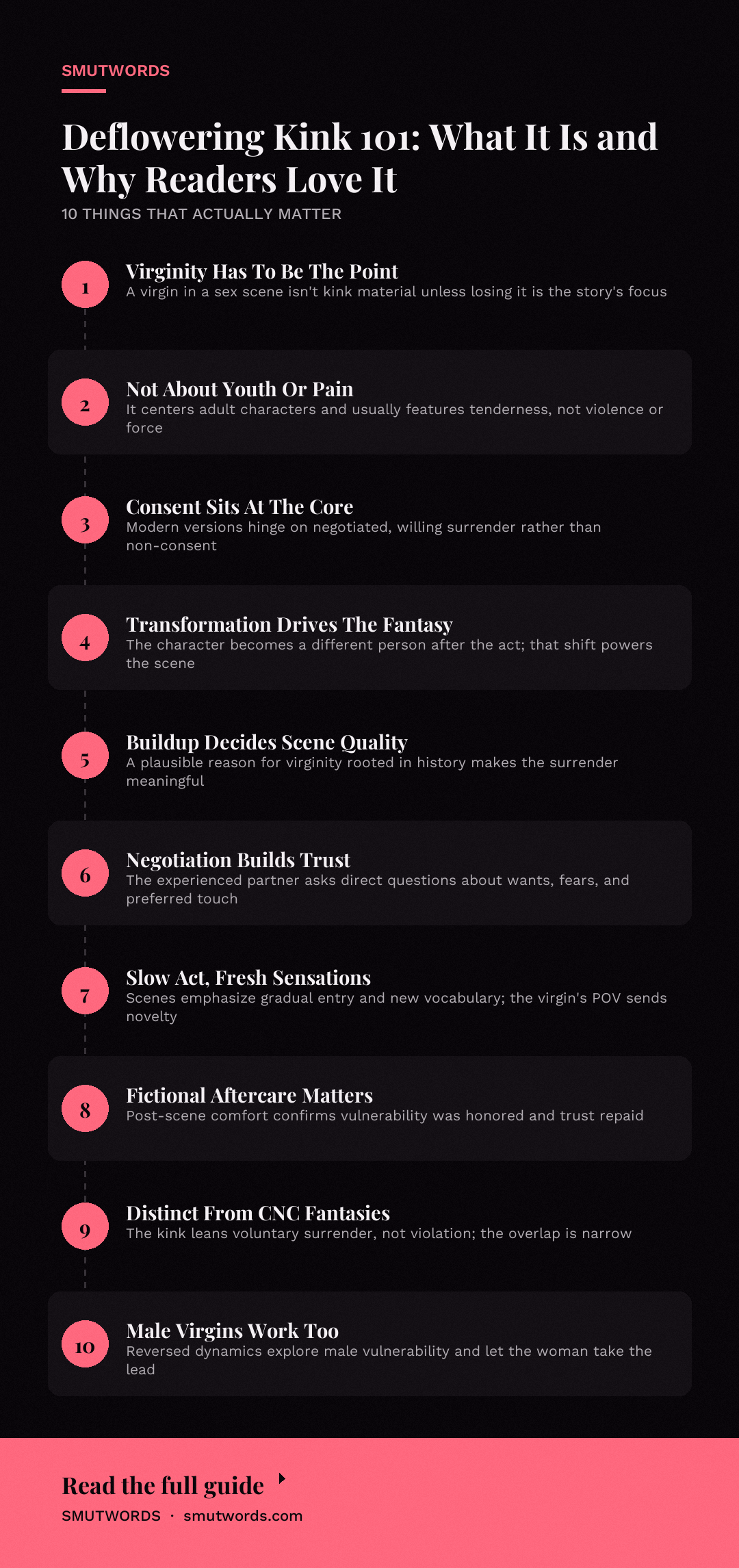
In fiction, this translates to a scene where one character is sexually inexperienced, often a virgin in the literal sense, and another character guides, claims, or initiates them. What does and does not count as this kink matters. A character who simply happens to be a virgin in a sex scene is not automatically deflowering kink material. The kink requires the virginity to be the point.
The narrative must pause on the significance of the first time, dwell on the trust required, and treat the moment as a threshold crossing. The anticipation matters as much as the act itself. Scenes built around this kink typically include extended buildup: the confession of inexperience, the careful negotiation, the trembling hesitation, and the explicit acknowledgment that after this moment, nothing will be the same.
Common misconceptions about this kink are worth clearing up. First, it is not inherently about youth or age play; adult characters losing their virginity to other adults is the overwhelming norm in the fiction that features it. Second, it does not require pain or violence. While some versions emphasize a "breaking" or claiming dynamic, the mainstream romance iteration focuses on tenderness and care.
Third, it is not automatically a non-consent fantasy. True deflowering kink in contemporary erotica almost always centers enthusiastic, negotiated consent, even when the fantasy framework includes reluctance or taboo elements. The taboo roleplay landscape includes many flavors, but this one usually sits squarely on the side of willing surrender, like the dynamics explored in grumpy hero stories where the guarded partner finally lets someone in.
The kink operates on several levels simultaneously. There is the physical level, where the sensations of first penetration are described with heightened detail. There is the emotional level, where fear, trust, and affection collide. And there is the symbolic level, where the loss of virginity functions as a transformation of identity.
A character who was one kind of person before the act becomes another kind of person after it. That transformation is the real engine of the kink.
Where Deflowering Kink Comes From
The deflowering kink has a longer and more complicated history than most kinks in the SmutWords glossary, because its roots reach back to the very origins of erotic storytelling. In classical literature and mythology, virginity was consistently framed as a treasure to be won, a prize with intrinsic value. The deflowering of a maiden appears as a central event in countless myths, from Persephone's abduction to the legends of virgin goddesses and mortal lovers.
These stories established a template: the first time is a cosmic event, a crossing of thresholds that changes the fundamental nature of both participants. By the time the novel emerged as a literary form, defloration scenes had become a staple of romance and erotic writing. Eighteenth- and nineteenth-century erotic fiction, from Fanny Hill to the works of the Marquis de Sade, treated the deflowering scene as a required set piece.
In these early texts, the tone was often comic or transgressive, with the deflowering framed as a triumph of seduction or an act of conquest. The woman's pleasure was frequently secondary to the achievement of penetration itself.
The twentieth century shifted the framing dramatically. The sexual revolution and the rise of mass-market romance novels moved the deflowering scene from the fringes into the mainstream of women's romantic fiction. Authors like Kathleen Woodiwiss and Johanna Lindsey built entire plots around the loss of virginity, often in historical settings where the stakes were literal: a ruined reputation, a forced marriage, a question of honor.
The "deflowering" became the moment when the hero proved his worth by either taking the heroine's virginity with care or by protecting it until the right moment. The medieval romance subgenre leans heavily on these stakes, with its emphasis on arranged marriages, dowries, and the social meaning of a bride's purity before the wedding night.
Contemporary erotica and romance have complicated the trope further. The modern deflowering kink often subverts the historical power dynamics. The experienced partner might be the woman and the virgin the man, reversing the traditional gender script. Or the "virgin" might be someone who has had other sexual experiences but is still literally untouched, a distinction that fuels countless romance plots.
The rise of fan fiction and self-publishing has also diversified the kink, moving it away from strictly heterosexual pairings and into LGBTQ+ contexts where the idea of "first time" carries different cultural weight. The publishing shift toward explicit content in the 2010s meant deflowering scenes could now show the physical details that earlier eras had to fade to black, and readers responded with enthusiasm.
How It Shows Up in Erotica
When deflowering kink appears in erotica and romance, the author faces one central craft challenge: making a single moment feel inexhaustibly interesting. The scene must justify its buildup, deliver on the emotional promise, and find something fresh to say about an event as old as human storytelling. Strong versions of this trope share several structural features worth studying.
The buildup phase is where most successful deflowering scenes win or lose their reader. A skilled author spends significant page time establishing why this character is still a virgin. The reasons vary: religious conviction, past trauma, social anxiety, a career that left no room for intimacy, or a deliberate choice to wait for someone who feels right.
The reason matters less than its plausibility. A virginity that exists only so the hero can take it feels thin. A virginity rooted in the character's history and psychology makes the moment of surrender meaningful.
Negotiation and consent form the second pillar of the modern deflowering scene. The experienced partner often asks direct questions about what the virgin wants, what they fear, and how they want to be touched. This dialogue serves a dual purpose: it builds trust between the characters, and it models the kind of communication that real-world readers may be learning about for the first time.
Many authors write deflowering scenes where the experienced partner checks in constantly, pausing to ask if the virgin is ready, reminding them they can stop at any moment. This pattern reflects the broader shift toward consent-forward writing in contemporary erotica, and it makes the eventual act feel safer and more emotionally resonant.
Enjoyed this? Get a free book.
Join the list and we will send a complete free story straight to your inbox, plus new releases every week after that. No credit card, no catch.
The act itself typically gets slower treatment than other sex scenes. Where a rough sex scene might emphasize speed and power, a deflowering scene emphasizes gradual entry, careful positioning, and verbal reassurance. The physical sensations are described with fresh vocabulary, acknowledging that the character has never felt this specific pressure or fullness before.
The author often shifts into the virgin's point of view to capture the sensory novelty. Readers experience the moment through fresh eyes, which makes familiar acts feel new again.
Common variations of the deflowering kink include:
- The guarding hero: a man who protects a woman's virginity until marriage or commitment, then takes it with reverence. Common in historical and religious romance.
- The experienced teacher: usually an older or more worldly partner who guides a nervous virgin through their first time with explicit instruction and praise.
- The claiming scenario: a dark or paranormal romance where the deflowering functions as a permanent bond, a mate claim, or a magical commitment that cannot be undone.
- The second virginity: a character who has had sex before but feels like a virgin again after a long drought, trauma, or religious re-commitment. The scene follows the same beats of care and discovery.
- The reversal: the male character is the virgin, and the female character takes the lead. Often plays with the heroine's need for control and the hero's vulnerability.
- The wedding night: historically flavored or contemporary, where the deflowering is scheduled, anticipated, and framed as the consummation of a formal commitment.
What makes a strong deflowering scene versus a flat one comes down to specificity. Weak versions rely on generic language: "He entered her slowly and she gasped." Strong versions ground the scene in the characters' particular dynamic.
A shy scientist virgin might mentally catalog every sensation. A proud, guarded virgin might resist tears until a single one escapes. A defiant virgin who chose abstinence to spite a controlling parent might laugh with relief when the anticipated pain never comes. The best authors tie the physical first time to the character's emotional arc so the scene resolves something that has been building since page one.
Aftercare within the fiction matters as much as the act. Strong versions of the deflowering kink include what happens after: the trembling, the laughter, the quiet conversation, the reassurance that the experience was good, the cuddling, the checking of the body for soreness or bleeding. This fictional aftercare serves the same narrative function it serves in real scenes. It confirms that the vulnerability was honored and that trust was repaid.
Deflowering Kink vs CNC
The most common point of confusion around the deflowering kink is its relationship to consensual non-consent (CNC). The two overlap in certain historical and dark romance contexts, but they are not the same fantasy. CNC scenes involve the performance of resistance and force within an agreed-upon framework of consent.
A true CNC deflowering scenario might involve a heroine who is "taken" against her will as part of a roleplay or a darker narrative. That version exists and has its audience.
The mainstream deflowering kink in contemporary romance and erotica, however, leans the opposite direction. It is not about forced entry but about voluntary surrender. The emotional core is trust, not fear. The virgin character actively chooses the partner and the moment. The weight of the scene comes from the gift being given, not the prize being seized.
Readers who seek out deflowering kink are typically looking for intensity through intimacy, not intensity through violation. The overlap with CNC is real and worth naming, but treating the two as interchangeable would mislead any reader exploring either fantasy for the first time.
Frequently Asked Questions
Is the deflowering kink about actual virgins or just the fantasy?
It is about the fantasy, not a real-world requirement. Most readers and writers of this kink are not virgins. The appeal is the narrative intensity of a fictional first time, not a literal preference for real partners with no experience. The fantasy allows adults to revisit the emotional power of a first time without any real-world awkwardness or risk.
Why do so many romance novels use the virgin heroine trope?
The virgin heroine gives the author a built-in escalation arc. Because the character has never had sex, every step toward intimacy carries extra weight: the first kiss, the first touch, the first full surrender. The trope also amplifies the hero's responsibility and the emotional stakes of the relationship. Historically, it reflected real social consequences for unmarried women, which is why it dominates historical and medieval romance settings.
Is the deflowering kink the same as age play?
No. The deflowering kink centers on inexperience, not age. The characters are adults, often fully grown and accomplished in every other area of their lives.
The source of arousal is the symbolic weight of the first time, not the age difference between partners. If a story involves age play, it is a separate kink entirely and usually a separate narrative project.
Can men be the virgin in deflowering kink stories?
Absolutely, and this variation has grown steadily more popular. Male virginity in fiction allows authors to explore vulnerability in male characters, which many readers find deeply appealing. The dynamic often inverts the traditional script: the experienced woman takes the lead, reassures her nervous partner, and guides him through his first time with patience and explicit communication.
Does the deflowering scene require the virgin to feel pain?
Not in contemporary fiction. The older tradition of deflowering scenes often included tearing and pain as proof of virginal status. Modern versions usually acknowledge the possibility of discomfort while emphasizing pleasure, arousal, and preparation. Many authors write the first time as genuinely pleasurable from the start, which reflects a broader cultural shift toward understanding that an aroused, relaxed body does not necessarily experience first penetration as painful.
How do I roleplay deflowering scenes safely?
Separate the fiction from reality. If you are roleplaying a virginity scene with a partner who is not actually a virgin, establish the fantasy context explicitly and agree on the script before you begin. If one partner is genuinely inexperienced, the scene should involve slow pacing, explicit consent for each escalation, and generous aftercare afterward. Vulnerability is the point of the fantasy, so the aftercare should address both the physical and emotional residue of the scene.
Final Thoughts
The deflowering kink endures because it dramatizes the single most transformative moment a sexual life can contain. Whether framed as a sacred gift, a claimed prize, or a nervous fumbling that turns into something tender, the first time gives writers an unrivaled opportunity to collapse a character's whole history into one heartbeat of decision.
Read it in a grumpy hero story where the guarded man finally lets his walls down, or in a historical romance where the stakes are literal survival and honor. For a masterclass in slow-burn anticipation and payoff, look to the wedding night scenes in classic medieval romance, where the deflowering kink does its most patient and powerful work.







Loading comments…