
The secret baby trope is the romance novel equivalent of a time bomb with a lullaby soundtrack. A couple shares one night, one week, or one desperate mistake. The heroine walks away pregnant, and the hero spends years in blissful ignorance. Then, through a chance meeting, a business deal, or a child who looks exactly like him, the truth detonates.
This is a story about what happens when a man discovers he has a child he never knew about, a woman who made that choice alone, and the messy, emotional work of becoming a family after the fact. It's one of romance's most durable engines for forced reconciliation, built-in angst, and the highest possible stakes.
What Secret Baby Actually Means
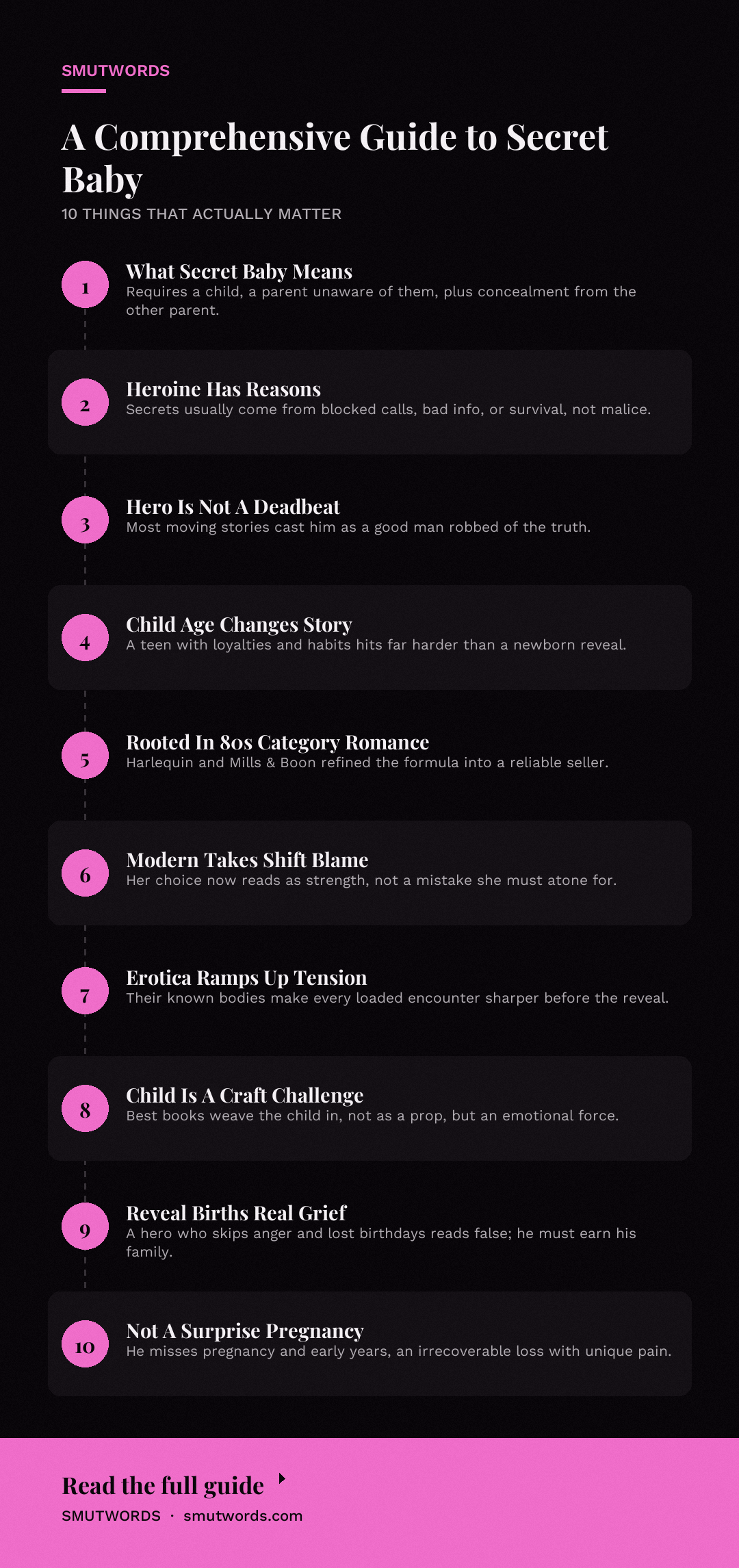
At its core, a secret baby story requires three elements: a child, a parent who does not know the child exists, and a deliberate or accidental concealment of that fact. The parent in the dark is almost always the hero. The parent keeping the secret is almost always the heroine.
The child is typically born after the couple has separated, meaning the hero misses the pregnancy, the birth, and the early years. The reveal happens later, often years down the line, and forces the couple back into each other's orbit.
The term itself is straightforward, but the trope carries more nuance than the name suggests. A secret baby is not simply an unplanned pregnancy that leads to a marriage of convenience. In that scenario, both parties find out about the baby around the same time.
The secret element requires an information asymmetry. The heroine knows she is a mother. The hero does not know he is a father. That gap in knowledge is what generates the story's central conflict.
Common misconceptions abound. Many readers assume the heroine always withholds the child out of spite or revenge. In practice, the most compelling versions of this trope feature heroines with plausible, even sympathetic reasons for their silence.
She may have tried to contact him and been blocked by a family member. She may have watched him leave and assumed he would not want the responsibility. She may have been told he was dead, married, or moved on.
The secret is rarely pure malice. It is usually a survival mechanism that later becomes an impossible truth to confess.
Another misconception is that the hero is always a deadbeat. The most affecting stories give him an excuse for his absence. He was deployed overseas. He was in a coma. He was lied to by someone who wanted him gone.
The trope works best when the hero is genuinely a good man who was robbed of the truth. His shock and grief upon learning about his child hit that much harder.
A hero who simply walked out and never looked back creates a different, less sympathetic story. The child's age at reveal matters enormously. A baby revealed at six months creates a very different dynamic than a teenager revealed at sixteen.
Older children come with established personalities, opinions, and loyalties. They have already formed a family unit with their mother.
The hero is not just discovering a baby. He is discovering a person who already has a life, a schedule, and a fierce protective instinct toward the parent who raised them.
Where Secret Baby Comes From
The secret baby trope has roots that stretch back well into the early days of mass-market romance publishing. It became a defining feature of the Harlequin and Mills & Boon category romances of the 1980s and 1990s, where the formula was refined into something nearly scientific.
A typical plot involved a heroine who had a brief, passionate affair with a wealthy or powerful man, discovered she was pregnant, and chose to raise the child alone. Years later, circumstances forced them back together, and the truth came out.
That era codified the trope's most recognizable beats. The 1990s in particular saw an explosion of secret baby titles, driven by reader demand for stories that combined emotional anguish with the promise of a happy ending.
Editors at category romance lines actively solicited these plots because they sold reliably. The formula offered a guaranteed source of conflict that did not require villains or external threats. The couple's own history provided all the tension the story needed.
As romance publishing evolved, so did the secret baby story. The early versions often painted the heroine as foolish for not telling the hero, and the narrative arc frequently involved her being punished for her deception before winning his forgiveness.
Contemporary treatments have shifted significantly. Modern readers expect the heroine's decision to be treated with more complexity. Her choice to raise her child alone is framed as an act of strength and self-sufficiency rather than a mistake she must atone for.
The genre has also diversified the kinds of heroes who populate these stories. The classic secret baby hero was frequently a billionaire or a sheikh, a man whose wealth and status made the revelation particularly complicated.
That archetype remains popular, but the trope now appears across subgenres. Contemporary romance, romantic suspense, and even historical settings all use the structure.
The shift mirrors a broader trend in publishing toward greater variety in class, profession, and life circumstances for romance protagonists.
The rise of indie publishing and e-reading platforms changed the trope's economics. On platforms like Kindle Unlimited, secret baby romance thrives in serialized and high-volume formats. The trope's built-in emotional stakes make it ideal for readers who want a complete emotional arc in a single sitting.
It also pairs naturally with other popular elements like marriage of convenience and second chance romance, allowing authors to stack reader-pleasing tropes into a single narrative.
How It Shows Up in Erotica
The secret baby trope in erotic romance operates on a different set of priorities than in sweet romance. The heat level is higher, the scenes are more explicit, and the sexual tension between the estranged couple carries a particular charge.
These are two people who have already been intimate. They know each other's bodies. The secret between them does not diminish the attraction. If anything, it makes every encounter more loaded, because the hero is falling for the heroine again without knowing the full truth of what connects them.
Writers working in this space have developed a set of reliable structural beats:
- The couple reunites under some forced circumstance, often professional.
- The hero is frequently a billionaire CEO or a powerful businessman who encounters the heroine in a context that reopens their history.
- She is working for his company, or she needs his help, or she is engaged to someone else he simply cannot allow to marry her.
- Their reunion is charged with unresolved sexual tension from the start.
The sex scenes in a secret baby erotic romance serve a dual purpose. They re-establish the physical bond between the couple, and they deepen the emotional stakes of the eventual confession.
Every time the hero touches the heroine, the reader is acutely aware that he does not know about the child. The heroine's guilt and fear are present even in her moments of greatest pleasure.
The best authors keep that tension visible without letting it flatten the heat of the scene.
Variations on the trope in erotica often involve the timeline of discovery. Some stories reveal the secret early and use the remainder of the book to explore the emotional aftermath. Others hold the reveal until late, building maximum suspense.
A particularly effective variant places the reader in on the secret from page one, creating dramatic irony. The reader watches the hero fall in love with the heroine and her child, knowing the moment of revelation is coming and dreading the impact.
What separates a strong secret baby erotic romance from a flat one is the handling of the child's presence. Children in romance novels are a craft challenge. They cannot be treated as props who conveniently disappear for long stretches of page time.
The best books integrate the child into the emotional fabric of the story. The hero's first meeting with his child, whether he knows the truth yet or not, should carry weight.
A well-written scene where a man who does not realize he is a father plays with a child who has his eyes is worth more than pages of internal monologue about guilt.
The physical reunion between the parents carries additional weight when the heroine has not been with anyone since the hero. That choice is a common one in these stories and serves a clear narrative purpose. It means their first time together after the revelation of the secret baby is genuinely a return to one another.
Enjoyed this? Get a free book.
Join the list and we will send a complete free story straight to your inbox, plus new releases every week after that. No credit card, no catch.
Her body remembers his. The intimacy is not just physical but a reclaiming of a connection she thought she had severed.
The hero must also process the revelation of a secret baby while grappling with desire for a woman he now views differently.
Strong versions of this trope in erotica also spend time on the hero's emotional journey after discovery. His anger, hurt, and sense of lost time are legitimate. He has missed birthdays, first steps, and the entire experience of watching his child grow.
Working through that grief before he can become a present father is essential. A hero who forgives instantly reads as false. One who experiences real pain and then chooses his family anyway earns the happy ending.
This emotional arc shares DNA with the medieval romance tradition of the knight earning his redemption through trials, though the battlefield here is a nursery rather than a tourney.
Secret Baby vs Forced Proximity
Readers frequently conflate the secret baby trope with forced proximity, but they operate in fundamentally different registers. Forced proximity places two characters in a confined situation, such as a stranded cabin or an isolated estate, where they must interact.
Secret baby is specifically about the concealment of a child's existence. The two can overlap, and often do. A secret baby story frequently uses forced proximity as a device to bring the parents back together after the reveal.
The comparison that creates more genuine confusion is secret baby versus second chance romance. A secret baby story usually is a second chance romance. The couple must rebuild a relationship that was interrupted by separation.
The distinction lies in the mechanism. Second chance romance can occur for any number of reasons: timing, career, immaturity, or outside interference.
Secret baby adds a specific, concrete secret that fundamentally changes the nature of the rift. The hero did not just lose the heroine. He lost a child he never knew existed.
The emotional calculus differs accordingly. In a plain second chance romance, the central question is whether two people can overcome whatever broke them apart.
In a secret baby story, the central question is whether the hero can forgive the deception and whether the heroine can trust that his desire for her is not just an obligation to his child. The presence of a child raises the stakes beyond the couple's personal happiness. A child's welfare and sense of family are on the line.
Another point of comparison is the related trope of surprise pregnancy, where the couple discovers the pregnancy together or the hero learns of it shortly after separation. The key difference is temporal.
In a surprise pregnancy, the hero finds out in time to be part of the pregnancy or at least the early months. In a secret baby, he misses all of it.
Months or years of the child's life are simply gone, a fact he can never get back. That irrecoverable loss is the source of the trope's unique melancholy and dramatic power.
A well-handled secret baby reveal often shades into a redemption arc romance, where the hero must prove himself worthy of a family he failed to protect through his ignorance.
For readers who enjoy watching a powerful man humbled by love, the dynamic pairs well with the taboo roleplay scenarios that dominate much of erotic fiction.
The presence of a substantially older child also distinguishes a secret baby from a surprise pregnancy in practical terms. A story where the heroine has raised a child for a decade is dealing with a completely different set of logistics.
The child has opinions, relationships, and an established routine. Inserting a father figure into that dynamic requires a slow, careful approach.
Frequently Asked Questions
Why does the heroine keep the baby a secret instead of telling the hero?
The most effective stories give her a reason that makes emotional sense. She may have tried to contact him and been blocked, fled an abusive situation, or been told he had moved on.
Modern romance treats her choice as complicated rather than villainous. The best heroines made the best decision they could with the information they had at the time.
Is the secret baby trope the same as a surprise pregnancy?
No. A surprise pregnancy typically involves both parents learning about the baby around the same time, often early enough for them to navigate the pregnancy together.
A secret baby means the hero does not know about the child until months or years after the birth. He misses the pregnancy, delivery, and much of the child's early life, which is a distinct source of grief.
Why are so many secret baby heroes billionaires?
The trope pairs naturally with billionaire romance because wealth raises the stakes. A billionaire hero has resources that make the revelation complicated.
He can offer a life of ease, but he also has an image, a legacy, and possibly a family board of directors to answer to. The power imbalance between a wealthy hero and a heroine who has been raising a child alone also creates useful tension.
Do secret baby stories always end with the couple together?
In romance fiction, yes. The genre contract promises a happy ending with the hero and heroine emotionally committed to one another.
The shape of that ending varies. Sometimes they marry immediately. Other stories end with them dating and coparenting, having earned their way back to each other through trust rebuilt over the course of the narrative.
What makes a secret baby romance emotionally satisfying?
The hero must genuinely grapple with what he lost. A story that skips his grief and moves straight to him being a doting father feels hollow.
The best versions let him feel the weight of missed birthdays and first words, then watch him choose to be present for everything that follows. The heroine also needs to have an honest emotional arc around her decision to keep the secret.
Can this trope work with a female hero keeping a secret from a male one?
Yes, though it is less common. The trope lands hardest when the person keeping the secret has genuine agency.
A heroine who conceals a pregnancy to protect herself or her child from a dangerous partner is a darker and more complex variation. In those stories, the eventual reveal often feels less like a betrayal and more like a justified act of self-preservation that the hero must earn forgiveness for inspiring.
Final Thoughts
The secret baby remains one of romance's most reliable structures because it delivers an entire emotional arc in a single premise. The love story begins before the book opens, the betrayal is baked in, and the redemption requires the hero to become a father as much as a partner.
The best versions respect both parents' perspectives and treat the child as a person rather than a plot point.
For a masterclass in how the trope compounds with another high-stakes dynamic, look for a story that combines it with marriage in trouble, where the couple is already struggling when the revelation of a secret baby arrives and reshapes everything.
This premise also works wonders alongside the rivals to lovers framework, where the parents were once adversaries and the child becomes the reason they finally see each other clearly.
And if you want to explore the dynamic where the hero never had a chance to be a father because the heroine vanished entirely, the free use vs gangbang debate over consent and agency offers a useful lens for how much control each partner truly had in the relationship's collapse.








Loading comments…