
Somnophilia is a kink built on a specific and delicious contradiction: one partner is aroused by sex with someone who is asleep or unconscious, and the whole charge of the scene comes from that person's inability to participate in the usual way.
In erotica, somnophilia almost never means genuine assault. It means a scenario where consent has been arranged in advance, the sleeping partner has agreed to be used while unaware, and the waking partner gets to experience surrender, trust, and vulnerability in their most literal forms.
The sleeping body is still, warm, and completely open. The awake partner acts anyway. That gap between unconsciousness and desire is the entire engine of the kink.
What Somnophilia Actually Means
The word comes from the Latin somnus (sleep) and the Greek philia (love or attraction), so the literal translation is "attraction to sleep" or "love of the sleeping." In practice, somnophilia describes arousal tied to a partner who is asleep, drifting off, just waking, or otherwise not actively conscious during sex.
That covers a wider range than most readers assume. A scene where one partner wakes the other with oral sex counts. A scene where someone is fucked in their sleep and only realizes it halfway through counts. A scene where a character is drugged, magically unconscious, or in a coma-adjacent state also counts, though that variant lives mostly in fantasy and paranormal romance, where the rules of reality are already suspended.
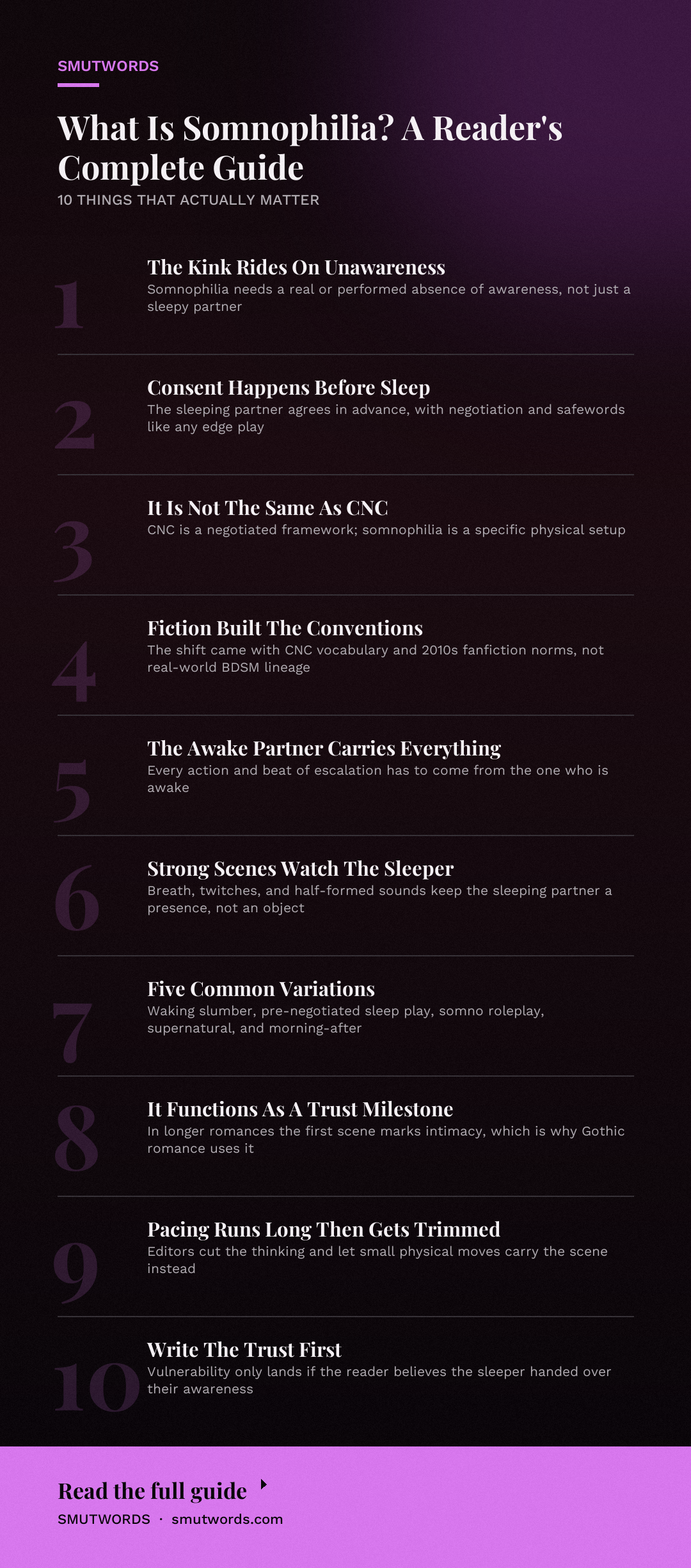
Somnophilia is not the same as a partner who is simply passive, tired, or half-asleep but still responsive. The kink depends on a real or performed absence of awareness. If the receiving partner is awake enough to moan on cue, you are writing sleepy sex, not somnophilia.
It also is not automatically consensual non-consent, though the two overlap often. CNC is a broader framework where partners roleplay a lack of consent. Somnophilia is a specific mechanism, a body that cannot consent in the moment because it is asleep. The consent happens before the scene, sometimes days before, through negotiation and safewords like any other edge play.
Where Somnophilia Comes From
Somnophilia has existed as a recognized paraphilia in clinical literature since the late nineteenth century, but its life as a romance and erotica trope is a much more recent and more interesting story. For most of the twentieth century, sleep sex appeared in literary fiction as violation, not fantasy. The trope carried a shadow of assault, and it was written that way on purpose.
The shift happened alongside the broader rise of consensual non-consent as a named, negotiated kink in the 1990s and 2000s. Once readers and writers had a vocabulary for "we agreed to this beforehand," the sleeping partner could become a willing participant even while unconscious. That reframing is what moved somnophilia out of the taboo-only zone and into mainstream dark romance.
The 2010s fanfiction boom did enormous work here. Sleep sex scenes became a staple of kink meme fills, and the community norms around them (negotiate first, use a safeword, respect the waking partner's limits) carried over into published romance. By the 2020s, somnophilia scenes were showing up in paranormal romance, mafia romance, and fantasy romance without much fanfare at all.
The publishing history matters more than any real-world BDSM lineage here, because somnophilia in fiction is almost entirely a fiction-first kink. Writers built the conventions. Readers reinforced them. The trope now has its own grammar.
How It Shows Up in Erotica
The craft problem with somnophilia is the same one that makes it interesting: the sleeping partner cannot drive the scene. Every line of dialogue, every physical action, every beat of escalation has to come from the awake partner. That puts enormous weight on the waking character's interiority, and it is where strong versions of the trope separate from flat ones.
A weak somnophilia scene treats the sleeping partner as an object. A strong one treats them as a presence, breathing, twitching, murmuring, on the edge of waking, with the awake partner cataloguing every micro-signal and second-guessing whether they should continue. The tension lives in that watching.
Common variations authors reach for:
- Waking slumber: the sleeping partner wakes mid-act, disoriented, and either sinks into it or plays at protest. This is the most popular version in contemporary romance because it gives readers two emotional beats in one scene.
- Pre-negotiated sleep play: both partners set ground rules before bed, sometimes with a safeword written on a nightstand note. The scene then plays out in full, with the sleeping partner genuinely out.
- Somno roleplay: the "sleeping" partner is awake and pretending, often for the thrill of the game. This is the safest to write and the easiest to land, but it loses some of the uncanny edge of the real version.
- Magical or supernatural somnophilia: a vampire, incubus, fae, or bonded mate takes their partner while they sleep, sometimes through a pheromone bond or a dream-walking mechanic. See The Complete Guide to Pheromone Bond Relationships for how those bonds get used to sidestep the consent problem entirely.
- Morning-after somnophilia: the sleeping partner wakes to find the scene already underway and chooses to keep going. This overlaps heavily with sleepy morning sex and is the gentlest entry point into the kink.
Structurally, the strongest somnophilia scenes hinge on one question: does the sleeping partner get to want this? If the answer is yes, and the writing shows that want through breath, body, and half-formed sounds, the scene works. If the answer is nothing, the scene flattens into a body doing things to another body, and readers check out.
The dynamic pairs naturally with a few other tropes. Writers often layer in use kink, where the sleeping partner's whole appeal is that they are being enjoyed without reciprocating. It also fits alongside primal play when the scene leans into scent, heat, and the instinct-driven quality of a body acting on hunger.
Enjoyed this? Get a free book.
Join the list and we will send a complete free story straight to your inbox, plus new releases every week after that. No credit card, no catch.
In longer romances, somnophilia scenes often function as a trust milestone. The first time a guarded character lets their partner do this is a declaration of intimacy, not just a sex beat. That is why the kink shows up in Gothic Romance: Everything You Need to Know, where withholding and surrender carry the emotional weight of the whole book.
Voice matters more here than in almost any other kink. The awake partner narrates, so the reader is stuck inside their head, feeling the guilt, the hunger, the thrill, the tenderness, the urge to wake the other person and the urge to let them sleep. Get that voice right and the scene writes itself. Get it wrong and no amount of choreography saves it.
One practical craft note: pacing. Somnophilia scenes tend to run long because the awake partner has so much room to think.
Editors who have read hundreds of these learn to trim the thinking and let the body carry more. A hand resting on a hip. A breath held. A sleeping partner shifting, and the awake partner freezing. Those small moves do more work than paragraphs of internal monologue.
Somnophilia vs Consensual Non-Consent
Somnophilia and consensual non-consent are frequently conflated, and the confusion is real enough to be worth untangling. CNC is a framework, a negotiated agreement that one partner will act as though consent is absent, even though it was freely given in advance. Somnophilia is a scenario, a specific physical setup where one partner is asleep and therefore unavailable for in-the-moment communication.
You can have somnophilia without CNC (a sleeping partner wakes and enthusiastically joins in). You can have CNC without somnophilia (a roleplay where both partners are awake and pretending they are not). Most dark romance that features a sleeping partner blends both, because the whole dramatic point is that the sleeping partner is being used and that they wanted to be.
If you sit down to write one and find yourself sliding into the other, that is usually a sign the scene is working. The two kinks are cousins, not rivals.
Frequently Asked Questions
Is somnophilia the same as rape fantasy?
No, though they overlap. Rape fantasy in romance usually involves an awake partner roleplaying resistance. Somnophilia requires a sleeping or unconscious partner specifically. Both depend on pre-negotiated consent in the fiction, and both usually feature a safeword or a clear negotiation scene before the action starts.
What makes somnophilia scenes consensual in fiction?
Three things: a negotiation scene before the sleep, an established signal the sleeping partner can use if they wake and want to stop, and an ongoing awareness by the awake partner that the agreement only holds as long as the sleeping partner still wants it. If those are on the page, the scene reads as consensual even when the sleeping partner technically cannot consent in the moment.
How do authors handle safewords when one character is asleep?
Common solutions include a physical signal the sleeping partner can use, a word or sound agreed on ahead of time that the awake partner listens for, or a pre-scene conversation that explicitly grants permission for the whole encounter with no in-the-moment override. The last version is riskier and appears more in dark romance than in lighter contemporaries.
Does somnophilia always involve penetration?
No. Waking someone with oral sex, touching them while they sleep, or bringing them to orgasm before they fully wake all count. The kink is about the sleeping partner's unawareness, not a specific act.
What is the difference between somnophilia and sleep play?
Sleep play is the broader real-world term for any sexual activity involving sleep or drowsiness, including hypnosis-adjacent and drowsy-sex variants. Somnophilia is the specific kink where the arousal comes from the partner's unconsciousness. Most sleep play scenes in erotica are somnophilia; not every somnophilia scene is deep sleep play.
Why is somnophilia so popular in dark romance and paranormal romance?
It gives writers an in-fiction way to explore powerless sex between characters who genuinely love each other. The sleeping partner's helplessness is loving rather than cruel, and the awake partner's restraint becomes a measure of their devotion. Paranormal romance loves it because supernatural rules (bonds, dreams, mating instincts) can make the consent structure explicit without a scene of negotiation.
Final Thoughts
Somnophilia works when the writer treats the sleeping partner as a full person who chose this. Not a prop. The kink rides on vulnerability, and vulnerability only lands if the reader believes the sleeping character trusted the awake one enough to hand over their awareness for the night.
Write that trust first, and the scene will carry itself. For a book that handles sleep-adjacent surrender with unusual care and heat, start with a dark romance where the somnophilia scene is built on months of established intimacy rather than a single reckless night, and notice how much of the charge comes from what happened before anyone closed their eyes.







Loading comments…