
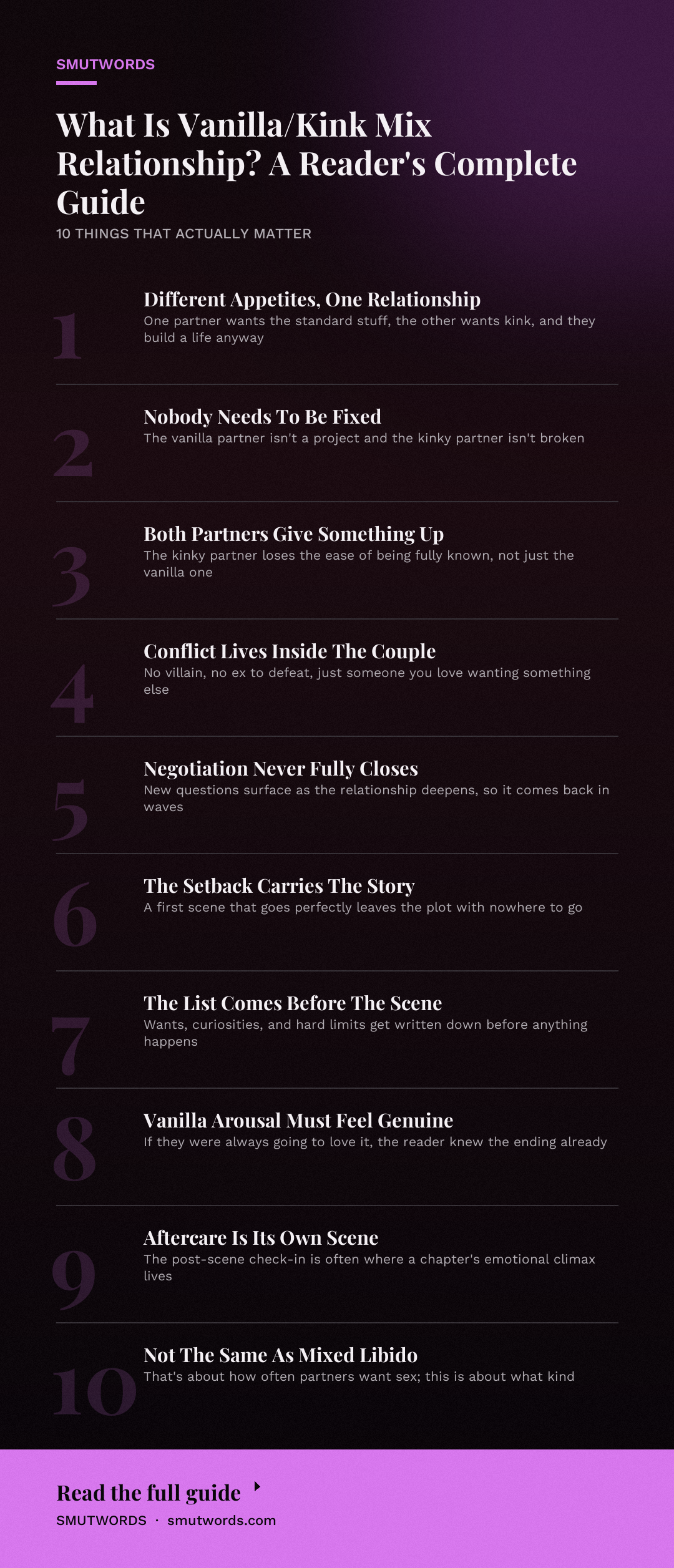
A vanilla/kink mix relationship is one where two people with genuinely different appetites for sex build a single intimate life together anyway. One partner wants the standard stuff and is content there. The other wants rope, orders, pain, power, or any of the hundred things that live under the kink umbrella.
Neither is broken. Neither is owed a conversion. The whole erotic engine of these stories is the negotiation: two people deciding, over and over, what they're willing to give, what they need to keep, and how to tell the difference out loud.
This is one of the most emotionally loaded dynamics in modern erotic romance, because it puts the conflict inside the relationship instead of outside it. There's no villain. There's no ex to defeat.
There's just someone you love who doesn't want the thing you want, and the ongoing question of whether that's workable. Readers keep coming back because the answer is never simple, and because the payoff, when both people find a version of the relationship that fits, feels earned in a way that pure fantasy rarely does.
What Vanilla/Kink Mix Relationship Actually Means
The term describes a partnership where one person sits comfortably in conventional, non-kinky sex and the other carries active kink or BDSM interests. "Vanilla" is the shorthand for the first person, and it's descriptive rather than insulting. It means someone's desires run toward the familiar: standard positions, standard pacing, no power exchange, no gear, no negotiated scenes.
Plenty of vanilla people have rich, adventurous, deeply satisfying sex lives. Vanilla isn't a synonym for boring or repressed.
The mix part is where it gets interesting. A vanilla/kink mix relationship isn't defined by what happens in bed on any given night. It's defined by the gap between what each partner wants and the ongoing project of managing that gap.
Some couples close it almost entirely. Some leave it half-open. Some decide the gap is too wide and part ways, which is also a legitimate ending for a story to reach.
A few things this term does not cover:
- Two kinky people with different kinks. A rope enthusiast dating a sadist is a compatibility negotiation, but it's not a vanilla/kink mix. Both partners already speak the language.
- A vanilla person who's curious but inexperienced. Curiosity is its own dynamic. The mix relationship specifically involves one partner whose baseline desires don't include kink.
- A one-time experiment that goes badly. Single scenes don't define a relationship. The mix dynamic is about the long arc.
- A kinky person who's currently single. Obviously. But it needs saying, because readers sometimes search the term hoping for solo-kink content and land somewhere else.
Common misconception: that the vanilla partner is always the one compromising. In well-written versions of this dynamic, the kinky partner gives up just as much: the ease of being fully known, the freedom to stop translating their desires into gentler language, the relief of not having to negotiate every time they want something specific. Both people are usually sacrificing something real.
Another misconception: that the kinky partner is the "real" one and the vanilla partner is a project to be worked on. That framing shows up in lazy writing and it flattens both characters. The strongest versions of this trope treat each person's desires as equally valid and equally fixed.
It's worth separating the mix relationship from plain kink negotiation, which happens between any two people with any two sets of desires. Negotiation is a skill you use inside a mix relationship. The mix relationship is the ongoing condition that makes the negotiation continuous rather than one-and-done.
Where Vanilla/Kink Mix Relationship Comes From
The dynamic has existed in erotic writing for as long as kink has, which means a very long time, though it wasn't named until recently. Early twentieth-century erotic literature often used kink as a corruption arc: a vanilla character gets drawn into dark desires by a more experienced partner and either surrenders or is ruined.
The vanilla side of the equation was passive. It had no interiority. It was a territory to be conquered.
The shift started with second-wave kink publishing in the seventies and eighties, when writers began treating kinky characters as people with emotional lives rather than as warnings. Even then, the vanilla partner usually existed to be converted or discarded. The story was about the kink, and the vanilla character was furniture.
The genuine change came with online fanfiction and the romance boom of the 2000s and 2010s. Once readers had access to thousands of stories, a subset of writers started pushing back against the conversion narrative. What if the vanilla partner stayed vanilla? What if the kinky partner didn't need to be cured of anything either?
What does a relationship even look like when neither person changes at the core?
That question turned out to be extraordinarily productive. The mix-relationship trope now has its own subgenres: the cautious introduction, the slow-build negotiation, the disastrous first attempt, the moment of genuine mismatch, the middle-ground solution that satisfies nobody perfectly but works anyway. There's an entire shelf of contemporary erotic romance built on exactly this premise.
The genre context matters more than any real-world BDSM history here, because the trope is fundamentally a publishing phenomenon. Real couples in mixed-desire relationships have always existed, but only recently have they been written as protagonists instead of as obstacles. The change is in who gets to have the interiority.
A quieter shift: the trope has started to include kink education as a plot element. Characters research munches, read about rope safety, and have the kind of pedestrian conversations about consent that real people actually have. That wasn't standard twenty years ago. It's now a recognizable subgenre beat, and readers actively seek it out.
How Vanilla/Kink Mix Relationships Show Up in Erotica
On the page, this dynamic lives and dies on the negotiation scenes. The sex matters, but the conversations around the sex are where the writing either works or falls flat. A scene where the kinky partner finally explains what they want, in plain language, to a partner who's trying hard to understand, can carry an entire chapter on dialogue alone.
Strong versions of the trope follow a recognizable rhythm: tension, confession, cautious attempt, setback, recalibration, deepening. The setback matters enormously. If the first scene is a total success and both people walk away glowing, the story has nowhere to go. Readers want the moment where the kinky partner realizes they're holding back too much, or the vanilla partner realizes they said yes to something they weren't actually ready for.
Common variations authors use:
Enjoyed this? Get a free book.
Join the list and we will send a complete free story straight to your inbox, plus new releases every week after that. No credit card, no catch.
- The cautious introduction. The kinky partner tests the water with something light (a command, a blindfold, a tied wrist) and watches for the vanilla partner's reaction.
- The list scene. Both partners sit down and actually write out what they want, what they're curious about, and what's off the table. This is the trope's version of a meet-cute, and it's wildly popular.
- The disastrous first attempt. Someone says yes to something they're not ready for, breaks down, and the couple has to rebuild from there.
- The outside-the-bedroom compromise. The kink happens in a separate context (a weekend, a hotel, a scheduled scene) so the vanilla partner can stop feeling like every night has negotiation attached.
- The trial separation from kink. The kinky partner gives it up entirely for a while, and the story tracks what that cost actually looks like.
- The "both stay who they are" ending. Rare but well-loved. The couple finds a workable arrangement where neither person has changed in substance.
Strong versions handle the anticipation carefully. The kinky partner describing what they want to do, slowly, over several pages, while the vanilla partner listens and decides, is often sexier than the eventual scene itself. Take that away and the story loses its charge.
Flat versions make one of a few predictable mistakes. The vanilla partner gets converted cleanly and the kink becomes the couple's shared thing. Or the vanilla partner is written as a prude whose resistance is the story's conflict. Or the kinky partner is a tortured genius whose desires are presented as inherently more interesting than their partner's.
Each of these flattens the dynamic into something simpler than it actually is.
A specific craft note: the best versions write the vanilla partner's arousal as genuine, not resigned. When a vanilla character tries a scene and finds themselves unexpectedly into it, that word "unexpectedly" is doing important work. If they were always going to love it, the reader knew the ending before the scene started.
Aftercare deserves its own beat. Whether the scene involves any kind of impact play or not, both partners usually need some kind of post-scene processing, and that processing is often where the emotional climax of a chapter lives. The vanilla partner asking "was that okay? did I do it right?" and the kinky partner answering honestly is a full scene on its own.
The fluid bonding conversation sometimes shows up here too, especially in stories where the couple is deciding how much physical intimacy to share inside versus outside the kink context. It's a specific negotiation with its own weight, and writers who handle it well tend to handle the rest of the dynamic well too.
One comparison worth flagging: this dynamic shares some DNA with forbidden erotica, because both depend on the tension of wanting something you're not sure you're allowed to have. The difference is that forbidden erotica usually pits the desire against an external rule (a taboo, a society, a forbidden pairing), while the vanilla/kink mix pushes the conflict inward, into the relationship itself. The forbidden thing isn't the kink. The forbidden thing is the honest conversation about it.
Similarly, the editor/author dynamic in some editor/author romance stories uses a version of the same negotiation structure: two people with mismatched power and different vocabularies for what they want, working out how to meet in the middle. Different surface, same underlying machinery.
Vanilla/Kink Mix Relationship vs Kink Negotiation
These two terms get confused constantly, and the confusion is understandable. Kink negotiation is the act. A vanilla/kink mix relationship is the condition. Negotiation is what happens when the kinky partner asks for something specific and the couple works out the terms.
The mix relationship is the broader fact that one person in the couple is vanilla and the other isn't, which means negotiation keeps coming back around.
A couple can negotiate once and be done. A vanilla/kink mix couple negotiates in waves, because as the relationship deepens, new questions surface.
Do we tell our friends? Do we have a standing date for scenes, or is it spontaneous? What happens when one of us has a bad night?
The negotiation never fully closes. That's the shape of the dynamic, and it's why stories set in this space tend to run long.
Frequently Asked Questions
Is a vanilla/kink mix relationship the same as a mixed-libido relationship?
No. Mixed libido is about how often partners want sex. Vanilla/kink mix is about what kind of sex they want. It's entirely possible to have a couple who both want sex three times a week but want completely different things when they get there.
Can a vanilla/kink mix relationship actually work long-term?
Yes, with genuine effort from both sides. The key factors are honest communication, mutual willingness to find middle ground, and neither partner secretly hoping the other will change in a fundamental way. Couples who try to hide their real desires to keep the peace tend to burn out.
Does the vanilla partner always have to try kink?
No. Trying is common in the trope, and many real couples do explore, but it's never obligatory. Some couples find a stable arrangement where the kinky partner gets their fix in agreed contexts and the vanilla partner stays entirely outside that part of their life. That arrangement has its own risks and rewards, and stories that depict it honestly tend to be more interesting than stories that force a conversion.
What makes mix-relationship stories feel realistic or fake?
Realistic versions let both partners have genuine needs, give them room to negotiate badly before they negotiate well, and don't guarantee a tidy resolution. Fake versions treat one side as the "correct" answer, move from first conversation to full scene with no setbacks, and skip the emotional aftermath.
Where do you actually start with this kind of negotiation?
With a conversation, not a scene. Listing each partner's wants, curiosities, hard limits, and soft limits, then comparing the lists without trying to fix anything yet. Stories that show the list before the scene tend to write better scenes because the reader knows exactly what's at stake.
Can the kinky partner be the one who compromises more?
Absolutely, and this happens more often than the trope usually admits. Kinky partners in mix relationships regularly scale back, hide, delay, or reframe their desires to protect the relationship. That's a real cost, and the best stories mark it clearly instead of treating the kinky partner's satisfaction as a given.
Final Thoughts
The vanilla/kink mix relationship is the trope for readers who want their erotic fiction to have weight. The heat comes from two people who genuinely want each other working out how to want each other well, which is a harder problem than any scene can solve. It rewards writers who take both partners seriously and readers who don't need a conversion arc to feel satisfied.
If you want a starting point, look for titles that begin with the negotiation rather than the scene. The kink is the point of the story, and the negotiation is how the story gets there.







Loading comments…