Walk into any reader space and say "why choose" and watch the confusion split three ways. One reader assumes you mean six men, one woman, a schedule on the fridge. Another hears "reverse harem" and conjures anime screenshots and chosen-one magic.
A third assumes you mean a woman dating around before she picks somebody, which is the closest to wrong. The label "why choose but not harem" exists precisely because the Why Choose romance has been quietly merged with two other things it doesn't belong to, and the merging has made it harder to find the books you actually want.
The short version: Why Choose is a consent structure. Harem Building is a plot engine. Reverse harem is a marketing category. They overlap, often, but none of them requires the others, and books that break the assumed combination get mislabeled, under-tagged, and passed over by the readers most likely to want them.
Here is what each term actually does, and what changes about a story when the label on it changes.
Why Choose vs Reverse Harem: What Actually Differs
Start with the term itself. "Why choose?" is a question a book answers by refusing to answer it. The protagonist ends up with more than one partner, and the story treats that ending as satisfying rather than a failure to commit.
That's the whole definition. It tells you nothing about how many partners, what genders, whether anyone else is involved, or whether there's magic.
Reverse harem is a market category with a lot of inherited furniture. It came out of Japanese media and picked up tropes along the way: five to seven love interests is standard, one per personality archetype, frequently at least one surly baron or brooding general, and often a protagonist who turns out to be a lost princess of something. The "reverse" part historically meant the harem dynamic flipped gender. Reverse harem doesn't guarantee the protagonist keeps everyone at the end.
Which means a reverse harem book can end with a single choice and still be shelved as reverse harem, and a Why Choose book can have two partners, no magic system, and a modern apartment with laundry in the basement. Those are different reader contracts.
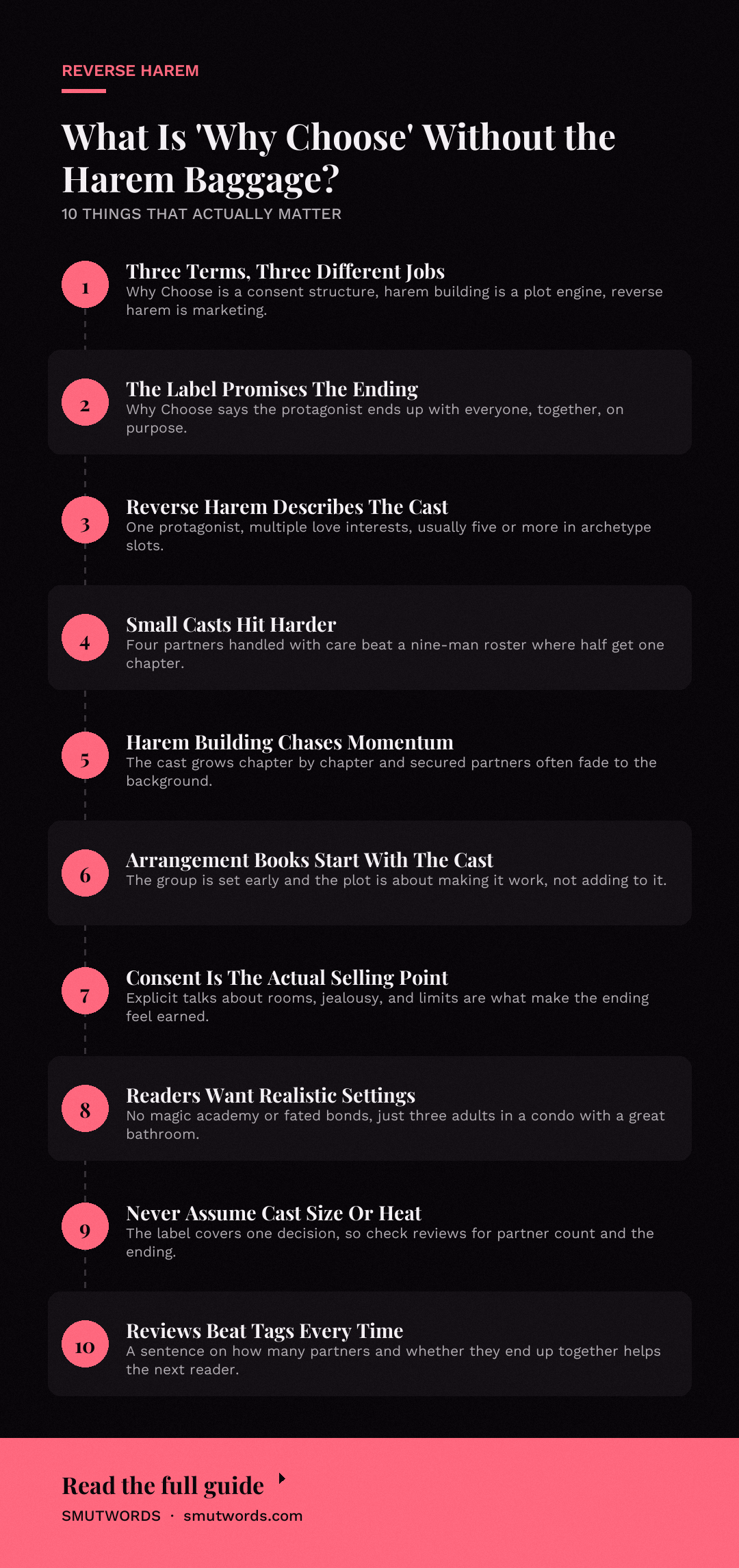
- Why Choose tells you how the book ends: together, everyone, on purpose.
- Reverse harem tells you the shape of the cast: one protagonist, multiple love interests, usually five or more, usually with archetype slots to fill.
- Harem building tells you the plot structure: a character collecting partners over time, like a fantasy party filling out, with a lot of page time spent on recruitment and group integration.
You can have three, you can have one, and the third one is doing something entirely different from the other two.
The Myth: "Why Choose Means a Big Cast"
The number people assume is six. Six or seven partners, one per trope, arranged like a starting lineup. That image comes from reverse harem's archetype habit and from web serials that genuinely do run nine-book arcs because that's how the platform pays.
Two-partner Why Choose exists and is having a good year. A four-person arrangement with one established pair and a newcomer who's handled with actual care lands harder than a nine-man roster where half the men get one chapter each. The number isn't the fantasy. The fantasy is that no one gets shipped off to a farm at the end, and that the book doesn't treat the protagonist as indecisive for wanting everyone in the room.
A four-partner book has to negotiate four sets of feelings, four schedules, and roughly six relationship pairings among the partners themselves. A big-cast book skips most of that in favor of the recruitment high. If you've noticed that eight-partner books feel oddly thin despite the word count, that's why: the cast is wide enough that nobody gets depth.
Harem Building Is a Plot Engine, and It Reads Different
Harem building borrows from a different tradition entirely, closer to a litRPG party-filling structure than to romance. The protagonist starts with no one, meets a partner, wins them over, adds them to the group, and repeats. There's a rhythm to it.
That rhythm produces a specific reading experience: momentum toward more, with the current partners often underused once they're secured. The protagonist's arc is about accumulation. Nobody's relationship is the destination because the destination keeps moving.
Why Choose books that readers praise tend to invert this. The cast is set early. The plot is about making the arrangement work, which means conflict comes from within the group, from outsiders who don't know or don't approve, or from practical problems like a job that has them living in a cabin in the woods for six weeks.
Compare that setup to cabin in the woods vs big city romance and you can see how a single setting choice decides whether the partners get forced into the same room and made to deal with each other.
The Giveaway Test
Read the first hundred pages. If the protagonist has added a partner in the last chapter and the previous two are barely on the page, it's harem building with a Why Choose ending bolted on. If the existing partners are still bickering in chapter twelve and nobody's been added since chapter four, it's the arrangement story.
Neither is bad. They're different books that both wear the same tag, and picking one when you wanted the other is why readers leave three-star reviews saying "it was fine but not what I expected."
Consent Is Where the Label Actually Earns Its Place
The most useful thing about "Why Choose" as a label is what it promises about consent. The protagonist isn't being passed around or seduced into an arrangement by a cocky billionaire who decided for her. She's a participant who wanted this, and the book is supposed to spend page time on the mechanics of making it work.
That means explicit conversations. Who sleeps in which room. How jealousy gets handled and by whom.
What happens when one partner feels sidelined and says so out loud. What the group does when the outside world finds out.
A book that hands you six men and skips straight to the spice is a book that skipped the part that makes the ending feel earned.
Enjoyed this? Get a free book.
Join the list and we will send a complete free story straight to your inbox, plus new releases every week after that. No credit card, no catch.
This is also where some writers lean into dynamics that sound kinky on the back cover and get handled with real care inside. Kitten play is a decent example: the label promises a power exchange with headspace, and a good Why Choose version of it doesn't just have the protagonist call a partner Daddy and then run the scene in the dark.
The couple or the group discusses limits, safewords, and aftercare on the page. See Kitten Play 101 for what the dynamic is supposed to look like when it's done properly.
Why Readers Search "Why Choose but Not Harem"
Three patterns explain most of the searches.
- They want a small cast. Two to four partners, all developed, no roster churn.
- They want modern or realistic settings. No magic academy, no fated-mate bonds, no lost princess of a magical kingdom. Just three adults in a condo with a great bathroom.
- They want the arrangement to be the plot. Not a harem they collect their way into, but a relationship they have to actively maintain. The mechanics of a poly household are more interesting to them than the hunt for another member.
Note what those don't rule out. Two-partner or four-partner. Anthology-adjacent collections. Anything with a whole cast of adults in their thirties who already have jobs.
In fact, that's the growing edge of the subgenre: Why Choose written the way a marriage-in-trouble novel is written, with the existing relationship under real strain. A Comprehensive Guide to Marriage in Trouble covers the emotional logic those books borrow wholesale.
What the Label Changes for You as a Reader
Here's the practical part. When you see Why Choose on a shelf or in a tag, here's what it's supposed to guarantee, and here's what reviewers can actually tell you.
What you get
An ending where the protagonist stays with multiple partners and the book treats that as a win. No last-minute elimination, no sudden monogamy reveal, no one wandering off to find themselves. If the book doesn't deliver that, it's mistagged, and you should say so in a review because the next reader is relying on it.
What you should never assume
Cast size. Setting. Heat level, though Why Choose runs hot more often than not.
The gender of the partners. Whether the partners are involved with each other or only with the protagonist.
Whether there's any magic or fated-mate bond at all. The label covers one decision, and readers who assume it covers all the rest end up confused and annoyed.
What to check before you buy
Check the cast list if the author provided one. Check whether the reviews mention a "slow burn" or an "instant heat." Check whether the setting is contemporary and whether the book is advertised with an archetype cast. Two paragraphs of reviews will tell you if it's an arrangement story or a recruitment story.
If you're coming from the monster side of the genre, the setting question matters even more. A monster breeding romance can absolutely be Why Choose, and plenty are, but the label alone doesn't tell you whether the partners are monsters, whether the protagonist is a monster, or whether the whole thing is tender instead of monstrous. Check monster breeding romance for how that subgenre handles the arrangement question, then check the reviews on the specific book.
Where the Subgenre's Actually Going
Two directions at once. One group of writers is pushing toward fewer partners and more page time, and reviewers are rewarding them for it. Three is becoming a real number on covers again. The other group is doubling down on the roster, and those books are getting an explicit "large cast" or "harem" tag so nobody's surprised.
The good news for readers is that the tags are getting better. The bad news is that old catalog listings and backlist titles are still mislabeled, so part of your job is reading reviews rather than trusting the tag alone.
A book with a soldier romance backbone and one partner who's a surly captain can be a Why Choose if the protagonist keeps both men, or it can be a single-love-interest military romance if she doesn't. The genre label tells you nothing about which until you look.
If you want to find the small-cast end of the shelf, search the term and then filter reviews for the number of partners. If you want the big cast, search for "large cast" or "harem building" directly. And if a book you read matches neither, write a review saying exactly how many partners are on the page and whether they're all together at the end.
That single sentence is more useful to the next reader than a five-star rating with no context.
The One Thing to Get Right
If you take nothing else away, take this: the label is a promise about the ending. Everything else about the book, including who's in it and how they got there, is a separate question, and it's on us as readers to check the answer before we buy. The name "Why Choose" exists because the answer is supposed to be "everyone." When a book delivers that, the tag has done its job.
Final Thoughts
Go in with the right question. If you want the arrangement story, the adults negotiating a shared life and a shared bed, the small cast, the explicit conversations about who sleeps where, then that's the version of the subgenre you're looking for, and it exists.
If you want the cast, the hunt, the recruitment, the group growing chapter by chapter, that's a different book and it's also out there. Use the number of partners and the ending to pick, trust the reviews over the tag, and leave a sentence or two behind for whoever's behind you on the shelf.




Loading comments…