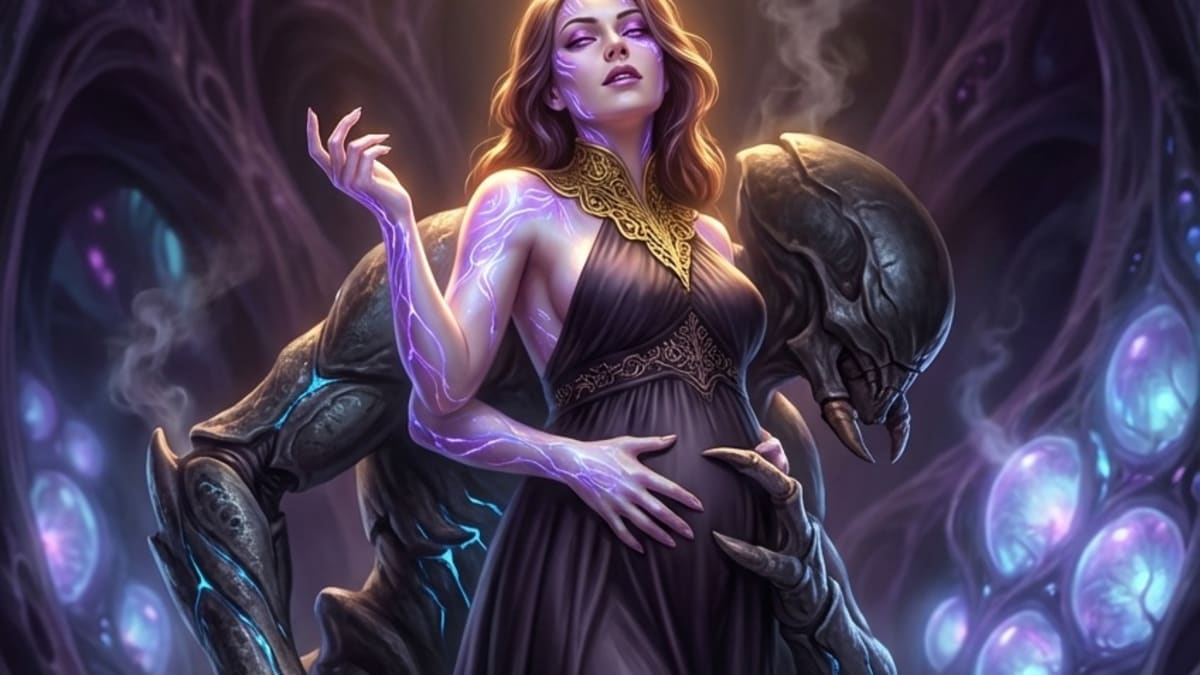
Vampire romance is a subgenre of paranormal romance in which a vampire and a partner (human, another vampire, or something else with fangs and a pulse problem) fall into a love affair built on hunger, danger, and permanence. The bite is often sexual. The blood is often foreplay. And the central promise is a love that refuses to end just because a body does.
If you have ever finished a book at 3 a.m. and immediately searched for "more like this," you already know the pull. This guide is the long, thorough answer to what vampire romance actually is, where it came from, and how to tell a great one from a forgettable one.
Readers come to vampire romance for a specific thrill: the tension between lethal hunger and tender devotion, where every kiss carries a little risk and every bite reads as surrender. The genre trades on that contrast and on the fantasy of being wanted by something that could destroy you and chooses, instead, to worship you. It is one of the oldest and most reliable engines in erotic fiction, and it keeps getting reinvented.
What Vampire Romance Actually Means
The short glossary version says a vampire falls in love with a mortal or immortal partner, blending sensual danger with eternal devotion and blood-sharing as an intimate act. That is accurate but thin. The full definition has a few moving parts worth naming.
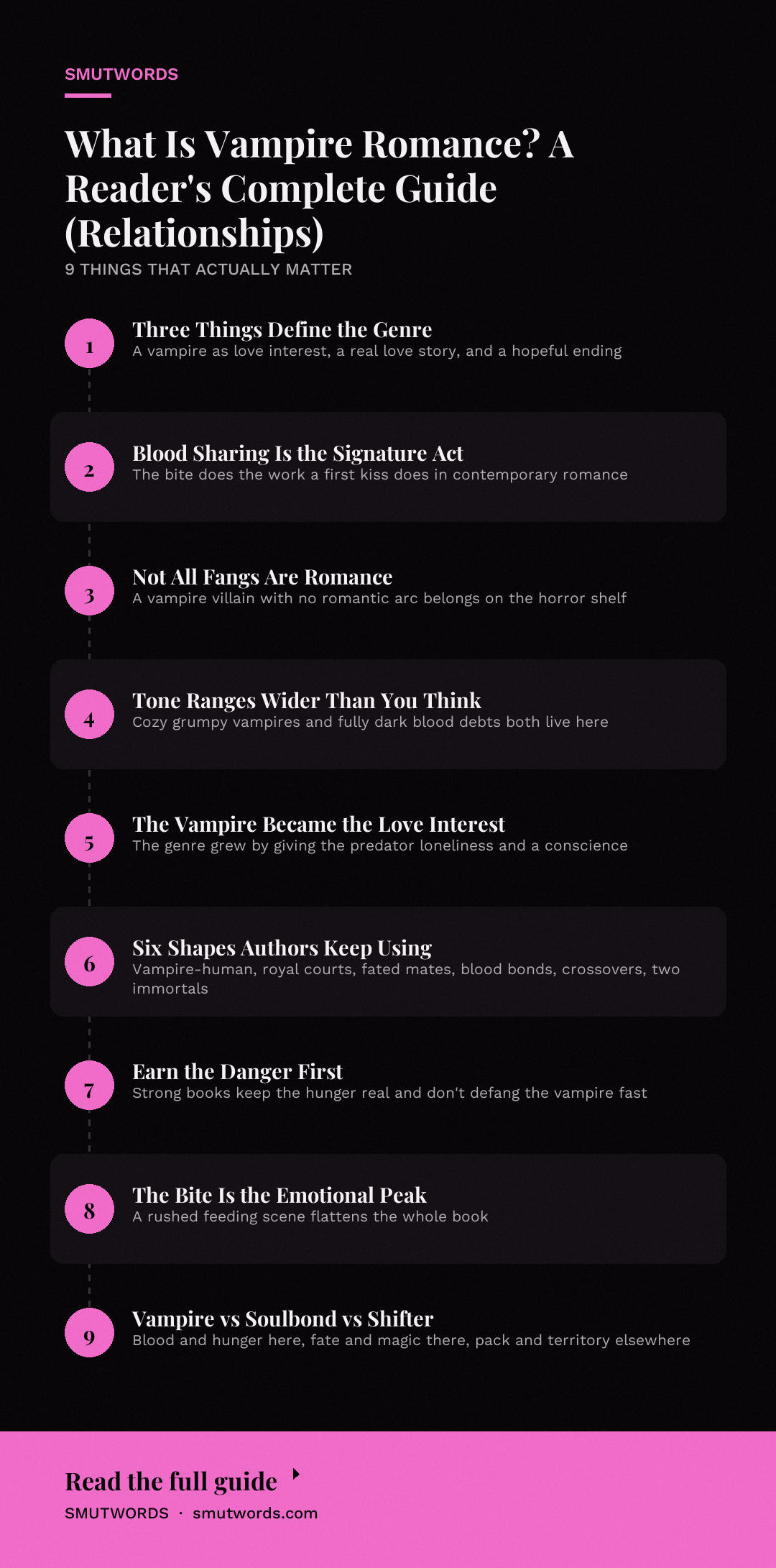
Vampire romance sits inside the larger paranormal romance category. It requires three things working together: a vampire as a romantic lead (not only a villain), a genuine love story with emotional stakes, and a happy or at least hopeful ending. A horror novel with a seductive vampire is not vampire romance. A dark fantasy where the vampire is a monster and the human is prey, with no romantic resolution, belongs on a different shelf.
The name itself is literal. "Vampire" comes from the folkloric undead blood-drinker, and "romance" from the long tradition of love stories with high emotional stakes. Put them together and you get a genre that treats blood as both sustenance and intimacy. Blood-sharing is the genre's signature act, doing the work that a first kiss does in contemporary romance: it is vulnerability, commitment, and a little bit of horror all at once.
What Counts and What Doesn't
A lot of books get labeled vampire romance that are really something else. Here is a working test.
- Counts: The vampire is a love interest. The relationship drives the plot. Blood, bite, or feeding features in the intimate scenes. There is an emotional arc toward union, even if it is complicated.
- Counts: The vampire may be monstrous or morally grey, as long as the romance is the engine and the ending lands somewhere hopeful for the couple.
- Doesn't count: The vampire is purely an antagonist with no romantic throughline, or appears only to be defeated.
- Doesn't count: A gothic novel with erotic undertones and a tragic, unresolved ending. That is gothic horror wearing a velvet coat.
- Doesn't count: A story where the "vampire" is a metaphor with no actual blood-drinking or supernatural stakes (unless the author is playing a very deliberate game).
Common Misconceptions
The biggest misconception is that vampire romance is all brooding aristocrats in castles. Plenty are. But the genre also runs on biker vampires, vampire bakers, military vampires, and vampire kings with sprawling courts and complicated politics.
The second misconception is that it is inherently dark. Some vampire romance is genuinely dark, full of coercion, blood debts, and morally grey heroes. But a huge chunk of the genre is warm, funny, and cozy, with a vampire who is basically a grumpy immortal with a sweet tooth and a soft spot for the heroine. The tone ranges as widely as any other romance subgenre.
The third is that the vampire has to be male. Plenty of the best vampire romance features a female vampire as the lead, sometimes with a human man, sometimes with another woman. The power dynamics shift depending on who holds the fangs.
Where Vampire Romance Comes From
The honest history here is a publishing history, not a folklore history. Vampires have been seductive in Western literature since at least the nineteenth century. But vampire romance as a recognizable, marketable subgenre is a much more recent animal, and it grew up alongside the modern romance industry.
The big cultural shift came with the late-twentieth-century boom in paranormal romance. Before that, vampire fiction tended to be horror. The vampire was a threat, a predator, a cautionary figure. The move that built the genre was making the vampire the love interest, and then giving him (or her) interiority: loneliness, longing, a conscience, a reason to protect the person he craves instead of just draining them.
By the 2000s, paranormal romance with vampires was a dominant commercial category. Bookstore displays were wall-to-wall fangs and brooding cover models. Television and film pushed it further into the mainstream, and the viral success of those adaptations created new readers who came in wanting the tension, the bite, and the promise of forever.
How the Trope Has Evolved on the Page
The early vampire romances leaned hard on the mystery and the courtship. The vampire was often older, powerful, wealthy, and mysterious, and the human heroine spent the book being drawn in despite herself. Blood-sharing was the big intimate milestone, sometimes arriving late and often treated with near-wedding levels of ceremony.
Later waves loosened that formula in productive ways. Contemporary settings became common. Vampire communities got organized into courts, syndicates, or packs with their own politics. Female vampires started leading books.
The fated-mates structure, borrowed heavily from shifter romance and the soulbond tradition, became a dominant plot engine.
More recently, the genre has gotten greedier about crossovers. Vampire and werewolf romances, vampire and witch romances, and even vampire crossover stories that borrow the heat and structure of other subgenres are now normal. The tone has also split: some authors lean into cozy, low-angst vampire romance, and others go fully dark. The genre has enough room for both.
The Publishing Phenomenon Angle
Vampire romance is a genre phenomenon as much as a trope. It survives because it is endlessly remixable. Every few years a new wave arrives, often driven by adaptation, and the whole category gets a fresh audience. That rhythm is not a sign of a tired genre. It is a sign of a flexible one.
The structural advantages are obvious. A vampire is automatically forbidden, automatically dangerous, and automatically permanent. You get the taboo tension without inventing a fantasy world from scratch. You get the immortality fantasy for free.
And you get a built-in physical intimacy scene (the bite) that can be as explicit or as restrained as the author wants. That combination is why the genre keeps coming back.
How It Shows Up in Erotica
This is where an editor who has read hundreds of these books can talk shop. On the page, vampire romance does specific work. The craft question is not whether the vampire is sexy. It is how the book builds and spends its tension.
The strongest vampire romance treats the bite as the emotional peak, not an afterthought. A well-written feeding scene does everything a great sex scene does: it slows the pace, isolates the couple, raises the stakes, and asks for surrender. The writing has to make the reader feel both the horror and the heat, often in the same paragraph.
The Variations Authors Use
The genre has a recognizable set of shapes. Here are the ones you will encounter most often.
Enjoyed this? Get a free book.
Join the list and we will send a complete free story straight to your inbox, plus new releases every week after that. No credit card, no catch.
- Vampire and human. The foundational setup. The vampire is ancient or powerful; the human is mortal, vulnerable, and exactly what the vampire craves. The power gap is enormous, and the craft is in making it feel like devotion rather than predation.
- Vampire king/queen. Royal or court politics. The vampire rules a hierarchy, and the romance collides with obligation, succession, and the needs of the community.
- Fated mates with vampire. A predestined bond. The couple is drawn together by something larger than choice, and the plot often involves fighting the bond before surrendering to it. This is close cousin territory to pack mates romance and the fated-bond structures in Alpha/Beta/Omega dynamics, with fangs swapped in for a different kind of hierarchy.
- Blood bond. Feeding creates a lasting physical or psychic connection. It is often treated as a kind of marriage, sometimes with side effects like shared feelings or a compulsion to be near the other person.
- Vampire and werewolf (or other supernatural) crossover. The couple comes from rival or allied species, and the romance carries the extra weight of politics, prejudice, or territorial conflict.
- Vampire and vampire. Two immortals with all the baggage that brings. Often used for established relationship tension or for a rare equal-power couple.
Some vampire romances borrow heavily from power-exchange structures, with the blood bond or the turning act behaving like a formal commitment. If that appeals, the craft of doing it well is similar to the ideas in this piece on building rituals in a power-exchange relationship, where the small repeated acts carry the relationship's weight.
What Makes a Strong Version Work
The best vampire romance does a few things consistently.
- It earns the danger. The vampire's hunger is present and real, and the author does not defang it too quickly. The first feeding matters, and so does every one after.
- It gives the vampire interiority. Loneliness, hunger, a conscience, a long history: the vampire should feel like a person with a past, not a set of fangs with a chiseled jaw.
- It makes permanence feel earned and complicated. Forever means something different when the couple is mortal-and-immortal. The best books face the practical and emotional mess of that head-on.
- It lets the bite be intimate. If the feeding is described with the same care and heat as the sex, the book trusts the genre's core engine.
- It uses the side characters. Courts, covens, packs, and blood families give the book texture and hand the couple real stakes outside the bedroom.
The weaker versions share a flatness. The vampire is dangerous in the blurb and tame on page ten. The feeding is rushed or awkwardly placed. The permanent-forever promise is asserted rather than shown, and the romance leans on the "he is a monster for her" idea without giving either character something to actually want.
Writing the Heat with Care
Vampire romance spans the heat spectrum, from closed-door to fully explicit. When the feeding and the sex overlap, pacing is everything. A scene that jumps straight to the intense climax without any build reads flat. It needs the same escalation and pacing discipline you would give any explicit scene, the same logic laid out in this guide on how to write a JOI game with escalation that actually works.
Bondage and restraint often show up alongside the bite, especially in darker vampire romance where the power dynamics are part of the appeal. If that is the version you are drawn to, this comprehensive guide to bondage covers the physical and emotional craft of that kind of scene.
Crossovers and Crossover Appeal
Vampire romance has a natural crossover position. It shares tropes with shifter romance, fantasy romance, and even sci-fi romance. The fated-bond structure echoes soulbond; the territorial politics echo the territorial shifter trope; the royal courts echo the hierarchies in shifter pack stories.
Some of the more overt crossovers even borrow the heat and structure of adjacent genres, including the more unusual corners of the catalog. Readers who like their vampire romance with a side of strange sea creatures sometimes find the same appeal in kraken romance or merman romance. It is all one big catalog of supernatural love, and vampire romance sits at the center of it.
Vampire Romance vs Soulbond and Shifter Romance
Two comparisons come up often enough to be worth naming, because they genuinely overlap.
Vampire romance and soulbond romance share the fated connection, the intense attachment, and often the blood or psychic link. The difference is the source.
Vampire romance roots the bond in blood and hunger. Soulbond romance roots it in magic or fate, and it can appear with any species, including elf romance or even the more unusual corners of the catalog like alien breeding trope. Many vampire books use a soulbond-like structure, which is why the terms get confused.
Vampire romance and shifter or pack romance also overlap. Both feature supernatural courts or hierarchies. Both run on territorial politics and fated mates.
The distinction is usually the species and the physical intimacy. Shifter romance tends toward pack dynamics and the idea of a chosen family (this guide on pack dynamics relationships covers that structure well), while vampire romance leans toward the blood bond and the immortal court.
If you are trying to decide which subgenre to read next, use this quick test.
- Pick vampire romance if you want blood as intimacy, immortal courts, and the mortal-and-immortal power gap.
- Pick soulbond romance if you want the fated connection without necessarily committing to fangs.
- Pick shifter or pack romance if you want territorial politics, chosen family, and mate bonds tied to nature.
Frequently Asked Questions
Is vampire romance the same as paranormal romance?
Vampire romance is a subgenre of paranormal romance. Paranormal romance is the umbrella; vampire romance is one of its most popular branches, alongside shifter, witch, and fae romance. A book can be both, and most vampire romance is shelved as paranormal.
Do vampire romances always have a happy ending?
Within the romance genre, yes, a hopeful or happy ending is the norm, even when the couple is separated by mortality. Darker vampire romance may push the couple through a lot of pain first, but the genre's contract is generally a resolution that leaves them together. Horror with a romantic subplot is the exception, not the rule.
What is a blood bond in vampire romance?
A blood bond is a lasting connection created by feeding. It often works like a psychic or emotional tether, sometimes with side effects such as shared feelings, a compulsion to be near the other person, or a commitment that resembles marriage. It is the genre's signature intimacy mechanic and appears in most vampire romance variations.
Can vampire romance be cozy or low-angst?
Yes. A large and growing part of the genre is cozy or low-angst, with a grumpy but soft-hearted vampire, a warm human love interest, and a plot that keeps the stakes emotional rather than apocalyptic. If you want fangs without the horror, this is the corner of the genre to read.
What is the difference between vampire romance and vampire erotica?
Vampire romance centers the love story and emotional arc, with sex scenes in service of that arc. Vampire erotica centers the sex and may have less romantic resolution. The two overlap heavily, and many books sit right on the line, but the emphasis is the tell.
Why is the bite such a big deal in vampire romance?
The bite is the genre's equivalent of the first kiss, the first time, and the wedding night rolled into one act. It is vulnerability, surrender, commitment, and a little horror, and it can be written as explicit or as restrained as the author wants. A book that gets the bite right usually gets the whole romance right.
Final Thoughts
Vampire romance works because it lets a love story last forever and makes that promise feel both thrilling and complicated. The hunger, the bite, the mortal-and-immortal gap, the courts and covens and blood bonds: all of it is machinery for the same fantasy, that someone dangerous and ancient would choose you and keep choosing you for centuries.
If you are ready to start somewhere, pick up a book that takes the bite seriously and gives its vampire a real interior life. That is the version of this genre that stays with readers, and it is the one worth reading first.




Loading comments…