
Widow/widower romance is a love story built on top of a death. One or both protagonists have buried a spouse, and the book tracks what happens when attraction arrives anyway: the guilt, the logistics of a life already furnished with someone else's habits, the slow permission to want again. It is a trope about love after loss, and it lives or dies on whether the dead partner feels like a person rather than a plot device.
That last point is the whole genre in miniature. A widow or widower romance that treats the deceased spouse as an obstacle to be cleared will read thin no matter how hot the sex is. A widow or widower romance that lets the dead partner keep a seat at the table, complicated and loved and sometimes resented, will wreck the reader in the best way.
What Widow/Widower Romance Actually Means
The term covers any romance in which a protagonist has lost a spouse to death before the story begins, or loses one early enough that the loss frames the entire arc. The surviving partner is the widow (woman) or widower (man), and the romance is the relationship that follows, whether the love interest is a stranger, a friend, a former flame, or someone the dead spouse knew.
The category is broader than people assume. It includes:
- Widow romance where the heroine is rebuilding a life and a business, and the love interest is incidental to her survival until he isn't
- Widower romance with children, where the single-parent logistics carry as much weight as the romance
- War widow romance, where the death happened in service and the grief is public as well as private
- Widow with a secret, where the marriage was not what outsiders believed
- Widower who swore off love, where the loss hardened him into someone the heroine has to thaw
- Double widow/widower, where both protagonists are grieving and neither can pretend otherwise
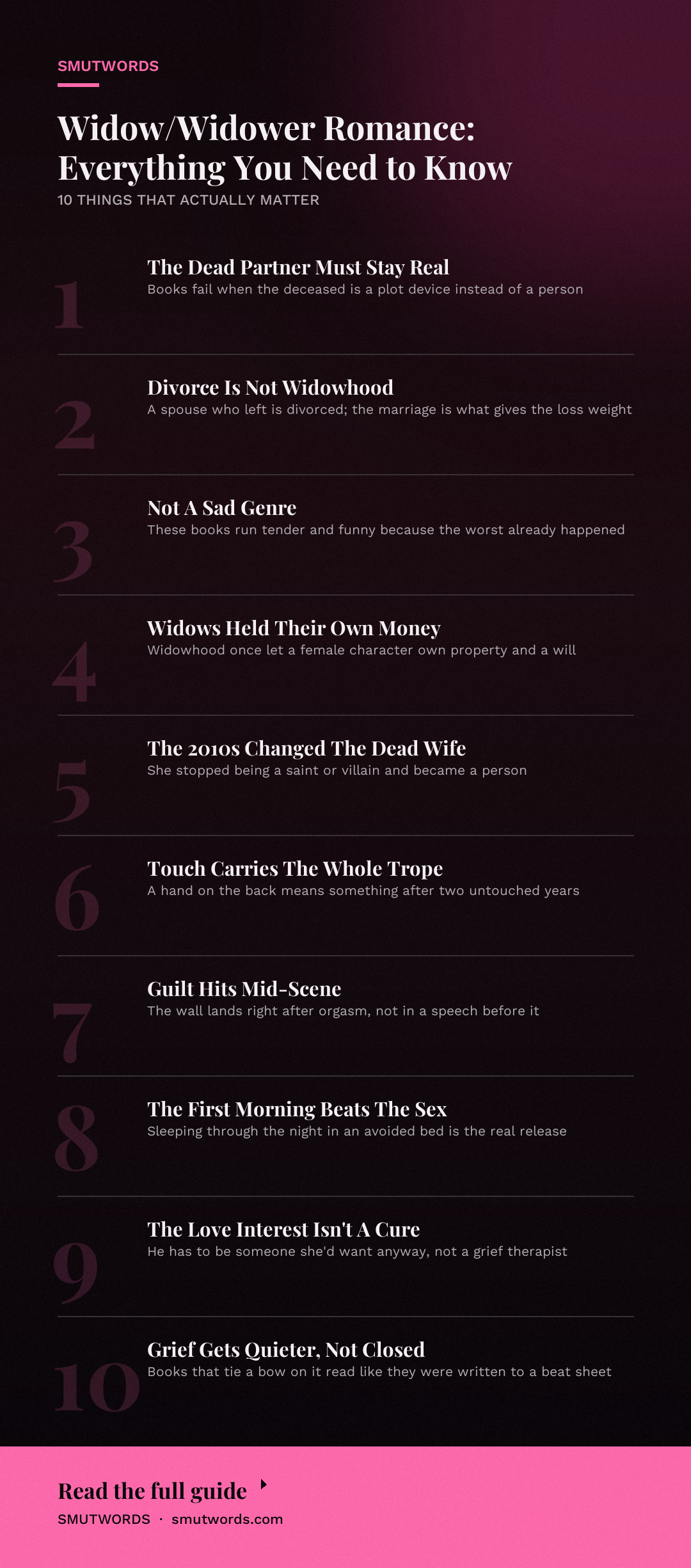
What does not count matters just as much. A hero whose wife left him is divorced, not widowed. A heroine who lost a fiancé she never married sits adjacent to the trope but not inside it, because the marriage is what gives the loss its specific gravity.
And a dead spouse who turns out to have been cartoonishly evil is a different, weaker book. The grief has nowhere to go once the reader stops caring about the person being mourned.
The most common misconception is that this is a sad genre. It is not. Widow and widower romance tends toward tenderness, dry humor, and an unusually high tolerance for messy feelings, precisely because the characters have already survived the worst thing.
They are not afraid of a hard conversation. They are afraid of wanting.
Where Widow/Widower Romance Comes From
The widow has been a romance protagonist since the genre had a name. In the eighteenth and nineteenth centuries, when a woman's legal existence was often folded into her husband's, widowhood was one of the few states in which a female character could plausibly hold money, property, or a will of her own. Novels noticed.
The merry widow became a stock figure in English comedy, and by the Victorian era she was a fixture of sensation fiction: older, sharper, allowed appetites a maiden heroine could not have.
The widower arrived later and slower. For most of the twentieth century he was a supporting character, the brooding uncle or the sad neighbor, rarely the romantic lead.
That changed with the paperback boom of the seventies and eighties, when category romance discovered that a man grieving his dead wife made an excellent source of conflict for a heroine who wanted him. The widower's emotional unavailability became a structural obstacle, and the heroine's job became, in the crude phrasing of the era, to bring him back to life.
The trope shifted again in the 2010s. Two things happened. First, romance readers got louder about wanting grief handled honestly rather than used as a convenient excuse for a hero to be rude. Second, the dead wife stopped being a saint or a villain and started being a person, which meant readers could mourn her too.
Contemporary widow/widower romance now often gives the deceased a point of view in flashback, a voice through letters or voicemails, or at minimum a set of specific preferences the protagonist still honors without thinking.
The publishing side explains the trope's shape. Widow and widower romance sits in a sweet spot for category and indie publishing: it promises emotional depth, it justifies a slow burn, and it lets an author deliver a guaranteed happy ending to a reader who has spent three hundred pages worried she would not get one. That guarantee is the whole business model of romance, and this trope is one of the clearest places it does its work.
How It Shows Up in Erotica
On the page, this trope does something most romance subgenres cannot: it makes touch itself loaded. A widow who has not been touched in two years does not experience a hand on her back the way a single heroine does. Every physical beat carries the comparison, sometimes welcome, sometimes devastating.
Strong widow and widower romance tends to handle that in a handful of specific ways.
The body remembers differently. The best versions of this trope are specific about the physical mismatch between the new lover and the dead spouse.
He kisses with more pressure. He is taller, so the heroine has to stand differently. He is quieter in bed.
The new body is not better or worse. It is different, and the difference is the erotic charge.
Guilt arrives mid-scene, not before it. A weaker book has the heroine announce that she feels guilty and then proceed. A stronger book lets her be fully present in the moment and then hit a wall at the worst possible time, which is usually right after orgasm or right before one. That timing is where the trope earns its reputation for gut punches.
The dead spouse has opinions. Not literal opinions, usually. But a heroine who still cooks her late husband's breakfast on Sundays, or a widower who has not moved a jacket in the entryway, is telling the reader more about grief than any monologue would. Authors who trust those details get a lot of free emotional weight.
Enjoyed this? Get a free book.
Join the list and we will send a complete free story straight to your inbox, plus new releases every week after that. No credit card, no catch.
The first time is rarely the sexiest scene. Often the scene that hits hardest is the first ordinary morning, when a protagonist realizes he slept through the night in a bed he had avoided for years. Erotica in this trope runs on that kind of release as much as on physical release.
Readers of edge play know the buildup-versus-payoff equation well. Those who want a longer treatment of that craft can read Understanding Edging: A Full Breakdown, which is about exactly this kind of delayed payoff.
The love interest has to be a person, not a cure. The flat version of this trope makes the new partner a grief therapist with a nice jawline. The strong version makes him or her someone the protagonist would have wanted regardless, so the reader never feels that the dead spouse was replaced rather than grieved.
What makes a widow/widower romance fall flat is usually one of two failures: the dead partner is reduced to a saint the protagonist must be talked out of mourning, or the grief is resolved too cleanly and too early, so the back half of the book has nothing to do.
Grief does not close. It gets quieter, gets carried differently, gets packed into a box and taken out on anniversaries. Books that admit this feel true. Books that tie a bow on it feel like they were written to a beat sheet.
There is also a heat question worth naming. This trope can run anywhere from closed-door to explicit, but sexually explicit widow and widower romance has a distinct advantage: it can show the protagonist rediscovering her own body on the page, which is a very different arc from discovering sex for the first time.
The discovery is of appetite, not mechanics. Writers who lean into that find the trope's richest material.
A note on the pairings. Widow/widower romance shares a lot of DNA with redemption arc romance, since the protagonist often believes she has no right to happiness and spends the book earning the reader's permission to take it.
It also overlaps with marriage in trouble in stories where the marriage was already fracturing before the death, which is a darker and much less common variant. And when the romance begins with a setup neither party chose, it can borrow structure from blind date romance, though the emotional stakes are of course a different weight class.
Small-town settings show up constantly in this trope, which makes sense given the genre's affinity for places where everyone knows the protagonist's history. That is a big part of why lumberjack romance and widow romance so often appear on the same shelf: both are built on a withdrawn protagonist in an isolated setting, and both get their heat from the slow erosion of that isolation.
Frequently Asked Questions
Is widow/widower romance the same as second chance romance?
They overlap but are not identical. Second chance romance usually means the same two people reconnecting after a breakup. Widow and widower romance involves a new partner and a loss that cannot be undone, though it is sometimes shelved alongside second chance books because the protagonist is getting a second shot at love, just not with the same person.
Can a widow/widower romance be a rom-com?
Yes, and some of the funniest books in the trope are comedies. The humor tends to come from the protagonist's bluntness about death, family members who mean well and say terrible things, and the awkwardness of dating again after years out of practice.
The grief does not disappear. It just shares space with jokes, which is how a lot of actual grieving works.
Do I need to have lost someone to enjoy these books?
No. Most readers of this trope have not been widowed. The appeal is the emotional math: watching someone who believes love is over for them find out it is not. If you have lost a partner, these books can be comfort reads for obvious reasons, and many authors write them precisely for that audience.
What is a war widow romance?
It is a widow romance where the spouse died serving in the military, which adds a public dimension to the grief. The protagonist may be dealing with a folded flag, a military funeral, survivor benefits, or a community that treats her loss as civic property. The love interest is often a fellow service member or a man with his own history of loss.
How long should the grieving period be in a widow romance?
There is no rule, and books range from months to a decade after the death. What matters is that the timeline feels honest for the character. A heroine who is six months out and still sleeping in his shirt reads differently from one who is five years out and has already rebuilt everything except her willingness to date.
Does the dead spouse ever come back?
Rarely, but it has been done, usually in suspense-driven romance where the death was faked or misreported. Those books are a different animal from the standard trope, since the protagonist's grief gets retconned rather than carried. Readers who want the emotional core of the trope should check whether the death is confirmed before picking one up.
Final Thoughts
The trope works because it refuses to pretend that love is simple or that a new relationship erases an old one. The best books in it let the dead partner stay in the story, let the grief stay real, and let the happy ending arrive anyway, earned by a protagonist who had every reason to stop hoping.
If the darker register appeals to you, the same emotional machinery runs through Gothic Romance: Everything You Need to Know, where grief, old houses, and the dead refusing to stay quiet are all part of the furniture.
Start with a single-parent widower romance set in a small town, the version of this trope that has the most room for children, neighbors, and the ordinary domestic tenderness that makes the payoff land. The list below has the ones worth your night.






Loading comments…