
Musician romance is the contemporary romance subgenre where at least one protagonist makes their living (or is fighting to) with an instrument, a voice, or a studio console, and the love story runs straight through the demands of that career. Tours, label pressure, 3 a.m. bus rides, one night in a city you'll never see again, the way a soundcheck can swallow an entire relationship.
The fantasy is specific: someone brilliant and semi-feral who plays like it hurts, and the question of whether you get to keep them once the world finds out how good they are.
What Musician Romance Actually Means
The term covers a wide band of books, and readers argue constantly about where the edges sit. At its core, a musician romance needs two things: a character whose identity and daily life are organized around music, and a plot where that career generates real, ongoing conflict for the couple.
One of those halves alone isn't enough. A book about a woman who falls for a guy who plays guitar at open mics as a hobby, where the music never disrupts anything, is a small-town romance with a soundtrack. A book about a famous singer who could be a famous anything, because the fame is interchangeable and the job never appears on the page, is a celebrity romance wearing a leather jacket.
The label also stretches across genres of music itself, and the flavor changes dramatically depending on which one you pick. The category includes:
- Rock star romance: the loudest, most established wing, built on stadiums, indulgence, and the mythology of the tortured frontman. See the rockstar romance entry for the narrower version of this trope.
- Country music romance: Nashville, songwriting circles, and a strong current of home, family, and class tension running under the heat.
- Classical musician romance: conservatories, orchestras, ruthless auditions, and competence as foreplay.
- Pop and boy-band romance: image management, contracts with morality clauses, and the machinery of manufactured fame.
- Indie and struggling-artist romance: day jobs, van tours, and the tension of loving someone who won't quit.
- Artist-manager romance: the power dynamic version, where the person holding the career is also the person in the bed.
A few things don't count even though readers sometimes file them here. A protagonist who is famous for acting, modeling, or being a billionaire with a piano he never touches is a different trope. So is a story where music is pure metaphor, present only as a mood the author invokes to signal "sensitive, wounded man."
The biggest misconception is that musician romance is automatically rock star romance. Rock is the loudest branch, not the whole tree. The second misconception is that these books are all about fame. Plenty of the best ones are about the years before anyone knows your name, when the only thing standing between the couple and stability is a gig that pays in beer.
Where Musician Romance Comes From
The trope's publishing history starts with the fan and the groupie, which means it starts a little disreputable. Rock music in the 1960s and 70s produced a whole genre of memoir and journalism obsessed with what happens backstage, and romance publishing spent decades treating that world as something to be entered from the outside, usually by a young woman discovering sex and danger at the same time.
Through the 80s the formula was straightforward: innocent heroine, jaded star, a night she'll never forget, a lesson about the cost of fame. The musician was closer to an obstacle than a love interest. He was proof that the real world was more exciting than wherever she came from.
The 1990s and early 2000s pushed the trope toward the mainstream, mostly through series romance and the rise of the modern rock star paperback. Suddenly the musician got a point of view. The books started letting the reader inside the tour bus instead of watching it drive past, and the arc shifted from "she survives him" to "they survive this."
The real turning point was indie publishing and the ebook boom of the 2010s. Self-published rock star romance exploded, and the market rewarded authors who wrote the lifestyle in detail: rider demands, label negotiations, the physical toll of touring, the specific loneliness of a hotel room in a city you can't name.
Two shifts followed. First, the musicians got more diverse and less predictable, with women headlining, queer couples taking center stage, and country, K-pop, and classical settings gaining readers instead of just guitar-and-whiskey.
Second, the conflict moved. Older versions blamed the industry for everything. Contemporary versions often make the couple's own communication the real villain, which is a much harder book to write and a much more satisfying one to read.
Worth noting as a genre phenomenon: musician romance has some of the most devoted re-read culture in contemporary romance, partly because tour schedules, studio sessions, and album rollouts give authors a natural structure for serials. That structure is also why so many of these books land in marriage in trouble territory by book three, once the couple is established and the question becomes whether the life they built can hold.
How It Shows Up in Erotica
The craft problem unique to this trope is that music is an abstract experience and prose is not. A scene can describe a chord change, but it can't make anyone hear it. The best authors solve that by writing around the music, focusing on what the performance costs the body doing it, and what it does to the person watching.
On the page, the strongest musician romances tend to share a set of load-bearing scenes. A soundcheck that turns into a conversation with no audience. A green room where someone is already undressing. A hotel corridor with a door that shouldn't be knocked on.
A stage door after a show where the crowd noise is still ringing in everyone's ears.
The heat itself is usually built on three engines:
- Adrenaline transfer. The show ends, the body is still running hot, and someone has to do something with all that leftover energy. This is the trope's most reliable sex-scene setup.
- Access as intimacy. Being allowed backstage, into the writing room, into the version of him that exists before the performance face goes on.
- Competence. Watching someone be extremely good at something is a turn-on, and musicianship gives an author an excuse to write it in detail.
Authors also lean on a small set of variations that reliably change the story's temperature. The bodyguard or crew member who's the only one not impressed by fame. The duet partners whose creative connection turns physical.
The manager or label executive who holds professional power and becomes the couple's central conflict. The ex-bandmate, where the history is loaded and the dynamic lands somewhere between rivalry and hate to love.
What separates a strong version from a flat one comes down to specificity. Flat musician romance describes a "famous rock star" and stops there. Strong musician romance knows what kind of van the band drives, how much the tour pays per night, whether he can read music, why the second album nearly killed him, and what the label is threatening if it doesn't hit.
Consent and chemistry also matter more here than in a lot of tropes, because the power imbalance between famous and unknown, or between artist and manager, is real and the reader feels it. If you want to see how authors handle that line without breaking the scene's momentum, the SmutWords guide to safewords in erotica fiction is worth reading alongside any of these books. Musician romance runs on negotiation as much as it runs on chemistry.
The Archetypes Readers Actually Show Up For
Most musician romance leads land in one of a handful of wells, and the wells have very different sexual temperatures.
Enjoyed this? Get a free book.
Join the list and we will send a complete free story straight to your inbox, plus new releases every week after that. No credit card, no catch.
The frontman. Charismatic, self-destructive, watched by everyone, honest with exactly one person. His heat comes from attention: the fact that hundreds of people want him and he chose to be here with you.
The quiet one. Bassist, drummer, session player, producer. Competent, observant, low on drama until provoked. He's the trope's most requested archetype for a reason, because the contrast between what he does with his hands on an instrument and what he does with them elsewhere does a lot of work for free.
The woman headliner. Increasingly the center of the genre. Her arc tends toward autonomy, and the sex scenes tend to be about who gets to be in charge of a person whose entire life is scheduled by other people.
The one who's leaving. The musician whose entire character is built around the next city, which makes any relationship a countdown. This is the version that produces the hardest third-act breakups.
Structures That Work
The tour is the trope's natural clock. A 30-city run gives an author a built-in escalation, a built-in ticking clock, and a built-in reason the couple can't simply talk things through in a kitchen. Novels that use the tour as structure almost always move faster than novels that use it as backdrop.
The album cycle is the longer version: writing, recording, release, promotion, burnout. It suits duologies and series, and it's the structure most likely to eventually turn into a marriage-in-trouble plot, because the couple has already survived the getting together and now has to survive the success.
Then there's the aftermath structure, which starts after the fame and moves backward. These books are quieter, denser, and often the most emotionally brutal, because the musician who has already been chewed up by the industry is a different creature than the one still chasing it.
What Makes These Books Fail
The single most common failure is a musician who never seems to actually work. If every scene involving music is a performance for the love interest, the career reads as decorative and the stakes evaporate.
The second is a love interest with no life. When one half of the couple exists only to be supportive, the relationship is a fan's fantasy rather than a partnership, and readers notice by the midpoint.
The third is fame with no friction. No missed birthdays, no contract clauses, no creative disagreements, no one getting sick of the road. Musician romance runs on friction. Remove it and you've got a meet-cute with better lighting.
Musician Romance vs Rockstar Romance
These two get used interchangeably, and the confusion is fair, since rock star romance is the subgenre that built the trope's audience. The distinction is scope. Rockstar romance specifically means rock music, with the sound and the culture attached: guitars, grit, stadium tours, the particular mythology of the band.
Musician romance is the umbrella. A cellist preparing for a competition, a Nashville songwriter ghostwriting hits for someone else, a K-pop idol under a dating ban, and a jazz drummer playing a residency all belong to the broader category without being rock star books at all.
That difference matters for what you're actually getting. Rock star romance delivers a specific fantasy of excess and rebellion. Musician romance can deliver that same fantasy, or it can deliver something quieter and stranger, like two people who understand each other's creative process better than anyone else ever will.
If you want the wide version of the trope, read broadly. If you want the loud one, start with the rock star shelf. Readers chasing the fated-mate version of that same intensity tend to end up at fated mates, which scratches a similar itch from a different angle.
Frequently Asked Questions
What is musician romance?
It's a contemporary romance subgenre where one or both main characters are professional or aspiring musicians, and the plot is shaped by the realities of that career. Tours, recording, label pressure, and creative ambition drive the relationship's conflicts and milestones rather than sitting in the background.
Is musician romance the same as rock star romance?
No. Rock star romance is one branch of it. The wider category also covers country, classical, pop, indie, and session-musician stories, and the tone shifts a lot depending on which one you pick.
Why are so many musician romance leads written as difficult men?
Because difficulty creates the story. A successful, emotionally available musician with a stable schedule doesn't generate much conflict, and readers come to this trope for the tension between loving someone brilliant and living with what that brilliance costs them.
Do musician romances always involve cheating or groupies?
No, and the genre has shifted away from that over the last decade. Older books leaned harder on temptation and betrayal; current ones are more likely to make the obstacle touring logistics, label interference, creative disagreement, or plain bad communication. Cheating still appears, but it's no longer the default third-act turn.
Can musician romance work with a female musician as the lead?
Absolutely, and some of the strongest recent entries do exactly that. Her arc usually centers on control: over her image, her schedule, her sound, and her body, which is why these books often read as more political and more sharply observed than the male-frontman version.
What should I look for in a good one?
Specificity. If the author knows what album cycle the characters are in, what the tour pays, and what the label is threatening, the rest of the book usually holds. If the music only shows up when it's convenient for a romantic beat, it probably won't.
Final Thoughts
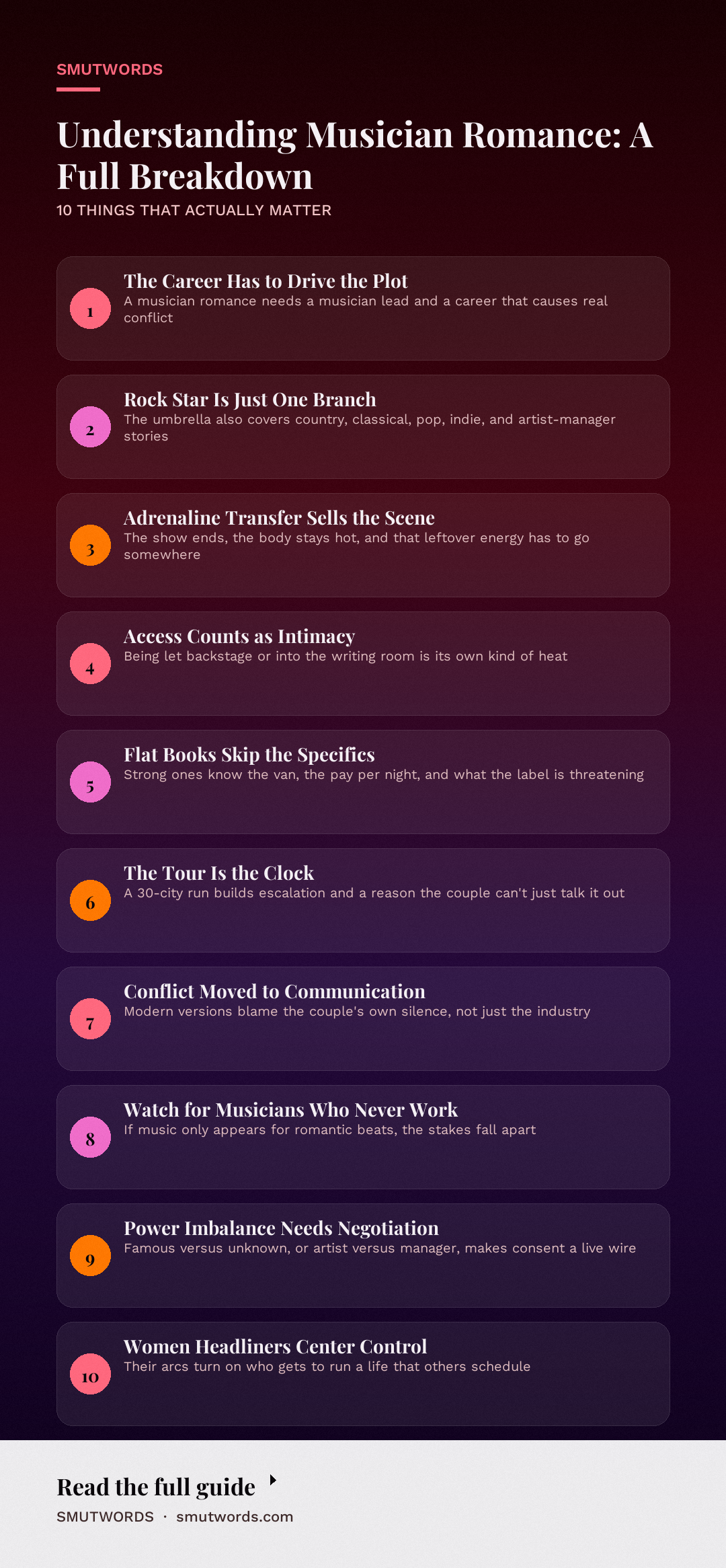
Musician romance works because it takes something readers already have a physical relationship with, music, and hands it to a person who is very good at it and very bad at everything else. The best books in the trope keep the job real: the rehearsal, the rejection, the second-guessing, the sheer logistical mess of loving someone whose calendar belongs to a tour.
Start with a book that gets the studio scenes right. If the author can make a recording session feel like a sex scene, they can make the sex scenes feel like a whole album.





Loading comments…