
A fluid bonding discussion is the conversation partners have before they decide to stop using barriers during sex. That means talking through STI testing, who else each person is sleeping with, what "exclusive" actually means to both of them, and what happens if something changes. The term borrows the language of bodily fluids and applies it to a decision people make on purpose, out loud, usually more than once.
In erotica, these scenes have become a whole subgenre of tension: two people sitting across from each other, clothes on, saying the thing that changes everything.
It is not the sex itself. It is the moment before, where the trust gets spoken instead of assumed. Writers have figured out that a fluid bonding discussion can carry more heat than a graphic scene because it forces characters to be honest in ways they normally avoid. That honesty is the whole appeal.
What a Fluid Bonding Discussion Actually Means
The phrase started in kink and non-monogamy communities as shorthand for a specific agreement: no condoms, no dental dams, no barriers between these particular people. "Fluid bonding" names the physical reality (semen, vaginal fluid, saliva, blood all moving between bodies without latex in the way) and "discussion" names the part that matters more, which is the negotiation that makes it consensual and informed.
In practice, a fluid bonding discussion covers several concrete things. Not every conversation hits all of them, but a thorough one does:
- Testing status and timing. When was each person last tested, for what, and what were the results?
- Current partners and recent partners. Who else is in the picture, and what barriers are used with them?
- What exclusivity means to each person. Some people define it as "no other partners." Others define it as "no other barrier-free partners."
- What acts count. Penetration, oral, anal, and exchange of fluids all get separate decisions in careful negotiations.
- What happens if something changes. A new partner, a broken condom, a positive test, a lapse in judgment. The plan for that gets made in advance.
- What both people actually want. Some people agree to barrier-free sex because they crave it. Others agree because their partner wants it and they feel pressured. The discussion is supposed to surface that difference before it becomes a problem.
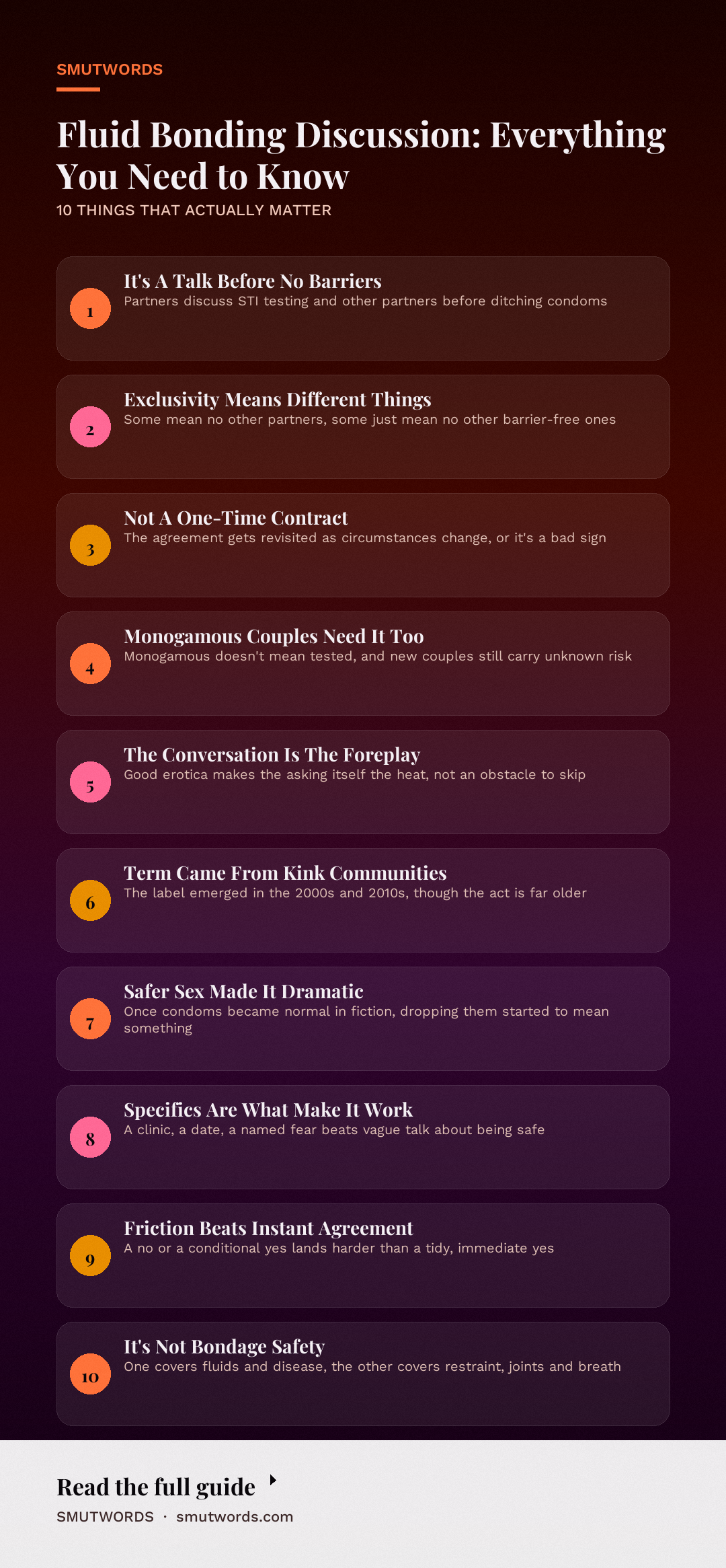
What it does not mean: it is not a one-time contract written in stone, and it is not a loophole for skipping safer sex practices with everyone. It is a specific agreement between specific people that gets revisited as circumstances change. A fluid bonding discussion that happens once and never again is usually a bad sign, in fiction and in life.
A common misconception is that this is only a non-monogamy term. Monogamous couples have these conversations constantly, especially at the point where a relationship is new enough that testing status is still unknown. The exchange of fluids with a new monogamous partner carries the same risks as with a non-monogamous one, and the conversation is the same shape.
Another misconception: that bringing it up kills the mood. In good erotica, the opposite happens. The conversation is foreplay.
Where the Fluid Bonding Discussion Comes From
The terminology itself is relatively recent, emerging from kink and polyamory communities in the 2000s and 2010s as language for something people had been doing informally for decades. The concept is much older than the label. The idea of "going bare" as a milestone of trust has existed in erotic writing since before anyone called it fluid bonding.
In pre-AIDS erotic fiction, barrier-free sex was often just the default. Rarely discussed, because there was no cultural expectation that it needed to be.
The 1980s and 1990s changed that. Safer sex messaging moved into mainstream culture, and by extension into romance and erotica, where condom use became a visible narrative choice. Authors started writing testing conversations, sometimes clunkily, sometimes beautifully.
A scene where a character pulled out a condom or asked about testing stopped being invisible and became a character beat.
The more interesting shift came later. Once condoms became common in erotic fiction, the decision to stop using them became dramatic material. It stopped being the neutral default and started signaling something. A character who asks to go barrier-free is asking for a specific kind of intimacy, and the other character's answer reveals a lot.
By the 2010s, especially in the self-published romance and erotica boom, the "testing talk" scene had become a recognizable beat in its own right, particularly in contemporary romance, mafia romance, and the more emotionally serious end of paranormal romance.
Fluid bonding discussions also bled into subgenres where biological realities are heightened. In impregnation kink, the conversation is almost mandatory because the stakes are the entire point of the story. In wolf shifter romance, the conversation often gets translated into a mate-bond ritual or a scent-marking beat, but the emotional structure underneath is the same: two people agreeing, on the record, to stop protecting themselves from each other.
The rise of fated mates tropes in paranormal romance created a related pressure. When two characters are destined for each other, the fluid bonding discussion gets compressed or bypassed entirely, because destiny overrides the need to negotiate. Some readers like that. Others find it hollow, and the best fated mates writers tend to insert some version of the conversation anyway, even when the plot says they don't have to.
How Fluid Bonding Discussions Show Up in Erotica
This is the part where a scene either works or doesn't, and it usually comes down to whether the author treats the conversation as an obstacle to get through or as the main event.
The strongest versions of these scenes are doing the same work as a good consent negotiation or kink negotiation: they establish what each person wants, what they're afraid of, and what they're willing to risk, and they do it in dialogue that a reader actually wants to read.
The most common structures authors use:
- The clinic scene. Both characters get tested together, often in a slightly awkward waiting room, and the conversation happens with paperwork in hand. Low heat, high intimacy, great for slow burns.
- The kitchen table talk. Two people, late at night, one drink each, condoms on the counter as a visual prop. The reader knows what's coming. The characters have to say it anyway.
- The post-conflict reconciliation. A fight happens, then the conversation, then the sex. Often the most emotionally loaded version, and the hardest to write without making the reconciliation feel too easy.
- The heat-of-the-moment stop. Right before penetration, someone pauses and asks the question. The pause itself is the drama. Whether the other person says yes, no, or "let's talk about it tomorrow" determines the tone of everything that follows.
- The already-done version. The conversation happened off-page, and the scene opens with both characters already barrier-free. Some authors skip the talk entirely and trust the reader to assume it happened. This works when the story has earned it and falls flat when it hasn't.
- The negotiation as foreplay. The talk is written as a seduction. Testing status becomes dirty talk. The asking is the sex. This is the version that ends up on the reader's reread list.
What makes a fluid bonding discussion strong on the page, in editorial terms, is specificity. Vague talk about "being safe" reads as filler. A scene works when it names things: a specific clinic, a specific date, a specific person with an unknown status, a specific fear.
Enjoyed this? Get a free book.
Join the list and we will send a complete free story straight to your inbox, plus new releases every week after that. No credit card, no catch.
The moment a character admits something they didn't have to admit, like a recent slip-up, a past partner they didn't disclose, or a worry about their own testing history, the scene comes alive. That admission is the heat.
What makes it flat is when the conversation exists only as a box to check. When both characters agree instantly with no friction, when the testing status lines are delivered like a recitation of a form, or when the conversation ends and never comes up again even though the plot introduces obvious reasons it should, readers notice.
The best writers keep the agreement alive across the book. A test result shows up at a bad time. A character's ex reappears. A condom breaks, and the plan the couple made earlier is what they fall back on.
A related craft note: this conversation sits naturally next to other negotiated beats in a well-structured scene.
A fluid bonding discussion might precede a milking table scene, where the physical setup itself requires pre-agreement, or follow a scene that pushed a character into subspace, where the drop afterward makes the moment for a serious talk. It pairs well with aftercare, since both are unglamorous conversations that carry real emotional weight, and a scene that handles one well usually handles the other well too.
One more editorial point: the fluid bonding discussion is one of the few places in erotic fiction where a character can say something risky without a physical act attached. That means it lands hardest when it's not choreographed into a tidy resolution.
A character who asks and gets told no, or who asks and gets a "yes but here are my conditions," is more interesting than a character who asks and hears "of course, I've been tested twice and I only sleep with you." Friction is what makes the agreement mean anything.
Fluid Bonding Discussion vs Bondage Safety
These two get confused because both are pre-scene negotiations about bodily risk, but they address completely different things. A fluid bonding discussion covers disease transmission and fluid exchange. Bondage safety covers physical restraint: circulation, nerve pressure, the ability to release someone quickly in an emergency. The two can happen in the same conversation, and often do, but a scene can have one without the other.
Where the confusion bites is when authors write a negotiation scene and treat it as a catch-all. A single paragraph where characters agree on a safeword and mention they're both clean does not satisfy either topic well. If you're writing a scene that includes both restraint and barrier-free sex, consider giving each topic its own paragraph or beat. Readers who care about this stuff will notice.
For readers trying to figure out which term applies to what they're reading: if the negotiation is about what happens to the body during the scene (breath, joints, bondage, pain), you're reading a bondage safety conversation. If it's about what moves between bodies and what the long-term consequences of that might be, it's a fluid bonding discussion. The actual RACK framework covers both, along with everything else.
Frequently Asked Questions
What is a fluid bonding discussion in real life?
It's a conversation partners have before deciding to stop using barriers during sex. It covers STI testing, current and recent partners, what exclusivity means to each person, and what the plan is if something changes. Monogamous couples have these conversations as often as non-monogamous ones, especially early in a relationship.
Do you need a fluid bonding discussion if you're both monogamous?
Yes, because "monogamous" doesn't mean "tested." Two people who have only slept with each other can still carry infections from before the relationship started, including ones that don't show symptoms. A test and a conversation cost one afternoon and prevent a lot of problems.
How is a fluid bonding discussion written in erotica without killing the mood?
The strongest versions treat the conversation as foreplay rather than a formality. Specifics help (a clinic name, a date, a fear a character admits), and friction helps more. A character who asks for something and doesn't get an instant yes is more compelling than two characters who agree immediately.
What should a fluid bonding discussion cover if someone has multiple partners?
Testing schedules, what barriers are used with other partners, what counts as a change in status, and how quickly each person expects to be informed if something happens. The conversation usually gets revisited more often in non-monogamous setups, so the agreement includes a check-in schedule.
Is fluid bonding the same as going bare?
Mostly, in practice. "Going bare" describes the act, and "fluid bonding" describes the agreement behind it. The discussion part is what distinguishes it from a one-time decision made in the heat of the moment with no testing or follow-up.
Why do authors write fluid bonding discussions so often in shifter and alien romance?
Because those subgenres already trade in heightened biological stakes: mating bonds, scent, fertility, and physical differences between species. Authors translate the STI and exclusivity conversation into worldbuilding terms, but the emotional shape is the same negotiation about trust and exposure. A scene written for spitting kink handles it the same way lighter subgenres do, just with more explicit specifics.
Final Thoughts
A fluid bonding discussion is one of the few scene types in erotic fiction where the characters have to be brave with their clothes on. The conversation is the plot, and the payoff is whatever comes after: the trust, the risk, the moment where two people stop protecting themselves from each other on purpose.
For a story that handles the beat with real stakes and real tension, start with the Safewords in Fiction piece, which walks through how authors manage consent on the page without breaking the scene.
If you want to read the beat written well, watch for the pause. The good versions almost always have one: a character stops mid-motion, asks the question, and waits. That pause is where the whole conversation lives.






Loading comments…