
Baker romance is a romance subgenre built around a protagonist who makes bread, cakes, or pastries for a living, with the love story unfolding in and around the bakery, café, or patisserie itself. Flour on the apron. A proofing dough left to rise while two people argue over the last croissant. An oven that runs hot enough to excuse a flushed face.
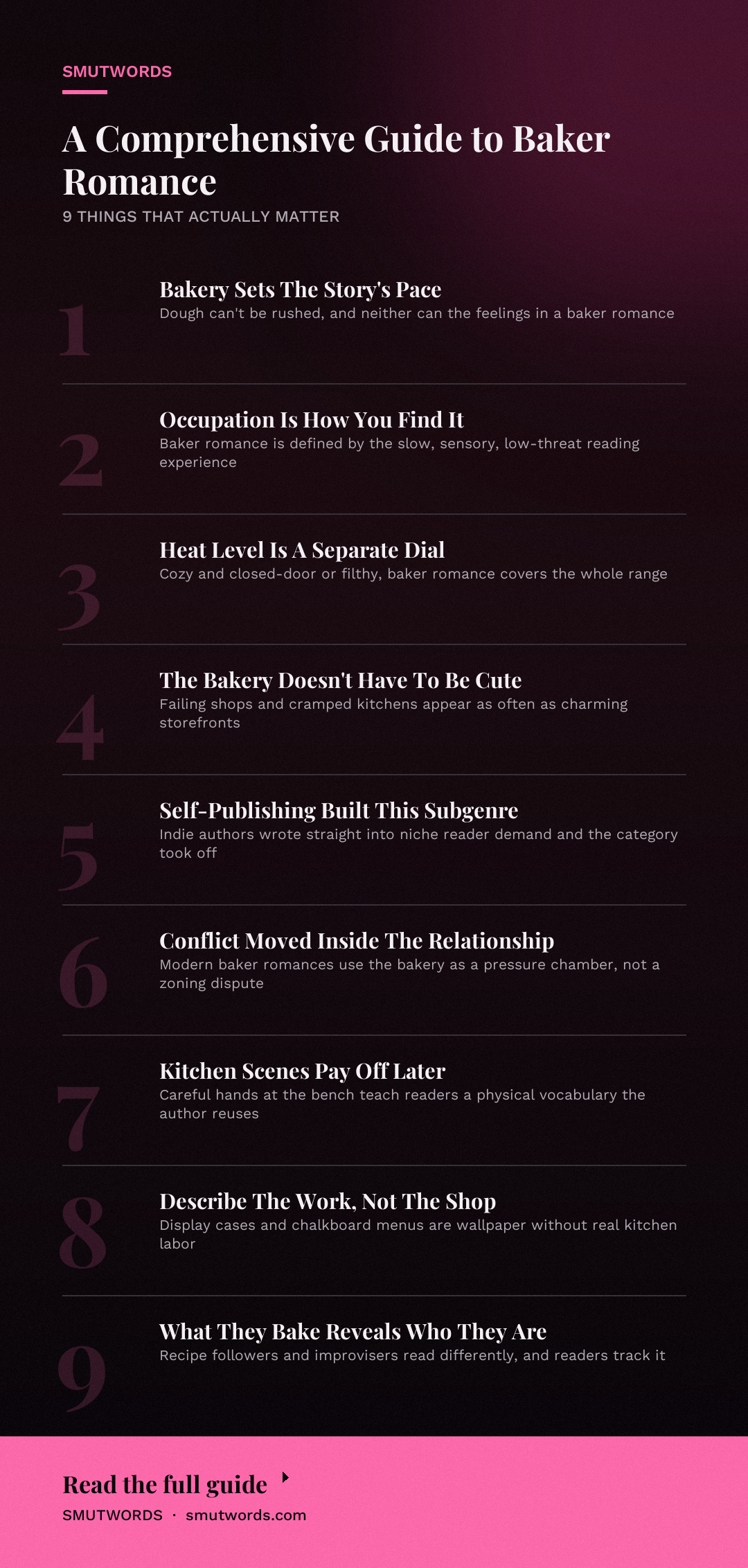
The bakery is not decoration in these books. It sets the pace of the relationship, because dough will not be rushed and neither will the feelings. If you have ever finished a novel and immediately wanted butter and a warm roll, you already understand the appeal. This guide covers what the term actually means, where the subgenre came from, and how the best versions make the heat and the comfort work at the same time.
What Baker Romance Actually Means
Baker romance is a trope designation and a subgenre label at once. As a trope, it means one or both romantic leads work in baking, and the physical act of making food carries emotional weight in the story. As a subgenre, it describes a whole shelf of books: small-town bakery romances, big-city patisserie dramedies, holiday baking competitions, second-chance stories where the former couple now runs rival storefronts on the same block.
The label is broad on purpose, and that causes some confusion. Here is what counts and what does not.
- Counts: A protagonist who bakes professionally, or whose baking is central to their daily life and identity. Scenes that take place in a working kitchen. Food that gets described with real sensory attention. A romance that develops partly through the shared labor of baking.
- Counts: Bakery owners, pastry chefs, bread bakers, cake decorators, chocolatiers, a home baker running a weekend market stall with ambitions of a storefront.
- Does not count: A single scene in a bakery that could be relocated to a coffee shop with no loss. A character who "used to bake" and never touches flour on the page. Food used purely as scenery with no tactile or emotional role.
- Does not count, strictly speaking: Cooking more broadly. Chef romance overlaps heavily, and readers often browse them together, but baker romance has its own texture. Baking is slow, precise, and repetitive. Restaurant cooking is fast, improvisational, and loud. The pacing difference shapes the entire love story.
The name is descriptive rather than literary. It came out of reader communities and publishing marketing, not from any single author or manifesto. When readers started tagging their shelves "baker romance," they were describing a specific reading experience: low-threat, sensory, domestic, and slow-burning.
That reading experience is the real definition. The occupation is how you find it.
One common misconception is that baker romance means clean or closed-door romance. It does not. There are cozy baker romances with the bedroom door shut, and there are filthy ones where the pastry counter gets thoroughly abused.
The trope describes setting and sensory texture. Heat level is a separate dial entirely, and authors turn it wherever they like.
Another misconception: baker romance does not require the bakery to be cute. Plenty of these books take place in failing businesses, cramped kitchens with a broken walk-in, or a shop the heroine inherited from a grandmother she is still grieving. Warmth in this subgenre is a tone the story earns, not a decorating scheme.
Where Baker Romance Comes From
Baking has appeared in romance for as long as romance has had domestic settings, but baker romance as a recognizable, browsable subgenre is a much more recent development. Its real history is publishing history, and it moves in a fairly clean arc.
Small-town contemporary romance through the 1990s and 2000s routinely included a bakery or diner among its cast of local businesses. The bakery was often background: a place where the heroine worked while the real plot happened elsewhere, usually involving a rancher, a returning first love, or both. The occupation provided sweetness and small-town rooting, but the baking itself rarely drove the story.
The shift came with the indie and self-publishing boom, when authors could write directly into niche reader demand and readers could organize around hyper-specific tags. Once readers could search "bakery" and find hundreds of titles, publishers noticed the pattern and started acquiring into it deliberately. The cozy bakery romance became a reliable holiday category, then a reliable year-round one.
Two adjacent trends pushed it further. First, the rise of food writing as popular entertainment made readers fluent in kitchen vocabulary. Terms like laminate, proof, crumb, and cold ferment stopped being jargon and became texture.
Second, the broader acceptance of explicit romance as a mainstream category meant that sensory indulgence was no longer a code for chastity. A book could dwell on the pull of warm dough and then follow that sensation straight into bed.
Series culture shaped the subgenre as much as any single title. Once a bakery appears in one book of a small-town series, it anchors the whole town. Readers return for the shop as much as for the leads, and authors build recurring kitchens full of employees who each deserve a book. That structural incentive is why baker romance clusters into towns, streets, and family businesses rather than one-off settings.
It is also why the subgenre has produced an unusually large number of multi-book arcs where the bakery is a genuinely consistent character across a whole series. If you want a wider view of how those arcs and categories get built and sold right now, The State of Erotica Publishing Right Now covers the current category landscape well.
What changed most in the last decade is the tension at the center. Early bakery stories usually kept the conflict external: a developer wants the building, a festival might be cancelled, the grandmother's recipe is missing.
Modern baker romance is likelier to put the conflict inside the relationship, using the bakery as a pressure chamber. Two people who make food together all day and cannot stop wanting each other is a stronger engine than a zoning dispute, and the craft has moved toward it.
How It Shows Up in Erotica
The baking scenes do double duty. They build intimacy at a pace readers can feel, and they set up a physical vocabulary the author can borrow later. When a book teaches you in chapter three that the hero's hands are careful and sure when he laminates dough, chapter twelve gets to skip the introduction. Every sensation in the kitchen is an advance payment on sensation elsewhere.
The strongest versions treat the work as genuinely demanding. Baking is early mornings, scalded forearms, a proof that fails because the kitchen was too cold. When a character's competence is real, their attention becomes hot. A love interest who watches someone work with total focus is already in a charged position, and the author does not have to push.
Common variations that show up again and again:
Enjoyed this? Get a free book.
Join the list and we will send a complete free story straight to your inbox, plus new releases every week after that. No credit card, no catch.
- The rival storefront. Two bakers competing for the same customers, the same festival slot, or the same affection. This rides directly on the enemies to lovers framework, with the twist that the conflict has a tangible scoreboard: sales, ribbons, an empty case at noon.
- The cinnamon roll hero. Sweet, gentle, quietly filthy under the flour. The trope name comes straight from the pastry, and the appeal is the contrast between soft presentation and what happens after the shop closes.
- The return. The love interest comes home to a town they left, and the bakery is the one thing that stayed. Regret plus butter is a devastating combination.
- The appraisal or rescue. The bakery is failing, and the person sent to fix the books or buy the building is the person the baker cannot stop staring at.
- The apprenticeship. One lead teaches the other. Skill gap plus close quarters equals a slow, deliberate burn, often with a hand-over-hand moment at the bench that both characters replay for chapters.
- The festival or competition. Time-boxed, high-stakes, easy to escalate. Overnight bakes and shared hotel kitchens give the author a plausible excuse to lock two people in a small hot room.
Another reliable pattern is the early-hours overlap. Two characters who only ever see each other at 4 a.m., hands floured, half awake, in a space the rest of the town has not entered yet. That private-hour intimacy is one of the subgenre's best tools, and it cooperates naturally with a secret relationship plot, because the bakery already functions as a private world with a locked door and a prep list nobody else sees.
What makes a flat baker romance is almost always the same failure: the author describes the shop instead of the work. You get display cases and chalkboard menus and a general atmosphere of quaintness, and none of the specific, unpleasant, deeply physical labor that gives the trope its pull.
Burnt caramel that sets too fast. A sourdough starter that smells like gym socks and is treated like a pet. The rattle of a bad mixer at 5 a.m. Specificity is the entire effect.
Strong versions also respect the pacing that baking imposes. You cannot make a croissant faster by wanting it more. That brute fact gives an author a legitimate reason to slow a relationship down without the characters looking stupid, which is the single hardest problem in romance plotting.
The dough has to rest. So do they. Readers feel that imposed patience as tension rather than delay.
Sex in these books tends to inherit the same sensory toolkit. Warm, close rooms. Hands that smell like vanilla and yeast. Countertops cleared with a forearm.
The best authors are careful about the actual logistics and use the bakery's genuine textures without pretending a floured marble slab is a comfortable surface. The ones who skip past realism get readers arguing in reviews about sanitation. A quick beat of plausibility, a floured bench wiped down, a walk-in cooler left to the imagination, goes a long way.
One more craft note: the food should mean something. In the strongest books, what a character bakes reveals who they are. The one who follows a recipe to the gram is not the same as the one who bakes by feel, and readers track that.
When a careful character finally improvises, or a chaotic one finally writes a formula down, that is a character beat disguised as a kitchen beat. The pastry case is a mirror, and the author should aim it at somebody.
Heat level in baker romance runs the full range. Cozy versions keep the bedroom door closed and the tension in the proofing. Explicit versions can be remarkably filthy, often using food as foreplay in ways that would horrify a health inspector.
If you like the sensual tactile emphasis of this subgenre, the same sensory-first approach shows up in lumberjack romance, which swaps flour and sugar for sawdust and wool. Both subgenres sell a specific physical world, and both live or die on whether that world feels real.
Frequently Asked Questions
Is baker romance the same as small-town romance?
No, though they overlap heavily. Small-town romance describes the setting and community scale. Baker romance describes the protagonist's occupation and the sensory focus it brings.
A baker romance can take place in a major city, and plenty of small-town romances have no bakery in them at all. When both labels fit a book, that usually means a warm, low-threat story anchored by a local business.
Does baker romance have to be a sweet, low-heat romance?
No. The trope controls tone and texture, not explicitness. Some of the tamest baker romances are closed-door and some of the filthiest books on the subgenre's shelf take place behind a bakery counter. Check the heat rating, not the pastry, when you are deciding whether a specific book is for you.
What is a cinnamon roll hero?
It is a character type named after the pastry: outwardly sweet, gentle, and kind, with unexpected depth or intensity underneath. In baker romance the name does double duty, since the cinnamon roll hero often literally makes the cinnamon rolls. The appeal is the gap between the soft surface and what the character wants, and how deliberately they go after it.
Why do so many baker romances involve rivals or competitions?
Because it gives the couple a concrete, measurable conflict without making either of them cruel. Competing for the same account, festival, or lease puts them on opposite sides of something real while keeping the stakes local and the contact constant. It is a clean way to run an enemies to lovers arc without asking readers to forgive anything unforgivable.
Are there baker romances with darker plots?
Yes, though the subgenre's default tone is warm. Bakers show up in darker stories as side characters, and occasionally as leads in books where the bakery is a fragile thing someone is trying to take. If you want a bakery-sized sense of scale with a genuinely sinister edge, look at cosmic horror romance, which keeps the small-town intimacy and removes the safety.
What should I look for in a well-written baker romance?
Specific kitchen labor, real early mornings, a love interest who notices how the protagonist works, and food that reflects character. If the book never mentions a failed bake, a bad mixer, or an unglamorous 4 a.m. start, the author is using the bakery as wallpaper and the sensory payoff will be thin.
Final Thoughts
Baker romance works because it slows everything down. Dough needs time, butter needs cold, and two people who want each other badly have to stand in a small warm room and wait anyway. That enforced patience is the whole trick, and the authors who understand it turn a bakery into the most pressurized space in town.
If you want to see the trope executed with real kitchen competence and a genuinely filthy undertow, start with the ranked list below. The first entry on it earns the flour on its cover.








Loading comments…