
Cyberpunk romance is love story fiction set inside a high-tech, decaying future: neon cities, corporate overlords, body modification, surveillance, and two people who want each other badly enough to risk the machine that owns them. The genre runs on friction between chrome and pulse, between a world that treats bodies as inventory and characters who insist on wanting anyway.
If you came here from the glossary, this is the long version: what the term covers, where it came from, how authors actually build these books, and why the cold-tech/hot-blood contrast keeps selling.
What Cyberpunk Romance Actually Means
"Cyberpunk" as a label comes from a 1983 short story by Bruce Bethke, and it stuck to a wave of science fiction that fused cybernetics, computer networks, and punk's anti-authoritarian streak. The romance side arrived later and mostly from the other direction: romance readers and authors borrowing the aesthetic, the politics, and the gadgets because the setting produces spectacular romantic pressure.
The working definition is broad on purpose. A cyberpunk romance is a romance novel where the central relationship develops inside a dystopian, technology-saturated near-future, and where that setting shapes the plot rather than decorating it.
The city is a character. The tech is a plot engine. The couple's problem is usually some mix of corporate violence, debt, data, or the price of staying human in a system designed to make that expensive.
What counts
- Near-future or far-future urban settings dominated by corporations or states that treat people as assets.
- Cybernetics, neural links, cloning, AI, synthetic bodies, or full-dive virtual spaces as load-bearing elements of the plot.
- A romance that reaches a hopeful or at least chosen ending, however battered the world stays.
- Characters whose bodies, memories, or identities have been altered by the tech, and a love story that deals with the consequences.
What doesn't count
Urban fantasy with a smartphone cameo is not cyberpunk romance. Neither is a generic space opera with a romance subplot, unless the story is genuinely about the city, the network, and the corporate grip on daily life.
Dystopia alone isn't enough either. A grim future with no meaningful technology on the page is just a bleak romance. The tech has to do work: it creates the obstacles, the leverage, and often the erotic charge.
Common misconceptions
The biggest one is that cyberpunk romance has to be cold or cerebral. In practice the genre's most popular books are intensely physical and emotional, sometimes more so than contemporary romance, because the setting keeps threatening to delete the body that wants.
Another misconception: that it's a niche. The aesthetic has bled into everything from undercover plots to marriage-in-trouble arcs, and a lot of readers are already reading cyberpunk romance without using the label. If you've read a book where a couple has a fight while one of them is jacked into a corporate server, that's this.
Where Cyberpunk Romance Comes From
The honest history here is a publishing one. Cyberpunk fiction arrived in the 1980s through novels and short stories that made the city, the network, and the megacorporation into the whole point. Those books had sex, often strange sex, but romance as a genre promise had no place in them. A love interest in classic cyberpunk is usually a casualty.
Romance publishing spent the 1990s and 2000s developing its own futurist wing: time travel romance, paranormal romance, and eventually science fiction romance, which built a readership willing to follow a couple into space, into the past, or into a colony on a dead moon.
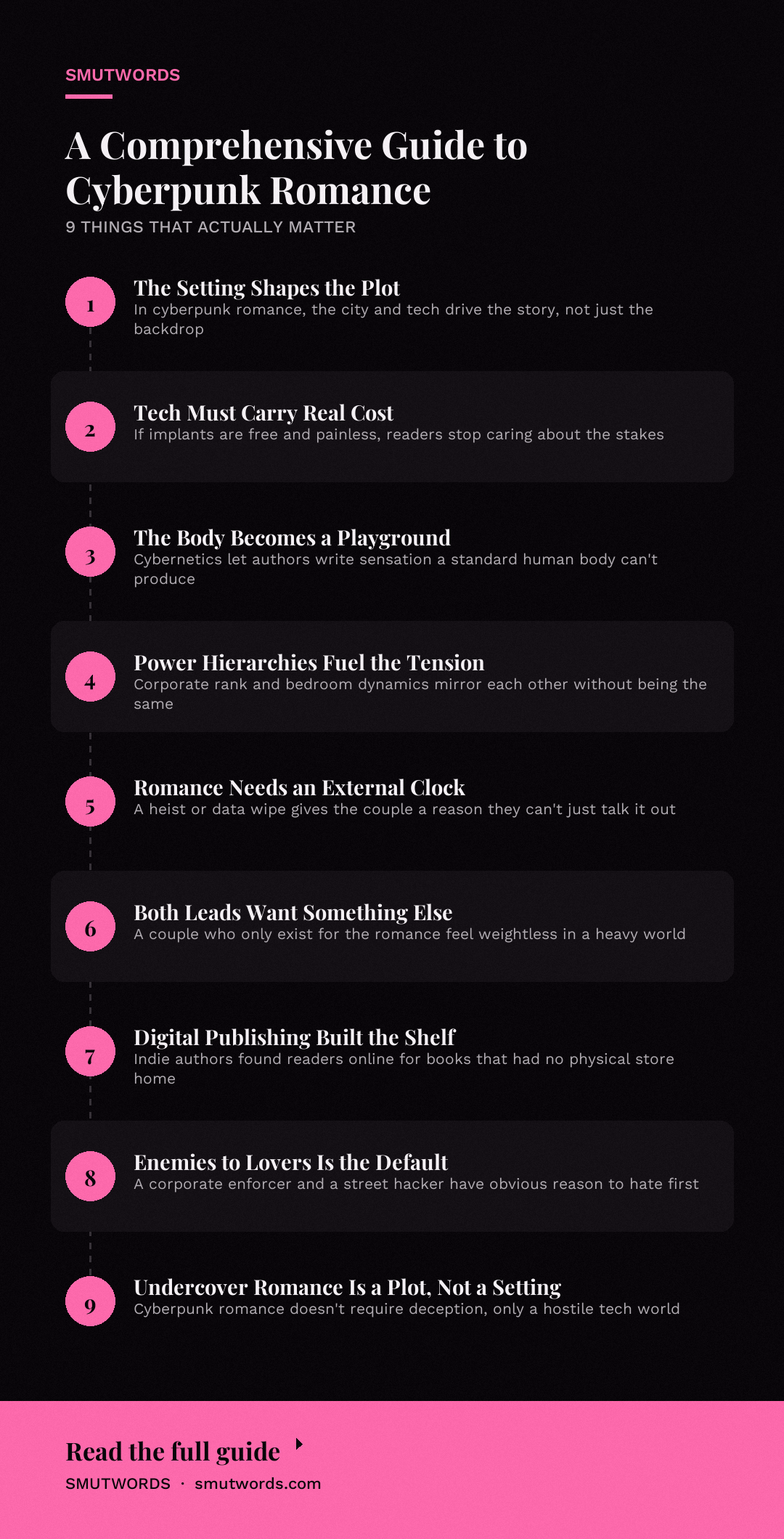
Cyberpunk romance as a recognizable shelf category is largely a 2010s and 2020s phenomenon, and digital-first publishing drove it. Indie authors could publish genre-blended books fast, price them cheaply, and find readers through algorithmic recommendation instead of shelf space. A book that was half hacker thriller and half slow-burn love story had nowhere to sit in a physical store and a perfect home online.
The aesthetic shifted along the way. Early cyberpunk borrowed heavily from noir: rain, trench coats, one weary man against the tower. Romance rewrote that. The city stayed neon and hostile, but the protagonist gained a partner, sometimes a co-conspirator, and the plot gained an ending that wasn't just defeat with style.
Recent entries lean harder into intimacy under surveillance: two people who can only touch in a room with the cameras off, or who fall for each other across a network while their real bodies sit in different corporate dormitories.
The genre has also absorbed more romance structure over time. Enemies to lovers is now close to a default engine, since a corporate enforcer and a street hacker have an obvious reason to hate each other before they have a reason to undress.
How It Shows Up in Erotica
In erotica and spicy romance, the setting is a sex scene generator that most other subgenres can't match, and the good authors know exactly which levers to pull.
Start with the body. Cybernetic enhancement gives a writer total control over sensation. A character can have a nervous system tuned for combat, an interface port that turns touch into data, a synthetic spine that shouldn't be able to feel anything and does. Authors use this to write pleasure that a standard human body can't produce, which is one of the reasons the subgenre draws readers who want something physically unfamiliar.
Then there's the power layer. Cyberpunk runs on hierarchy: executive and runner, owner and owned, licensed citizen and unperson.
That maps onto erotic power exchange almost too easily, and a lot of these books run a dominance dynamic where the corporate structure and the bedroom structure mirror each other without ever being the same thing. If you want the vocabulary for that overlap, our breakdown of BDSM and its four letters covers the consent and negotiation framework that the strong versions of these scenes build on.
Watch the physical detail, too. A leather catsuit, a wired harness, a collar that reads biometrics: genre costume does real erotic work, and it's worth understanding how much mileage those garments carry. Our guide to the leather catsuit fetish explains why the outfit reads as armor and invitation at once, which is exactly the register cyberpunk scenes want.
The variants authors actually write
- Cyborg romance: one or both leads are partly synthetic, and the love story turns on whether a modified body can still be claimed, wanted, or trusted.
- Hacker romance: the couple meets across a network, in code, or inside a job that requires them to break into the same system from opposite sides.
- Virtual reality romance: the relationship starts or lives in a full-dive environment where bodies are optional and identity is negotiable.
- Post-apocalyptic romance: the tech is scavenged rather than sleek, and survival pressures replace corporate ones.
- Corporate enemies to lovers: the most commercially dominant variant right now, often with a security chief and a runner circling each other.
- AI or synthetic partner romance: the love interest is a program, an android, or something that insists it has a self, and the plot has to decide whether that's true.
What makes one work
The strong versions keep three things tight. First, the tech has a cost. If the implants are free and painless, the reader stops caring. The best books make enhancement expensive, addictive, monitored, or permanent, so every upgrade is also a loss.
Second, the romance has an external clock. A heist that starts in twelve hours, a data wipe scheduled for morning, a corporation closing in on the safe house. Genre romance needs a reason the couple can't just talk it out over a long weekend, and cyberpunk supplies that reason for free.
Third, both leads want something in the world besides each other. A runner with a cause, a corpo defector with a debt, a medic trying to keep her clinic open. A couple who only exist for the romance feel weightless in a setting this heavy.
Enjoyed this? Get a free book.
Join the list and we will send a complete free story straight to your inbox, plus new releases every week after that. No credit card, no catch.
What makes one flat
Flat cyberpunk romance usually fails in one of two directions. Either the worldbuilding is a mood board, all rain and neon with no actual rules, or the romance is a checklist of tropes with no reason behind the attraction. Neither survives contact with a reader who's read fifty of these.
There's also a specific trap in the sex scenes: treating the tech as a novelty button. If every intimate moment is a demonstration of a gadget, the emotional thread goes slack. The gadget should be doing something to the relationship, not to the reader's novelty budget.
One more craft note. Because these books often run a power-imbalance dynamic, the negotiation has to be visible on the page, especially when one character has legal authority over the other. Collars, restraints, and control games read as hot when the terms are clear and as uncomfortable when they aren't. Our guide to collar and leash play is useful here, because the mechanics of negotiated submission translate directly into a setting where literal leashes exist as hardware.
Structure the subgenre tends to follow
Most cyberpunk romance runs a recognizable shape. The couple meets through a job, a crime, or a shared enemy. They're forced into proximity by external pressure rather than by choice. The relationship escalates physically before it escalates emotionally, because the setting rewards acting fast and punishes confessing.
Then the midpoint betrayal or reveal: one of them has been working for the corporation, or is a plant, or has a directive they can't override. The third act is usually an escape, a heist, or a public act of sabotage, and it doubles as the romantic climax. The couple doesn't fix the world. They carve out a small piece of it where they get to keep each other.
Cyberpunk Romance vs Undercover Romance
Readers search these two together a lot, and the overlap is real but not total. Undercover romance is defined by a character operating under a false identity inside a dangerous institution: a cop in a crime family, an agent in a cult, an infiltrator in a rival firm. The tension comes from deception and the threat of exposure.
Cyberpunk romance can absolutely be undercover romance. A corporate spy embedded in a hacker collective is both. But cyberpunk romance doesn't require deception. Two mercenaries doing a clean job with no cover story can carry a cyberpunk romance with no undercover element at all.
The cleaner distinction: undercover romance is a plot structure, cyberpunk romance is a setting plus a thematic argument. One tells you how the couple lies to each other. The other tells you what the world does to bodies and what love costs inside it.
Where the related tropes plug in
Because these books run on opposition, the enemies to lovers engine shows up constantly, sometimes doing the heavy lifting of the entire first act. The runner and the security chief who've been sabotaging each other for months make the transition to allies feel earned in a way that insta-love never does.
Some authors push that further into full hate to love territory, where the hostility is personal rather than professional and the resolution requires an actual reckoning, not just a shared gunfight. That version is harder to write and, when it lands, far more satisfying.
Other tropes bolt on without much friction. A secret baby plot works when the tech supports it, say a pregnancy hidden inside a corporate database or a child raised in an unregistered district.
A marriage in trouble arc fits perfectly for a long-married pair of operatives whose diverging loyalties have started to crack the partnership. And the blind date romance structure has a natural cyberpunk version: two people matched by an algorithm that knows more about them than they know about each other, meeting for the first time with their faces filtered.
One trope to handle carefully is the stalker romance. In a world of total surveillance, obsessive attention is easy to justify and easy to make genuinely disturbing. The good versions are clear about where the danger sits and don't blur the line between a hot possessive dynamic and a horror story by accident.
Frequently Asked Questions
What is cyberpunk romance in simple terms?
It's a love story set in a high-tech, decaying future, usually a neon megacity run by corporations. The couple's romance develops inside that world, and the technology, surveillance, and inequality all shape how they meet, what they risk, and what they can keep.
Is cyberpunk romance the same as sci-fi romance?
No. Science fiction romance is the umbrella term for any romance with speculative science elements, including space opera, time travel, and alien romance. Cyberpunk romance is a specific slice of it, defined by the urban dystopia, the corporate power, and the body-modification tech.
Does cyberpunk romance always have a happy ending?
If it's shelved as romance, yes, or at least a hopeful-for-now ending. The couple ends up together, often at real cost. Books that end in tragedy usually get labeled as cyberpunk fiction with a romantic plot rather than cyberpunk romance.
Why do readers like the contrast between cold tech and intense emotion?
The setting dehumanizes by default, so any genuine intimacy inside it reads as an act of defiance. That gives even a simple sex scene a political charge, and it makes the couple's private world feel like the only warm room in a frozen city.
Can cyberpunk romance include BDSM dynamics?
Often, yes. The genre's built-in power hierarchies, ownership language, and body-control themes make it a natural fit, and many authors run explicit negotiated dynamics. What matters is that the consent and the terms stay legible to the reader.
Are cyborg romance and cyberpunk romance the same thing?
Cyborg romance is a subset, focused on relationships where one or both leads are partly mechanical. Cyberpunk romance is broader and includes hacker plots, virtual reality stories, and corporate thrillers where nobody has visible implants at all.
How much worldbuilding does a cyberpunk romance need?
Enough that the rules stay consistent and the tech has real costs. You don't need a political history of the megacity, but you do need to know who owns the streets, what an upgrade costs, and what happens to people who can't pay.
Final Thoughts
Cyberpunk romance works because it takes the two things romance readers want most, genuine intimacy and real stakes, and wires them into a world that's hostile to both. The neon is fun, but the reason the subgenre has legs is simpler: it's hard to write a boring love scene when the room is bugged and the clock is running.
If you're ready to start reading, the ranked list of cyberpunk romance books below is the best place to begin. Pick one where the couple has a job to finish and something to lose, and you'll see the whole appeal inside fifty pages.







Loading comments…