
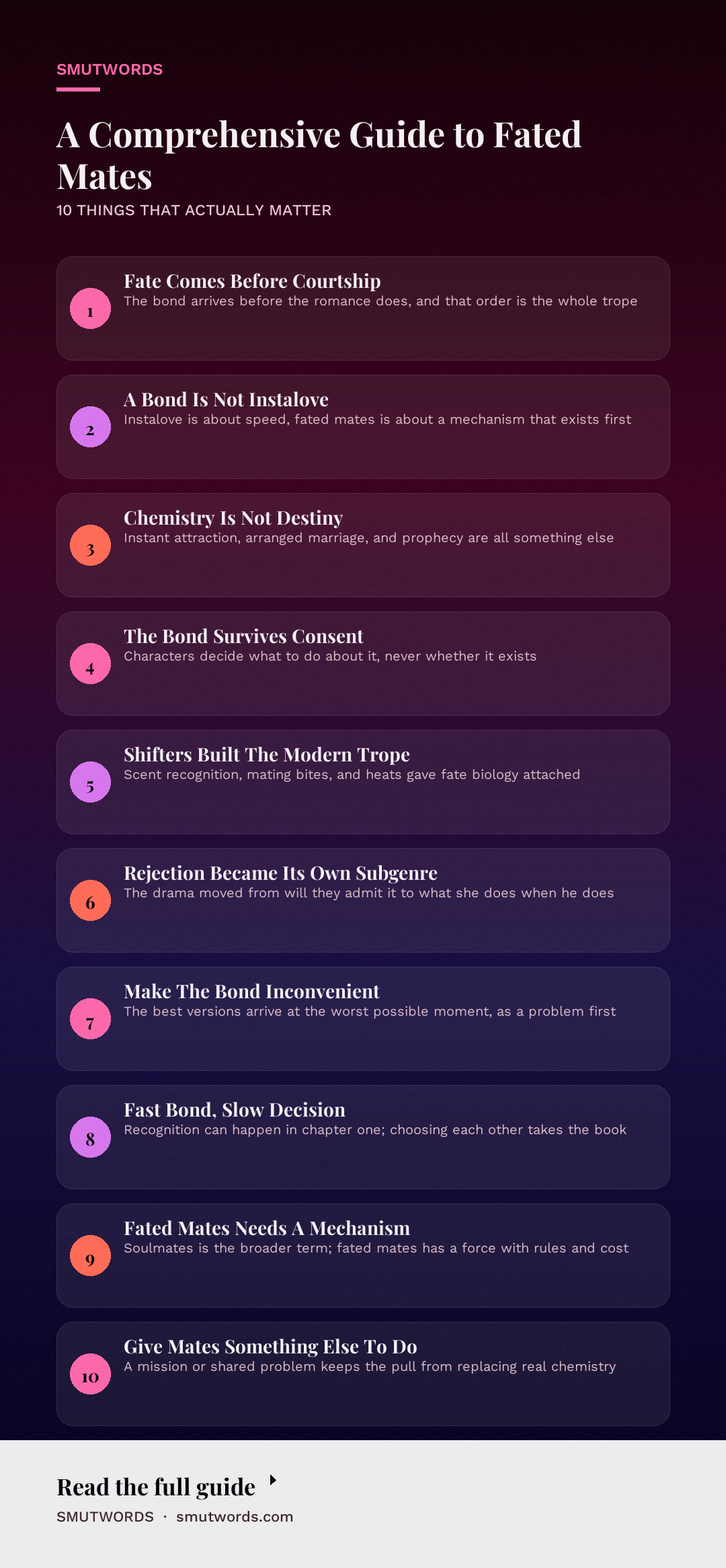
Fated mates is the romance trope where the universe, biology, magic, or some combination of the three has already decided two people belong together, and the story is about them catching up to that decision. The bond arrives before the courtship does. A wolf shifter scents his mate across a crowded bar and his knees nearly buckle. A vampire recognizes a heartbeat and knows, instantly, that he will never feed from anyone else.
Fated mates is one of the most reliably consumed engines in paranormal and fantasy romance. Readers who love it tend to love it hard, in long series, at volume.
What Fated Mates Actually Means
The term carries two ideas at once. "Mates" implies a pairing with weight behind it, something closer to a biological or spiritual fact than a preference. "Fated" adds the cosmic authorship: somebody or something wrote this down before either character got a vote.
That combination is what separates a fated mates story from a story where two people simply fall in love fast. Instalove is a pacing choice. Fated mates is a metaphysical claim. The characters usually feel the difference themselves, and so does the reader.
Several things commonly get mistaken for fated mates but do not qualify on their own:
- Instant attraction. Chemistry is not destiny. Two characters can want each other on sight with no bond, no mark, no pull, and that is just a strong meet-cute.
- Arranged marriage or political matchmaking. A contract binds people together. Fate is not a notary. Related but distinct, and the difference matters in Prince/Princess Romance, where the obligation is social rather than cosmic.
- One character deciding the other is "the one." Obsession dressed as destiny is its own thing, covered under Stalker Romance. If only one party feels the pull and the other is genuinely free, the bond is one-sided.
- A prophecy. Prophecies say what will happen. Mates bonds say who you are. Plenty of books have both, but a prophecy alone is not the trope.
What does count: a recurring, usually mutual, often involuntary recognition. It can be chemical (pheromones, scent, a heat cycle), magical (a mating mark, a soulmark, a binding ritual), or narrative (the narrator simply tells you these two are meant).
The defining feature is not how the bond works. It is that the bond precedes consent and survives it. The characters get to decide what to do about it. They do not get to decide whether it exists.
Language drifts by subgenre. "Bonded mates" usually implies the bond can be formalized or completed. "Soulmarks" points to visible marks that pair up. "Chosen ones" leans toward prophecy and destiny outside the body, while "predestined pairing" is the general-purpose term.
"Soulmate trope" is the mainstream-literary cousin, softer and often without the biological teeth.
Where Fated Mates Comes From
The idea of destined lovers runs through myth and folklore for as long as people have been writing anything down, from Plato's story of split souls to the twin flames of Sufi poetry. That background is real and worth knowing, but the fated mates trope as readers mean it now is a publishing phenomenon with a much shorter, sharper history.
Its modern form grew out of paranormal romance in the 1990s and 2000s, when vampire and shifter series started treating the bond as a plot engine instead of a symbol. Earlier gothic romance used destiny as atmosphere: a brooding hero, a mysterious pull, an air of doom. The newer wave made the bond structural. It came with rules, a timeline, consequences for refusing it.
Wolf shifters did most of the heavy lifting in that period. Scent recognition, pack hierarchy, mating bites, and heats gave authors a ready-made framework where fate was not abstract; it had biology attached. The wolf shifter romance boom made the trope recognizable to readers who would not have described themselves as fantasy fans at all.
Three shifts changed how the trope reads over the last twenty years:
- From rejection to agency. Early books rarely let a character refuse the bond and mean it. Rejected-mates plots became their own subgenre, and the drama moved from "will they admit it" to "what does she do when he does."
- From one subgenre to many. Fated mates spread into alien romance, monster romance, reverse harem, dark romance, and even contemporary stories with no magic, where the "fate" is emotional rather than supernatural.
- From certainty to tension. As readers got tired of instant resolution, authors started building conflict into the bond itself: a mate who is dangerous, a mate on the other side of a war, a bond that arrived at the worst possible time.
The publishing side matters too. The trope is extremely series-friendly. Once the mechanism exists in a world, it can be reused for every couple in the backlist, and readers who finish one book are already primed for the next.
That is the actual reason the trope dominates so much shelf space in paranormal romance. Nothing else writes a nine-book series as efficiently.
How It Shows Up in Erotica
Craft-wise, a fated mates book is doing one specific job: it front-loads the certainty so the story can spend its pages on something else. Take away "do these two belong together" and you have to replace it with a better question. The books that work replace it with "what does belonging cost them."
You can usually hear the answer in the first recognition scene. What a strong version does that a flat one skips:
- It makes the bond inconvenient. The best fated mates stories arrive at the worst possible moment. He is on assignment. She already has a life. They are technically enemies. The bond is a problem before it is a gift.
- It gives the bond rules and limits. Distance sickness. A mark that burns. A mate who can be sensed but not found. Rules produce scenes. A vague cosmic pull produces vibes.
- It lets one of them resist for real. Not a token resistance that collapses in chapter two. Actual refusal, with reasons the reader respects.
- It uses biology as intimacy, not shortcut. The pheromones and the heat and the shared heartbeat should create specificity, not speed up the plot.
- It pays off the physical. Mating bites, claiming, first contact after prolonged separation. Erotica readers came for the body, and vague spiritual bonds waste that.
Common variations, and what each one does to the story:
- Instant recognition. Both parties feel it at once. Good for high-heat, low-conflict reads where the tension comes from outside.
- One-sided bond. He knows. She does not. Excellent for power imbalance, longing, and slow reveals. This is the engine behind a lot of dark romance.
- Rejected mates. One refuses, usually publicly. The rejection is a wound the rest of the book has to work through.
- Forced proximity via the bond. The pull drags them into the same space, sometimes literally. Pairs naturally with Parallel Universe Romance and portal plots, where the bond crosses worlds.
- Harem or multi-bond. One character has several mates. Popular in reverse harem and in Monster Breeding Romance, where the bond ties into reproduction and the story's heat comes from how many people are pulling at once.
- Broken or severed bond. The bond existed and was cut, or is failing. Emotional weight without the setup cost.
Authors who write the trope well do one thing consistently: they make the bond fast and the decision slow. The recognition can happen in the first chapter. The choice to actually be together can take the whole book, or the whole series.
Enjoyed this? Get a free book.
Join the list and we will send a complete free story straight to your inbox, plus new releases every week after that. No credit card, no catch.
There is also a consent question sitting underneath the trope, whether or not authors address it. A bond that removes choice is a loaded premise, and readers notice when it is handled lazily. Strong stories give the characters room to say yes in a way that matters, including under pressure.
Some authors handle this with negotiation and check-ins inside the bond, described in ways that read like safewords in fiction. Others lean into the lack of choice and let the reader read it as fantasy. Both approaches can work. Neither works when the author pretends the question is not there.
One more craft note: the mate bond is a narrator's friend and a pacing villain. Because the pull does so much work, it can substitute for the slow building of two people actually liking each other.
The fix is unglamorous. Give the mates something to do together that is not the bond. A mission, a problem, a household, a shared goal.
Fated Mates vs Soulmates
These get used interchangeably, and in marketing copy they often are. In practice they diverge along one line: whether the bond is enforced by something outside the couple.
Soulmates is the broader term. Two people fit, deeply and completely, and the story's job is to show how. It has no minimum requirement of magic, biology, or destiny. A soulmate romance can be entirely contemporary and realistic, with the "soul" part functioning as metaphor.
Fated mates requires the external force. There is a mechanism, and it has properties. It can be sensed, resisted, measured in some fictional way. It usually comes with a cost.
You can think of it as overlapping circles. All fated mates are soulmates by vibe. Not all soulmates are fated mates by structure.
If you are looking at a book and cannot tell which one it is, ask whether the two characters could plausibly walk away happy with other people. In a soulmate romance, maybe. In a fated mates book, the answer is written into the physics of the world, and usually the answer is no.
Frequently Asked Questions
What is the fated mates trope in romance?
It is a trope where two characters are paired by a force outside their control, usually a supernatural or biological bond, and both the characters and the reader know early on that these two belong together. The story's conflict comes from what stands in the way, not from whether the pairing is correct. It appears most often in paranormal, fantasy, alien, and monster romance.
Is fated mates the same as instalove?
No, though they overlap. Instalove is about speed: the characters fall fast. Fated mates is about mechanism: there is a bond that exists before feelings do.
A fated mates book can be slow burn, with the bond recognized immediately and acted on two hundred pages later. Instalove can happen with no destiny involved at all.
Why do readers like fated mates so much?
The trope removes the anxiety of not being chosen. It promises that the love is real and mutual and cannot be undone, which frees the reader to enjoy the tension of everything else. It also delivers intensity without a long trust-building arc, which is why it pairs so well with high-heat erotica.
Can fated mates work without magic or shifters?
Yes, though the "fate" gets subtler. Contemporary romances sometimes use intuition, dreams, near-miss timing, or an unexplained sense of recognition to stand in for the bond. The result reads more like magical realism than fantasy. It can work well, but the trope's sharpest versions usually keep some concrete mechanism for readers to grab onto.
What is a rejected mates story?
It is a fated mates variant where one character refuses the bond, often publicly, usually early. The rejection is treated as a serious injury, and the rest of the book deals with the aftermath. The variant exploded in popularity because it turns the trope's built-in certainty into a source of real pain instead of easy comfort.
How long has the fated mates trope existed?
The idea of destined lovers is ancient, but the trope as readers recognize it took shape in paranormal romance in the 1990s and 2000s alongside the shifter and vampire boom. Since then it has spread into alien romance, monster romance, dark romance, and reverse harem, and the rules have gotten more varied with each new subgenre.
Final Thoughts
Fated mates is a promise the genre makes to the reader: these two are going to end up together, and everything else is negotiable. What separates a memorable book from a forgettable one is how much the author is willing to make that promise cost. Bonds with rules, mates with reasons to resist, and recognition scenes that arrive at the worst possible moment are what push the trope past its own convenience.
New to the subgenre and want a clean entry point? The alien romance route is the most welcoming on-ramp, and this guide to where to start is the place to begin.





Loading comments…