
Temperature play is the use of heat and cold on the body during sex or a scene, and it's one of the most reliably vivid tools in the kink toolbox. A drip of warm wax on the stomach, an ice cube dragged along the inner thigh, a metal toy left in the freezer for twenty minutes: each one produces a sharp, immediate, unmistakable sensation that pulls every nerve ending to the surface.
In erotica, temperature play works as a contrast engine. It makes characters feel their own skin, sharpens anticipation, and gives an author a physical, nonverbal way to show who is in control and who is about to find out.
What Temperature Play Actually Means
The term covers any deliberate use of hot or cold sensation as part of erotic play. The heat source can be a candle made for the purpose, warmed massage oil, a heating pad, warm breath, or a toy designed to heat. The cold source can be ice, a chilled glass toy, refrigerated metal, a cold compress, or a splash of ice water.
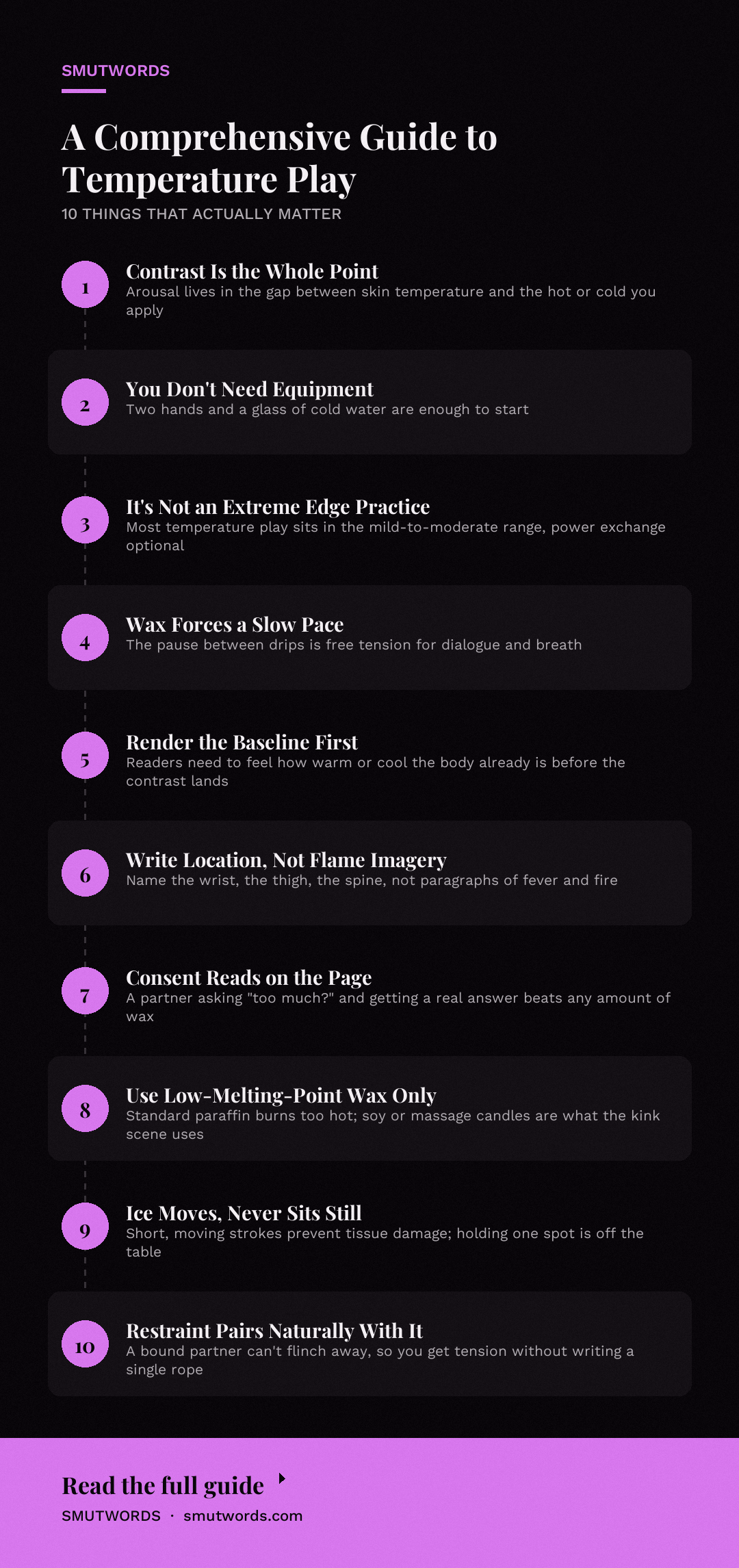
The point in every case is contrast: the body registers the difference between the heat or cold and its own skin temperature, and that gap is where the arousal lives.
What counts as temperature play is broad, but not infinite. A warm bath that happens to precede sex is atmosphere. A scene where someone deliberately places ice on a partner's throat and watches their reaction is temperature play, even if no other kink element is present. The intent and the deliberate application are what separate the practice from incidental warmth or cold.
The most common misconception is that temperature play requires equipment. It doesn't. Two hands and a glass of cold water are enough.
The second misconception is that it's an extreme edge practice. Most temperature play sits comfortably in the mild-to-moderate range, and plenty of vanilla couples do a version of it without calling it anything.
What Doesn't Count
Temperature play does not mean burning someone. Candle wax in the context of kink generally means low-melting-point wax applied from a height so it cools on the way down. It also doesn't mean hypothermia or frostbite; ice is used in short, moving strokes rather than held in one spot. Anything that produces real tissue damage has left the territory.
It also isn't automatically a power exchange. Temperature play can be dominant, submissive, or completely egalitarian.
Two partners taking turns with an ice cube is temperature play. A dominant methodically dripping wax down a restrained partner's spine is also temperature play. The sensation is the kink; the power dynamic is optional garnish that plenty of authors add.
Where Temperature Play Comes From
Hot and cold as erotic instruments predate modern publishing by a wide margin. Historical accounts of bathhouses, saunas, and communal bathing all describe warmth as a sensual medium, and cold water plunges after heat have been part of ritual practice in multiple cultures for centuries.
The specifically kinky version, where hot and cold are applied to the body deliberately to provoke arousal and submission, has a traceable modern history in mid-twentieth-century fetish writing and photography, where wax play and ice play appear as recognizable acts with their own visual language.
The candle wax scene in particular has a clear literary lineage. By the 1970s and 1980s, fetish magazines and early kink nonfiction were describing wax play as a beginner-friendly edge activity: low equipment cost, high visual drama, easy to photograph. That combination pushed it into the mainstream of kink representation faster than more equipment-heavy practices. Ice play followed a similar path, appearing as shorthand for sensory overload and heat-fever contrast in erotic fiction of the same era.
Online publishing changed the distribution. When erotic romance exploded as a digital category in the 2010s, temperature play became a common supporting act in BDSM-flavored contemporary romance: a scene in a dungeon, a wax drip on a bound partner, an ice cube followed by a warm mouth.
It also became a favorite device in paranormal romance, where the heat of a shifter or a vampire gives the author a literal biological excuse for temperature contrast. That's a genre shift worth noticing: in contemporary romance, temperature play is a choice a character makes; in paranormal romance, it's often built into what the character is.
How It Shows Up in Erotica
On the page, temperature play does three jobs at once. It provides immediate physical sensation, it creates a control dynamic because one partner applies and the other receives, and it regulates pacing. The slow drip of wax forces a scene to move at the speed of a candle, which is a gift to a writer who wants tension held in a single room for twenty pages.
The strongest temperature play scenes are written close to the body and specific about location. Not "he dripped wax on her" but "the first drop landed on the inside of her wrist, and the second landed an inch below it, and the third landed nowhere for a long moment."
Specificity is what makes the reader's own skin register the sensation. Vague heat language is the most common failure mode: paragraphs of flame and fever imagery without any actual geography of bodies.
Common Variations Authors Use
- Hot candle wax. The most represented variant in print. Authors typically specify low-temperature wax, a height the candle is held above the skin, and the pause between drops. The dominant's patience is the erotic content.
- Ice play. Usually used as a follow-up: cold after heat, tracing the path a hand or mouth just took. Ice is the more common choice for a first scene because it's easy to remove and it doesn't leave residue.
- Warmed massage oil. The gentle end of the spectrum. Oil warmed in the hands and pressed into the spine is temperature play at its most accessible, and it's frequently the entry point for characters who are new to the whole idea.
- Cold metal toys. Glass, steel, or chilled dildos. Authors love these because the object can be shown in the scene beforehand, sitting in a bowl of ice while the reader waits alongside the character.
- Warming gels. Chemical heat sold as a toy. In fiction these often appear as a surprise, with a character who didn't know the gel would warm up discovering it mid-scene.
- Sensory deprivation with temperature. Blindfolding one partner so that the only information arriving is whether the next touch will be hot or cold. This variant does the most work for tension because the character can't prepare.
- Contrast pairs. Cold then warm mouth, wax then ice, chilled glass then body heat. The pairing movement, back and forth, is where most published scenes live.
The Craft: What Makes It Work or Fall Flat
A strong temperature play scene makes the reader feel the contrast. That means the author has to render the baseline. The reader needs to feel how warm the character already is before the cold arrives, or how cool the room is before the wax lands. Contrast is a relative effect, and the writing has to establish both sides of it.
Competent authors also use temperature play as pacing. Wax is the slowest dramatic tool in the kit because it forces the scene to unfold one drop at a time. The pause between drips is free tension. The best writers lean into it, using that pause for dialogue, for breath, for the receiving character's internal monologue about what's coming next.
The anticipation is a legitimate ingredient, not filler.
A weak scene uses temperature play as a decorative flourish without consequences. The candle appears, the wax lands, and nothing changes about power, trust, or pacing. The scene reads like a checklist.
Enjoyed this? Get a free book.
Join the list and we will send a complete free story straight to your inbox, plus new releases every week after that. No credit card, no catch.
A strong scene lets the sensation push a character somewhere: to a confession, to a surrender, to a limit hit and respected. The heat is a tool that changes the emotional state of the room.
Consent reads on the page. The strongest scenes establish what the receiving character is willing to take and then honor it. A partner asking "too much?" and receiving a real answer before continuing is more erotic than any amount of dripping wax. If you want a useful primer on how that negotiation actually goes in practice, our piece on hard limits vs soft limits explains the sorting process well.
Temperature Play in Dynamic-Heavy Stories
Where temperature play really shines is in stories with strong power exchange. Wax makes the top's patience and attention visible: they have to control the height, the drip, and the pauses. The bottom's tolerance becomes a currency exchanged in real time. That dynamic-heavy framing puts it in company with other intense, consent-negotiated kinks like feral play and use kink, both of which ask the same question: how much can a character take, and who decides.
It also partners naturally with restraint. A bound partner can't flinch away from the ice, and the author gets the tension of restraint without writing a single rope. If rope is what you want, shibari is the practice to read up on, and it works beautifully alongside temperature play because both emphasize attention, stillness, and the body's surface.
The tool can also serve group dynamics. A scene in an orgy where different partners each bring a different sensation, ice from one, warm oil from another, creates a layered sensory environment that a solo scene can't. Authors who write group scenes often use temperature play to give each participant a distinct tactile signature.
What Readers Should Know Before Trying It
If you're reading a scene and wondering if you can replicate it, the practical guidelines are straightforward. Test temperature on a less sensitive area first: the inside of the wrist, the back of the hand, the upper arm. Keep a heat-safe mitt or cloth nearby so you can quickly remove any toy or extinguish any candle. Establish a safeword before the scene, and agree on what happens when it's used.
Candle wax deserves its own caution. Most paraffin candles burn too hot for skin. Low-melting-point soy or specialty massage candles are what the kink scene actually uses, and the height the candle is held above the skin matters as much as the wax.
If a book doesn't mention either detail, it's writing fantasy, not instruction. Ice should be moved and never held in one place long enough to cause tissue damage.
And a safeword handles the rest: it's the universal stop button that overrides every other signal.
Temperature Play vs Related Practices
Temperature play is sometimes confused with, or folded into, wider categories of intense sensation. The most useful distinction is against practices that look intense but work through a different mechanism.
Rough sex works through force, pressure, and impact. Temperature play works through heat transfer. A scene can contain both, and often does, but they're separate tools that need separate negotiation.
The other real point of comparison is intensity management. A wax drip and a hard spank both produce a sharp sensation, but the wax is time-delayed and surface-only, while the spank is instant and deep. Readers who love one often love the other, and writers who love writing one should learn to write both. The difference on the page is pacing: wax drips are slow, spanks are sharp.
Frequently Asked Questions
What is temperature play?
It's the deliberate use of hot and cold sensation on the body during sex or a scene, via candles, ice, warmed oil, chilled metal, or heating products. The goal is contrast, arousal, and a vivid physical experience for both partners. It can be gentle or intense and works with or without a power exchange.
Is temperature play safe?
It's safe when done with the right tools and attention. Use low-melting-point candles, not standard paraffin; test any temperature on a less sensitive area first; keep a cloth or mitt nearby to remove toys; move ice rather than holding it still. Agree on a safeword before you start and stop immediately when it's used.
What kind of candle is used for wax play in books?
Specialty massage candles or candles made from soy or other low-melting-point waxes, held above the skin so the wax cools before it lands. Standard household candles burn too hot and shouldn't be used on skin. Authors who know the subject usually specify the type of candle and the height it's held at.
Can temperature play be done alone?
Yes, though it's more limited. Ice, a warm shower, or a heated massage roller can all be used solo. The paired version is what dominates erotica because the tension comes from one partner applying and the other receiving, and from the negotiation between them about what comes next.
Why does temperature play show up so often in BDSM romance?
It's cheap to set up, deeply visual, and produces immediate physical reactions that are easy to write. It also gives authors a slow, dramatic pacing tool and a way to show a dominant partner's patience and care. Wax in particular reads unmistakably as a deliberate kink act, so it signals the genre fast.
What's the difference between temperature play and sensory deprivation?
Sensory deprivation is about removing input, usually with a blindfold, earplugs, or a hood. Temperature play is about adding intense, contrasting input. The two combine well: a blindfolded partner has no way to know whether the next touch is hot or cold, and that unpredictability is the point.
Final Thoughts
Temperature play is one of the few kinks that fits comfortably in a first scene and in a deeply established dynamic, which makes it unusually flexible for writers and readers alike. It rewards specificity, patience, and a genuine understanding of how contrast works on the body.
If you want to see it done with real craft, start with a scene that treats wax not as a prop but as a conversation between two people about how much the other can take. For a book that does exactly that, look toward the temperature play titles on SmutWords' ranked list; they're the ones worth your first read.








Loading comments…