
Wolf shifter romance is a subgenre of paranormal romance built around werewolves and other lupine shapeshifters: people who live as humans most of the time and turn into wolves when instinct, moonlight, danger, or a mate demands it. The transformation is the hook. The love story runs on something older and harder to argue with, usually a fated bond that snaps into place before either party has a chance to be sensible about it.
If you have ever finished a book at 3 a.m. muttering "okay but where is my alpha," you already know the appeal.
This guide covers where the subgenre came from, how it actually functions on the page, the variants you will run into, and what separates a wolf shifter romance worth rereading from one that collapses the moment the mating bite heals. It is the long answer. The glossary entry was the handshake.
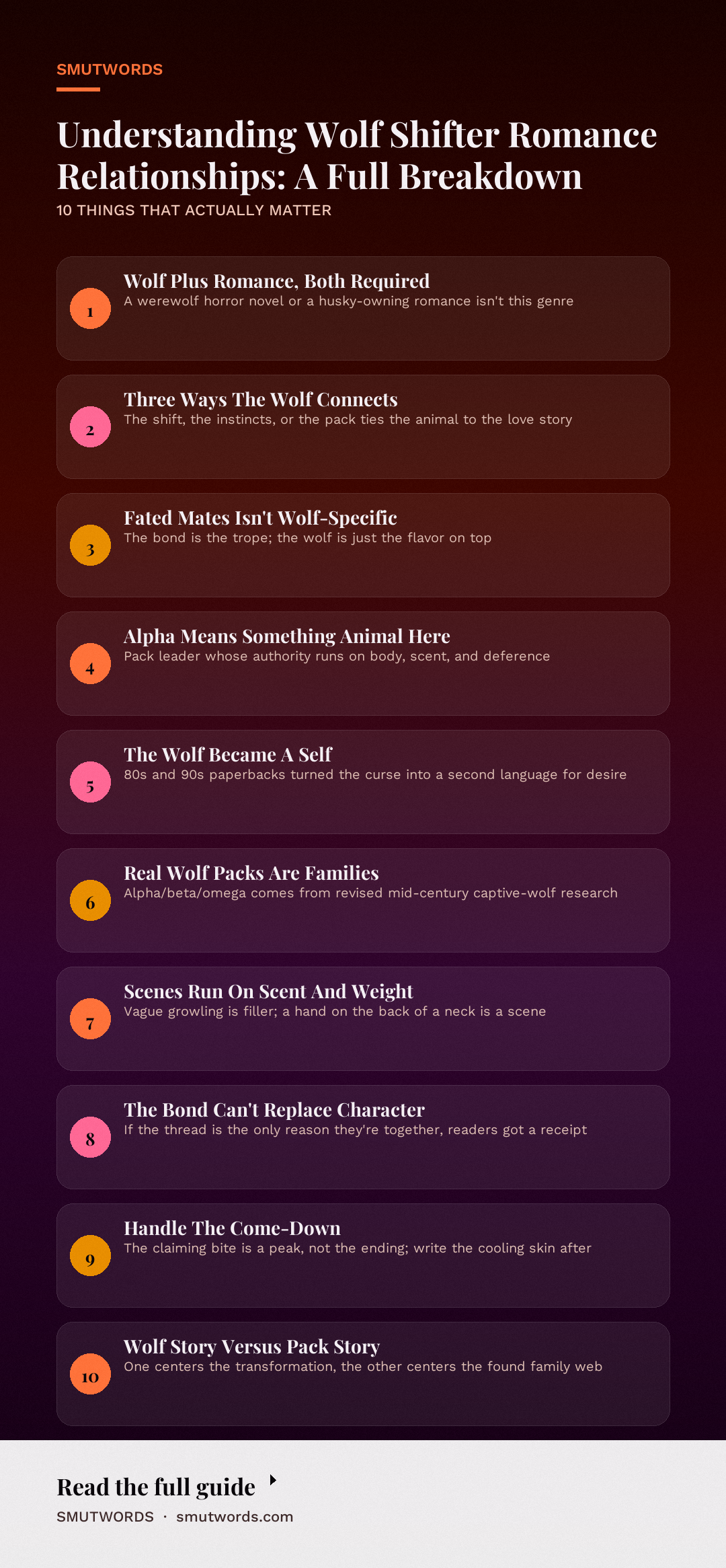
What Wolf Shifter Romance Actually Means
The name tells you the two load-bearing beams: a wolf, and a romance. Neither alone gets you there. A horror novel about a werewolf tearing through a village is not wolf shifter romance. A contemporary romance where the love interest happens to own a husky is not either, no matter how much the cover artist wants you to think so.
The genre requires a shapeshifter whose dual nature is structurally tied to the love story. That tie usually takes one of three forms. The shift itself can be the obstacle. The shifter's instincts can be the engine. Or the pack can be the world the couple has to survive, negotiate with, or escape.
Most strong books use all three.
What does not count is worth spelling out, because the category gets stretched past usefulness.
- Not every shapeshifter is a wolf shifter. Bear, big cat, dragon, and serpent shifters share shelf space but run on different instinct logic. A bear shifter hero is territorial in a slower, heavier way. A wolf shifter hero is pack-wired and dominance-wired, and the books behave accordingly.
- Not every fated mate story is a shifter story. Fated mates exist across fae romance, vampire romance, and straight-up fantasy. The bond is the trope. The wolf is the flavor.
- Not every alpha is a wolf. The word "alpha" has escaped containment into billionaire romance, mafia romance, and roughly every BookTok cover of the last four years. In this subgenre it means something specific and animal: a pack leader whose authority is enforced by body, scent, and the willingness of others to defer.
A common misconception is that wolf shifter romance is just monster romance with fur. It is closer to a courtship structure with teeth. The wolf is a device for making commitment feel biological, irreversible, and slightly terrifying, which is exactly what a lot of readers want from a love story and rarely get from a meet-cute.
Where Wolf Shifter Romance Comes From
The werewolf is one of the oldest monsters in the Western canon, but the version that powers this subgenre is much younger and much more specific. Two ancestors matter. The first is the gothic werewolf film tradition of the 1930s and 1940s, which established the tragic cursed man who cannot control his transformation.
The second is the 1980s and 1990s paranormal paperback boom, which started asking a question the gothic never bothered with: what if the wolf was not a curse but a self? Once the wolf became a self, the romance was inevitable. The transformation stopped being punishment and became a second language for desire, aggression, fidelity, and all the things a polite hero cannot say out loud.
The real turning point was the late 1990s and 2000s, when paranormal romance became a mass-market engine. Publishers realized that readers would buy pack series the way they bought family sagas, one brother at a time, and that a single fictional pack could sustain ten or fifteen books.
This is when the recognizable architecture appeared. The alpha with a dead father and a disputed claim. The pack territory with a border that means something.
The human woman who wanders in. The mating bond neither of them chose.
The 2010s pushed the subgenre toward self-publishing, and the effects are still visible. Once authors no longer needed a New York editor's approval, the rejected mate plot exploded, the omegaverse crossover happened, and serialized pack fiction got much, much filthier.
The 2020s added a further shift: readers started demanding the heroine's wolf get equal page time, and the "she was the alpha all along" arc went from novelty to expected move.
Worth naming plainly: the pack hierarchies most books use have almost nothing to do with real wolf biology. Actual wolf packs are family units, usually a breeding pair and their offspring. The "alpha/beta/omega" structure comes from mid-century captive-wolf research that has since been substantially revised.
Erotica kept the fantasy anyway, because the fantasy is the point. Nobody is reading this subgenre for wildlife accuracy, and the books that insist on it tend to be less fun than the ones that just build the mythology and commit.
How It Shows Up in Erotica
On the page, the subgenre has a recognizable physical grammar, and it is worth naming what a strong scene actually does. The best wolf shifter romance writing is sensory and specific. It tracks scent, temperature, weight, the sound of claws on a hardwood floor, the way a body runs hotter than it should.
Vague growling is filler. A hand closing on the back of a neck is a scene.
The tension almost always comes from a mismatch between animal certainty and human hesitation. The wolf knows. The person has a job, a lease, a dead sibling, a grudge, a reason to leave. Good authors let the wolf be right and let the human be right too, so the conflict has somewhere to go besides "he was mean and then he was sorry."
There is a real kinship with predator/prey play here. The chase, the stalking, the moment the larger body catches up, all of it maps onto consensual predator-prey dynamics that kink readers already know how to read. The subgenre just gives the predator a mating bond and a mortgage.
Enjoyed this? Get a free book.
Join the list and we will send a complete free story straight to your inbox, plus new releases every week after that. No credit card, no catch.
Here is what a solid scene typically loads in:
- A scent trigger. The first hit of the mate's smell, described with more precision than any other sense in the book. This is the subgenre's equivalent of a lightning bolt and it should hit like one.
- A territory note. Whose space are they standing in, and does it matter? This is where the territorial shifter trope does its work, and it does it best when the territory is small and specific, a cabin, a bar, a bedroom.
- A shift, or the threat of one. The body changing mid-argument mid-kiss is one of the most useful tools the subgenre has. It externalizes arousal into something you can see.
- A pack witness. Someone from the pack dynamics web reacts, and the reaction tells you the political cost of the bond.
Frequent variants, with notes on which ones earn their keep:
- Fated mates. The bond is predetermined and mutual. Works best when the obstacle is outside the coupling, because there is no will-they-won't-they left to play with.
- Rejected mate. One party refuses the bond, usually for pack-political or self-protective reasons. The strongest version of this variant treats the rejection as a genuine wound the other party has to grieve, not a misunderstanding to clear up in three pages.
- Alpha/omega. Borrowed from omegaverse and grafted onto lupine hierarchy, complete with heats, knots, and a biology that is frankly doing a lot of plot work. Flavorful, divisive, extremely popular.
- Enemies within the pack. Rival alphas, contested succession, a challenger who wants the territory and the mate both.
- Human/wolf pairings. The human partner has no instincts to fall back on, which makes them the best POV in the subgenre when the author is willing to use them as more than a tourist.
- Hybrid and cross-species pairings. Wolf meets something else, which usually means the hard-won pack rules stop applying and everybody has to improvise.
Where flat versions fail is almost always the same place: the bond gets used as a substitute for characterization. If the only reason these two are together is that a mystical thread says so, the reader has been handed a receipt instead of a relationship. The books that last give the couple a reason to like each other that has nothing to do with the bond, then let the bond make that liking unbearable.
The other common failure is forgetting the aftermath. A scene where the wolf takes over, claims, and bites is a peak, not an ending. Strong wolf shifter romance handles the come-down carefully, in the same spirit as good aftercare in romance fiction.
That means the cooling skin, the half-embarrassed silence, the negotiation of what just happened and what it means for tomorrow. Skip that and the scene reads like a set piece. Write it and the scene reads like a relationship.
Wolf Shifter Romance vs Pack Mates Romance
These two get conflated constantly, and the difference is worth pinning down if you are trying to figure out what you are in the mood for.
Wolf shifter romance is organized around the transformation and the animal self. The wolf is the subject. Pack matters, but the story is about what it means to be two things at once, and the love story is usually the crucible for that question.
Pack mates romance is organized around the group. The pack is the subject. Bonds form sideways as much as they form toward a single romantic partner, and the emotional payoff is distributed across a web of relationships rather than concentrated in one couple. Found family is the whole engine, not a subplot.
Plenty of books are both, and the good ones are honest about which one they are leading with. If you finish a book and your favorite part was the pack dinner scene, you want the second thing. If your favorite part was the moment he half-shifted in the doorway and she didn't back up, you want the first.
Frequently Asked Questions
What is wolf shifter romance, in one sentence?
A romance subgenre in which one or both leads are werewolves who shift between human and wolf forms, with the love story typically driven by fated-mate bonds, pack politics, and animal instinct that overrides ordinary courtship. The transformation is the premise. The relationship is the plot.
Do I have to read a series in order?
Usually yes, at least loosely, because packs are shared across books and the alpha of book one is often the brother of book four. Many series are written to be standalone-friendly, but you will get more out of the pack politics if you start where the author tells you to start.
Is fated mates the same thing as true mates?
Mostly, yes, with a wrinkle. "Fated mates" is the broad term for a bond neither party chose. "True mates" is usually a stronger claim inside the same mythology, meaning the one real match rather than a possible one, and many series use both terms with a deliberate hierarchy between them. There is a full breakdown of how the terms differ across books and how authors use the distinction structurally in this guide to true mates.
What is the difference between alpha/omega and regular shifter romance?
Alpha/omega borrows its vocabulary from omegaverse and adds biological designations that come with heats, knots, and instinct-driven cycles. Standard wolf shifter romance keeps the pack hierarchy but usually leaves the reproductive biology softer. The alpha/omega variant is more explicit about biological compulsion and more polarizing as a result.
Why do readers like possessive heroes so much in this subgenre?
Because the possessiveness arrives with a built-in justification. The bond explains the intensity, which lets readers enjoy a level of devotion and claim that would be alarming in a contemporary romance with no supernatural framing. Nobody has to be talked into it. The wolf already decided.
Are there wolf shifter romances with a female alpha?
Increasingly, yes, and it is one of the healthiest developments in the subgenre. Female alphas, female wolves paired with human men, and dual-alpha pairings all circulate widely now. If you want the power dynamic inverted or equalized, the catalog is no longer thin.
How does this compare to other monster and paranormal romance subgenres?
Wolf shifters sit closest to the human end of the spectrum. Compare a wolf shifter to something like kraken romance or a merman romance and the difference is legibility: the wolf passes as a person, holds a job, argues about the mortgage, and then shifts.
That near-human quality is what makes the animal parts land harder. Readers who want the love interest further from human should look at cryptid romance or the stranger end of the shelf, where a dinosaur romance is waiting to make the wolf look positively domestic.
Final Thoughts
Wolf shifter romance works because it takes the messiest part of falling for someone, the part where you would follow them across a state line without a coherent argument for why, and gives it a biological alibi. The bond is a permission slip. What the author does with that permission is the whole book.
If you are picking your first one, look for a series opener with a contested succession and a heroine who does not fold in the first fifty pages. Or start with a rejected mate book and see how it feels to watch someone be turned away by the one person the universe picked for them.
Either way, the best place to begin is wherever the pack is loudest and the alpha is least sure of himself. That is usually chapter one.






Loading comments…