
Most writers get safewords wrong in the same way. They treat the word like a fire alarm: something you install, mention once on page three, and then never touch again until a scene goes sideways and someone has to jerk the handle.
The scene stops. The mood dies. The reader is yanked out of the fantasy and handed a pamphlet.
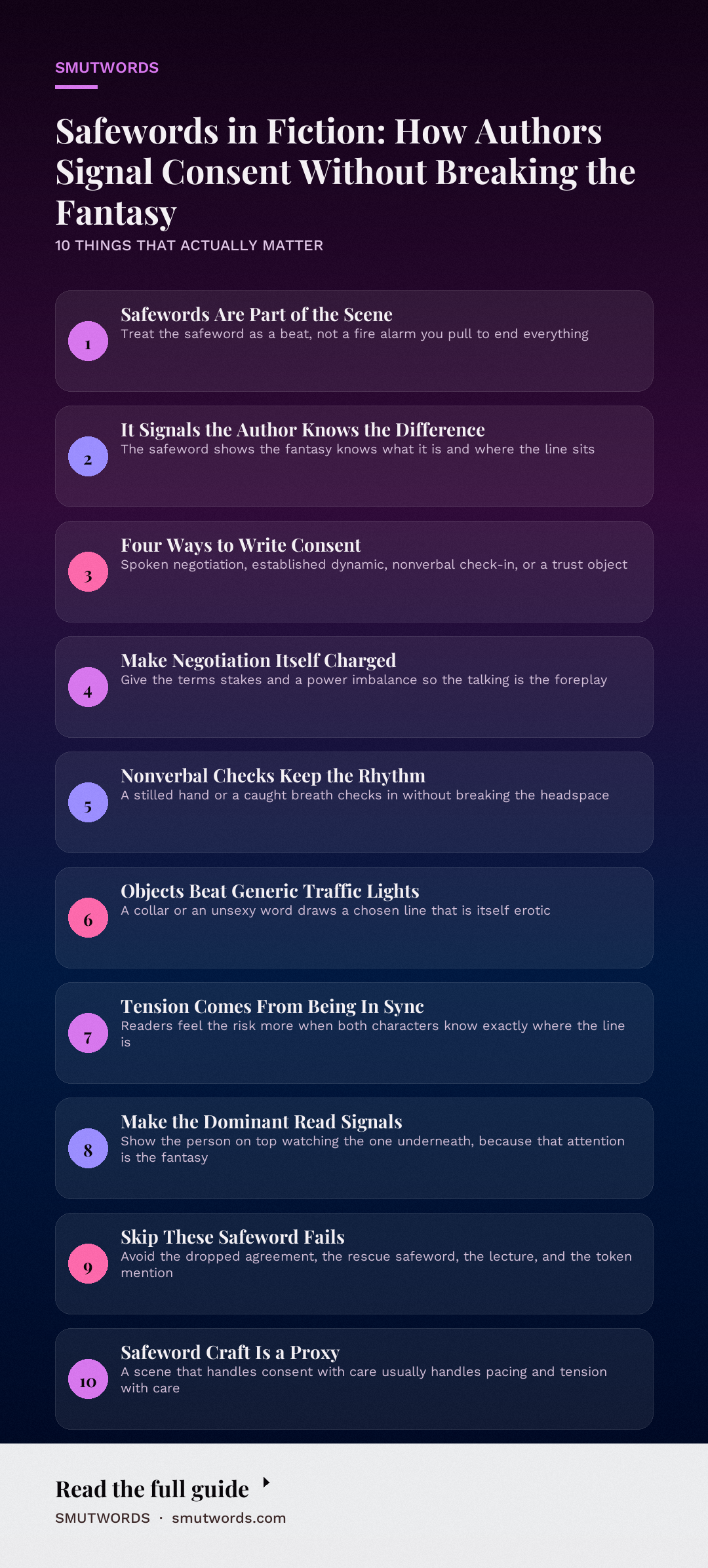
The authors who actually understand safewords in erotica fiction do it backwards. They treat the safeword as part of the scene, not a cord you pull to end it. It becomes a beat, a piece of texture, sometimes the kinkiest thing on the page.
That's the whole trick, and almost nobody talks about it because it sounds less exciting than "he tied her to the headboard." It isn't.
Why Safewords Matter More in Fiction Than in Real Life
In a real scene, a safeword is a tool. You agree on it, you use it if you need it, and ideally you never do. It's insurance.
In fiction, a safeword does something heavier. It tells the reader that the fantasy knows what it is, and that the author isn't confused about the difference between a fictional power exchange and an actual one.
Readers who play with heavy tropes, masochism, degradation, predator prey kink romance, noncon-adjacent fantasy, are doing something precise with their attention. They want the danger on the page and the safety underneath it.
A safeword is the structural hinge that lets both exist at once. Get it wrong and the scene reads as unsafe (unsexy, often upsetting) or as a paperwork exercise (also unsexy, just boring). Get it right and it disappears into the scene's logic so completely that the reader feels the control even when nobody's saying the word.
The Four Ways Good Authors Handle Consent on the Page
There's no single correct method. Different scenes need different machinery. Here's what actually works, ranked from most visible to most invisible.
- The spoken negotiation. Characters talk it through before anything happens. Explicit, clear, and easy to fumble if the dialogue sounds like an HR briefing.
- The established dynamic. The couple already has rules from a previous scene or a previous book. The reader learns the safeword by watching it get used or referenced, not explained.
- The nonverbal check-in. A pause, a look, a hand on the jaw, a question folded into dirty talk. The consent lives in the choreography, not the dialogue.
- The trust object. A collar, a key, a color, a specific word that isn't "stop." The object carries the meaning so nobody has to explain it.
Most strong scenes use two of these at once. The negotiation sets the rules, then the nonverbal check-in holds them up mid-scene without interrupting the rhythm.
The Spoken Negotiation, Done Right
The failure mode here is a scene where two characters sit on opposite ends of a couch and discuss limits like they're reviewing a rental agreement. It's technically careful and completely dead on arrival.
The fix is to make the negotiation itself charged. In He Paid Him to Fuck Me, the entire premise is a transaction, which means the negotiation is the foreplay. Money changes hands, terms get set, and the terms are the whole point.
Nobody's pretending this is a meet-cute. The arrangement is the kink.
That's how you make consent dialogue hot: give it stakes, give it a power imbalance, give it a reason to exist beyond ticking a box. Kink negotiation gets sexy when the negotiation is itself an act of dominance.
One character sets the terms and the other accepts them. That's a scene. It has a winner and a loser and tension running through it, and the reader is already turned on before anyone's clothes come off.
The Established Dynamic
Longer works have an advantage here. If the couple has history, the safeword can be part of their shared language without a single line of explanation.
She says a word. He stops. The reader clocks exactly what happened because the author trained them two chapters ago.
This is where series and serialized erotica pull ahead of standalone shorts. A dynamic like the one in Permission Slip: A Cuckold Erotic Short Story runs on an established agreement between two people.
The permission is the engine. The safeword is the brake. Neither works without the other, and the reader understands both because the story built the vocabulary first.
Nonverbal Consent Signals That Keep the Scene Moving
Here's where craft separates from checklist-writing. A spoken "are you okay?" mid-scene can work, but it's a hard reset. It changes the register. It pulls both characters, and the reader, out of the headspace and back into the room.
Nonverbal signals don't do that.
A hand that goes still against a hip. A breath that catches and gets acknowledged with a slower stroke. Eye contact held a beat too long on purpose. A question folded into dirty talk so smoothly the reader almost misses it was a check-in.
Predator/prey dynamics lean on this hardest, because the whole premise is that one person is being chased and the other is doing the chasing. The scene can't stop for a debrief. The check-in has to happen inside the chase.
Which means the author has to write a pause that still reads as movement, and that's a genuinely difficult thing to do well. When it works, it's the difference between a scene that feels dangerous and a scene that feels rehearsed.
Using a Color, a Word, or an Object
Traffic lights are the classic and they're fine if the story earns them. Green means go, yellow means slow down, red means stop. The problem is they're so widely known that they read as generic. If a scene uses colors, it should probably do something with them that a hundred other books haven't already done.
Objects are more interesting. A specific collar that gets fastened a specific way. A necklace. A particular word that isn't "stop" because "stop" is sometimes part of the scene and the characters need something that means the opposite.
Enjoyed this? Get a free book.
Join the list and we will send a complete free story straight to your inbox, plus new releases every week after that. No credit card, no catch.
A safeword that's deliberately unsexy, like a pet name or a mundane household object, does something clever: it's a hard line between fantasy and reality that both characters agreed to draw on purpose. That line is itself erotic. It means the people involved know exactly what they're doing and chose it anyway.
Nonverbal is where a lot of readers quietly nope out of a scene without being able to explain why. If the submissive character's check-ins are all verbal and formal, the scene reads like a session with a therapist. If they're all nonverbal and never once confirmed, the scene reads as unsafe.
The sweet spot is a nonverbal check that the dominant character actually responds to.
That's the version where the reader sees the power flowing both directions. The person on top is reading the person underneath. That's the fantasy. Not the rope. The attention.
Why Consent Signals Don't Kill the Tension (When They're Written Well)
This is the anxiety that keeps authors from writing safewords into scenes at all. Won't it flatten the danger? Won't the reader stop feeling the intensity the moment consent becomes explicit?
No, and here's why. The tension in a power-exchange scene doesn't come from whether the characters are safe. It comes from whether they're in sync. Two people in a scene where everything is unspoken and nothing is confirmed is a scene where the reader is watching two strangers gamble.
Two people in a scene where both know exactly where the line is and the dominant one is pushing right up to it on purpose: that's a different feeling. It's hotter because it's deliberate. The danger is chosen.
The person taking the risk knows exactly what they're risking, and the person holding them knows exactly what they're holding.
A safeword that never gets used is a promise. A safeword that almost gets used is a plot point. That second thing is where scenes get unforgettable, because now the reader knows the line is real and one character just tested it.
Where Consent Signals Get Handled Well in Specific Subgenres
Different tropes need different machinery, because the whole structure of the fantasy changes what consent has to do.
Shifter romance is the obvious test case. When one character has an animal side, the consent question gets reasked every time the animal comes close to the surface. A wolf shifter romance that ignores this reads as a human relationship with fur.
The good ones build the safeword into the bond itself, so that the human side and the animal side are both checking in. The tension is whether the animal side will listen to a signal that only exists in words.
In Lured by the Lizard Beast, the negotiation is baked into the species gap. Two beings from different worlds have to invent a shared language for "stop," and inventing it is part of the scene.
Exhibitionism has its own version. When the kink is being watched, the consent question expands to include whoever's watching.
Shared Without Shame: A Hotwife Exhibition & Sharing Fantasy runs on an agreement between partners about who gets access, and the safeword is what makes the sharing feel chosen instead of done to someone.
The couple negotiated the terms. The reader watches them keep those terms under pressure.
And some premises need consent handled almost entirely through structure, because the scenario is deliberately designed to remove the option to say no. Free Use Casino is a setup where the agreement happens before the story starts.
The reader knows going in that the characters opted in. The scene never has to stop and ask, because the asking already happened, and everything that follows is the consequence of that one decision. That's a legitimate craft move. It only works if the author makes the original agreement clear enough that the reader can feel it operating in the background the entire time.
Genuinely darker kinks need the same treatment, scaled up. Humiliation kink runs on words that would be cruel outside an agreement. Inside one, they're a gift. The safeword is what turns an insult into a scene instead of an injury, and the good writers never let the reader forget which one they're watching.
Safeword Fails: What to Avoid
A few patterns reliably ruin a scene, and they're worth naming.
- The agreement that never comes back. The author front-loads a negotiation scene on page two, then writes 40 pages of a scene that never references it. The reader forgets the rules were ever set.
- The safeword that saves the day. Someone uses it in the third act as a rescue, which turns it into a plot device instead of an ongoing agreement. It should have been present throughout, not sprung.
- The lecture. The author steps out of the scene to explain why safewords matter, usually in a paragraph that could have been lifted from a brochure. The reader feels the seams.
- The token safeword. It gets mentioned once, never used, never referenced again. It's a decoration, and readers can tell.
- The unspoken everything. No negotiation, no check-in, no signal, just two characters going at it with no visible communication. This doesn't read as edgy. It reads as the author not having thought about the question.
None of these are about being prudish. They're craft failures. The safeword wasn't woven in, it was stapled on.
How to Write a Safeword Scene That Actually Works
If you're writing one, the sequence matters less than the integration. Introduce the terms as part of the dynamic, not a preamble. Let the safeword show up at least once before it needs to matter, so it's already loaded when the scene gets intense.
Make sure the dominant character visibly watches for signals, because the reader needs to know someone's paying attention. And let the safeword shape the ending of the scene, whether it gets used or not.
For readers, this is the thing to look for when you're deciding which books actually know what they're doing. A scene that handles consent with some care is almost always a scene written by someone who also handles pacing, character, and tension with care. The safeword is a proxy for the whole craft.
Final Thoughts
If you want to see a negotiation carry the entire erotic charge of a scene, read He Paid Him to Fuck Me. The terms are set, the terms are the point, and the tension never drops because the consent was never treated as an interruption. It's the cleanest example of the principle running through this whole post: the rules aren't the opposite of the fantasy. They're the floor the fantasy stands on.







Loading comments…