
Forced orgasm is a kink in which one partner controls another's climax completely: when it happens, how many times, and whether it's allowed to stop. It sits at the far end of the power exchange spectrum, past teasing and denial, where the dominant partner keeps going through sensitivity, resistance, and sometimes tears until the submissive is spent.
In erotica it's one of the most reliable engines for a scene, because the stakes are physical, immediate, and impossible to fake. Everything a reader wants from a control dynamic, compressed into one escalating arc.
This guide covers what the term actually means, where it came from as a genre trope, how authors write it well versus badly, and the practical realities of the practice itself. It's the most complete piece we've written on the subject, and it's aimed at readers who want the real answer rather than a teaser.
What Forced Orgasm Actually Means
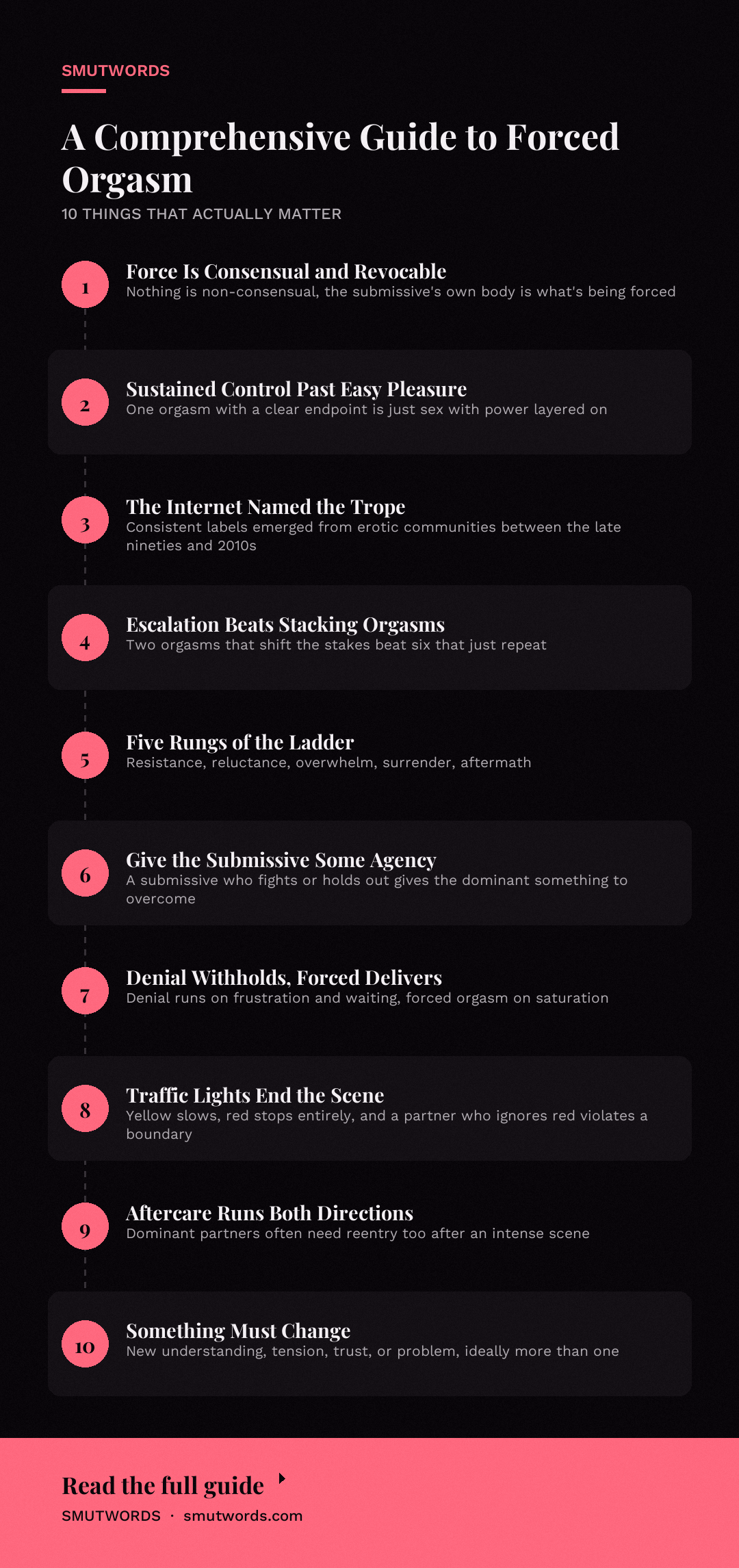
The word "forced" is doing a lot of work here, and it's worth being precise about what it does and doesn't describe. In a real scene between consenting partners, nothing is forced in the sense of non-consensual. The force is consensual, negotiated, and revocable. What's being forced is the submissive's own body, made to respond on someone else's schedule rather than their own.
That's the entire appeal. The submissive's body is doing something they can't control, and the dominant partner is the reason. Control over orgasm is one of the most intimate levers in the whole kink vocabulary because it overrides conscious will.
Orgasm control is the umbrella term, and forced orgasm is one specific expression of it. Under that umbrella you'll also find keyholding, where a dominant partner holds the literal or figurative key to a submissive's release, sometimes for days or weeks. The relationship between the two is structural: keyholding is the withholding, forced orgasm is the delivering, and both rely on the same transfer of authority.
What counts and what doesn't
A scene where a dominant partner brings a submissive to orgasm once, with enthusiastic participation and a clear end point, is just sex with a power dynamic layered on top. That's fine. It isn't forced orgasm. The distinguishing feature is sustained control past the point of easy pleasure.
What typically qualifies:
- Multiple orgasms in sequence, with the submissive given no recovery time and no say in the pacing.
- Continuing after the submissive asks to stop, where the asking is part of the scene's texture rather than a genuine withdrawal of consent.
- Overstimulation play, where sensitivity becomes a form of intensity in itself, and the body keeps responding past the point the mind wants it to.
- Orgasm torture, the more extreme end, where the continued stimulation becomes genuinely difficult and the dominant partner's authority is the only thing keeping the scene going.
- Orgasm training, a longer arc where a submissive is conditioned to climax on command, or to a specific trigger, over many sessions.
What doesn't count: a single orgasm the submissive was fully in charge of. A scene with no ongoing communication. Anything happening to someone who hasn't agreed to it. That last point matters, and we'll come back to it.
The common misreadings
The most frequent mistake readers make is assuming "forced" means the submissive never consented. In erotica the term is used almost exclusively for consensual power exchange, where the force is theatrical. The confusion is understandable because the language overlaps with non-consent stories, but they're separate categories with separate audiences and separate handling.
The second misreading is that forced orgasm is just rough sex with a fancy name. Rough sex is about physical intensity, and forced orgasm is about controlled release. A scene can be rough without any forced orgasm and can feature forced orgasm without any roughness.
The mechanics are different, and so is the reader payoff. If you want the physical-intensity version of the framework, our rough sex entry breaks it down properly.
A third misreading: that it's always a punishment or a degradation scene. It can be, and some of the best versions are, but it also shows up as devotion, as worship, as a way for a dominant partner to demonstrate how completely they know a submissive's body. The tone is a dial an author sets. It's not a fixed property.
Where Forced Orgasm Comes From
The history here is more a publishing history than a practice history. Orgasm control as a practice is old, appearing in letters, diaries, and manuals going back centuries. As a named trope in erotic fiction, it's much newer and much more traceable.
In the mid-twentieth century, explicit erotica moved through a small number of underground channels. Orgasm control appears in that material, but rarely under a consistent name. The language was diffuse. Different writers described the same dynamic using different words, which makes the early history of the term difficult to pin down and, honestly, less interesting than what happened later.
The real shift came with the internet. Between the late nineties and the early 2010s, a handful of erotic communities settled on consistent terminology. Forced orgasm, orgasm torture, and orgasm denial all emerged as distinct labels during that period. Once readers could search for a specific kink, writers started naming it explicitly.
The next shift was structural. When self-publishing turned romance into a mass-market industry in the 2010s, forced orgasm migrated out of pure kink writing and into mainstream dark romance. It stopped being a niche label and became a plot beat. That migration changed the trope's typical length, tone, and function.
Three things happened to the trope during that move:
- It got longer. A kink scene might run a few thousand words. A dark romance can build toward a forced orgasm scene across fifteen chapters of tension and pay it off in eight pages.
- It got more psychological. The focus shifted from the mechanics of the stimulation to what the scene means for the relationship, especially for a dominant partner who needs the exchange as much as the submissive does.
- It got more negotiated on the page. Contemporary romance and dark romance both now routinely show the conversation before the scene. That's a change in reader expectations as much as in author preference. Ten years ago, showing the negotiation would have broken the fantasy for many readers. Now a lot of readers find the negotiation hot on its own.
The trope has also spread sideways into subgenres where you wouldn't expect it. Possessive monster romance uses it heavily, since a creature with overwhelming physical capacity naturally fits a scene about a partner who can't tap out. For a deeper look at how that dynamic plays out, our guide to the possessive monster trope covers the overlap.
How It Shows Up in Erotica
Here's the craft problem. Forced orgasm scenes are easy to start and hard to finish. The setup writes itself. The payoff depends entirely on whether the author understands escalation, and many don't.
The scenes that fail share a shape. Two pages of penetration, one orgasm, second orgasm, third orgasm, end. The physical content is correct and the scene is dead on arrival.
Nothing changes. The submissive's state at line one is identical to their state at the final line, just with more sweat.
The scenes that work escalate something other than the stimulus. The number of orgasms can stay constant and the scene still works, provided the psychological distance between the two characters shifts.
The escalation ladder
The strongest versions of this trope climb a consistent set of rungs. Each rung changes the relationship, not just the intensity.
- Resistance. The submissive holds out, treats the control as a challenge, keeps some dignity. The dominant partner has to actually earn the next orgasm.
- Reluctance. The resistance fails. The submissive's body responds before the mind agrees. Something in them has been overridden, and both characters notice.
- Overwhelm. Pleasure stops being pleasurable and becomes something closer to a physical fact the submissive has to endure. This is where overstimulation usually enters the scene.
- Surrender. The submissive stops fighting the response and lets the dominant partner have it. Submission to their own body rather than to a stated limit.
- Aftermath. The most underrated rung. Whatever the dominant partner does after the scene ends tells the reader what the scene meant to them.
You don't need all five, and you don't need them in that order. Two or three rungs, done honestly, beat all five done as a checklist.
Common structural variations
Within that ladder, a handful of recurring shapes show up across the genre.
The punishment shape. Forced orgasm as a disciplinary act. The dominant partner sets the scene up as a consequence for something, and the humiliation is part of the point.
This variant tends to sit inside a degradation kink frame, where the submissive's response to the punishment is the actual thing being punished. Very common in dark romance and in any story with a strong D/s structure.
Enjoyed this? Get a free book.
Join the list and we will send a complete free story straight to your inbox, plus new releases every week after that. No credit card, no catch.
The devotion shape. The opposite treatment. The dominant partner uses the scene to demonstrate total knowledge of the submissive's body, bringing them to completion repeatedly as an act of care.
The reader payoff is the competence. This version often pairs with love scenes rather than punishment scenes and tends to be gentler in tone even when the mechanics are identical.
The proving shape. Forced orgasm as a test. The submissive has something to prove, to the dominant partner or to themselves, and the scene is the proving ground. This is the most common shape in series fiction, because it can be paid off across multiple books.
The humiliating shape. The scene happens in front of someone, or under conditions the submissive finds embarrassing. This overlaps heavily with voyeurism, since the audience is often as important as the act. Our guide to exhibitionism in erotica breaks down the audience dynamic in more detail if that version of the kink is what you're chasing.
What makes a strong version work
The consistent factor across the scenes that land is that the submissive isn't a passive object. The best writing gives them some agency in the resistance, even when they ultimately lose. A submissive who fights, bargains, or holds out longer than expected gives the dominant partner something to overcome, and readers feel the victory.
The second factor is the dominant partner's interiority. A scene written entirely from outside the dominant partner reads as mechanical. When the reader gets even a paragraph of what the control means to them, the whole dynamic deepens.
The third factor is consequence. Something has to be different after the scene than before it. A new understanding, a new tension, a new trust, or a new problem. Ideally more than one.
Where weak versions fall apart
Flat versions tend to make one of three errors. They treat the scene as a set piece with no before and after, so it floats free of the story. They make the submissive's surrender instant, which removes the conflict the scene needs. Or they stack orgasms without changing the emotional temperature, which reads as repetition rather than escalation.
There's also a technical trap specific to this trope. Because the mechanic is the same each time, variation has to come from the situation. Where the scene happens, who's present, what's at stake, what the submissive is trying not to do. Authors who write strong forced orgasm scenes are almost always authors who understand that the buttons stay the same but the circumstances move.
Forced Orgasm vs Orgasm Denial
These two get confused constantly, which is fair, because they're opposites that sit in the same family.
Orgasm denial is the withholding of release. The submissive is kept on edge, sometimes for hours or days, and the entire tension is anticipation. Nothing is delivered. The scene runs on frustration and waiting.
Forced orgasm is the opposite motion. Release is delivered, repeatedly, past the point the submissive wants it. The tension is saturation rather than deprivation.
Both belong to orgasm control, and both require the same trust and the same negotiated limits. Authors sometimes use them together across a longer arc: denial first, to build pressure, then forced orgasm as the release valve. That combination is one of the most effective structures in the whole kink vocabulary, because the reader experiences both ends of the scale in a single narrative.
The real-world side
In an actual scene, forced orgasm relies on clear safewords and ongoing check-ins. Overstimulation can cause physical discomfort and, for some people, genuine emotional distress, especially when the play is sustained or combined with other stressors. That's worth saying plainly rather than glossing over.
The standard safeguard is a traffic-light system, where the submissive can call yellow to slow things down or red to stop. Red ends the scene, full stop, regardless of how far in it is. A dominant partner who doesn't respect red isn't a dominant partner. They're someone violating a boundary, and the difference matters.
Aftercare is the other half. Forced orgasm scenes produce a specific kind of physical and emotional depletion that isn't always obvious in the moment. A submissive can come out of a scene shaky, cold, or unexpectedly sad.
Reentry into normal states takes time, water, warmth, and attention. Dominant partners often need aftercare too, particularly if the scene was intense or involved continuing through a limit.
Fiction handles this with a light touch, and it should. A romance novel isn't a manual. But authors who mention reentry at all, even in a paragraph, tend to write scenes that land more completely, because the reader trusts that the characters are safe and can therefore relax into the intensity.
Frequently Asked Questions
Is forced orgasm the same as non-consent?
No. In erotica and in real practice, forced orgasm describes a consensual exchange where one partner controls the other's climax. The force is agreed to in advance and revocable at any point.
It's a distinct category from non-consent fiction, which has its own conventions and audiences. For the version where the consent itself is ambiguous or coerced within the story's logic, our dubcon romance guide covers how that's usually handled.
How many orgasms does a forced orgasm scene usually involve?
There's no standard number, and good scenes don't count. What matters is that each one escalates the dynamic rather than repeating it. A scene with two orgasms that shift the emotional stakes is more effective than a scene with six that don't. Readers respond to change, not to tally marks.
Can forced orgasm be written without explicit content?
Yes, and it appears often in closed-door and fade-to-black romance. The negotiation, the buildup, and the aftermath carry the trope just fine without the explicit scene itself. What readers want from it is the power exchange, and power exchange can be conveyed through dialogue and framing as easily as through description.
What's the difference between forced orgasm and overstimulation?
Overstimulation is the physical state of being past comfortable sensitivity, and it's often part of a forced orgasm scene. Forced orgasm is the structural dynamic of one partner controlling the other's release. You can have overstimulation without any power exchange, and you can have forced orgasm that never reaches overstimulation at all.
Why do readers find this trope so affecting?
Because it compresses two things readers want from a control dynamic into a single scene. The submissive experiences total loss of control over their own body, and the dominant partner demonstrates total command. That combination produces a very specific kind of intimacy, since the submissive is handing over something genuinely private. The intensity is the point, not an accident of the setup.
Does forced orgasm appear in non-BDSM romance?
Regularly. Any romance with a dominant, controlling, or possessive love interest can feature a lighter version, often without the explicit D/s framing. The trope shows up in mafia romance, monster romance, and any subgenre where one character outranks the other in power. The intensity varies widely, but the underlying beat is the same.
Final Thoughts
Forced orgasm works best when the author remembers that the scene isn't about the orgasms. It's about one character holding a level of access to another that nobody else has, and both of them knowing it. The physical details are the surface. What readers actually came for is the transfer of control and what it does to both people involved.
If you want to see the trope handled with real craft, look for a book where the dominant partner's need is as visible as the submissive's surrender. That's the version that stays with a reader long after the scene ends, and the one worth recommending to anyone who thinks they've outgrown the kink.






Loading comments…