
Eldritch futanari is a romance and erotica trope where a character who is futanari (a woman with a penis alongside her other anatomy) is also something vast, ancient, and fundamentally inhuman: a cosmic entity, a thing from between dimensions, a being whose true shape would break a human mind to look at. The term names the collision point between two obsessions that usually live in separate genres.
On one side, cosmic horror and its appetite for the unknowable. On the other, the specific erotic charge of a lover whose body delivers explicit, very human pleasure. Put them in the same character and you get a lover whose anatomy is graphic and whose existence is impossible. The horror and the heat come from the same source: this being's body does not obey the rules, and neither does the pleasure it offers.
Readers come to eldritch futanari for the tension between awe and intimacy. A partner who is literally beyond comprehension raises the stakes on consent, surrender, and trust, because you cannot fully know what you are saying yes to. The trope also satisfies a blunter curiosity: what does a cosmic entity do with a body that can be touched, penetrated, and made to come? The best stories in this vein hold both halves of that question at once.
What Eldritch Futanari Actually Means
Break the phrase into its parts and the trope's structure gets clear fast. "Eldritch" carries the Lovecraftian inheritance: ancient, alien, indifferent, often tentacled or geometrically wrong, a presence that registers on the body before the mind can name it. "Futanari" is a term borrowed from Japanese erotic art and doujinshi culture, describing a character with a feminine body and a penis.
In SmutWords usage it labels anatomy, and many readers use it alongside or interchangeably with terms like futa or intersex, though the words carry different histories and connotations. Combine the two and you get a specific character type: a being of cosmic scale or origin who presents with feminine form and futanari anatomy, and whose relationship with a human protagonist drives the plot and the sex.
What counts as eldritch futanari is broader than a single image. The being might be a tentacled god wearing a woman's shape, a creature that lives in the space between stars and has taken a body it finds interesting, or a human who has been altered by contact with something vast and now has anatomy that shouldn't be possible.
A short list of what does and doesn't land in this bucket:
- Counts: a cosmic entity who appears as a beautiful woman with futanari anatomy and pursues a human lover.
- Counts: tentacle futanari stories where the nonhuman anatomy and the phallic anatomy are both part of the same creature's design.
- Counts: a human protagonist slowly altered by an eldritch bond until their body and desires stop being human, especially a transformation written with the same explicit focus as the sex.
- Doesn't count, narrowly: an ordinary monster girl or demon love interest with no cosmic, reality-bending aspect. She may be a great read, but she isn't eldritch.
- Doesn't count, narrowly: a cosmic horror story with no explicit content and no futanari character. It shares a mood, not the trope.
The most common misconception is that eldritch futanari is just tentacle hentai wearing a bookstore jacket. That reading gets the anatomy right and the stakes wrong. The tentacles are a delivery device; the actual engine is the gap between what the human lover can sense and what the eldritch partner actually is.
Another common mistake in reading this term literally: it does not require tentacles at all. A being of impossible geometry, one that lives in dreams, or one whose body shifts depending on who is looking at it will do fine. What it requires is that the partner's existence is genuinely beyond human comprehension while the sex on the page stays concrete.
Where Eldritch Futanari Comes From
This trope has a specific, traceable history as a publishing phenomenon rather than a folk tradition. Its oldest layer is cosmic horror: Lovecraft's early twentieth-century weird fiction, and the wider tradition of eldritch, unnameable entities that the human mind cannot hold. That tradition gave erotica a language for sublime terror, a vocabulary of impossible bodies and minds breaking under contact. It also gave romance a ready-made antagonist, the unknowable other who turns out to want something intimate.
The second layer is Japanese erotic art. Doujinshi and online art communities formalized futanari as a category of its own from the 1990s onward. They also normalized tentacle content as a distinct genre, and comics, games, and online art made tentacle anatomy a recognizable visual shorthand. The combination of a feminine form, an explicit phallus, and tentacles as extra limbs came together in niche communities across the 2000s, especially online.
The third layer is the English-language publishing boom. Dominant in indie ebooks, monster romance, and short explicit fiction, authors took the creature-lover template that mainstream paranormal romance had already proven and pushed it further into the weird. Once monster romance became a viable shelf category, eldritch futanari moved from art sites and adult forums into self-published novellas and serials with covers, tag systems, and reader communities.
The growth of platforms where authors could tag content and readers could sort by kink made the trope feel like a genre instead of a novelty. The evolution across those decades is visible in how the horror gets handled. Early cosmic horror erotica often leaned on the terror and left the romance thin, or used horror as a frame for a scene. Contemporary eldritch futanari skews toward romance structure.
The being still defies comprehension, but the story treats the protagonist's relationship with it as a relationship, with history, conflict, and a hopeful ending. The shift mirrors what happened across paranormal romance: the monster stopped being a threat and became a love interest. The difference here is that the eldritch quality is preserved instead of domesticated.
How It Shows Up in Erotica
On the page, eldritch futanari scenes do a few specific things, and the strongest versions do them in combination. The first move is sensory estrangement: the human protagonist cannot fully process what they are looking at. The being might occupy more space than its body should, or the room might feel different when it enters.
The second move is immediate physical intimacy that contradicts the awe. The protagonist's body responds with unmistakable human arousal to something that is not human at all, and that contradiction is the scene's engine. Craft here comes down to authorial discipline.
A strong eldritch futanari scene stays concrete even as the partner proves incomprehensible. Anatomy, sensation, and dialogue stay specific. What is ineffable is the partner's origin and nature, not the description of sex.
A flat version does the reverse: it hides behind adjectives about mind-breaking and then writes a generic sex scene with tentacles pasted on. Readers notice the switch immediately, and the tension collapses.
Enjoyed this? Get a free book.
Join the list and we will send a complete free story straight to your inbox, plus new releases every week after that. No credit card, no catch.
Here are common variations you'll find across the trope:
- Cosmic futanari: the partner is a star-scale entity wearing a human body for convenience, often ancient and patient.
- Tentacle futanari: the partner's nonhuman anatomy and phallic anatomy merge, so tentacles and the penis are aspects of the same body.
- Lovecraftian futanari: heavier cosmic horror lineage, with cults, forbidden texts, and a protagonist's sanity as a resource the story spends.
- Monster breeding romance: the eldritch partner has a biological agenda, linking this trope to the escalating stakes of the monster breeding romance style, where the body is a site of consequence as well as pleasure.
- Abyssal or deep-sea variants: the being comes from the ocean's darkness, all pressure, cold, and bioluminescence.
- Transformation arc: the protagonist's own body changes across the book as the bond deepens, and the transformation doubles as the romance's climax.
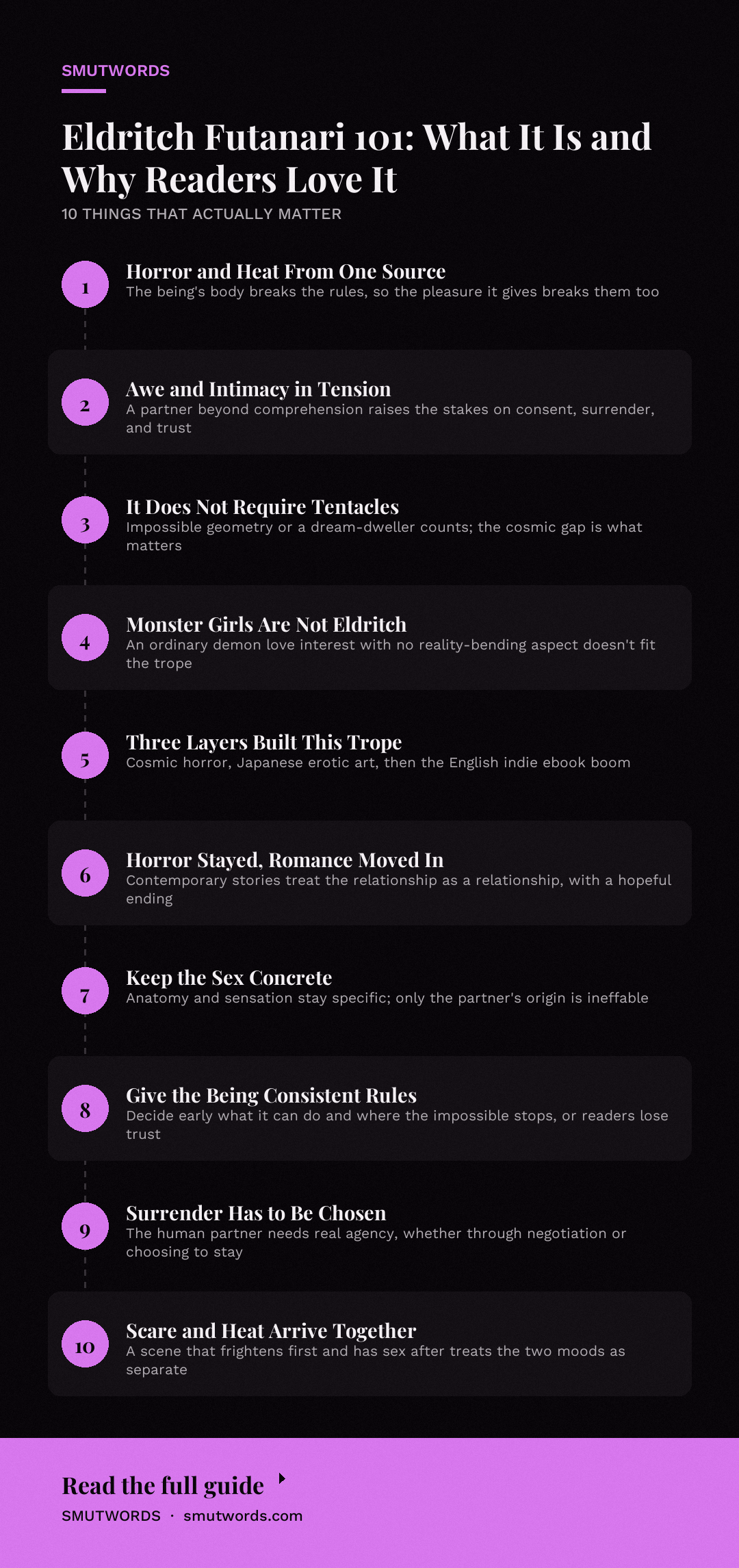
What makes a strong version work is a consistent rule set for the being. The author decides early what the eldritch partner can and cannot do, what it does not understand about humans, and where the "impossible" stops. A being who can break physics but still misreads human social cues is a character. A being who does whatever the scene needs is a plot convenience, and the reader's trust erodes fast.
Consent writing carries unusual weight in this trope. Readers who enjoy the surrender fantasy still want the surrender to be chosen, and the best stories give the human protagonist active agency. That can mean explicit negotiation, or it can mean a protagonist who keeps choosing to stay when walking away is clearly possible.
The paranormal romance tradition solved this problem decades ago, and eldritch futanari borrows from it: make the monstrous partner legible enough to love, and make the human partner capable of saying no. The scare and the heat should resolve together, not in sequence. A scene that scares first and then has sex afterward treats the two moods as separate.
A scene where the protagonist is overwhelmed, aroused, and frightened in the same breath is doing this trope properly. If you are writing the trope and want a quick gut-check, ask whether your two richest elements are the being's incomprehensibility and the sex. If the sex is the only one doing work, you have written monster erotica with a pretty label.
Stories that also involve altered bodies and dark bargains often overlap in mood with fallen angel romance, which trades in the same tension between a grand, ancient partner and a normal human lover. The difference is that the angel has a recognizable shape and a theological logic. The eldritch partner has neither, which is exactly the point.
Eldritch Futanari vs Cyberpunk Romance
The comparison worth drawing isn't with another monster trope; it's with cyberpunk romance, because both genres write about bodies that don't obey normal limits. In cyberpunk, the impossible is technological: chrome, wetware, hacked sensations, a body augmented past human baseline. The estrangement is industrial and man-made, and the story usually frames it as cost, corruption, or liberation.
Eldritch futanari locates the impossible in something older and stranger than technology. The body is altered or complicated by contact with a cosmic entity, and the awe is existential rather than corporate. A reader who likes one often likes the other because both offer a partner whose physical form is a mystery the protagonist can explore.
The distinction matters for finding the right shelf: cyberpunk romance promises a future and a body you can hack; eldritch futanari promises a body that was never yours to understand in the first place.
Frequently Asked Questions
What is eldritch futanari in simple terms?
It's an erotica and romance trope where a futanari character is simultaneously a cosmic, otherworldly being. The story plays the awe of encountering something unknowable against the explicit intimacy of a physical relationship. If it reads as monster erotica with reality-defying stakes and a mind-bending partner, you're in the right aisle.
Is eldritch futanari a kink or a genre?
It's a trope within several genres: cosmic horror erotica, monster romance, and short explicit fiction. Readers often use it like a tag to filter for a specific mood. The kink itself is the combination of cosmic dread and explicit anatomy, and the trope is the story shape that delivers it.
What's the difference between tentacle futanari and eldritch futanari?
Tentacle futanari is a more specific image: a futanari character whose nonhuman anatomy is expressed through tentacles. Eldritch futanari requires the cosmic, reality-bending quality and can use tentacles as one expression among many. A partner with tentacles can be purely biological and not remotely eldritch.
Why do readers like this trope so much?
The combination of intimidating cosmic power with intimate anatomy gives readers both the thrill of the unknowable and the satisfaction of a body that delivers human pleasure. It's also a vehicle for exploring consent and surrender with stakes most romance partners can't match. A being who could unmake you, and chooses intimacy instead, is a potent fantasy.
Do I need to know Lovecraft to enjoy eldritch futanari?
Not at all. Familiarity with the cosmic horror tradition helps you catch references, but most books explain the rules of their own eldritch partner as they go. Readers who enjoy the awe-and-dread mood usually find the trope intuitive even with no horror background.
Where can I find good eldritch futanari stories?
Look in monster romance and cosmic horror erotica, especially indie ebooks and serial fiction. Tag systems on reader platforms make it easy to filter for the trope. The books listed on this page are a good starting point because they have that combination of tentacle or cosmic anatomy and explicit sex handled with real story stakes.
Final Thoughts
Eldritch futanari works because it refuses to choose between awe and intimacy, and the best books in the trope keep both alive on every page. Find a story where the eldritch partner has consistent rules, where the human half of the couple keeps real agency, and where the sex stays as concrete as the horror.
That combination is rare and unmistakable. Start with the recommended titles below and read the first chapter to check the register. If the dread and the heat arrive together, keep reading.






Loading comments…