
Human/alien romance is a romance where one partner is human and the other is not from Earth. That sounds simple until you start reading it. The alien might be a seven-foot warrior with a tail, a telepathic scientist with no mouth, a serpentine diplomat who communicates in scent, or a glowing being who bonds for life the moment skin touches skin.
What unites the subgenre isn't the creature design. It's the premise that desire has to cross a gap no human relationship ever has to cross. Different bodies, different instincts, different ideas about what a mate even is.
The subgenre is one of the fastest-growing corners of genre romance, and it has its own internal logic, its own recurring structures, and its own set of craft problems that authors either solve beautifully or fumble in ways readers notice immediately.
What Human/Alien Romance Actually Means
The name describes the pairing, not the plot. One lead is human. The other is a member of an invented species, and the story treats that species difference as central to the relationship rather than cosmetic.
A book where the love interest has blue skin and no other alien traits is technically human/alien romance. A book where the love interest has different anatomy, a different lifespan, a different mating drive, and a different moral framework is doing the actual work of the subgenre.
What counts: cross-species biology that affects sex, reproduction, or bonding. Cultural friction that the couple has to negotiate rather than ignore. A genuine sense that the two leads are not the same kind of creature, even when they love each other. Language barriers, scent-based communication, mating cycles, hive instincts, territorial behavior, incompatible gravity preferences, all of it belongs here.
What doesn't count, or counts weakly: alien characters who are functionally human with a costume change. A warrior from another planet who thinks, courts, jokes, and fucks exactly like a human man from Ohio is science fiction furniture, not cross-species romance. Readers who love this subgenre can tell the difference within two chapters, and they say so in reviews.
A few persistent misconceptions are worth clearing up.
- "It's all tentacle porn." Some of it is. Most of it isn't. The subgenre spans sweet cozy alien romance, dark abduction stories, political space opera with a love plot, and yes, extremely explicit monster biology.
- "It's just shifter romance in space." Shifter romance usually keeps a human emotional register under the animal surface. Alien romance can throw out human emotional registers entirely, which is the whole point.
- "The alien is always the man." Not remotely true. Female aliens, nonbinary aliens, and genderless species with unfamiliar pronouns all have devoted readerships.
- "It's a niche." It's a category with authors running dozens of books deep. Vera Nyx on Building an 85-Book Alien Universe is a good look at how serialized this market has become.
One structural note: human/alien romance overlaps heavily with soulbond fiction, because a biological bond is a convenient way to make cross-species commitment feel inevitable instead of arbitrary. It also borrows from hybrid shifter romance whenever the couple produces children, since hybrid offspring raise the same questions about which biology wins.
Where Human/Alien Romance Comes From
The honest history here is a publishing history, not a folklore history. Alien romance didn't descend from ancient myth the way fae or cryptid romance can claim to. It grew out of science fiction's habit of using aliens to talk about human difference, and then romance's habit of taking any dynamic and asking what it looks like when the two people involved want each other badly.
The pulp era did the groundwork. Mid-century science fiction magazines ran stories about human-alien attraction constantly, usually with the attraction framed as transgressive, sometimes as horror, occasionally as tragedy. Those stories established the template: the alien as a being whose desire operates on rules the human lead doesn't understand yet.
Genre romance proper picked it up later and changed the ending. Where pulp killed the couple or turned the alien into a monster, romance insisted the divide could be crossed and the crossing could be worth it. That shift is the founding move of the entire subgenre.
The ebook boom accelerated everything. Once indie publishing made it possible to release a book a month to a dedicated readership, alien romance became one of the most serialized categories in romance. Series with twenty, forty, eighty installments stopped being unusual. Authors built planets, species, languages, and mating systems across decades of in-world timeline, and readers followed.
A few recognizable eras:
- Pulp and early sci-fi: human-alien attraction as taboo, danger, or tragedy. The alien is a problem to be survived.
- Nineties and early 2000s: romance publishers start letting the alien be a love interest with a happy ending. Still rare, still treated as a curiosity.
- Ebook boom onward: serialized alien romance becomes a category of its own. Fated mates, abduction premises, and mail-order-style arrangements multiply.
- Current era: wide tonal range, from cozy to extreme, with more authors writing aliens who are genuinely alien rather than reskinned humans.
If you want a sense of how a single author sustains a career inside this market, Penny London: Behind the Pen Name covers the business side of writing genre romance at volume. That business side is inseparable from how this subgenre actually functions.
How It Shows Up in Erotica
On the page, human/alien romance lives or dies on one question: how different are these two people, really, and does the story commit to it?
Strong versions commit. The alien's body doesn't work like a human body, and the sex scenes reflect that rather than working around it. The alien's instincts aren't human instincts with a label slapped on. When the human lead is confused, scared, or aroused by something they don't have language for, the prose lets them stay confused for a while instead of explaining it away in the next paragraph.
Weak versions hedge. The alien has a ridged forehead and a tragic backstory and otherwise behaves like a contemporary romance hero. The biology is mentioned in chapter three and never affects anything again.
The cultural divide gets resolved by chapter five so the couple can proceed to standard banter. Readers describe these books as "not alien enough," and it's the most common complaint in the category.
Enjoyed this? Get a free book.
Join the list and we will send a complete free story straight to your inbox, plus new releases every week after that. No credit card, no catch.
Common variations authors use:
- Abduction premise. The human lead is taken, often for reasons that turn out to be less sinister than assumed. The tension comes from captivity, translation failures, and the slow realization that the captor is not a villain. This is the single most common entry point in the subgenre and has its own etiquette readers expect.
- Fated mates with alien biology. A biological recognition, bond, or mating cycle forces the couple together before either of them has decided to want it. Related to pack mates romance in structure, though alien versions often make the bond one-to-one instead of communal.
- Human on alien planet. The human lead is the outsider, learning a society with unfamiliar rules about touch, status, modesty, and courtship. The erotic charge comes from being the only person in the room who doesn't know what any gesture means.
- Alien among humans. The reverse. The alien lead has to function in a human society while managing instincts, anatomy, or pheromones that make blending in difficult.
- Warrior and captive. A militarized alien culture, a human taken as spoils or as a diplomatic ward, and a slow renegotiation of who holds power.
- Cozy and low-conflict. Two people from different worlds figuring out how to share a kitchen. Gentle, often very funny, increasingly popular.
The territorial shifter trope shows up constantly in alien romance as well, usually with the alien's protectiveness framed as species instinct rather than jealousy. Done well, the territoriality gives the couple something to negotiate instead of a free pass for controlling behavior.
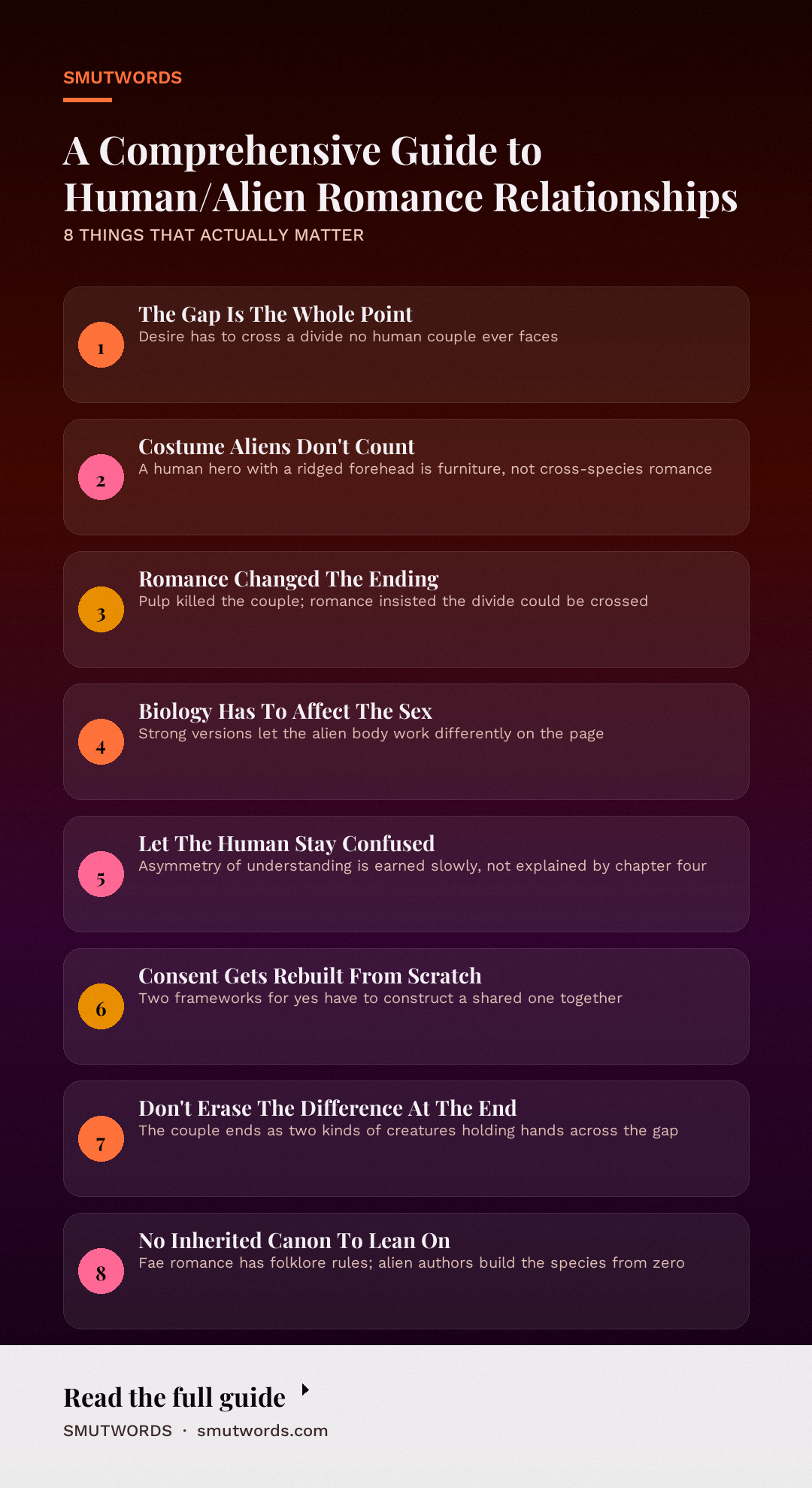
What separates a flat human/alien romance from one readers recommend for years comes down to a handful of craft decisions.
- Specificity of biology. The alien's body has particular features, and those features have consequences. Heat, scent, grip, stamina, sensitivity, cycle timing, what happens after.
- Asymmetry of understanding. The human lead doesn't get to be an expert on the alien's culture by chapter four. Knowledge is earned slowly.
- Concrete sensory detail over vague awe. "He smelled like ozone and warm metal" beats "an otherworldly presence filled the room" every time.
- Consent that has to be rebuilt. Two beings with different frameworks for what yes means have to construct a shared one. That construction is often the most erotic part of the book.
- A resolution that doesn't erase the difference. The couple ends up together as two different kinds of creatures. The gap closes enough to hold hands across, not so much that one of them stops being alien.
There's also a version of this subgenre that shades into horror-adjacent territory, with aliens whose biology is genuinely threatening and the romance built on precarious trust. Those books sit close to kraken romance in tone, where the love interest is enormous, non-verbal in human terms, and operating on an instinct the human lead can only partially read.
If you like the biological-bond machinery of the subgenre, What Is Multiple Mates Dynamic? A Reader's Complete Guide covers what happens when the alien structure involves more than one partner, which is common in hive-species and pack-species worldbuilding.
Human/Alien Romance vs Fae Romance
These two get compared often because both involve a human falling for a nonhuman with strange rules. The comparison is worth making, because the differences are instructive.
Fae romance draws on folklore with an established canon: courts, bargains, iron, titles, and a recognizable aesthetic that readers already have feelings about. Human/alien romance has no inherited canon. Every author builds the species from scratch, which means the worldbuilding burden is heavier and the reader's sense of what to expect is thinner.
The emotional difference matters too. Fae romance usually involves a power imbalance rooted in old magic and etiquette. Human/alien romance usually involves a power imbalance rooted in technology, biology, or physical capability. The fae lead knows the rules of the world and wields them; the alien lead often doesn't know the human's rules at all, which flips the dynamic into mutual confusion.
Both subgenres reward the same reader appetite: being wanted by something whose wanting you don't fully understand. If that's your taste, you'll likely read across both.
Frequently Asked Questions
Is human/alien romance the same as sci-fi romance?
No. Sci-fi romance is the broader category and includes human-human couples in space, AI romance, time travel, and cyborg stories. Human/alien romance is the specific subset where one partner is a nonhuman species. A sci-fi romance can have zero aliens in it.
Do I need to read alien romance series in order?
Usually yes, at least for the first book, because most series build one continuous world and the couple from book one keeps appearing. Some authors write each installment as a standalone with a new couple, but the species rules and political situation carry over and reading out of order gets confusing.
Why do so many alien romances use the fated mates device?
It solves a structural problem. Cross-species attraction needs a reason to exist that doesn't depend on shared culture or shared history, and a biological bond provides one. It also gives the couple a force pushing them together before either has decided to trust the other, which is a reliable engine for tension.
Are there human/alien romances where the alien is the woman?
Plenty. Female alien leads, alien women with human men, and same-gender cross-species pairings all exist across the subgenre. The pattern is less rigid than the covers sometimes suggest.
How explicit do these books get?
It ranges from closed-door to extremely graphic, and the explicitness usually correlates with how much the author commits to nonhuman anatomy. Books where the alien's body is genuinely different tend to spend more page time on how sex actually works between the two of them.
Is alien abduction romance a separate thing?
It's a subcategory, not a separate genre. The abduction premise is one of the most common openings in human/alien romance, but the story that follows can go anywhere: dark, cozy, political, or fated mates. The label describes the setup, not the tone.
Final Thoughts
Human/alien romance works when the author takes the word "alien" seriously and lets the difference stay real all the way to the last page. The payoff readers are chasing isn't novelty. It's the specific thrill of watching two beings who have no shared framework for desire build one anyway, word by word, touch by touch, until the gap between them becomes the thing that makes the relationship worth having.
Start with a series opener that treats its alien lead as genuinely other. Let the worldbuilding do as much work as the sex scenes.





Loading comments…