
Penny London does not have a favorite position. She has a favorite sentence length.
Ask her about the sex in her books and she'll talk about rhythm, about how a three-word paragraph after four long ones does more work than any description of a body part. Ask about her fan mail and she'll tell you the message that stuck with her wasn't about an orgasm.
It was about a woman who read one of her cuckold stories on a train and missed her stop. That detail gets to something about the penny london author interview people keep asking for and not getting: she thinks about the reader's body in space, where they are, what they're doing, what they're hiding while they read.
That's a working method, not a philosophy. It's also why her catalog reads the way it does.
Who Is Penny London?
London has been publishing on SmutWords for a stretch she describes vaguely as "long enough to have opinions about other people's openings." The catalog moves between registers that don't obviously belong together.
There's Permission Slip: A Cuckold Erotic Short Story, which is domestic and quiet and mostly happens in a driveway. There's Free Use Casino, which is none of those things. There's Lured by the Lizard Beast, which is exactly what the title says and doesn't apologize for it.
Readers who find her through one of those and then read the others often say the same thing in reviews: same hand, different room.
She doesn't think that's complicated. Writers who only do one thing get bored around book four, in her view.
Why Penny London Writes Short
Her books are short. Some are very short. She's been asked about this in every interview she's done and she's stopped softening the answer.
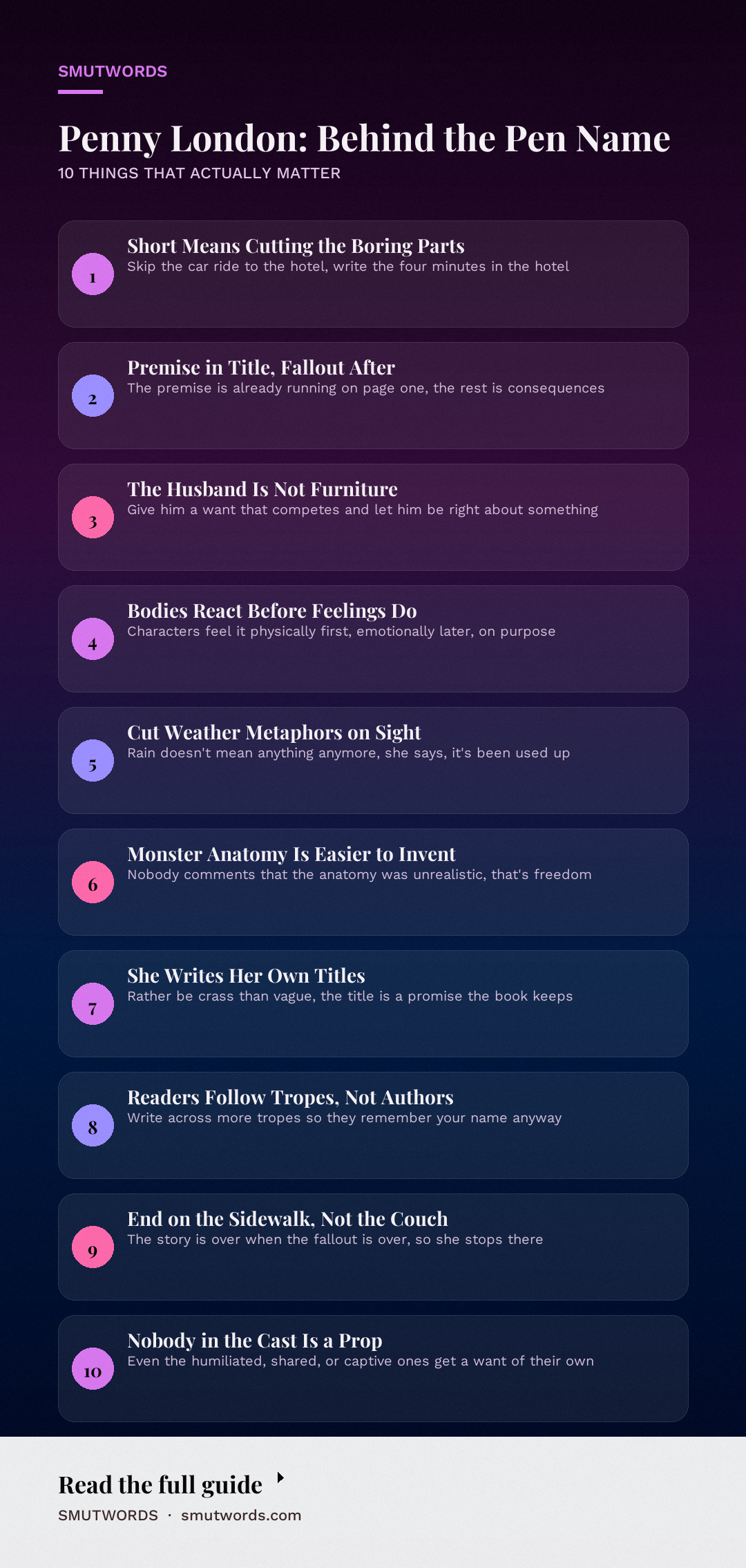
"A short story lets you skip the parts where nothing is happening," she says. "I don't want to write the car ride to the hotel. I want to write the four minutes in the hotel."
"If that means the book is forty pages, fine. The reader gets what they came for faster."
That's a craft position with teeth. It means no establishing scenes that exist to prove the characters have jobs. It means a story can open with the worst decision already made and the consequences already in motion.
She points to He Paid Him to Fuck Me as the closest she's come to a pure version of this: the premise is in the title, the transaction is on page one, and the rest of the book is the fallout.
"You don't need to explain why someone would agree to that," she says. "You need to explain what it does to them the next morning. That's the story. The agreement is just the door."
What She Cuts Before Publishing
She keeps a list. It's taped inside a kitchen cabinet, which is either very writerly or very annoying, depending on who's in the kitchen.
- Any paragraph where a character explains their own psychology out loud.
- Any sex scene that starts with a description of the room instead of a body.
- Any moment where a woman has a feeling about a man before she has a feeling in her own body.
- Metaphors involving weather.
The weather rule is firm. She wrote a thunderstorm once, hated it, and now cuts every one on sight. "Rain doesn't mean anything anymore," she says. "It's been used up."
The Hotwife Problem (Her Words)
London writes hotwife and cuckold material often enough that readers assume it's her core thing. She pushes back on that, but not because she's embarrassed. Her argument is craft-based.
"Most hotwife stories have the same structural flaw," she says. "The husband is furniture. He exists to be humiliated or to be aroused, and either way he's a prop."
"Readers feel that. It's why so many of those stories get complaints that the ending felt empty, even when the sex was good."
Her fix is unglamorous: give the husband an opinion that isn't the wife's. Give him a want that competes. Let him be right about one thing and wrong about another.
If you want to see the version of the trope she's talking about, Shared Without Shame: A Hotwife Exhibition & Sharing Fantasy handles it by keeping both partners conscious through every beat. Nobody is a passenger in that book. That's on purpose.
The One Scene She Rewrote Nine Times
She's specific about this because specificity is her whole deal. In Permission Slip, there's a moment where the husband watches from the driver's seat and the wife doesn't look back at him once.
London wrote it nine times over three weeks. The earlier drafts had the wife glancing at the mirror. The final draft doesn't.
"The glance was me being nervous," she says. "I didn't trust the reader to understand what the not-glancing meant. Cutting it made the scene colder and better."
How She Writes Monster and Alien Material
The beast books are the ones that surprise people, because the voice barely changes. The same attention to what a body does under pressure shows up whether the second character is a husband in a truck or something with a tail.
"Monster stories are honestly easier," she says. "You get to invent the anatomy. Nobody's going to write you a comment saying the anatomy was unrealistic. That's freedom."
The freedom comes with a rule though. Whatever the creature is, the human on the other side of it has to react like a person. That means hesitation, disgust that turns into something else, and at least one moment of genuine fear that doesn't get resolved by the end of the page.
Enjoyed this? Get a free book.
Join the list and we will send a complete free story straight to your inbox, plus new releases every week after that. No credit card, no catch.
Lured by the Lizard Beast follows that shape exactly, and so does Zorgon's Pet, where the captivity premise does more structural work than the biology does. If you want the broader conventions of that subgenre mapped out, we've written about it under monster breeding romance, and London's version of it stays close to the genre's wiring while refusing to let the human character go limp.
She also reads outside her own lane constantly. She cites What Is Viking Romance? A Reader's Complete Guide as something she went through twice, not for research but because the capture-and-claim structure of viking romance has the same bones as a lot of her abduction material. Swap the longship for a spaceship and the dynamic holds.
What She Borrows From Other Tropes
London thinks trope readers are smarter than they get credit for, and she writes accordingly. She'll drop a familiar structure in and then subvert one load-bearing element of it, and that single change does most of the work. A few she's admitted to stealing from:
- The fake marriage premise, for the way it forces proximity and a shared lie.
- Blind date romance, for the compressed timeline and the total absence of prior history between the characters.
- Soldier romance, for the built-in countdown. Somebody's leaving, and the clock is already running.
She's also said she'd write a cyberpunk romance if the right premise landed, but only if she could figure out what the body modification is doing emotionally instead of just visually. "Chrome for chrome's sake," she says, "is just jewelry."
On Covers, Blurbs, and the Title Problem
London writes her own titles. This is rarer than readers assume. Most authors in the space get a title suggestion from an editor or an algorithm-informed list, and London has turned down both.
"If the title doesn't tell the reader what they're getting, I've wasted their time," she says. "Somebody scrolling wants to know in two seconds whether this is for them. I'd rather be crass than vague."
That philosophy produced He Paid Him to Fuck Me, which is about as unfiltered as titles get, and she defends it on the same grounds. There's no clickbait in that title. There's a promise, and the book delivers on it in the first chapter.
The blurbs take longer. She writes them last, after the draft is done, because the story usually changes shape somewhere around the third act and the original blurb stops being true.
Her Blurb Formula, Roughly
She broke it down for us without being asked twice. One sentence on the situation. Two sentences on what makes it untenable. One sentence that stops before the resolution. No rhetorical questions. No "will she or won't she."
"'Will she' implies the reader doesn't already know," she says. "They do. They bought the book. Don't insult them."
What She Thinks About the Attention Economy of Smut
This is where London gets the most animated, and it's where her interview answers stop sounding like craft advice and start sounding like someone who's been doing this long enough to see the whole cycle.
She thinks the biggest shift in the last few years isn't the content. It's the discovery. Readers used to be loyal to authors. Now they're loyal to tropes.
"Somebody searches 'incubus romance' and they get a list," she says. "They don't care whose name is on the cover half the time. That's fine, honestly. It's honest."
"But it means the work has to be good enough that they remember you anyway." If you want to understand that particular subgenre from the reader side, our Understanding Incubus Romance Relationships: A Full Breakdown covers it, and London's read on it matches the consensus: atmosphere does more than anatomy.
Her response to trope-loyalty has been to write across more tropes, not fewer. If a reader finds her through a free-use casino story and then discovers she also writes mail-order-adjacent power dynamics, that's a win. She admits she's read our writeup on mail order bride stories more than once, mostly to check whether her own arranged-marriage setups were hitting the beats readers expect or missing them.
She's checked the nurse/patient territory too. Not her lane, but she kept notes. See our breakdown of nurse/patient romance if you want to see how the power asymmetry in a clinical setting gets handled, because it's the same structural question London works with in half her catalog: who has authority, and when does it break.
Questions Readers Ask Penny London
She gets a lot of the same ones. Here's how she answers them, paraphrased.
- "Do you write from experience?" No, and she finds the question boring. She writes from attention.
- "Will you ever write a full-length novel?" She says she'll write one when a premise needs the length. So far none have.
- "Why are your endings so abrupt?" Because the story is over when the fallout is over. She'd rather end on the sidewalk than in the therapist's office.
- "Do you read your reviews?" She reads the ones that quote a line back at her. She skips the ones that just say "hot."
- "Who are your influences?" She'll name two authors, both of whom write mostly dialogue, and then refuse to elaborate.
Multiple mates dynamics come up in her inbox too, since a few of her alien books gesture at that structure without fully committing to it. We've covered it in depth under multiple mates dynamic, and readers who like the more populated version of London's alien work will find the underlying logic there.
What Makes the Penny London Formula Work
Strip it down and the formula is three things.
1. Premise in the title, fallout in the pages
She never makes the reader wait for the premise to arrive. The premise is already running when the first page opens. Everything after that is consequences.
2. Bodies before feelings
Her characters react physically to the situation first and emotionally later. It's a deliberate order, and it's why her short books feel fuller than their page count suggests.
3. Nobody's furniture
Even the secondary characters get a want. Especially the ones who are supposed to be humiliated, or shared, or cuckolded, or held captive. If they only exist to be acted upon, she cuts them.
That third one is the throughline across every book she's published. It's why Permission Slip works as a cuckold story instead of just a humiliation story, and why Free Use Casino doesn't collapse into pure exhibitionism. The premise can be as transactional as you like. The people inside it have to want things they can't fully have.
If you're comparing her approach with other authors in the space, our interview with Penny Pepper on Building a 65-Book Free Use Series is the natural companion piece. Pepper scales across dozens of books; London deliberately doesn't. Two opposite answers to the same question about how much you owe a reader who found you through one trope.
Final Thoughts
If you've never read Penny London and want the entry point that shows her method clearest, start with Zorgon's Pet. It's the book where the premise, the boundary between captor and captive, and the deliberate refusal to explain anyone's psychology all click into place the way she's described them here.
Read that one first. The rest of her catalog will make more sense after it, and you'll know within twenty pages whether her rhythm works on you the way it works on the people who miss their train stops.







Loading comments…